
AI visibility guide for B2B brands
AI visibility measures how often AI assistants such as ChatGPT and Google AI Overviews name your brand when buyers ask about your category, and how well they describe you when they do. Its four measures cover your presence in the answer and how you compare with rivals there. They also track the answer's tone and whether the assistant cites your pages as sources. For a B2B brand, it decides whether you reach the shortlist a buyer builds before visiting any vendor's site.
 Jevgenia PogadajevaCFO, Snoika · 12 min read

























AI visibility for B2B growth
Buyers now build their first B2B shortlists inside AI assistants, so a brand those assistants leave out can lose a deal before anyone at the company hears about it. G2 surveyed 1,076 software buyers in March 2026 and found that 51% of B2B software buyers start their research with an AI chatbot more often than with Google, up from 29% in April 2025. The same survey found that 69% picked a different vendor than they first planned because of what a chatbot told them. Buyers who switch at that stage never enter your pipeline.
Across B2B purchases beyond software, Gartner surveyed 645 B2B buyers in late 2025 and found that 45% of buyers used GenAI during a recent purchase, mostly to gather information on vendors and products. Sam Altman, CEO of OpenAI, told the company's October 2025 DevDay that "more than 800 million people" use ChatGPT every week.
B2B purchases feel this shift more than consumer purchases do, because B2B buyers research for months and decide in committees. An AI answer squeezes that research into one paragraph, and the paragraph names a handful of vendors. If your brand isn't one of them, the committee never compares you at all. Start by asking the questions your buyers ask and seeing whether the answers include a vendor list. If they do, your category is already being decided there.
What AI search visibility means
AI search visibility is your brand's presence and standing inside the answers that generative AI tools write. While a search engine shows a ranked list of links, an AI model writes a reply whose text determines whether your brand appears. The work of improving that presence has 2 common names: generative engine optimization (GEO) and answer engine optimization (AEO). Both aim at the same result.
A useful definition separates a mention from a citation. A mention names your brand in the assistant's text, for example "Vendor A and Vendor B are common choices for mid-market teams," while a citation links to one of your URLs as a source. You can have one without the other. Mentions without citations leave your brand dependent on what third parties write about it, while citations without a brand name supply facts to the answer without credit for your brand.
Visibility changes with the platform and the wording of the prompt. The user's own history with the tool also affects it. ChatGPT and Google AI Overviews pull from different sources, so a strong result on one says little about the other. Accuracy matters because an assistant that misstates your pricing model or puts you in the wrong category sends away buyers who'd be a good fit. So check what the answers say about you with an AI visibility checker, along with how often they say it.
Google visibility vs AI visibility
Google visibility and AI visibility overlap, but they aren't the same thing. A page ranking first on Google can be missing from ChatGPT's answer to the same question. Ahrefs data scientist Xibeijia Guan ran 15,000 long-tail queries through Google and then through AI assistants. On average, just 12% of AI citations ranked in Google's top 10 for the original query. For ChatGPT the figure was 8%.
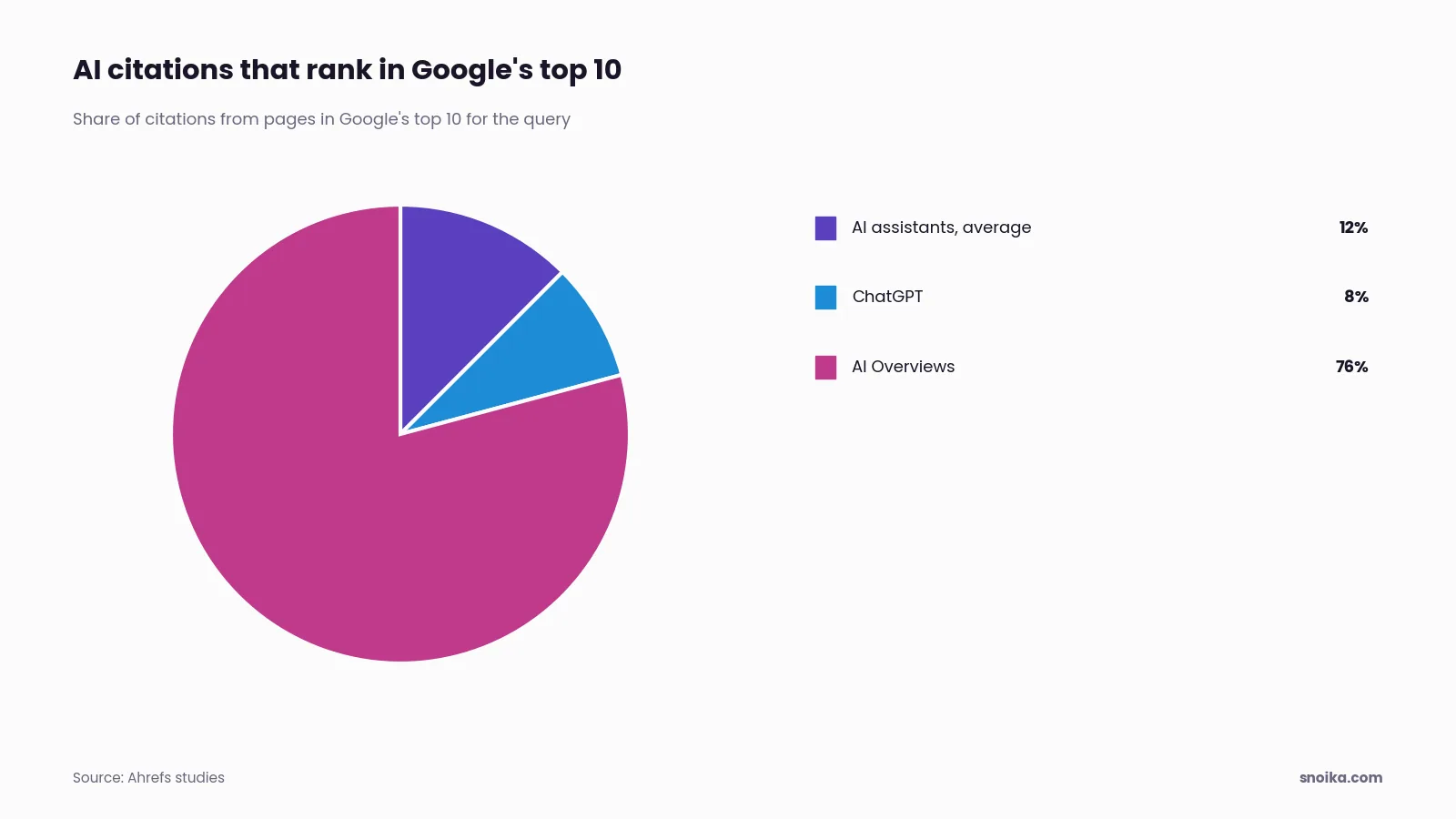
Google's own AI layer has much greater overlap with search rankings, as a separate Ahrefs study found that 76% of AI Overview citations come from pages already in Google's top 10. Good SEO still feeds AI Overviews much more than it feeds standalone assistants. Traditional search results also receive fewer clicks when AI summaries appear, according to the Pew Research Center, which tracked the browsing of 900 US adults and found that users clicked a traditional result in 8% of visits when an AI summary appeared, against 15% when it didn't.
| Dimension | Google organic visibility | AI visibility |
|---|---|---|
| Unit of success | A ranked position on a results page | A mention or citation inside a written answer |
| What the buyer sees | A list of 10 links plus ads | A summary that names a few brands |
| How sources are chosen | Ranking signals for one query | Retrieval across related sub-queries, plus training data |
| Stability | Positions shift over days or weeks | The brand list can change on every run of the same prompt |
| Main measurement | Google Search Console rankings and clicks | Repeated prompt testing across assistants |
| Effect on traffic | Drives the click | Often answers the question without a click |
Unit of success
- Google organic visibility
- A ranked position on a results page
- AI visibility
- A mention or citation inside a written answer
What the buyer sees
- Google organic visibility
- A list of 10 links plus ads
- AI visibility
- A summary that names a few brands
How sources are chosen
- Google organic visibility
- Ranking signals for one query
- AI visibility
- Retrieval across related sub-queries, plus training data
Stability
- Google organic visibility
- Positions shift over days or weeks
- AI visibility
- The brand list can change on every run of the same prompt
Main measurement
- Google organic visibility
- Google Search Console rankings and clicks
- AI visibility
- Repeated prompt testing across assistants
Effect on traffic
- Google organic visibility
- Drives the click
- AI visibility
- Often answers the question without a click
Back in February 2024, Gartner forecast that traditional search engine volume would drop 25% by 2026. Alan Antin, Vice President Analyst at Gartner, said at the time that GenAI tools "are becoming substitute answer engines." Keep your SEO and measure AI separately, regardless of the forecast's accuracy. Agrello, an e-signature company, grew organic search sessions 125.6% year over year, which shows that Google traffic is still worth winning. A Google report alone just can't show your standing in ChatGPT.
How AI visibility is measured
To measure your brand's AI visibility, run a fixed set of buyer prompts through each assistant many times and record how often your brand appears alongside its standing relative to rivals. Also record the tone of each answer and the sources it cites. One manual check tells you almost nothing. SparkToro tested 2,961 prompts and found under a 1% chance that ChatGPT or Google's AI would return the same brand list twice for the same prompt. How often a brand appears across many runs held up much better. The SparkToro researchers concluded that measuring that percentage is "(probably) a reasonable way to know how prominent or invisible your entity is within the AI's consideration set."
Build a prompt set that you repeat on a schedule, so you can read the four GEO metrics below as rates instead of single results. Snoika's prompt tracking, for example, runs weekly prompt sets in ChatGPT and Google AI Overviews, where most AI search traffic happens, and records these four measures.
Mentions and visibility rate
The visibility rate is the share of prompt runs in which the assistant names your brand. If your brand shows up in 30 out of 100 runs, your rate is 30%. Count each brand only once per answer, and split the prompts into clusters, such as problem-aware questions versus "best tool for" questions. A brand can do well on comparison prompts and still never appear when a buyer first describes the problem.
Share of voice
Share of voice is your mentions divided by all brand mentions across the same prompt set. It tells you how much of the answer space you hold compared with competitors. Your visibility rate can climb while your share of voice falls, which happens when the assistant starts naming more vendors overall. Track both.
Sentiment
Sentiment analysis records whether the answer recommends you or mentions you neutrally. It also captures drawbacks the answer flags, such as "expensive for small teams." Pay attention to the specific claims. If a negative statement keeps coming back, trace it to a review site or forum thread, or check for an old page on your own domain. You can then fix the source through AI reputation management.
Citations
Citation tracking records which URLs the assistant links to and whose domains they belong to. Citations to your own pages count as owned, while those to review platforms or analyst pages count as earned. Trade media citations also fall in the earned category. This metric shows you where to act, because it names the exact pages shaping the answer.
Auditing your AI visibility
To audit your company's AI visibility, establish a baseline from assistants' current answers to your buyers' questions and check what those answers say about you. Then find the content and technical gaps behind the result. Do this before you change anything, so you can tell later what worked. Follow the AI visibility audit steps in order.
- Write the prompt set. List the questions buyers ask at each stage, in their own words. Include problem questions ("how do I cut VAT filing time across EU countries") and category questions ("best VAT compliance software for ecommerce"). Add comparison questions that name your competitors. Get the wording from sales call notes and support tickets, since that's how buyers actually phrase things.
- Run each prompt repeatedly. Use ChatGPT and Google AI Overviews at minimum, and run each prompt several times, because single answers vary. Log every brand named and every URL cited.
- Calculate the baseline metrics. Work out visibility rate and share of voice per prompt cluster. Note which competitors show up most and which clusters leave you out.
- Check accuracy. Read every answer that mentions you. Flag wrong pricing or outdated features, and trace each error to its likely source. Do the same for a misplaced category.
- Check technical access. Confirm that your robots.txt doesn't block AI crawlers such as OpenAI's GPTBot and OAI-SearchBot. Also check that your key pages show their text in the HTML without depending on JavaScript, because crawlers that don't run scripts will skip that content.
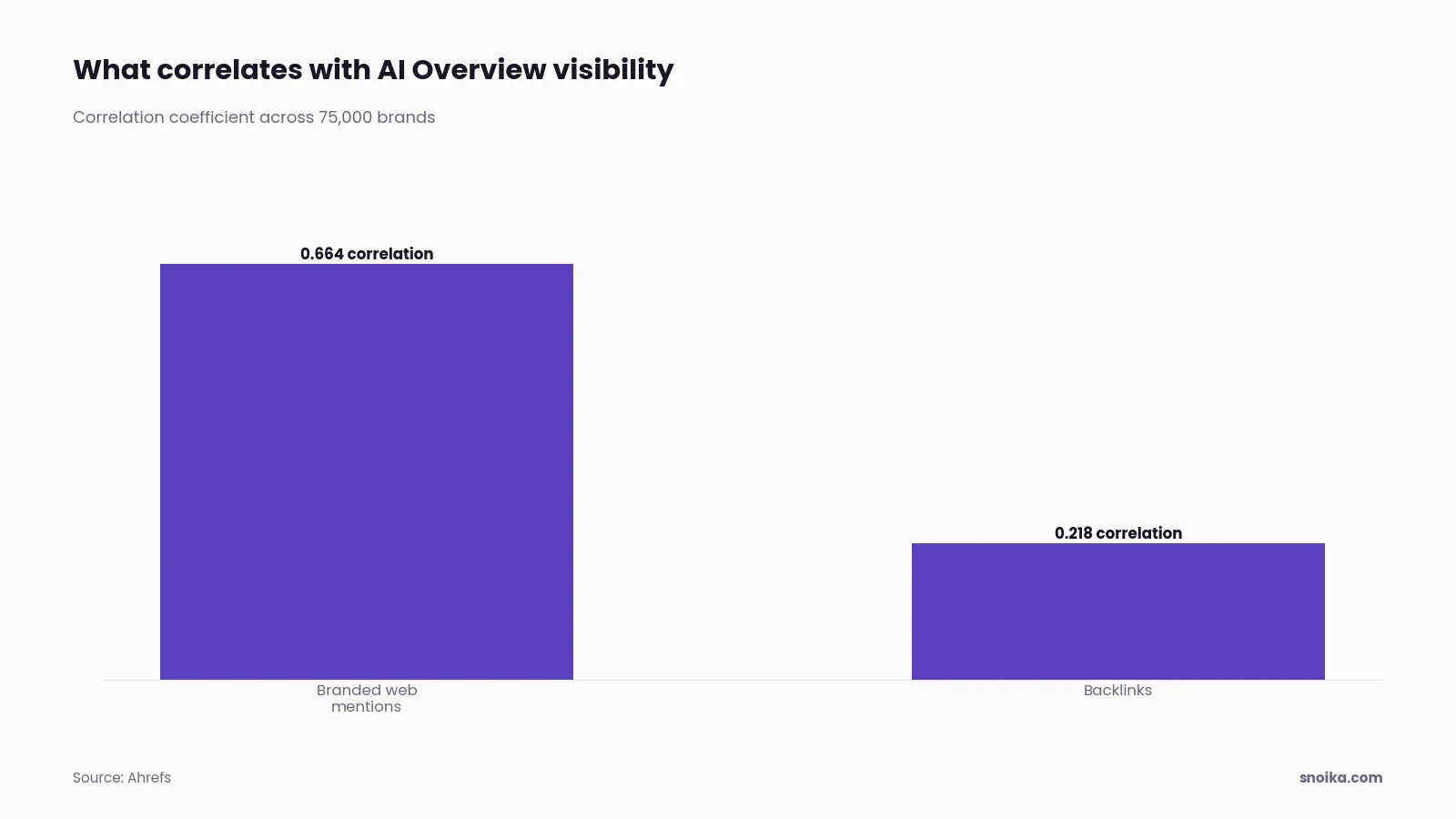
- Audit your off-site presence. An Ahrefs study of 75,000 brands found that branded web mentions had a 0.664 correlation with AI Overview visibility, against 0.218 for backlinks. List where your brand is discussed and where competitors appear without you.
- Connect your analytics. Set up AI referral tracking now so the audit has a revenue baseline.
That last step explains why GEO audits begin with access to analytics accounts. Snoika's onboarding, for instance, requires access to Google Analytics 4 (GA4) and Google Search Console before any AI visibility reports. It also requires Google Tag Manager access, because the visibility numbers only mean something next to traffic and conversion data. A common mistake is an audit made entirely of screenshots. It shows one moment and can't be repeated.
Tracking visibility over time
You track visibility over time by running the same prompt set on a fixed weekly schedule and watching the trend instead of individual readings. Weekly runs pick up model updates and competitor moves early. Fixing the prompt set means any change in your numbers comes from the market, and not from how you happened to ask that week.
The prompt set will still need to change as your offer changes. When you add prompts, version the set and keep the old core running next to the new one, so the trend line stays comparable. Mark your chart with the dates you publish new pages or earn press coverage. Add model release dates too. Otherwise you'll credit a lift to your own work when a platform update caused it.
Real gains arrive in steps, with lags in between. 1StopVAT, in tax and fintech, saw 10x growth in ChatGPT visibility in 7 weeks. Movement like that only shows up in a series of readings. A single check at week 3 would have suggested that nothing was happening.
Watch for 2 failure modes that distort the trend. Unlogged prompt edits cause prompt drift. Cost cuts that reduce runs per prompt cause sample shrinkage, which makes the numbers bounce. Either one can produce a trend that isn't real.
Benchmarking against competitors
To benchmark against competitors, you measure share of voice and citations for your brand and your rivals on the same prompt set, then compare the gaps cluster by cluster. Choose competitors from the answers themselves. The assistant's view of your category includes vendors your sales team never mentions. These can be consultancies or open-source alternatives. If those names keep appearing, they belong in the benchmark.
Run competitor analysis across 3 layers, with share of voice per cluster as the measure of where you trail. Sentiment shows how each brand is framed, for example who gets called the enterprise option and who gets called the budget one. Citation sources show why. When a rival keeps showing up through one comparison article or one review platform, you've found a specific gap you can close, with a specific place to close it.
Movement against rivals matters more than your absolute position. Vespia, a fintech SaaS company, recorded a 220% increase in AI brand mentions, and in a benchmark the question is whether a gain like that moved the brand past the competitors buyers weigh it against. Check the benchmark monthly and look at your top 2 or 3 rivals closely. A full market view every week produces noise instead of decisions.
Tying AI visibility to revenue
You tie AI visibility to revenue through 3 layers of evidence, starting with referral traffic from AI tools in your analytics and self-reported attribution from buyers. Connect both to pipeline outcomes measured over the same period as your visibility trend. Finance needs the 3 layers together to check the digital marketing ROI case.
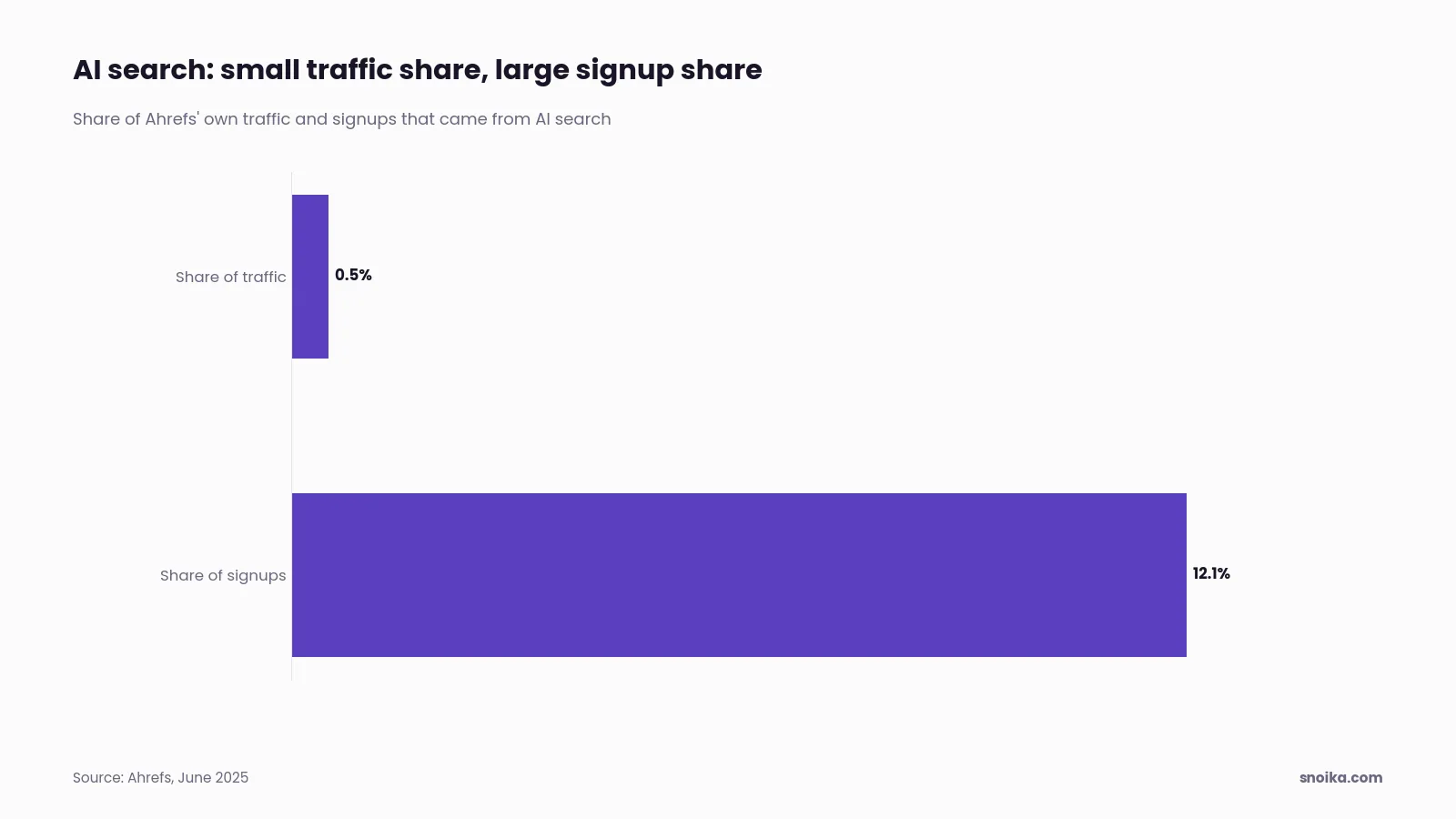
In GA4, build a custom channel group for sessions from AI referrers such as chatgpt.com and perplexity.ai, then follow those sessions through to conversions. The traffic is small, but it converts well. Ahrefs reported in June 2025 that AI search drove 12.1% of signups from 0.5% of its traffic, which is a conversion rate 23 times higher than organic search.
Referral data misses most of the influence. The Pew study found that users clicked a link inside an AI summary in just 1% of visits, so most buyers close the tab after they read your name. They arrive later through branded search or by typing your URL. To capture that influence, add a free-text "How did you hear about us?" field to your demo form and tag the answers that mention ChatGPT or other AI tools. Watch branded search impressions in Google Search Console too, because they rise when AI mentions rise.
Then put lead tracking results next to the visibility chart. For 3DPrinterOS, #1 visibility in ChatGPT for industry-specific queries turned AI search into a steady inbound lead source of 3–4 qualified inbound leads per day. After it reached top visibility in ChatGPT for targeted industry queries, 3DOS doubled its registered users. In both case studies the visibility gain came first and the business result followed it. Expect your numbers to show the same lag, and set reporting windows that leave room for it.
Choosing the right platform
The right AI visibility tool tracks the assistants your buyers use with enough prompt runs to give stable rates. It also lets you act on what it finds. Most tools now report a visibility score. They differ in how that score is produced and in what happens after you see it. Use those differences and an SEO tools comparison to evaluate a platform before you commit.
- Platform coverage. ChatGPT and Google AI Overviews are the minimum. Add others if your buyers use them.
- Prompt volume and frequency. You need enough prompts to cover each buyer stage, with repeated runs, on at least a weekly schedule.
- Citation-level data. The tool should show the exact URLs cited, along with mention counts.
- Competitor depth. Look for share of voice by cluster, plus visibility into rivals' citation sources.
- Language coverage. Buyers in Germany ask in German, and the answers change by language. Snoika, for example, creates content in 135+ languages and regional variants.
- A path to action. Prompt monitoring alone tells you where you're behind. Check whether the platform also builds content maps and publishes pages, and whether a person reviews what automation produces.
- Publishing model. If the tool publishes content, confirm where it goes. Snoika uses a DNS connection that requires no migration to publish on the client's own domain. The client approves every page in a dashboard before it goes live.
Pricing scales with the number of prompts and platforms, so set your prompt count first. A free tier that tests 10 prompts on 1 platform is enough to check whether a tool's readings match your manual checks; a full benchmark requires broader testing. Run that test before you sign anything.
Next steps
This week, write 20 buyer prompts and run each one 5 times in ChatGPT and in Google AI Overviews. Record every brand named and every URL cited. That gives you a baseline you own, which you'll need to judge any LLM SEO tool or agency. You'll also need it to judge a content plan like ours. Keep the spreadsheet. The prompts where a competitor appears and you don't are your first content briefs.
When you're ready to run that baseline weekly at scale, our team tracks AI visibility in ChatGPT and Google AI Overviews. We then build and publish the content that closes the gaps. Start free trial
FAQ
Measure ai visibility by repeatedly testing a fixed set of buyer questions across assistants. Divide answers naming your brand by total runs to calculate visibility rate, then compare your share of mentions with competitors. Separately, check how answers describe your brand and which sources they cite.
No, Google rankings don't reliably show whether an AI assistant will mention your brand. Google's AI Overviews overlap more with search rankings than standalone assistants do. Keep tracking search performance, but use repeated question tests to measure your presence in AI answers separately.
Start with a recorded baseline of repeated buyer-question tests before changing content. Use sales notes or support tickets to choose questions, then save the answers and cited URLs. Check inaccurate claims against their sources, and review whether crawlers can access your key pages.
Track AI referral sessions through to conversions, and collect buyers' own accounts of how they discovered your business. Compare those signals with pipeline outcomes over the same reporting period, allowing for a lag. Referral tracking alone misses buyers who read an AI answer without clicking.
Tracking costs depend on the number of prompts and AI platforms covered. Set the question count before comparing prices, and check how often each question gets tested. A small free test can help verify readings, but a full competitor comparison requires broader coverage.


