
AI visibility report for your brand
Your buyers now ask ChatGPT and Google's AI Overviews which vendor to pick, and they act on the answer without opening a website. An AI visibility report shows whether your brand appears in those answers and which competitors the assistants name in your place. Snoika audits sites and tracks brand visibility in Google and AI assistants, with a human review layer on top of automated workflows. Run the free report first, so you know where you stand before you spend anything on fixes.
Trusted by

























What the report covers
The report covers how ChatGPT and Google AI Overviews describe and cite your brand. It also shows where they rank you against competitors. Our AI brand visibility report answers six questions, each tied to a decision you'll make afterward.
| Component | Question it answers | What we show |
|---|---|---|
| Visibility score | How often do AI answers include you? | A score calculated over repeated prompt runs |
| Brand mentions | Where and how often are you named? | The full prompt list behind the count |
| Sentiment | Is the description favorable or flat? | The sources that drive a weak description |
| Endorsement | Do assistants recommend or cite you? | Whether citations link to your own pages |
| Share of voice | How do you compare to rivals? | Which competitors were included |
| AI readiness | Can AI systems read your site? | Specific pages flagged |
A report that only counts mentions is a monitoring snapshot. Ours includes the comparison and the readiness findings too, because those two tell you what to fix.
Your AI visibility score explained
Your AI visibility score is the share of relevant prompts where an AI assistant mentions your brand, measured across repeated runs. It's a percentage, and it only means something when you compare it with your competitors' scores on the same prompts.
What the score counts
AI answers change from one run to the next, so we build the score from many runs of the same prompt. Rand Fishkin, co-founder of SparkToro, ran a study that found under 1 in 100 runs returned the same brand list for an identical prompt. The SparkToro write-up puts it bluntly: "These tools are probability engines: they're designed to generate unique answers every time." A score built from a single screenshot is noise, so none of ours are.
What a good score looks like
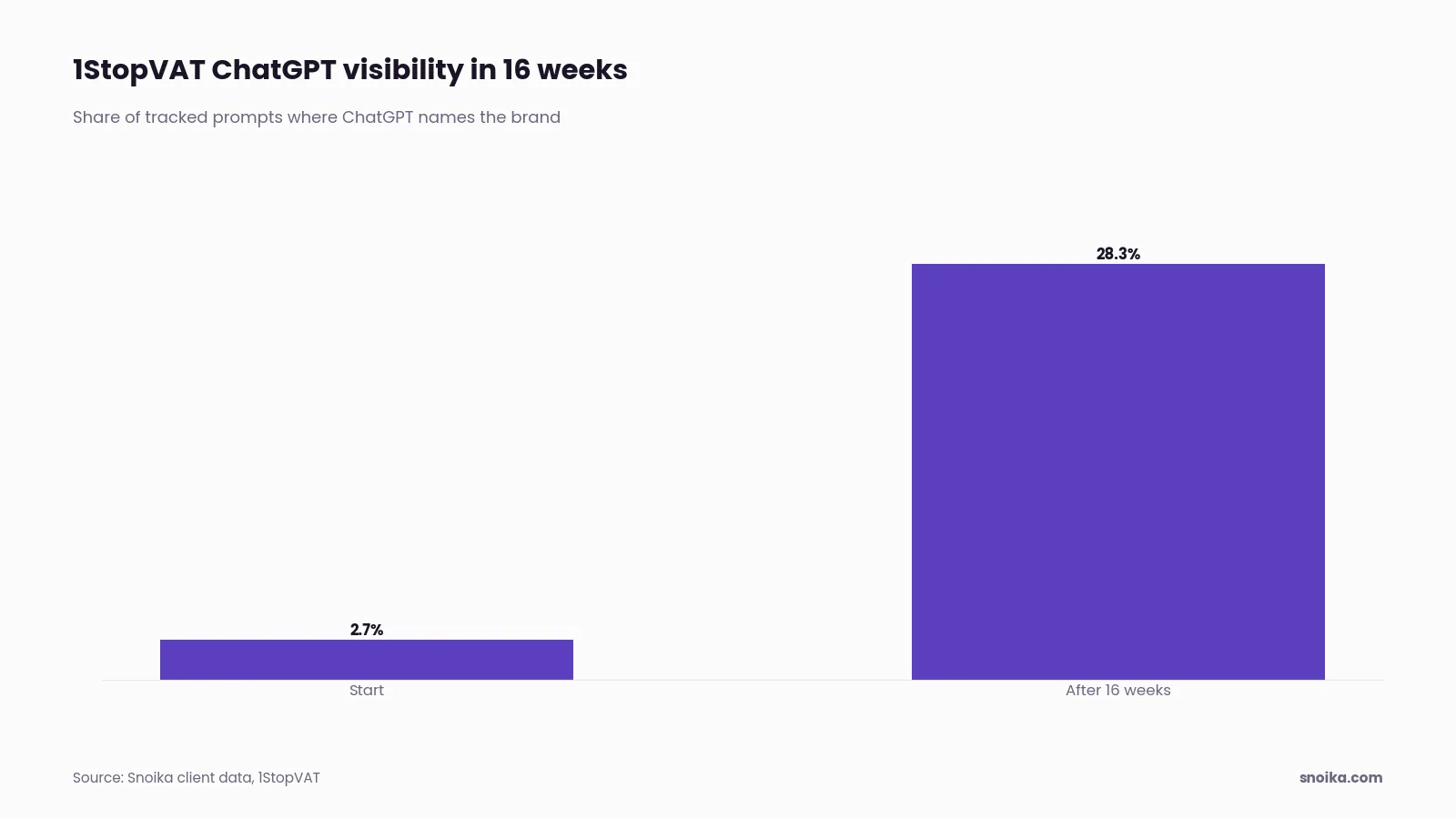
A good score is one that beats the brands your buyers compare you with, on the prompts those buyers type. No universal threshold exists, because a niche software category and a crowded consumer category produce different ceilings. The trend matters more than the starting number. Snoika's founder Anton Vedeshin reported to Startup Reporter 1StopVAT's move from 2.7% to 28.3% ChatGPT visibility in 16 weeks.
A low baseline like that is normal before any work starts. When you're behind your top two competitors, we close that gap first, before chasing a higher absolute figure.
AI versus Google visibility
AI visibility measures whether an assistant names you inside its answer, while Google visibility measures where your page ranks in a list of links. A traditional SEO visibility report tracks positions and clicks. An AI report tracks mentions and recommendations, and those can move without any change in rankings.
| Attribute | Google visibility | AI visibility |
|---|---|---|
| Unit measured | Ranking position of a URL | Brand mention inside an answer |
| Success looks like | A click to your site | Being named or recommended |
| Stability | Positions shift gradually | Answers vary run to run |
| Strongest known signal | Backlinks and on-page relevance | Brand mentions across the web |
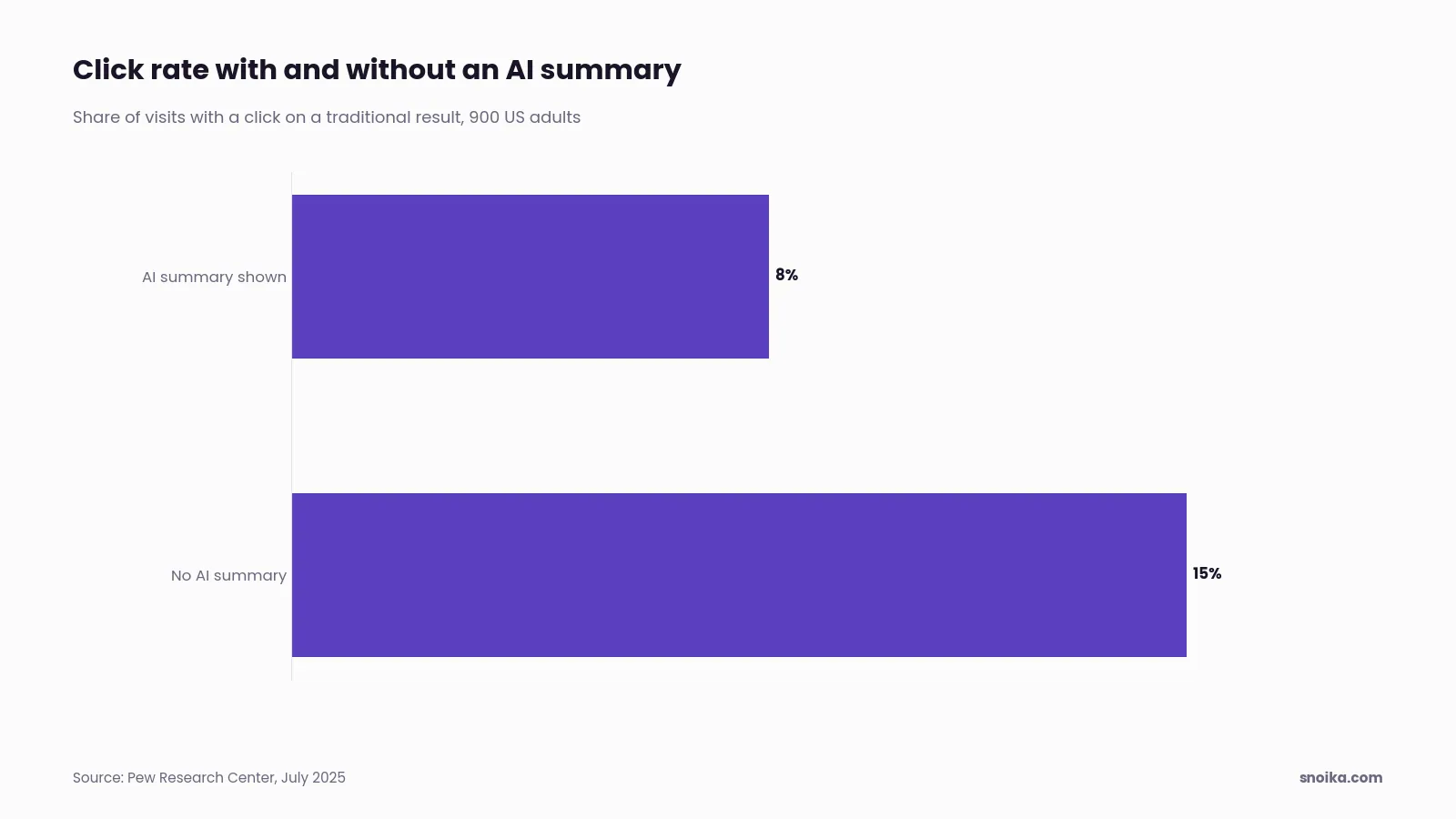
Pew Research Center tracked 900 US adults and found users clicked a traditional result in 8% of visits when an AI summary appeared, against 15% without one. A study of 75,000 brands found branded web mentions correlated with AI Overview visibility at 0.664, versus 0.218 for backlinks.
How we measure brand mentions
We measure brand mentions by running weekly prompt sets in ChatGPT and Google AI Overviews, then logging each time your brand appears in an answer. The prompts copy buyers' questions at each stage, such as "what is" questions and "best tool for" comparisons. Every mention is recorded with its prompt and platform in a dated entry, so you can see which questions you win.
Prompt selection decides how much the count means. If the prompts are written around your brand name, you'll look visible in a market where buyers never type that name, so we use category prompts without your name to show your real reach. The report lists every prompt behind the total, which makes it easy to hold against other AI visibility tools you've tried.
Sentiment tracking
Sentiment tracking records how an AI assistant describes your brand when it mentions you: favorably, neutrally or with a caveat that pushes buyers elsewhere. A mention that calls you "an older option with limited support" can hurt more than no mention.
The tone comes from sources the assistant has read, such as an outdated review, a stale pricing page or a forum complaint from three years ago. That's why each sentiment finding names the claim the assistant made, so you can trace it back. A source on your own site can be rewritten, while a third-party page needs fresh coverage that outweighs it.
Endorsement tracking
Endorsement tracking shows whether an assistant recommends you or cites your pages as a source. An endorsement puts you at the top of the list with a reason, while a mention puts you in the list.
3DPrinterOS achieved #1 visibility in ChatGPT for industry-specific queries and turned AI search into a steady inbound lead source, with 3–4 qualified inbound leads a day. We check citations separately, because if the assistant recommends you but cites a competitor's comparison page, your story depends on how that competitor tells it. The strongest result is a prompt where you're recommended and your own URL is the cited source.
Share of voice by platform
Share of voice is your mentions as a percentage of all brand mentions across the same prompt set, split by AI platform. A brand can lead in Google AI Overviews and trail in ChatGPT, because each system draws on different sources and phrasing.
Alphabet CEO Sundar Pichai reported AI Overviews reached 2 billion monthly users on the company's Q2 2025 earnings call. OpenAI CEO Sam Altman said at Dev Day 2025 that "more than 800 million people use ChatGPT every week." To raise your share of voice in ChatGPT, we work in this order:
Target lost prompts
We start with the prompts where competitors appear and you don't.
Publish answer pages
Pages answer those exact questions with specific facts.
Earn outside mentions
Mentions of your brand on third-party sites that cover the category feed the same answers.
Recheck each platform
The split by platform is rechecked every month, because a gain in one system doesn't carry over to the other.
AI readiness assessment
The AI readiness assessment checks whether AI systems and search crawlers can access your website's content and trust it. Strong content can't earn mentions when a crawler is blocked or the page structure hides the answer. The assessment covers:
Crawler access
Robots.txt rules that block AI crawlers.
Rendering
Pages that load content only through scripts.
Indexing
Broken indexing that keeps pages out of search.
Structure
Clear headings and direct answers near the top of a page, which make it easier for a model to extract facts about you.
Naming
Consistent naming of your company and products, which helps models extract those facts too.
Findings come page by page, so your developers know where to start.
How you get the report
You get the report free, with no credit card. The steps run in this order:
Request the report
Name your brand and main competitors.
Onboarding
We learn about the buyers in your category and your goals.
Connect your data
We connect Google Analytics 4 (GA4), Google Search Console and Google Tag Manager, plus your content management system (CMS) if pages will be published.
Receive the report
You choose whether to keep tracking.
Ongoing tracking runs in our search visibility tool. Plans differ by prompt volume and platform coverage and are on the pricing page.
Turning insights into citations
The report informs the content map and content creation, and it guides visibility strategies, so each gap it finds becomes a page or a fix. The map gains a topic for each prompt where a competitor wins, while a weak description calls for a page that corrects it with current facts.
Your domain
Pages go live on your own domain through a Domain Name System (DNS) connection, with no migration and on any CMS.
Your approval
You review and approve each page in the dashboard before it's published.
Your markets
Content can be created in 135+ languages and regional variants, which matters when AI answers differ by market.
Your first report records the date, the prompt set and the competitors, and we keep all three fixed when we measure again, so the next report compares like with like. Citations to the new pages show up in the next report cycle, which is where AI visibility reporting proves whether the work landed.
FAQ
Snoika's AI visibility report covers six components: visibility score, brand mentions, sentiment, endorsement, share of voice and AI readiness. Scores come from repeated prompt runs, and readiness findings name the specific pages to fix.
We start with the buyer questions where ChatGPT names competitors but leaves your brand out, and publish pages that answer them with specific facts. Mentions on third-party sites that cover your category help too, and we recheck ChatGPT separately, since gains on other platforms don't carry over.
A good score beats the competitors your buyers compare you with, on the same relevant prompts. There's no universal target percentage, so our report shows your score next to your competitors' and tracks the trend.
AI visibility measures whether assistants mention or recommend your brand inside answers, while Google visibility measures where your pages rank in search results. Your AI mentions can change while rankings stay the same, which is why our report tracks both separately.
We compare repeated runs of the same buyer prompts and competitors, with each platform assessed separately, against a dated baseline. A single answer isn't reliable evidence of improvement, because AI responses vary between runs.