
AI reputation management for your brand
A buyer who asks ChatGPT which vendor to pick reads an answer about your brand, whether or not you shaped it. Our AI reputation management tracks how AI assistants describe you. It also fixes wrong or outdated descriptions by publishing pages and third-party signals that those assistants cite. Start with the free AI visibility audit, which needs no access to your systems and runs its automated check in about two hours.
Trusted by

























Fixing your brand in AI
To fix your brand in AI, you have to change the sources assistants read, because a report alone changes no answers. Snoika covers both halves of the job, the tracking and the fixing:
Platform coverage
We measure ChatGPT and Google AI Overviews, where your buyers actually ask.
Fixing power
We publish corrections instead of only reporting problems.
Cadence
Weekly data catches a wrong answer before a quarter of pipeline goes by.
Approval
You review and sign off on every page before it goes live.
If you have writers and only lack data, a monitoring tool is enough. If you need the answers themselves to change, the fix has to be published, and that's the part we take on with human review.
Why AI citations miss brands
AI assistants leave a brand out when they can't find consistent, quotable facts about it in sources they already trust. A thin site or conflicting descriptions create gaps that competitors fill, and missing third-party mentions create gaps too.
Gartner predicted that traditional search volume will drop 25% by 2026 as chatbots take over those queries. Alan Antin, a Vice President Analyst at Gartner, said GenAI tools "are becoming substitute answer engines."
How AI answer monitoring works
We run weekly sets of buyer prompts through ChatGPT and Google AI Overviews and record exactly what comes back. ChatGPT and Google AI Overviews carry most AI search traffic. In October 2025, OpenAI CEO Sam Altman reported 800 million weekly ChatGPT users. Sundar Pichai said AI Overviews reached 2 billion monthly users.
Build the prompt set
The app generates prompts from your content map, and you add custom prompts for the questions your sales team hears.
Run it weekly
The same prompts run every week, so any change in the answers shows up as a trend.
Record the answer
We log mentions and the exact wording used about you. We also record sentiment.
Map the sources
Each answer's citations and cited pages are stored next to it.
Position competitors
You see where rivals appear in the same answers, week by week.
Detect weak brand signals
A weak brand signal is any answer where an assistant describes you vaguely or wrongly, or leaves you out. You improve your visibility in LLM results by fixing the weakest signals first, since they cost you the most buyer questions. Our free audit finds them: after a short form and a quick onboarding call, the automated check runs tailored buyer prompts and analyzes the responses, with a competitor check across your markets.
Missing mention
You're absent from prompts central to your brand.
Outdated description
The answer cites an old product or an old price model.
Negative wording
Sentiment leans against you without a current reason.
Competitor capture
A rival owns the prompt and the citations that go with it.
Correct wrong AI statements
You correct a wrong AI statement by fixing the pages the assistant reads. We rewrite the pages AI pulls from and align your brand facts across the site and in Wikidata. We also add structured data so the facts are easy to read by machine.
New and rewritten pages go live on your own domain through a DNS connection. That works on any CMS with no migration, and you approve every page in the dashboard before it publishes. After that, weekly tracking shows when the answer changes.
Strengthen the sources AI trusts
Your brand gets cited in ChatGPT when it appears on sites the model already quotes and has a page that answers the buyer's exact question. A study of 129K domains found that brands with heavy Reddit presence averaged 7 ChatGPT citations versus 1.8 for brands with little. We set up and schedule these visibility strategies in the Snoika app:
Community answers
Reddit and Quora threads where buyers compare vendors.
Professional channels
LinkedIn and YouTube content that assistants pull from.
References
Trustpilot reviews and Wikidata entries backed by backlinks.
Owned pages
Content creation and website rewriting, supported by Visibility Booster.
Language reach
Content in 135+ languages and regional variants for every market you sell in.
Measure AI share of voice
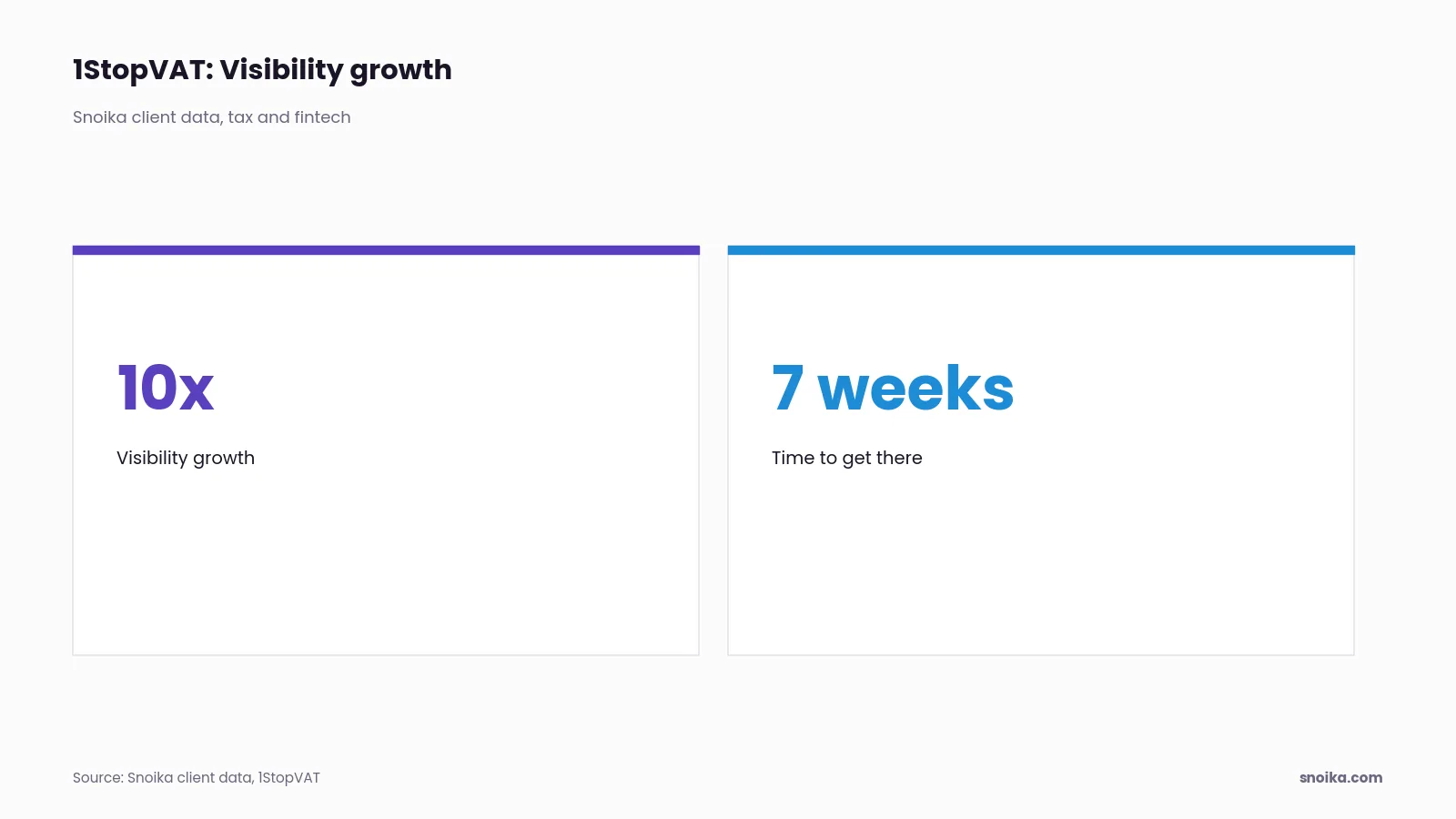
AI share of voice is the share of tracked answers that mention you, measured against your competitors on the same prompts. It depends on the prompt set and the market, so we compare like with like. 1StopVAT, in tax and fintech, saw 10x growth in ChatGPT visibility in 7 weeks.
Once an engagement starts, we ask for access to Google Analytics 4, Google Search Console and Google Tag Manager. That lets us tie share of voice to the traffic you already measure.
Track citations across LLMs
Citation tracking shows which URLs each assistant used to build its answer about you. A study covering 230,000 prompts over 13 weeks found ChatGPT's top-cited domains changed sharply after mid-September 2025. That's why we record cited pages every week and don't settle for a one-time snapshot.
Through the Snoika API and MCP server, you can also pull this data into BI dashboards or use it inside Claude, ChatGPT and Cursor. Every fix we publish goes through human review, and weekly tracking then shows whether the assistants' answers have changed.
FAQ
We publish pages that answer specific buyer questions and build mentions on sources the assistant already cites, found through citation records on your prompts. We also keep your brand facts consistent across your own pages and third-party references.
Snoika records the exact answers ChatGPT and Google AI Overviews give about your company every week, along with the sources they cite. Unlike monitoring-only tools, we also publish the corrections instead of leaving them to your team.
We correct the source pages behind the inaccurate answer and align your facts across your site and external references. You approve every rewritten page before it publishes, and weekly tracking shows when the assistant's description changes.
We start with the buyer questions where your brand is missing or described incorrectly, then improve the pages behind them using cited competitor sources to find coverage gaps. Results are compared on the same prompts each week so changes are meaningful.
There's no fixed turnaround for corrected AI answers. The roughly two-hour estimate covers our automated audit, not changes to assistant responses, and weekly tracking records when corrections appear.