Best LLM SEO tools
The best LLM SEO tools depend on what your team does with the data. Profound suits enterprise analytics teams. Peec AI suits agencies that need unlimited seats, and Otterly.ai is the cheapest way to test whether AI engines mention you at all. If you already pay for Semrush, its toolkit is the easy add-on. Writers who score drafts should pick Frase. Snoika suits SaaS teams that want the tracking and the content work done together.
 Artem LozinskyOperations and product, Snoika · 11 min read

























Tools built for LLM visibility
Six tools cover what an LLM visibility program needs. LLM visibility tools that monitor AI answers range from standalone trackers to platforms that also change your pages. We list them by the buyer each one suits best, because no single tool wins for every team, and that includes ours. The table compares entry prices from 2026 research. Check each vendor's live page before you buy, since prices in this category change.
| Tool | Best for | Entry price (2026) | What you get at entry | Main limit |
|---|---|---|---|---|
| Profound | Enterprise analytics teams | $99/month billed yearly | ChatGPT only, 50 prompts | Wider engine coverage sits in higher tiers |
| Peec AI | Agencies and in-house teams | $95/month for 50 prompts | 3 AI models, daily tracking | Extra engines cost more |
| Otterly.ai | A first, low-cost test | $29/month for 15 prompts | 4 engines included | Monitoring only, small prompt cap |
| Semrush AI Visibility Toolkit | Existing Semrush users | $99/month per domain | 25 tracked prompts | Requires a paid Semrush plan as well |
| Frase | Writers who score drafts | $38/month starting price | SEO and GEO content scores | AI tracking only on upper plans |
| Snoika | SaaS teams that want the work done | Plans on the pricing page | 10 prompts weekly on 1 AI platform (free) | Billed weekly, so compare on the same unit |
Profound
- Best for
- Enterprise analytics teams
- Entry price (2026)
- $99/month billed yearly
- What you get at entry
- ChatGPT only, 50 prompts
- Main limit
- Wider engine coverage sits in higher tiers
Peec AI
- Best for
- Agencies and in-house teams
- Entry price (2026)
- $95/month for 50 prompts
- What you get at entry
- 3 AI models, daily tracking
- Main limit
- Extra engines cost more
Otterly.ai
- Best for
- A first, low-cost test
- Entry price (2026)
- $29/month for 15 prompts
- What you get at entry
- 4 engines included
- Main limit
- Monitoring only, small prompt cap
Semrush AI Visibility Toolkit
- Best for
- Existing Semrush users
- Entry price (2026)
- $99/month per domain
- What you get at entry
- 25 tracked prompts
- Main limit
- Requires a paid Semrush plan as well
Frase
- Best for
- Writers who score drafts
- Entry price (2026)
- $38/month starting price
- What you get at entry
- SEO and GEO content scores
- Main limit
- AI tracking only on upper plans
Snoika
- Best for
- SaaS teams that want the work done
- Entry price (2026)
- Plans on the pricing page
- What you get at entry
- 10 prompts weekly on 1 AI platform (free)
- Main limit
- Billed weekly, so compare on the same unit
Profound: best for enterprise analytics teams
Profound is an analytics platform for large marketing teams, and the company raised a $96M Series C at a $1B valuation in February 2026. The entry tier covers one engine. You need the Growth plan at $399 a month to track 3 answer engines with 100 prompts. It reports on visibility and leaves the fixes to your team. Pick it when you have analysts who will turn its dashboards into work for other people.
Peec AI: best for agencies
Every Peec AI tier includes unlimited users, which is why agencies like it. The Pro plan costs $245 a month for 150 prompts, and Advanced costs $495 for 350 prompts with multi-country tracking and a Looker Studio connection. Prompts run daily. Peec AI is a tracker, so the content work still sits with you or your client.
Otterly.ai: best for a low-cost first test
Otterly.ai has the lowest entry price in this list. Its base plan covers ChatGPT and Google AI Overviews, with Perplexity and Microsoft Copilot also included. Claude and Gemini cost extra. But 15 prompts is a small sample, so treat Lite as a test of whether AI engines name you at all. The Standard plan at $189 a month gives you 100 prompts.
Semrush AI Visibility Toolkit: best for existing Semrush users
The Semrush toolkit tracks ChatGPT and Perplexity next to the SEO data you already keep there, with coverage of Gemini and Google AI Mode as well. An active Semrush subscription is required, so your real entry cost is the plan plus $99 for each domain. Agencies that track 10 client brands pay that line 10 times.
Frase: best for writers
Frase is a content tool with AI visibility added on top. It scores a draft for Google and for generative engines in one editor, which suits writers more than analysts. If your gap is page quality, start here.
Snoika: best for teams that want tracking and content together
Snoika is our AI search visibility tool. It pairs AI visibility tracking with content that we create and publish on your domain. Enterprise is priced on request. The section on where Snoika fits explains who should skip us.
LLM SEO vs traditional SEO
SEO for LLMs is the practice of getting your brand named and your pages cited in AI answers, and you'll also see it called generative engine optimization (GEO) or answer engine optimization (AEO). Traditional SEO ranks a page for a keyword on a results page. An AI assistant writes one answer from a handful of sources, so the page either makes it into that answer or it doesn't.
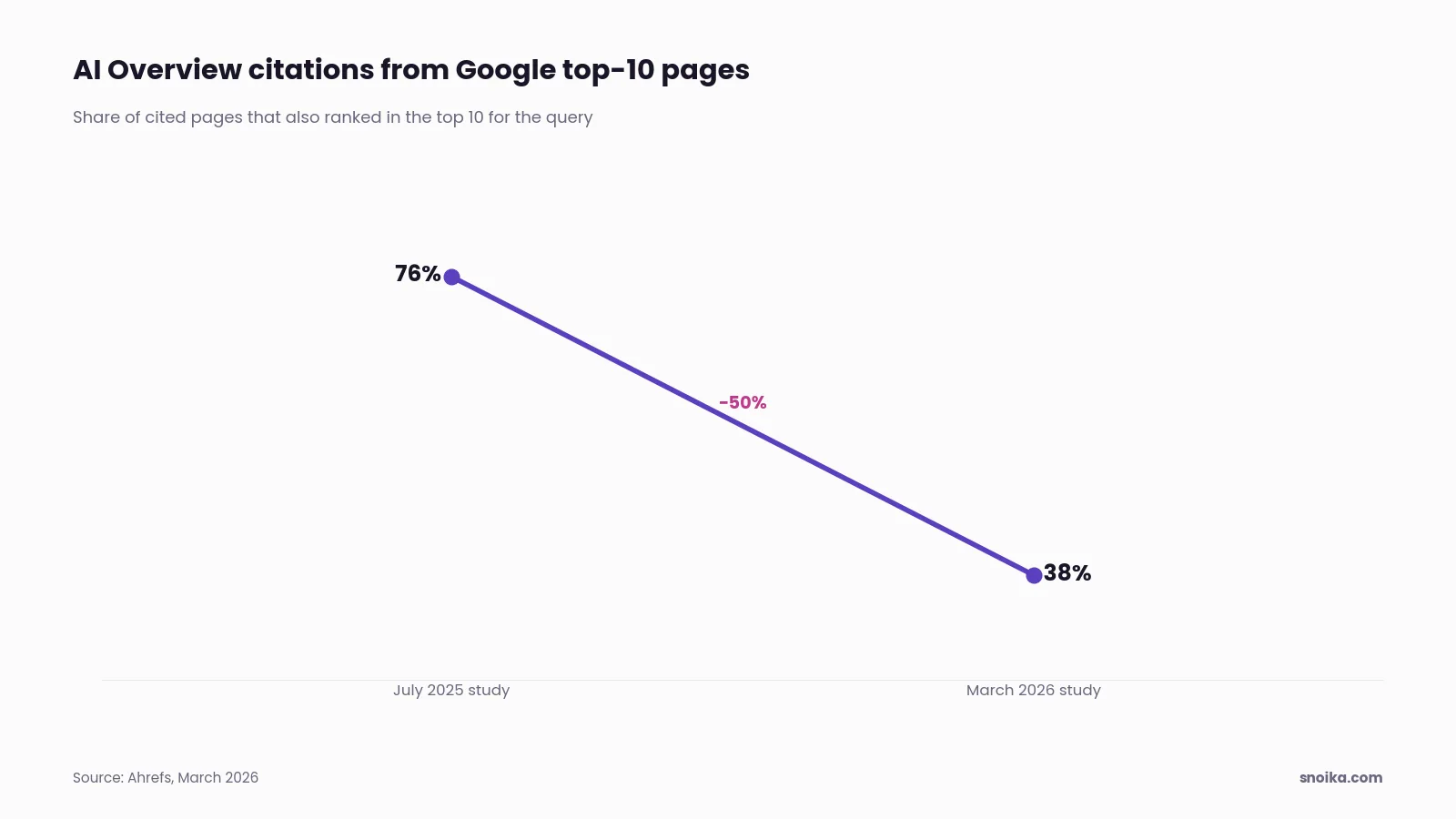
Rankings and citations have also drifted apart. In July 2025, Ahrefs found that 76% of Google AI Overview citations came from the top 10 organic results. When it repeated the study across 863,000 keyword results pages in March 2026, only 38% of cited pages also ranked in the top 10. A first-page ranking still helps. It just no longer predicts whether Google cites you.
That gap is what makes LLM optimization tools different from classic SEO suites. A rank tracker checks one keyword and gets a stable position back. An LLM tool sends a full prompt, the kind of question a buyer would type, to the assistant, again and again, because the answer changes from run to run. It then records four things across those answers. Alongside mention and citation records, it captures how you were described and what share of the answers named you rather than a competitor. Crawl access and content quality still matter in both disciplines. What changes is the unit you measure and what counts as a result.
LLM citation tracking tools
Citation tracking tools send a fixed set of prompts to AI assistants on a schedule. Each run records whether your brand appears in the answer and whether one of your URLs is cited as a source. Peec AI and Otterly.ai run prompts daily, and Snoika runs weekly prompt sets. Over weeks, the samples add up to a trend line that one-off manual checks can't give you.
A mention and a citation are different results, and good tools report them apart. The assistant mentions you when it writes your brand name and cites you when it links your page as evidence. Reviews and press coverage can earn you mentions without citations, while a page citation can appear in an answer that recommends a competitor. Sentiment is a separate layer, because an answer can name you and still warn buyers away.
The data source matters too. Tim Soulo, CMO at Ahrefs, points out in his review of tracking tools that buyers rarely ask "where does the data come from" when they compare them. Some tools query the consumer interface, and others call a model's API, which can answer differently. Ask each vendor which one it uses and whether you can read the raw answers. Country and language handling also need to be part of that discussion. Then check the prompt set itself. Prompts written by marketing that no buyer would ever type produce clean charts and tell you nothing.
Content scoring for retrieval
Frase is the clearest example of a tool that scores content for LLM retrieval. Its GEO Score grades a draft live in the editor, next to its usual SEO score. Frase says the score covers 3 signals for generative engines, and the first is authority, which it defines as credible sources worth citing. At Snoika, we build content maps from research and write pages to fit them; our editors review the pages before they go out.
The research behind these scores is thinner than the marketing suggests. Pranjal Aggarwal and co-authors from Princeton tested content changes across 10,000 queries in their 2024 paper. They found that adding statistics lifted a source's visibility in generative answers by up to 40%. Quotations from credible sources helped as well. That was a lab benchmark that imitated a generative engine. Live assistants have changed since then.
So test a score before you trust it. AI engines split a fetched page into passages and quote the passage that answers the prompt on its own. That's why a short paragraph with a number and a named source gets cited, while a long introduction rarely does. Ask what any score rewards. Then compare its grades with the pages your tracker shows as cited, because a score that doesn't predict citations is just a checklist.
Schema markup for LLMs
Schema markup helps machines read your entities, but current evidence shows it doesn't raise AI citations on its own. Louise Linehan and Xibeijia Guan of Ahrefs followed 1,885 pages that added schema between August 2025 and March 2026, compared against 4,000 control pages. They found no major uplift in Google's AI Overviews or AI Mode, and the ChatGPT results showed no major uplift either. Treated pages even declined slightly more than the controls, though the authors couldn't say why.
A February 2026 test by SEO consultant Mark Williams-Cook helps explain this result: it found that ChatGPT tokenizes JSON-LD as raw text, so it reads the markup as words and doesn't parse it as structured data. Whatever the markup states has to be on the visible page too.
Keep schema for Google rich results and for accurate entity data about your organization and its products, with their pricing. When a tool audits schema, check that it flags markup that contradicts the visible page. Don't expect a schema validator to fix a citation problem.
AI crawler access checks
An AI crawler check confirms that the bots feeding AI search can reach your pages, and it's the cheapest fix on this page. OpenAI's own crawler documentation says that sites opted out of OAI-SearchBot "will not be shown in ChatGPT search answers". GPTBot is a separate setting that only covers model training. You can block training and still allow search, so check the two user agents one at a time.
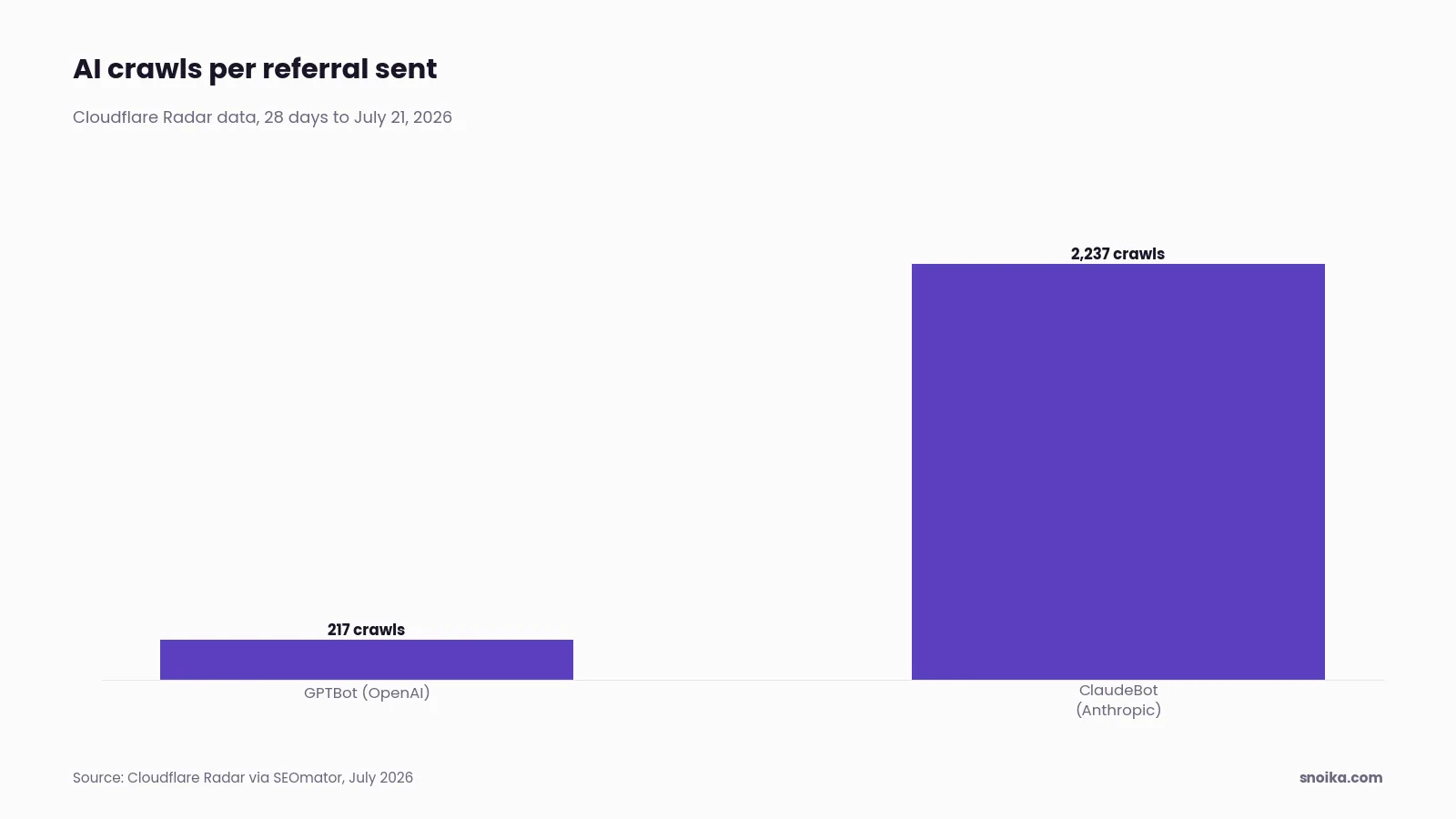
Blocking all AI bots, and accepting the visibility loss, is a choice some publishers make on purpose, because crawlers take far more than they send back. Cloudflare Radar data for the 28 days to July 21, 2026, compiled by SEOmator, shows GPTBot at 217 crawls for each referral it sends, and Anthropic's ClaudeBot at 2,237. A SaaS company that sells through discovery wants the search bots in and can decide on training bots separately.
A crawler access check also needs to cover the content delivery network or firewall, which can block AI user agents before robots.txt ever applies. OpenAI notes that ChatGPT-User, which fetches pages when a person asks, handles robots.txt differently from automated crawlers. Look for a site audit that tests each AI user agent against your live pages. Then confirm the result in your server logs.
Checking llms.txt files
To check your llms.txt setup, fetch the file and confirm its format. Your logs will then show whether any AI system ever reads it. Keep your effort in proportion. Across nearly 300,000 domains, SE Ranking found that 10.13% had llms.txt and saw no link between the file and AI citations. An Ahrefs study of 137,000 sites found that 97% of llms.txt files received zero requests.
Google's John Mueller wrote on Reddit that "none of the AI services have said they're using LLMs.TXT" and compared the file to the keywords meta tag. A file published for coding agents or documentation tools still needs checks for accessibility and accuracy.
- Open yourdomain.com/llms.txt in a browser and confirm it returns a 200 status as plain text or Markdown, without a redirect.
- Check that the first line is an H1 with your site or product name, because that's the only section the proposal requires.
- Read the summary under the H1 and make sure it matches how your homepage describes the product today.
- Test every link in the file and fix any that return errors or point to pages blocked in robots.txt.
- Search your server logs for requests to /llms.txt and note which user agents fetch it, if any do.
Step 5 tells you whether the file is worth keeping up. If nothing has fetched it after a quarter, leave it alone and spend the time on pages that assistants do cite.
Evaluation criteria for SaaS teams
SaaS teams should judge what LLM optimization software measures against its cost per prompt. They should also assess whether it leads to changes on the site. Price comparisons mislead here because vendors charge in different units. Charges can be tied to domains or seats, with billing by the month or, like ours, by the week. Before any demo, write down your top buyer questions and use them to assess each vendor against the criteria below.
- Engine coverage: the plan covers the assistants your buyers use, with any necessary coverage beyond the base tier.
- Prompt volume and cadence: divide the price by the number of prompts, and know whether they run daily or weekly.
- Pricing unit: calculate the cost for your actual domains and seats, then convert any weekly prices to one monthly figure for your real setup.
- Raw answer access: you can read the full answers and export them, so the numbers can be checked.
- Mention versus citation: the tool reports the two separately and shows which URL was cited.
- Traffic connection: the tool links to Google Analytics 4 (GA4) or Google Search Console (GSC), so visibility can be tied to sessions.
- Action layer: the tool, or the team behind it, changes pages, or you have staff to act on reports.
The action layer decides most purchases because a tracker with nobody acting on it becomes a monthly report that people stop opening. Run your shortlist on the same 20 prompts for 4 weeks, and you'll see which tool's numbers match what you find when you ask the assistants yourself.
Where Snoika fits
Snoika fits SaaS teams that want measurement and execution from one vendor, and it fits teams that only need a dashboard less well. Our platform combines SEO with optimization for generative and answer engines (GEO and AEO). We audit sites and track brand visibility in Google and AI assistants. Our content work covers maps and published pages. The same team runs the software and the services, and editors review the output of the automated workflows. If you have analysts and writers in-house, Otterly.ai or Peec AI will cost you less.
Our prompt tracking measures mentions and citations in ChatGPT and Google AI Overviews, where most AI search traffic happens, with share of voice and sentiment measured alongside them. During onboarding, we learn about your category and buyers in the context of your goals. We ask for access to GA4 and GSC, along with Google Tag Manager. When we'll publish pages, we also need access to your content management system (CMS). Pages then go live on your own domain through a DNS connection. You don't migrate anything, and you approve each page in the dashboard before it publishes.
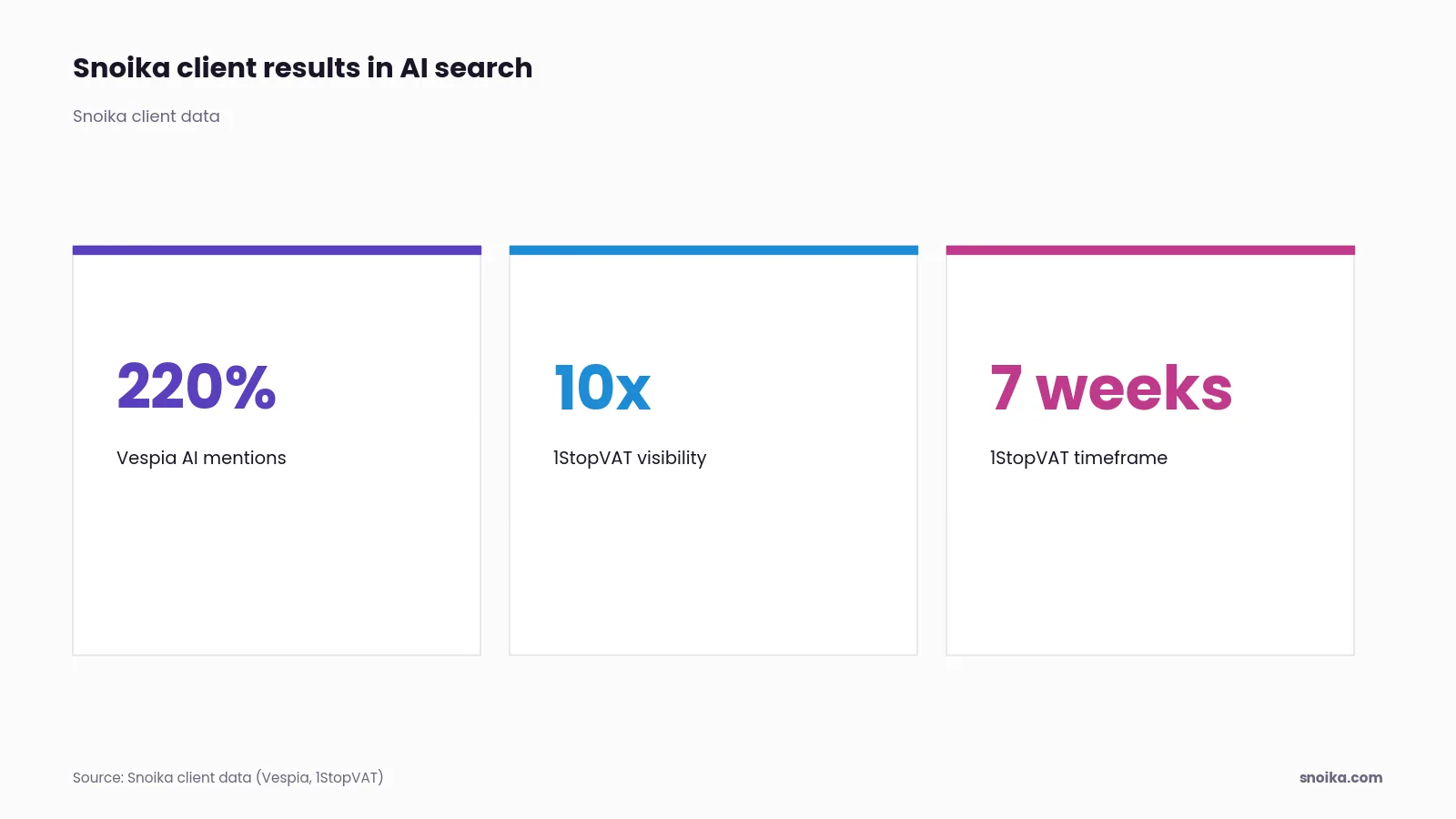
1StopVAT, in tax and fintech, saw 10x growth in ChatGPT visibility in 7 weeks. We also write content in 135+ languages and regional variants, which matters if you sell in markets where English-only tools stop at tracking.
Picking from this list
Pick the tool that matches who on your team will act on the data, then test it on a fixed set of prompts. A cheap tracker leaves the content changes to your team, so add Frase when writers own that work. A platform that handles both measurement and publishing suits teams that want to hand off both. Whichever LLM SEO tools make your shortlist, run the same 20 buyer prompts through each one in the same week. Answers vary by tool and by run, so prompts that differ from tool to tool give you numbers you can't compare.
FAQ
Yes. SEO for LLMs focuses on getting your pages cited and your brand named in AI answers. A high search ranking doesn't guarantee those results, so measure AI citations separately from traditional rankings.
Content editors with generative engine optimization (GEO) scoring assess drafts for LLM retrieval. Monitoring-only tools track appearances in AI answers instead. Before trusting a content score, compare its grades with actual citations, because evidence supporting these scores remains limited.
Fetch /llms.txt and confirm a 200 response without redirects. It should be plain text or Markdown with an H1 naming the site. Check the summary's accuracy and each link's accessibility. Then inspect server logs for requests to see whether AI systems read it.
Traditional SEO tools measure search rankings, while llm seo tools track mentions and citations in AI answers. They repeat buyer questions because answers vary between runs. When comparing tools, check whether their data comes from the consumer interface or a model's API.
Convert weekly charges to a monthly equivalent, then calculate the total for your domains and seats. Compare plans with matching engine coverage and prompt frequency. Include any required base subscription, since an add-on price may not represent the full cost.