
Enterprise SEO services for AI search
Your buyers now ask ChatGPT and Google AI Overviews which vendor to shortlist, and your brand's presence in those answers is a separate measure from a top Google ranking. Snoika's enterprise SEO services measure that gap across every brand and market you run. Then the same team fixes it with content in 135+ languages that it publishes on your own domain with your approval.
Trusted by

















The first step is a free AI visibility report for your main brand, so your team starts from a baseline it can check. TechCrunch put Snoika on its 2026 Startup Battlefield 200.
AI visibility for enterprise brands
AI visibility measures how often AI assistants mention your brand and cite your pages when buyers ask about your category. It also captures whether they describe you the way you'd want. Because AI assistants don't publish a ranking you can look up, our enterprise AI SEO platform tests real buyer prompts every week in ChatGPT and Google AI Overviews, where most AI search traffic happens. For each prompt, we record four signals:
- Mentions — Whether the answer names your brand.
- Share of voice — How often you appear compared with competitors.
- Sentiment — How the answer describes you.
- Citations — Whether the answer links to your page.
Our SEO solutions report all four, because a mention count alone won't tell you whether the answer linked to your page or recommended a competitor.
How AI changes enterprise SEO
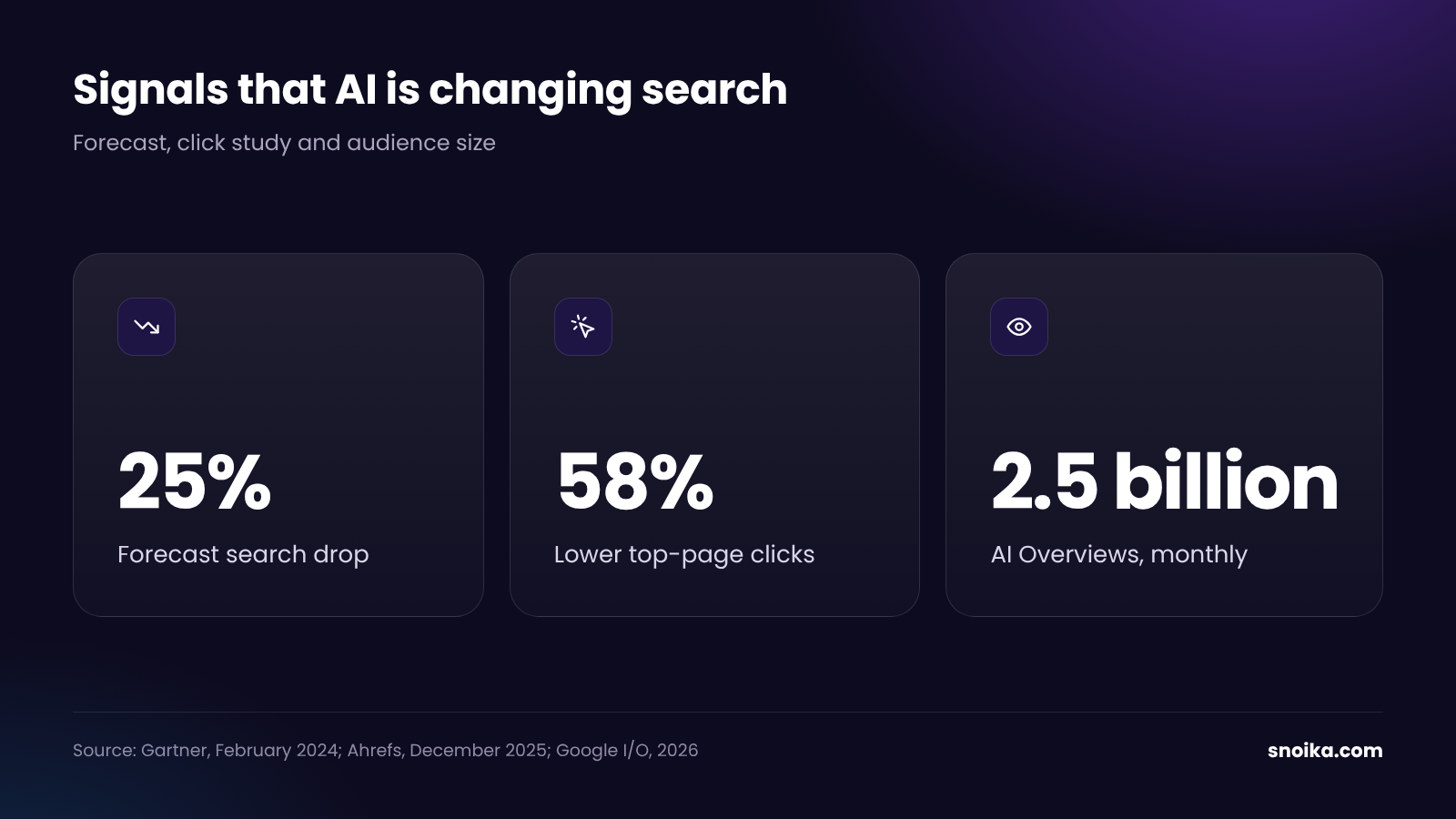
AI answers now sit between your rankings and your traffic, so ranking well has stopped being enough. In February 2024, Gartner predicted that traditional search engine volume would drop 25% by 2026. Alan Antin, Vice President Analyst at Gartner, said at the time: "Generative AI (GenAI) solutions are becoming substitute answer engines."
A click study re-run on December 2025 data found a 58% lower clickthrough rate for the top-ranking page when an AI Overview appears. Sundar Pichai, CEO of Google, said at Google I/O 2026 that AI Overviews has 2.5 billion monthly active users.
You need crawlable, well-ranked pages that a model can quote, along with a way to measure whether it does. Snoika's Visionary Anton Vedeshin reported to Startup Reporter 1StopVAT's move from 2.7% to 28.3% ChatGPT visibility in 16 weeks. That number comes from an AI visibility metric that a traditional rank tracker doesn't produce.
Multi-market brand tracking
Our multi-brand tracking measures each brand separately, in each market's language, against the competitors local buyers actually compare you with. A German buyer asking ChatGPT in German gets a different shortlist than a US buyer asking in English. That's why one global prompt set hides most of the picture. We set it up in three steps:
- 1Prompt setsWe build a prompt set for each brand and market, in the local language.
- 2Local competitorsWe name the competitors that matter in each market.
- 3Brand ownersYou give each brand an owner who acts on the results.
Our Enterprise plan covers multi-brand management with unlimited prompts across all AI platforms, and its content runs in 135+ languages and regional variants. Most enterprises measure a single brand first, then roll the setup out across the rest.
Governed content production
We keep SEO content under control for large marketing teams with one approval gate before publishing and one place where every draft waits for sign-off. Here is how a page moves:
- 011Human reviewOur team reviews the output of the automated workflows before it reaches you.
- 022Your approvalYour team reviews and approves each page in the dashboard before it goes live.
- 033PublishingApproved pages go live on your own domain through a DNS connection, with no migration and on any CMS.
Governance breaks down when regional teams publish outside the approval flow, or when nobody owns a page after launch. With Snoika, no page goes live without dashboard approval, so brand and legal reviewers keep their usual checkpoint in every market.
Enterprise security controls
Our security model starts with which systems we can access and what we can change there. We keep access to what each stage of the work needs:
ROI reporting across markets
ROI reporting for AI search ties visibility changes to outcomes your finance team already tracks, such as leads, sign-ups and impressions. Visibility is the leading signal and pipeline is the lagging one, so our reports show both for each market. 3DPrinterOS reached #1 visibility in ChatGPT for industry-specific queries and turned AI search into a steady source of 3–4 qualified inbound leads/day.
Our Enterprise plan includes executive reporting and dashboards. We agree on the outcome metric for each market before work starts, so the reports never turn into an argument about attribution.
Why legacy platforms miss citations
Legacy enterprise SEO software misses citations because it was built to record positions in a list of links, and AI answers aren't a list. A rank tracker can tell you that a page ranks third without showing whether ChatGPT named you in its answer or which source it quoted. One AI Overviews tracker found that 45.5% of cited sources are entirely new each time it observed them, so a monthly snapshot goes stale within days.
Our AI visibility tool runs prompts weekly and stores the answers themselves. That is how you see whether AI search engines cite your brand, and which page they cite.
Snoika versus legacy suites
Legacy suites and Snoika answer different questions, and plenty of enterprises will run both. The table compares them on the attributes buyers ask about most.
| Attribute | Legacy enterprise SEO suite | Snoika Enterprise |
|---|---|---|
| Main measure | Rankings, backlinks, technical health | Mentions, share of voice, sentiment, citations |
| AI platforms tracked | Varies by vendor, often add-ons | All AI platforms |
| Content production | Usually separate tools or agencies | Same team runs platform and services |
| Suits | Large technical SEO programs | Multiple brands, executive reporting |
Main measure
- Legacy enterprise SEO suite
- Rankings, backlinks, technical health
- Snoika Enterprise
- Mentions, share of voice, sentiment, citations
AI platforms tracked
- Legacy enterprise SEO suite
- Varies by vendor, often add-ons
- Snoika Enterprise
- All AI platforms
Content production
- Legacy enterprise SEO suite
- Usually separate tools or agencies
- Snoika Enterprise
- Same team runs platform and services
Suits
- Legacy enterprise SEO suite
- Large technical SEO programs
- Snoika Enterprise
- Multiple brands, executive reporting
When a legacy suite fits
A legacy suite fits if your main problems are crawl budget or site migrations across millions of URLs, or backlink audits at that scale. Those are technical SEO jobs, and the suites have years of depth there. Keep the suite if AI visibility is a question for next year.
When Snoika fits
Snoika fits if your board is asking why competitors appear in ChatGPT answers and your brand doesn't. Enterprise adds unlimited prompts and multi-brand management, and our done-for-you option suits teams that lack the capacity to write and publish. Plans are on the pricing page.
FAQ
Snoika tests your buyer prompts every week in ChatGPT and Google AI Overviews and records mentions, share of voice, sentiment and citations. On Enterprise, we track each brand and market separately with unlimited prompts.
With Snoika, every draft passes our human review and then waits in one dashboard for your team's approval. No page goes live without that sign-off, so brand and legal reviewers keep their checkpoint in every market.
Our AI visibility tool runs prompts weekly and stores the answers with their citations. Reports separate brand mentions from source links, because a mention doesn't mean your website was cited.
We build a separate prompt set for each brand and market, in the local language and against local competitors. You assign an owner to each brand, and we agree on a business outcome per market so visibility reporting connects to performance.