
SEO website design with AI-ready sites built from scratch
Snoika builds AI-ready websites from scratch, or rebuilds the one you already have, so search engines and AI assistants can read every page and cite it. Our SEO website design work starts with research and ends with tracking. That means the site goes live with its structure and content plan already decided. The usual first step is a free AI visibility report, which shows how ChatGPT and Google AI Overviews see your current site.
Trusted by

























AI-ready site built from scratch
An AI-ready website lets AI assistants fetch its pages as plain text and quote them, while an SEO-ready site only has to rank in Google. The difference is in how the pages render. Google runs JavaScript before it indexes a page.
AI crawlers mostly don't: the Vercel and MERJ crawler study found that OpenAI's GPTBot fetched JavaScript files in 11.5% of its requests and never ran them. So a site that loads its text in the browser can rank on Google and still look empty to ChatGPT.
Crawlable HTML
Every page ships as fast, crawlable HTML with schema on clean templates.
Content map
The plan for every page is in place on launch day.
Tracking
Analytics and tracking are already running when the site goes live.
Kept URLs
A rebuild keeps the URLs that already earn traffic, while a build from scratch suits a new brand or a site whose structure can't be saved.
To check your own site in a minute, search the source of an open page for a sentence from its body copy. If the sentence isn't there, AI crawlers can't see it either.
Design built around SEO
SEO in website design means planning a site's structure and code so search engines can crawl every page and match it to the searches your buyers make. The decisions that matter most come before anyone draws a mockup, so we settle them first:
Page types
The page types the site needs.
Target queries
The query each page type targets.
URL structure
How the URLs nest.
Linking
Which pages link to which.
When design comes first and SEO gets added later, the faults show up at launch: an H1 set as an image, product copy hidden in a slider, or one generic template stretched across service pages and articles alike. Fixing these afterwards costs more than avoiding them, because every fix touches each page built on that template. That's why you see our planned page types and the target query for each template before design starts.
How prompt-based editing works
After launch, you edit pages by writing a prompt that describes the change, such as a rewritten intro or an extra section on a service page. Your marketing team can change content while preserving the structure the site's SEO depends on.
Each page goes live only after you review and approve it in the dashboard, and our team adds a human review layer on top of the automated workflows. Every change a prompt makes passes your approval before visitors see it.
Built on managed infrastructure
Managed infrastructure means our team runs the technical layer under your site, so you don't patch servers or chase plugin updates. The same team runs the Snoika platform and delivers the services.
A speed drop or a crawl error doesn't get passed back and forth between a hosting company and a separate SEO consultant. On self-hosted sites, that upkeep falls to you, and performance slips after launch one plugin at a time.
Structured for AI citation
The website design that helps AI recommend your business serves every page as fast HTML that AI crawlers are allowed to read. Schema describes who you are, and each section answers one question under a clear heading. An assistant can only name a business whose pages it has fetched and understood, so being cited comes before being recommended.
Schema markup
Schema markup uses labeled fields to tell a machine about a page's organization and author, and product fields identify the product and its price. Clean headings do the same job for the text, because an assistant that lifts a passage needs to know which question that passage answers. We build both into the templates, so every new page gets them automatically.
AI crawler access
Access permissions determine whether a crawler can view a page, while rendering determines what it sees. Our builds set up fast rendering and AI crawler access from the start. The text sits in the HTML the crawler receives, and robots rules don't block the assistants your buyers use.
Where llms.txt fits
Jeremy Howard, co-founder of Answer.AI, introduced the format in September 2024: "We propose that those interested in providing LLM-friendly content add a /llms.txt file to their site."
Google's own guidance takes a different line: "You don't need to create new machine readable files, AI text files, markup, or Markdown" to appear in Google's generative AI features. We add an llms.txt file to each build because it costs little, as a small extra on top of the work above.
Core SEO signals we deliver
Every build ships with the technical SEO signals Google uses to index and rank pages. We set them up in the templates, so they don't have to be fixed page by page after launch.
| Signal | What we set up | Risk without it |
|---|---|---|
| Title tags | A unique title per page, written from its target query | Duplicate titles compete with each other in results |
| Meta descriptions | A description per page that matches what the searcher wants | Google writes its own snippet from page text |
| Canonical tags | A canonical URL on every page | Duplicate URLs split ranking signals |
| XML sitemaps | Sitemaps that update when pages are added | New pages take longer to be found |
| Redirects | Redirects from old URLs to their new pages | A rebuild loses the rankings the old URLs earned |
| Core Web Vitals | Templates checked against Google's "good" thresholds | Slow or unstable pages lose visitors |
| Internal links | Links placed from the content map's linking plan | Orphan pages receive fewer crawls |
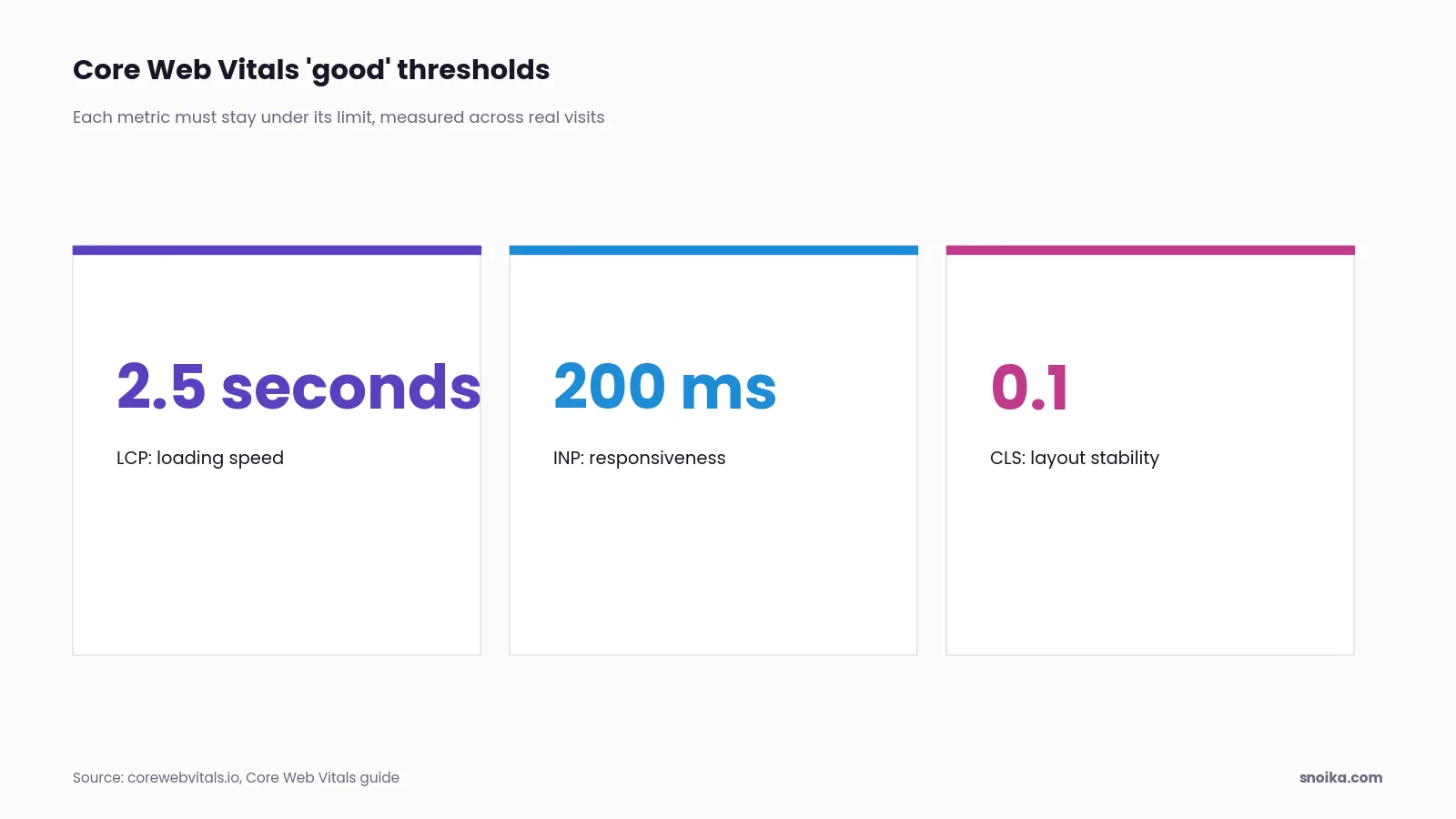
The Core Web Vitals guide at corewebvitals.io sets "good" at a Largest Contentful Paint (LCP) under 2.5 seconds. Interaction to Next Paint (INP) has to stay under 200 milliseconds, and Cumulative Layout Shift (CLS) under 0.1, all measured across real visits. We check the field data in Search Console, because a lab test can pass while real visitors on mobile still wait.
Early results in these signals were visible at ABS Technologies, which saw 6x SERP impressions and improved keyword indexability within the first 30 days. Its search visibility also increased significantly within that period.
Content map from day one
The content map is the plan for the whole website, and we write it before the first template is designed. It covers:
Keyword research
Live search volumes, plus a check of the search results page for every target.
Pillar research
Pillars, clusters and the prompts to target in AI assistants.
Market analysis
The countries and languages where demand exists.
Page outlines
Page types, H1s and H2 outlines based on what currently ranks.
Linking plan
An internal linking plan with priorities.
On a rebuild, the map includes an SEO audit of your existing pages to identify which need updates, redirects or deletion. These recommendations address technical issues or competition between two pages for the same query (cannibalization). Content can then be created in 135+ languages and regional variants.
What the build includes
The build includes page templates that match your site, plus GA4 and Google Tag Manager events set up so you can track the leads each page brings in. That tracking ties every page in the content map to a business result as well as a traffic figure. Snoika delivers the AI-ready build, the content map and the tracking as a single engagement.
You keep control of your content through downloads available at any time in JSON, Markdown, HTML5, CSV, XML or DOCX. Leaving never means copying pages out by hand, as it does with a closed site builder.
Who our builds suit
Our build is the closer match when your buyers research in AI assistants and you need the site found and cited there, with the content plan and tracking handled by one team. If your project is mostly a brand identity or a custom web application, a design agency is the better fit. Each build is scoped in a proposal around your market, and plans are on the pricing page.
Rebuild timeline
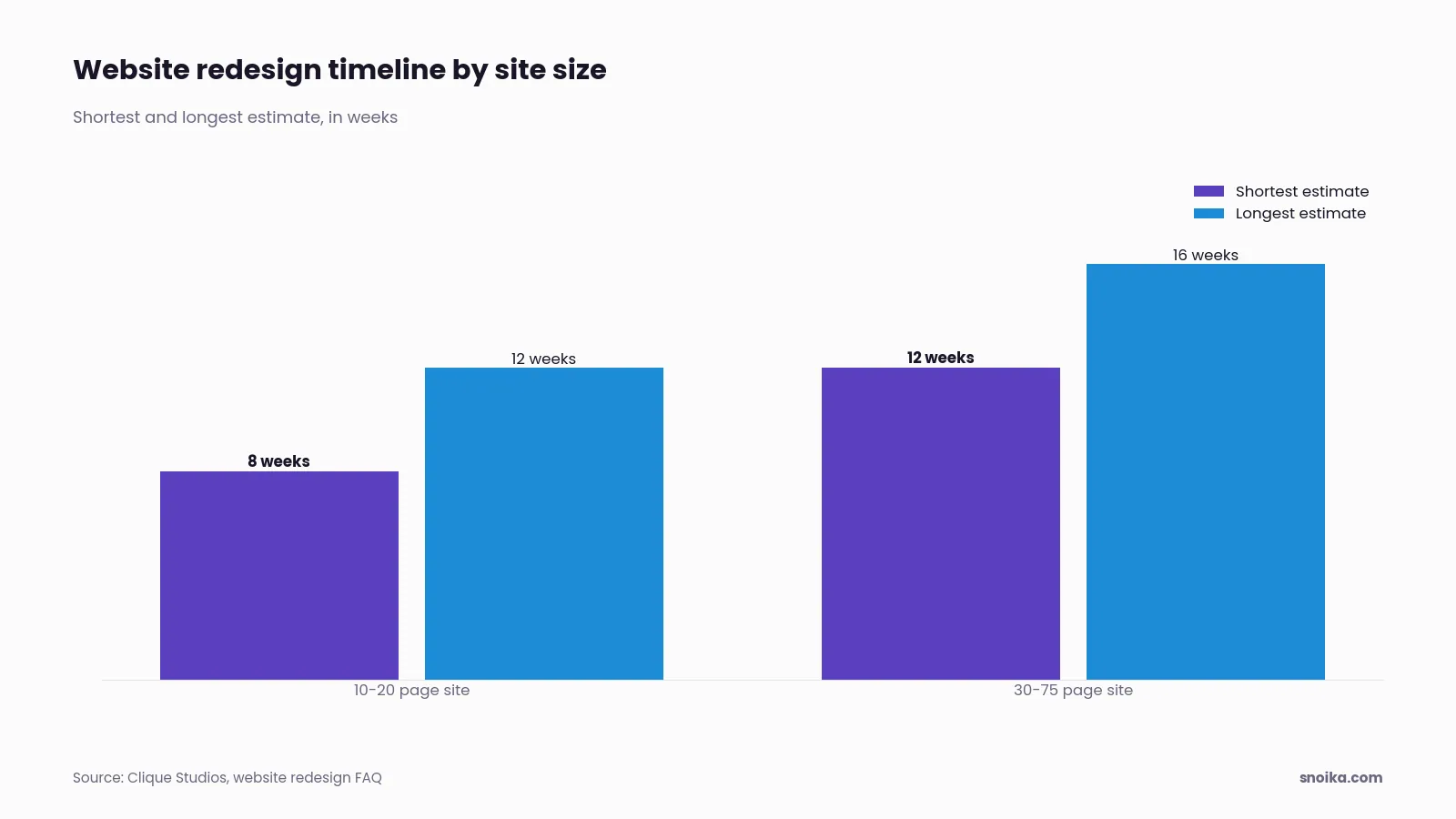
How fast an SEO-optimized site can be rebuilt depends primarily on how much is decided before work starts. Clique Studios puts a small business site of 10 to 20 pages at 8 to 12 weeks, and a 30 to 75 page site at 12 to 16 weeks. JKC Website Design puts a self-built site at 1 to 12+ months.
Phenomenon Studio has found that writing content after design starts adds three to six weeks. We write the content map and outlines first, which removes that wait, and the timeline for your build is set in the proposal.
When new pages are the right first step, they go live on your own domain through a DNS connection before a full rebuild. That works on any CMS with no website migration. Weekly tracking then shows whether the work is moving. Snoika's founder Anton Vedeshin reported to Startup Reporter 1StopVAT's move from 2.7% to 28.3% ChatGPT visibility in 16 weeks.
FAQ
SEO website design helps search engines read pages and match them to relevant searches. Before design starts, we give each page type a target search query and a place in the site's linking plan.
An AI-ready website delivers its text in the page's HTML so AI crawlers can read it without running JavaScript. A site can appear in search results yet remain unreadable to AI crawlers if its text loads only in the browser, which is why every Snoika build ships as crawlable HTML.
We set the rebuild timeline in the proposal, based on site size and how much planning is complete. Because we prepare the content map and outlines before design, there's no extra wait for content written later.
Our builds serve readable HTML and allow AI crawlers access, so assistants can find information about your business. Clear headings make passages easier to interpret, and schema describes the business. Being accessible enough to cite comes before being recommended.