
AI sentiment analysis for your brand
Snoika's AI sentiment analysis shows whether ChatGPT and Google AI Overviews speak well of your brand when buyers ask them for advice, along with the exact phrases behind that tone. You start with a free AI visibility audit. It needs no access to your systems, and after a short form and a quick onboarding call the check runs in about two hours.
Trusted by

























Brand sentiment in AI answers
Brand sentiment in AI answers is the tone an assistant takes when it names your company, from positive through neutral to negative. To find out whether ChatGPT describes your brand positively, we ask it the questions your buyers ask and record the tone of each answer, prompt by prompt, every week. Snoika logs the tone of every mention in ChatGPT and Google AI Overviews answers this way.
We track tone over time because the same prompt can get a warm answer on Monday and a cautious one on Thursday, so one screenshot proves little. A weekly record shows whether the tone is moving and which prompts are moving it.
How AI tone detection works
AI tone detection reads each answer as a buyer would, then labels how it treats each brand it names. Snoika applies this process to each tracked prompt.
Run the prompt
Each tracked buyer prompt goes to the assistant as written.
Find the brands
The answer is scanned for your brand and for your competitors.
Label the tone
Each brand gets a tone label for that answer on a scale from negative to positive, with neutral in the middle.
Keep the phrases
The words the assistant used about each brand are stored with the label.
Plot the trend
Tone appears over time next to mentions and citations, so you see whether a change in tone came with a change in sources.
We score competitors on the same prompts and keep the phrases behind each score. A score without phrases flags a problem without identifying what is wrong.
Which statements drive AI tone
Assistants turn negative because of specific sentences in their sources, and the stored phrases show you which ones. Compare a negative phrase with the pages the answer cites and the source sentence is easy to find. The two groups below cover most cases.
Claims on your own pages
Outdated material on your own site, such as an old pricing page or a retired feature still described as current, gives assistants weak material. Vague copy also leaves the model guessing. If the model can't find a clear statement of what you do well, it fills the gap from other sources.
Claims from third-party sources
Review sites, forum threads and comparison articles carry more weight than brands expect. One detailed complaint on a review platform can show up in an answer for months. We look at the cited sources for each negative answer and note which ones keep coming back, and those sources become your fix list.
Tracking endorsement vs mere mention
A mention puts you in the answer, and an endorsement means the assistant recommends you. Snoika records tone alongside mentions and citations to show whether AI assistants actually endorse your brand, because a mention count alone hides the difference. Each answer falls into one of four levels of endorsement.
Listed
Your name appears in a list with no comment.
Described neutrally
The assistant states facts about you without a view.
Recommended
The answer uses positive phrases and suggests you for the buyer's need.
Recommended with a citation
The praise links to a source, which makes it more stable.
A rising mention count with flat tone means visibility is up but preference isn't.
LLM sentiment vs social listening
Large language model (LLM) sentiment measures what assistants say about you, while social listening measures what people post. A brand loved on social media can still get lukewarm AI answers if the sources assistants read are old or thin.
| Attribute | Social listening | LLM sentiment |
|---|---|---|
| Source | Posts by people | Answers by assistants |
| Reach | Followers of a post | Anyone asking the prompt |
| Fix | Reply or engage | Change cited sources |
Social listening serves customer care. LLM sentiment analysis is the one to use when you need to know what buyers hear at the moment they compare vendors.
Fixing negative AI portrayals
You fix a negative AI portrayal by changing the pages and third-party sources the answer cites. Snoika starts with your pages before it addresses third-party sources.
Rewrite your pages
Pages that state outdated or vague claims get rewritten. They go live on your own domain through a DNS connection, on any CMS, and you approve each page in the dashboard first.
Address reviews
Trustpilot reviews that assistants quote are checked and answered.
Correct structured data
Wrong or missing Wikidata entries are updated.
Join the threads
Reddit discussions that shape answers get accurate, disclosed responses.
Expect changes over weeks. Assistants refresh their sources at their own pace.
Monitoring across multiple LLMs
To monitor brand sentiment across several LLMs, we run one prompt set on each assistant every week and compare the same metrics side by side. Snoika's tracking covers ChatGPT and Google AI Overviews, where most AI search traffic happens. Its weekly prompt sets measure mentions, share of voice, sentiment and citations.
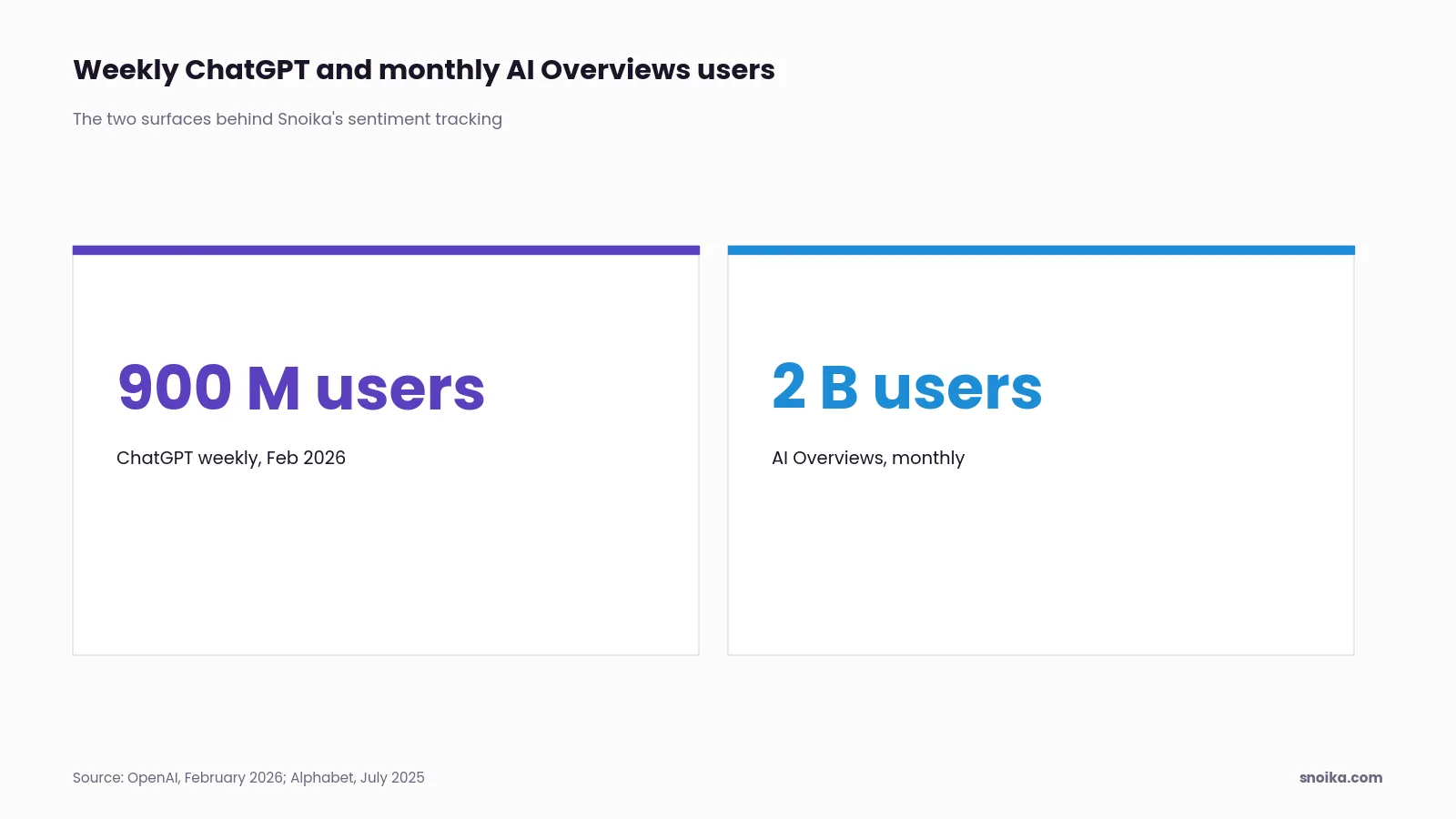
We focus on these surfaces because OpenAI reported 900 million weekly ChatGPT users in February 2026. Sundar Pichai, CEO of Alphabet, told investors that AI Overviews had 2 billion monthly users in July 2025. If your buyers rely on another assistant, check it by hand with the same prompts.
Turning neutral coverage positive
Neutral coverage turns positive when assistants find specific reasons to recommend you. A neutral answer means the model knows your facts but has no evidence of where you're the better choice. Pages that compare use cases, name customer outcomes and answer buyer objections give it that evidence.
Vespia, a fintech SaaS, recorded a 220% increase in AI brand mentions through content work like this. If you sell abroad, those pages need each market's language, since tone can differ by market. Snoika creates content in 135+ languages and regional variants.
Reporting AI sentiment to stakeholders
Stakeholders want sentiment tied to revenue, so our reports put tone next to traffic and leads.
Visibility change
How published content moves mentions, citations and share of voice in ChatGPT and Google AI Overviews.
Lead sources
Which pages bring leads, through the GA4 and Tag Manager events Snoika sets up.
Tone trend
Answers per prompt over time, grouped as positive, neutral or negative.
Data access
The Snoika API and MCP server pull the same data into BI dashboards and automate recurring reports.
Tracking plus fixes
Snoika gives you tone tracking and the fixes that change it from the same team. That team runs both the platform and the services, and a human reviews the automated work.
In our view, a monitoring-only tool is enough if your team already writes and publishes well. When you need someone to change the tone as well as watch it, we start from the prompts your buyers type before they choose a vendor and the phrases that win your most-recommended competitor its place, and that gap becomes the first content brief.
FAQ
Snoika records the tone of ChatGPT's answers to your buyers' questions every week and keeps the wording behind each label. We compare the same prompts over time, because one positive answer doesn't establish a trend.
Snoika records tone and exact phrases alongside mentions and citations, so it can tell a recommendation from a plain mention. Mention counts alone don't show endorsement.
Outdated claims on your own pages and complaints in third-party sources are the usual causes. We compare the stored negative phrases with the pages each answer cites, and the sources that keep coming back become the fix list.
We run the same buyer questions on each assistant every week and compare tone with the same labels. Our tracking covers ChatGPT and Google AI Overviews; if your buyers use another assistant, check it by hand with the same prompts.
Our AI visibility audit is free and doesn't need access to your systems. After a short form and a quick onboarding call, the check runs in about two hours.