
Content map with a full SEO content plan
We build a content map for your whole website. Every page you publish gets an outline built around a target query and a prompt to win in AI assistants, with a place assigned in your internal linking. The result is an SEO content plan your writers can work through in order, starting with what pays off first in Google and ChatGPT. Most teams start with a free AI visibility report, which shows where the brand appears in AI answers today and where the plan should begin.
Trusted by

























Content map for every page
A content map plans every page you have and every page you still need across your website, with research behind each decision. A quarterly blog calendar covers far less than that. The map specifies what to write for each market in publishing order and says what to do with the pages already live, because those two questions have to be answered together.
What an AI-optimized content plan includes
An AI-optimized plan needs everything a classic SEO plan has, plus the prompts buyers type into AI assistants. Our map covers:
- Keyword research. Live search volumes show which queries have demand now.
- SERP check of every target. It shows which page type Google rewards for that query.
- Pillar research. It decides how topics group into hubs.
- AI prompts. They set which buyer questions the page should answer in ChatGPT.
- Market analysis. It shows which countries and languages have demand.
- Page types with H1s. They define what each page is and what it's called.
- SERP-researched H2 outlines. They set what each page has to cover to compete.
- Internal linking plan. It decides which pages link to which.
- Priorities. They decide what gets written first.
- Review of existing pages. It decides what to update, keep or delete.
The prompts and the review of existing pages are always part of the map, because without them a plan is only a keyword list.
What a brief for AI visibility looks like
Every row in the map turns into a brief that a writer can follow without coming back to ask questions. Each brief contains:
- Page type with H1. It is paired with a target keyword and its volume.
- H2 outline. It comes from the pages that already rank.
- Prompts. These are the buyer questions the page has to answer.
- Links. The brief lists the internal links in and out.
- Facts with sources. The brief specifies what the writer must use.
To win AI citations, each section opens with a sentence that answers its heading directly, because assistants quote passages that make sense on their own.
How AI changes content planning
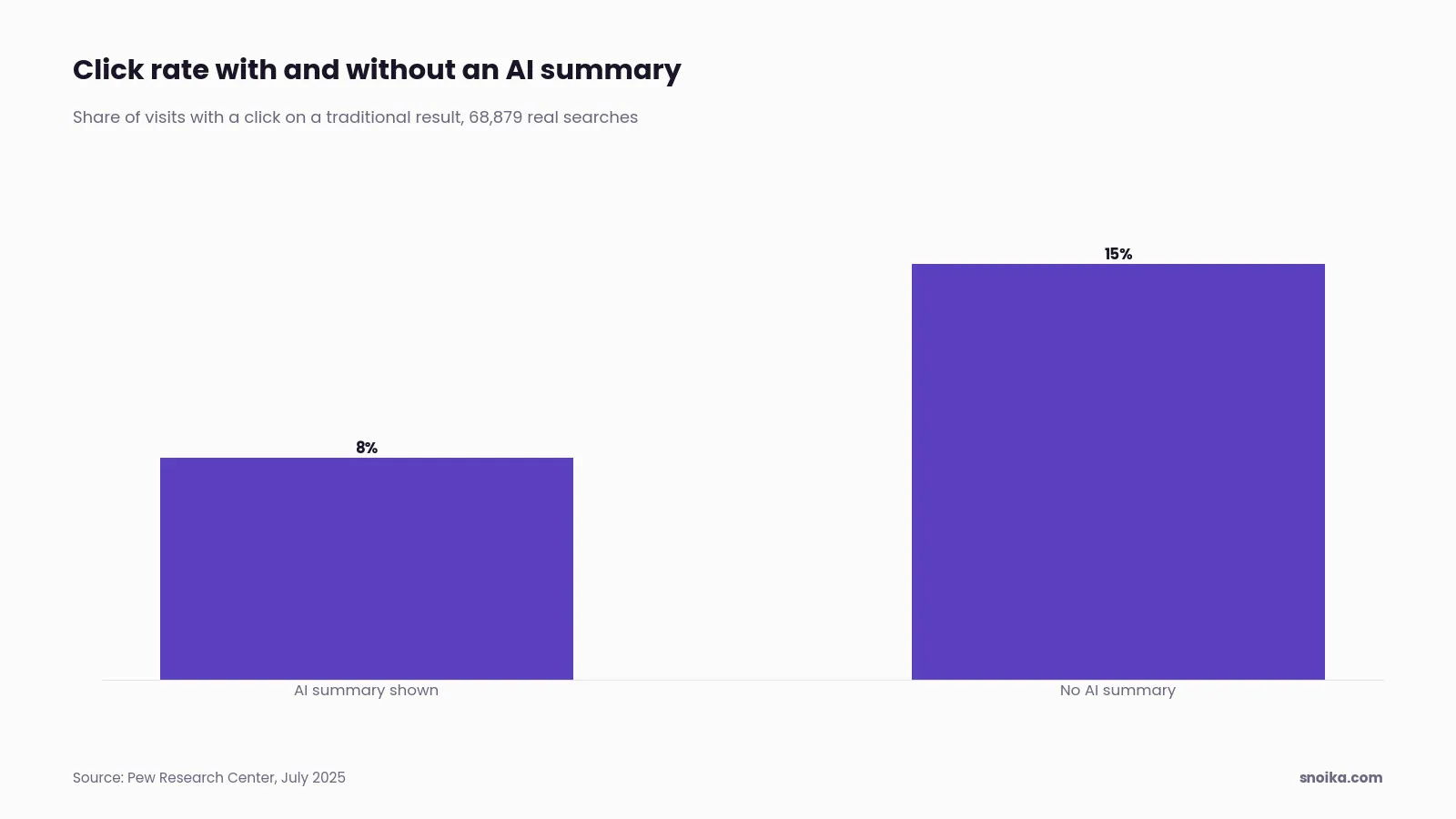
AI assistants now answer the question before the click, so a plan has to win citations as well as rankings. In a Pew Research Center study of 68,879 real searches, users clicked a traditional result 8% of the time when an AI summary appeared, against 15% without one. Meanwhile OpenAI CEO Sam Altman told developers in October 2025 that "more than 800 million people" use ChatGPT every week.
Software and finance buyers already ask ChatGPT for shortlists, while a local trade still wins most work through classic search. A plan that reports only rankings and sessions can't tell you whether you're being recommended. That's why we track mentions, share of voice, sentiment and citations in ChatGPT and Google AI Overviews with weekly prompt sets, because that's where most AI search traffic happens.
Prompt-led keyword research
We research the keywords people search, with live volumes, and the prompts buyers type into ChatGPT, and every target then gets a SERP check. Keywords tell you how many people look for something, while prompts tell you how they ask. A prompt is longer and full of constraints, such as "e-signature tool for a 20-person legal team in Germany," and those constraints point to pages a keyword list never suggests.
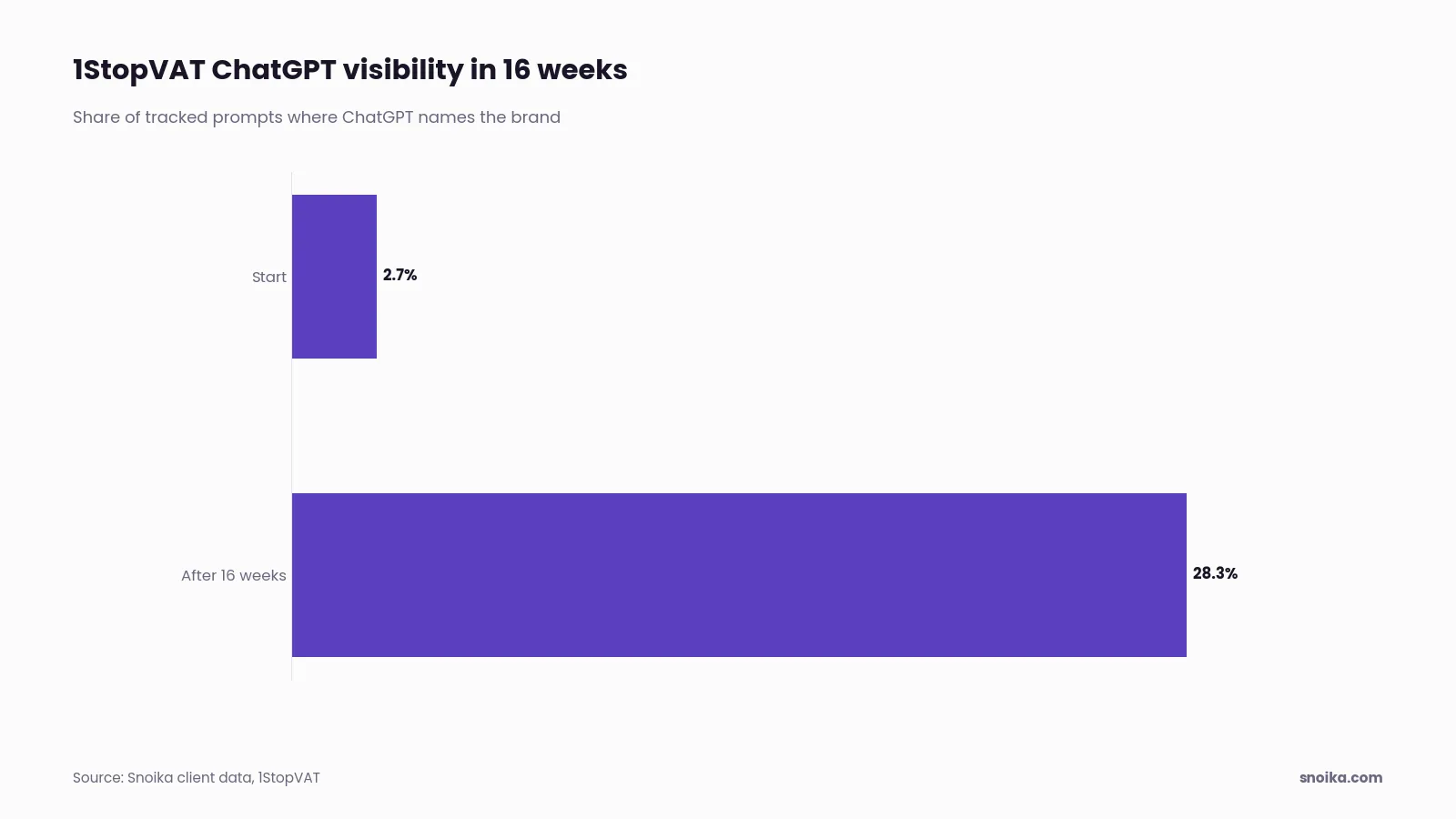
We find AI visibility gaps by running a fixed set of buyer prompts every week and recording which brands each answer cites. A gap is any prompt where a competitor appears and you don't. Each gap then maps to a fix, either a new page or an existing page that needs a direct answer it currently lacks. Snoika's founder Anton Vedeshin reported to Startup Reporter 1StopVAT's move from 2.7% to 28.3% ChatGPT visibility in 16 weeks.
Topic clusters for AI visibility
We build topic clusters that assistants cite by putting a pillar page around each buyer problem and covering every question around it in the format that question needs. Our pillars cover guides, product pages, comparisons, alternatives, glossary terms, tools and industry pages. A buyer who asks for "alternatives to X" expects a comparison, and a guide won't win that answer.
Format coverage matters because AI answers draw on more than one page. Pew found that 88% of AI summaries cited three or more sources. In our clusters, each page answers one question and links back to its pillar, so an assistant has more passages to pick from your site.
Markets worth entering
Market analysis shows which countries and languages have demand before anyone writes a page. We compare search volumes and SERP competition for each country, so you can see where a page has a realistic chance. Sometimes the answer is a regional variant, for example Brazilian Portuguese versus European Portuguese. Once a market earns a place in the map, we create the content in that language, from a choice of 135+ languages and regional variants.
We research each market instead of translating one plan. Buyers in Germany phrase prompts differently from buyers in Spain, and they meet different competitors in the results. A translated English plan carries over the English keywords along with the English blind spots.
Existing pages reviewed
The map gives each existing page a verdict: update, keep or delete, and every verdict comes with the evidence behind it. Deletions usually follow a technical issue or cannibalization, where two pages compete for the same query and Google ranks neither well. Folding the weaker page into the stronger one with a redirect recovers the ranking both pages were splitting.
Plans go wrong at this step. When someone deletes a page that has backlinks and doesn't set up a redirect, the authority that page built is gone. That's why a removed page that still earns clicks gets a redirect in our map.
Internal links planned upfront
Every page in the map gets its outgoing internal links before it's written, so new pages slot into the plan as they go live. The writer knows the targets and anchors from the brief. Cluster pages point to their pillar, the pillar points back, and no page is left orphaned for someone to rediscover during a later audit.
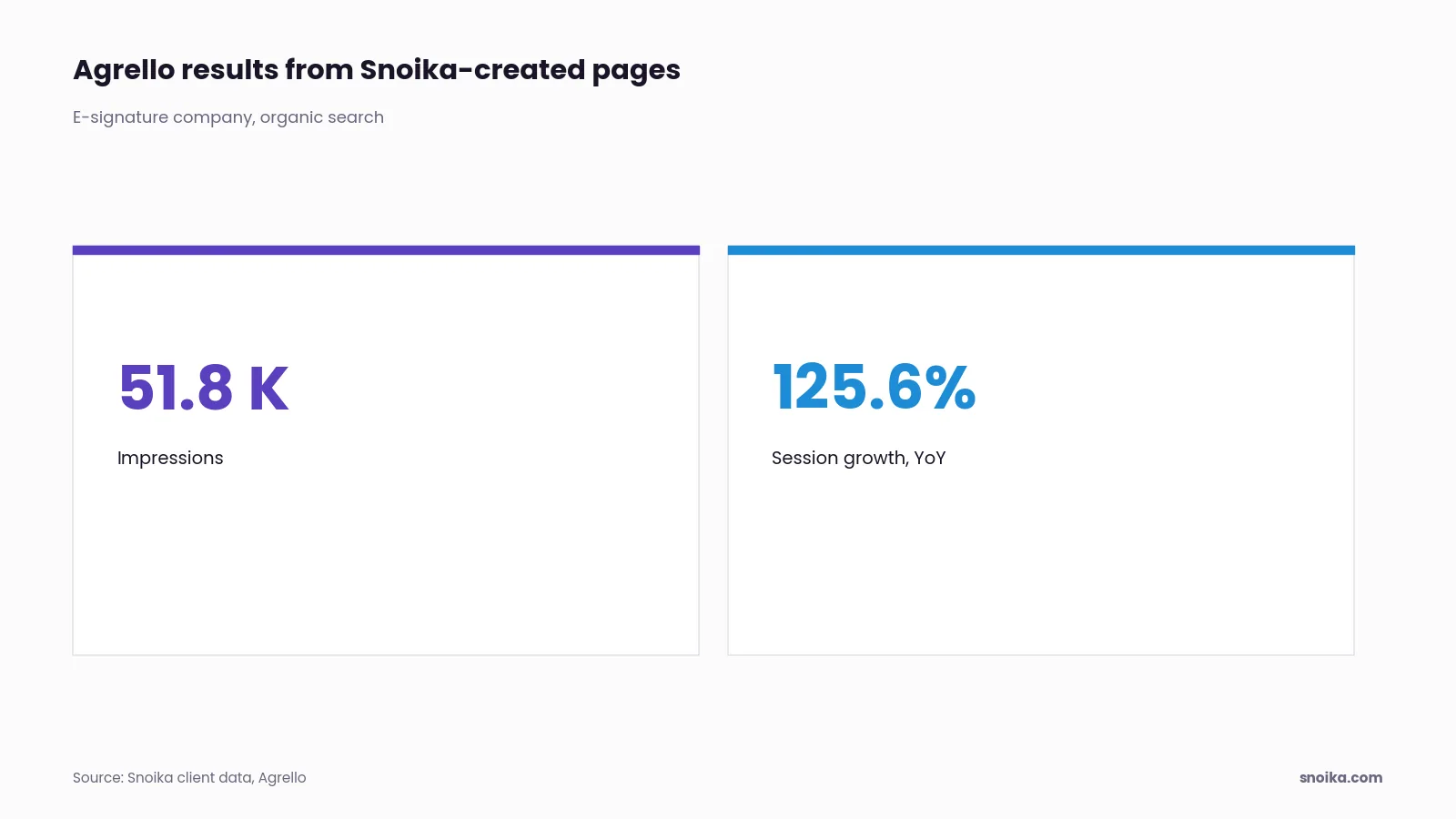
Planned links simplify publication: pages go live on your own domain through a DNS connection, with no migration and any CMS. You review and approve each page in the dashboard before it goes live. Agrello, in e-signature, generated 51.8K impressions from Snoika-created pages and +125.6% organic search sessions YoY.
Onboarding before research
Research starts only after onboarding, when we learn your category, your goals and who your buyers are. We ask for access to the data that sets your priorities:
Google Search Console
It shows the queries you already rank for.
Google Analytics 4 (GA4)
It shows which pages turn visits into leads.
Google Tag Manager
Access is part of the standard onboarding.
Your CMS
We need it when we'll publish pages for you.
Without that data, a plan guesses at priorities. The same team runs the platform and the services, and a human review layer checks the output of the automated workflows.
Planning tied to tracking
We build your SEO content strategy and measure whether it works, with weekly prompt tracking in every plan. A one-off plan leaves nobody checking the results, while our content map and the tracking that proves it worked come from the same people. Plans are on the pricing page.
Who this service fits
This service suits companies with a working product whose content needs a plan behind it. It fits best for:
Companies with unplanned content
Your website is meant to bring in buyers, but its content grew without a content marketing strategy.
B2B teams
It fits B2B and SaaS content marketing teams whose buyers already ask ChatGPT for shortlists.
Companies entering new markets
You need to know which markets have demand.
Our results so far come from tax and fintech software, e-signature and 3D printing software. It suits you less if you publish a few pages a year or sell only in one town, where a short keyword list and a local listing are all you need. If you already have a strategist and only need writing capacity, you're buying SEO content writing, which is a narrower service.
FAQ
Our content map pairs target queries and buyer prompts with pages, gives every page a writer brief with internal links, and uses market research to set publishing priorities. It also gives every existing page an evidence-backed verdict: update, keep or delete.
We build each cluster around a buyer problem, with a pillar page linked to pages that answer the related questions. Each page's format matches its question, such as a comparison for an alternatives query, and each supporting page links back to the pillar.
Our briefs define the target query, the buyer prompts the page must answer, a search-informed heading outline, and the facts and sources to use. They also list links into and out of the page, and every section opens with a direct answer.
We run the same set of buyer prompts every week and record which brands the answers cite. A gap is any prompt where a competitor appears and you don't, and each gap maps to a new page or an existing page that needs a more direct answer.
We update existing pages first when the evidence makes them a higher priority than new content. Search Console query data and page-level lead data from GA4 guide that decision, and pages competing for the same query are folded into one stronger page.