
B2B scaleup marketing for AI search
When a buyer asks ChatGPT for vendors in your category and your name isn't in the answer, you've lost that deal before the first visit to your site. In G2's March 2026 survey, 51% of B2B software buyers said they start research in an AI chatbot more often than in Google. Snoika measures where a b2b scaleup appears in AI answers in every market it sells into, then builds content around the gaps we find.
Trusted by




















We audit and track your presence across markets, write and publish the content, and people review each automated step throughout the process.
AI visibility for scaleup growth
A B2B scaleup gets recommended by AI assistants when its name keeps turning up in sources the models trust, and when its pages answer the exact questions buyers ask. The models pull from pages they can parse and quote. So a page that plainly describes what you do for your target buyers and states what it costs is easier for them to use than a page of brand claims.
Brand mentions on third-party sites help too, since the models check one source against another. Our first check is whether ChatGPT can name your category and your main use case without help.
Scaling content across markets
Scaling content across markets means writing for how each market searches, which is more than translating your English pages. Buyers in Germany and buyers in Brazil frame the same problem in different terms. They also trust different review sites, and the AI answers they get draw on local sources.
Which markets to localize first
We start with the markets where you already have pipeline or sales coverage. If a market sends you zero demos today, visibility there won't turn into revenue until someone can close the deals it brings in. We rank markets by revenue at stake, then by how weak your current AI presence is in each one. A baseline for one market tells you more than a thin global view.
What changes between language versions
The core product facts stay the same, along with the pricing logic and proof. The terminology and examples change, as do the competitors you're compared against. We structure each country version the same way so it answers the questions buyers ask there, with local currency and local regulation where those matter. We write SEO content in 135+ languages and regional variants, because Austrian German and Swiss German buyers don't always search in the same words.
Programmatic pages for new categories
To scale programmatic SEO across countries, we build one tested template per page type, fill it with data that differs from page to page, and roll it out one market at a time:
- 1Build one templateWe avoid pages that change only the country name, because Google and the models that read them treat those as duplicates.
- 2Add local factsEach page gets facts of its own, like local integrations or country rules.
- 3Test one marketWe check indexing and impressions there before we clone the template.
- 4Check for overlapEvery page must answer a question no other page on your site already answers.
Agrello, an e-signature company, generated 51.8K impressions from pages we created.
Tracking AI citations by country
Snoika tracks AI citations by country with weekly prompt sets, and our SEO solutions also write the content that closes the gaps. Other AI visibility tools either report Google positions without capturing AI answers or log mentions and leave the fixes to you. Here is what our tracking covers:
- Platforms — Mentions and share of voice in ChatGPT and Google AI Overviews, where most AI search traffic happens.
- Answer detail — Sentiment and citations for every answer.
- Markets — Prompts sorted by country, because a single global number hides the markets you're losing.
- Fixes — Content in 135+ languages, published on your own domain.
Why scaleups lose search abroad
Scaleups lose search abroad because their domain authority and content were built for the home market, and new markets get thin translations. Local competitors have years of reviews and press coverage in the local language, and those are the sources AI answers draw on.
Gartner forecast in 2024 that search volume would drop 25% by 2026 as AI assistants took over queries. If you're late to a market, you're competing for a shrinking pool of clicks and for a short list of names in each answer. That's why we check how often you're mentioned against local rivals before you launch.
Content infrastructure that compounds
Content compounds when every page lives on your own domain and links into a structure built around your topics. Pages on scattered microsites lose that effect, and so does content that has to move during a redesign. The pages we create go live on your own domain through a DNS connection, with no migration and on any CMS.
You review and approve each page in the dashboard before it goes live, and the authority those pages earn stays with your main domain. Our content map gives each new page a defined place before anyone writes it.
Content compounds when every page lives on your own domain and links into a structure built around your topics.
Prompt research for B2B discovery
AI SEO prompt research finds the questions buyers type into AI assistants, which are longer and closer to a purchase than keyword searches. A buyer types "SOC-compliant e-signature tool for a 200-person fintech in Poland". We build that list in four steps:
- 011Gather buyer languageWe collect real phrasing from sales calls and support tickets.
- 022Write the promptsWe turn it into prompts sorted by funnel stage and country.
- 033Run the promptsWe test each one in the assistants your buyers use and record who gets named.
- 044Fill the gapsWe write pages for the prompts where competitors appear and you don't.
During onboarding, we learn about your category and buyers in relation to your goals. We ask for GA4, Google Search Console and Google Tag Manager access, plus CMS access when we'll publish pages.
Measuring share of recommendations
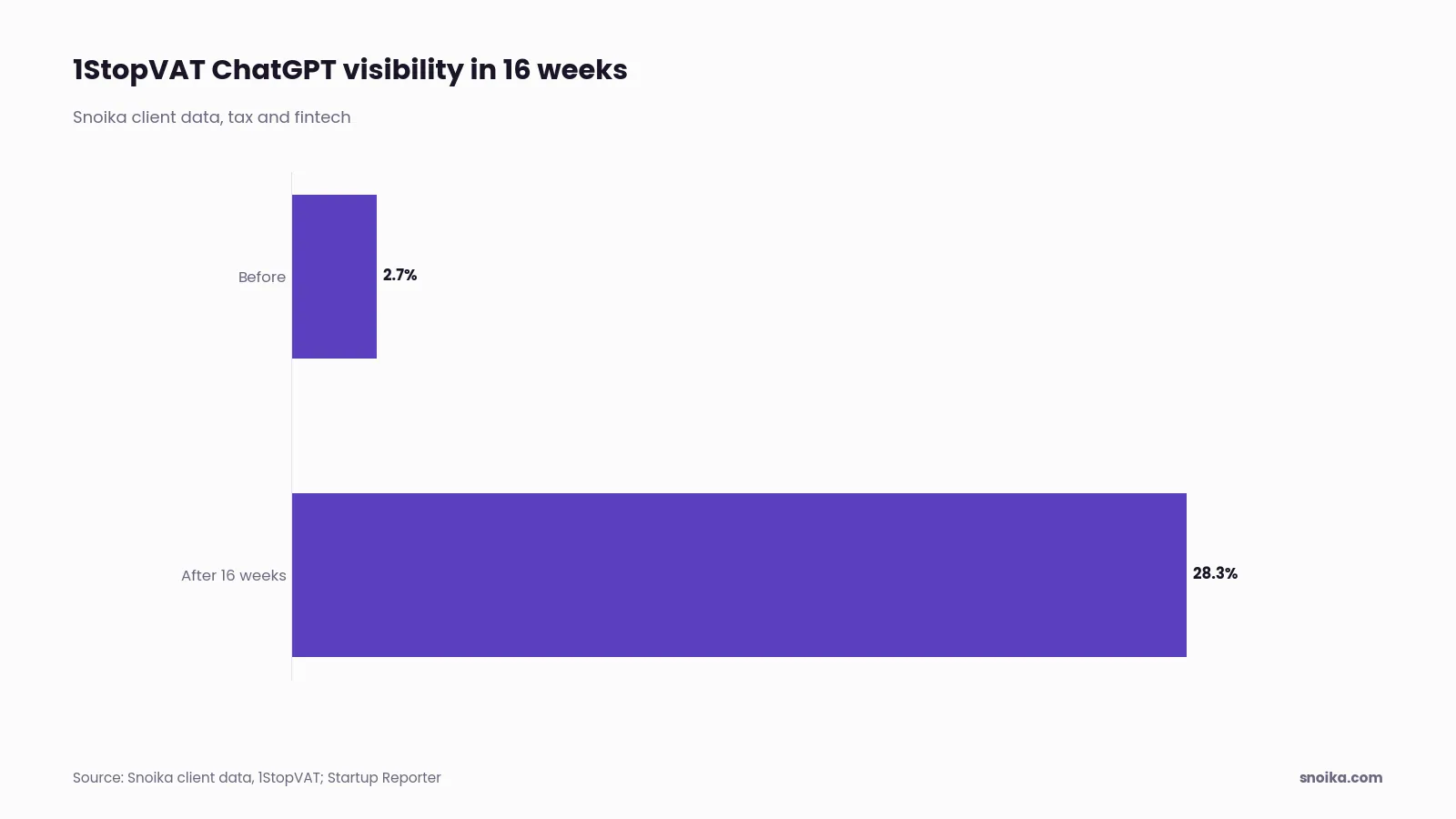
Share of recommendations is the percentage of relevant prompts where an AI assistant names your brand. It's the metric that maps most closely to shortlists. We track it weekly for each market, with sentiment beside it, because a mention that frames you as the budget option shapes the deal. Snoika's founder Anton Vedeshin reported to Startup Reporter 1StopVAT's move from 2.7% to 28.3% ChatGPT visibility in 16 weeks.
You can run the tracking through our self-serve plans from €124 per week or have us do the work for you. Enterprise plans include custom integrations and API access, arranged on a call with our team.
FAQ
Snoika helps a b2b scaleup answer specific buyer questions on its own pages and earn mentions in the third-party sources the models trust. We first test whether assistants can name your category and main use case, then fill the gaps with factual pages.
We test one template per page type in a single market and check indexing and impressions before rolling it out. Each page gets distinct local facts, such as country rules or integrations, and answers a buyer question no other page covers.
Snoika tracks mentions, share of voice, sentiment and citations in ChatGPT and Google AI Overviews with weekly prompt sets for each category and market. It also writes and publishes the content that closes the gaps it finds.
We use one consistent page structure that answers each market's buyer questions directly. Product facts and pricing logic stay the same, while terminology, examples, local currency and regulation adapt to each market.
See how AI talks about your brand