
AI citation tracking for your brand
An AI citation tracker shows you which web pages ChatGPT and Google AI Overviews link to when your buyers ask about your category, along with who owns each page. We record those URLs for every prompt we track and update them each week. You can see where AI cites your brand and where it cites a rival instead. Start with a free audit, which needs no access to your systems and returns results in about two hours, so you have a baseline before you change anything.
Trusted by

























See which sources AI cites
Every answer we track in ChatGPT and Google AI Overviews stores the URLs it cited. You can open any prompt and see the exact pages behind the answer. We tag each URL by owner, because the owner tells you what to do next.
| Cited URL owner | What it tells you | What to check |
|---|---|---|
| Your domain | AI trusts this page | Is it the right page? |
| Competitor | A rival holds the answer | Which page type wins |
| Third party | AI wants outside proof | Does it mention you? |
Answers change with the wording of a prompt. So we read citations one prompt at a time before drawing conclusions about the whole category.
Monitor your own cited pages
Our tracking shows which of your pages ChatGPT cites and which it skips for each prompt in your category. Most brands find the cited page is a different one from the page they would have picked.
Which pages ChatGPT cites
Each prompt lists the URLs from your domain that the answer linked. An old blog post sometimes wins over the product page you built for that exact question, which tells you the model found a clear, quotable answer in the post and couldn't find one on the product page.
We check whether the cited page still says what you want buyers to read. If it doesn't, we update it before writing anything new.
Pages that lose citations
A page that's cited one week and gone the next has lost to a fresher source. We compare the dates: did a competitor publish a comparison page, or did a review site update its list? If neither happened, the platform probably changed how it picks sources, and we watch the page for two or three more weeks before rewriting it.
Track competitor citation wins
To find out which competitors win AI citations, we track the same prompts for them that we track for you and count whose URLs appear. Every prompt records competitor URLs next to yours, so the comparison is built into the same report.
We look at the page types that win as well as the brands. A rival owns the answers about pricing with one clear pricing page, while you win the answers about features. And a competitor that leads in ChatGPT can be missing from Google AI Overviews, and those platform differences are where you can gain ground fastest.
Sources your buyers actually see
AI assistants cite forums, video platforms and editorial sites in place of your brand. A Search Engine Land report on an analysis of 30 million AI sources found Reddit was the most-cited source across the major assistants. YouTube and LinkedIn were also in the top five.
Your category's list will differ from that study: a B2B software buyer sees review platforms, while a consumer buyer sees forum threads. For each third-party page that shows up in your prompts, we check two things:
- Mention. Is your brand mentioned on it at all?
- Accuracy. If it is, does it describe you correctly?
Gap analysis across AI platforms
We monitor ChatGPT and Google AI Overviews first, because that's where most AI search traffic happens. Sam Altman, CEO of OpenAI, said in October 2025 that ChatGPT had reached 800 million weekly users. Google AI Overviews appear above ordinary search results, where your buyers already look.
We run a gap analysis in four steps:
Pick the prompts
We write the questions a buyer asks before they shortlist a supplier.
Compare the platforms
Each prompt is checked in both assistants, noting who gets cited in each.
Mark the gaps
We flag every prompt where a rival or a third party is cited and you aren't.
Rank by intent
The gaps closest to a buying decision get fixed first.
Citation data for content strategy
Citation data tells you what to publish because it shows which topics AI answers without you. Topics where you go uncited move into your content map as new pages or as updates to existing ones. Each gap is tied to the prompt that exposed it.
The new pages go live on your own domain through a DNS connection, with no migration and on any content management system (CMS). You review and approve every page in the dashboard before it goes live. After a page is published, its prompt stays in the weekly set, so you'll see whether AI starts to cite it.
Your share of AI answers
Citation share is the percentage of tracked answers that cite your domain. We measure it with prompt sets that run every week, alongside mentions, share of voice and sentiment, because a single snapshot can't tell a trend from noise.
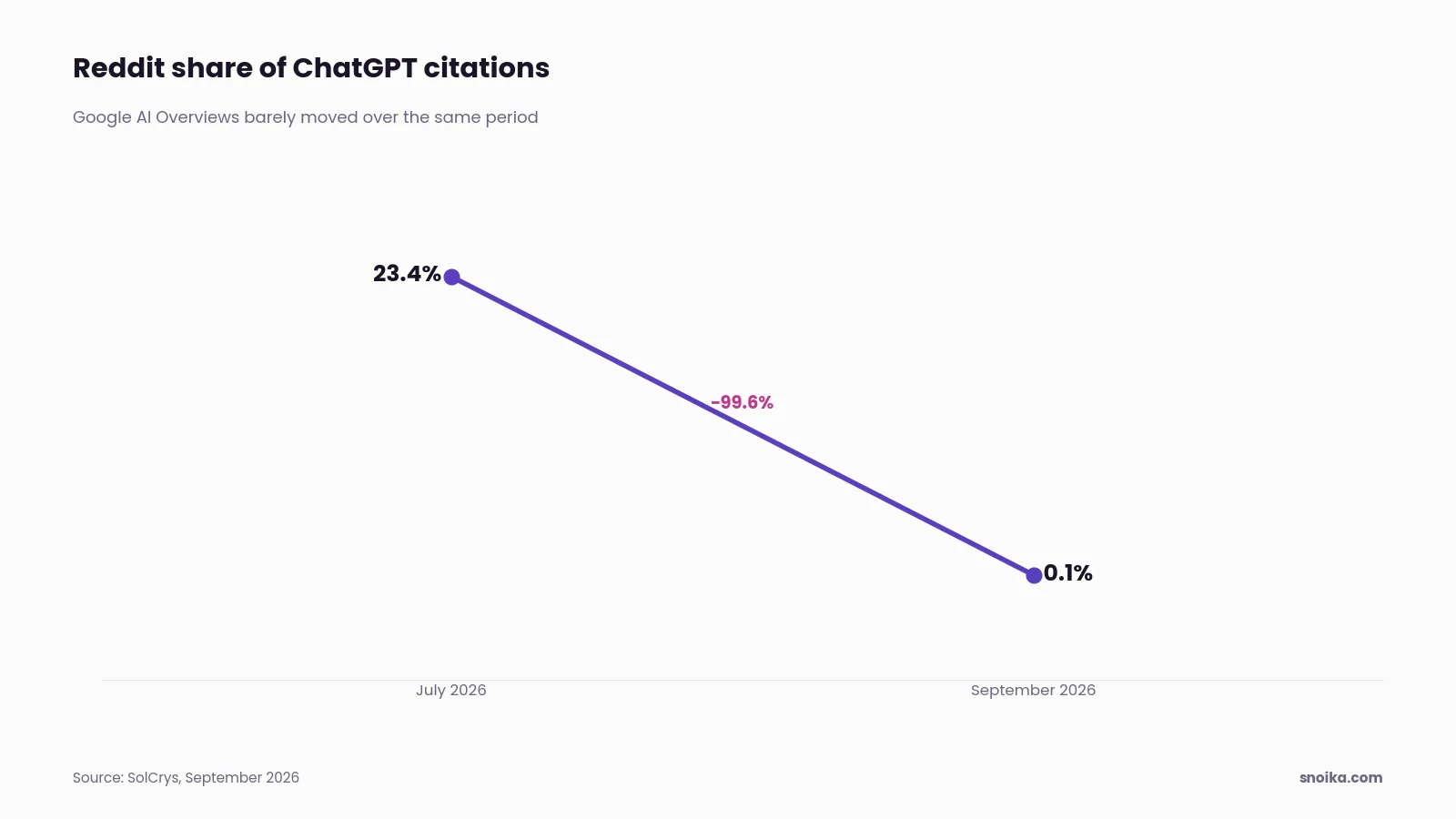
A SolCrys study found Reddit's share of ChatGPT citations fell from 23.4% to 0.1% between July and September 2026, while Google AI Overviews barely moved over the same period. Weekly data lets you spot a platform change like that before you blame your own content, and it shows when your work is paying off. 1StopVAT, in tax and fintech, saw 10x growth in ChatGPT visibility in 7 weeks.
When rivals get cited
When a rival gets cited from a page you don't control, the fix is off your site. We turn those off-site gaps into visibility strategies in the app, one for each source type:
Threads where buyers compare options in your category.
Quora
Answers that AI picks up for definition and "best option" questions.
Posts and articles that B2B answers cite.
YouTube
Videos whose transcripts and descriptions get quoted.
Trustpilot
Reviews that support recommendation answers.
Backlinks
Editorial links from sites the assistants already trust.
Wikidata
Structured facts about your brand that models can check.
We start with the source type that appears in the greatest number of prompts you lose, and we compare both platforms on the same day, because citations shift from week to week.
FAQ
Each prompt Snoika tracks lists the exact URLs from your domain that ChatGPT cited. When an older post is the cited page, we often update it before writing anything new.
Your tracked prompts show which third-party pages appear instead of your domain, and the mix varies by category. We check whether each cited page mentions your brand and whether it describes you accurately.
We track the same buyer prompts for your competitors as for you and count whose URLs appear, per platform. We also look at which page types win before deciding what to update.
We monitor ChatGPT and Google AI Overviews first, with the same buyer prompts on both, compared on the same day every week. A consistent prompt set shows whether a gap is specific to one platform.
Citation share is the percentage of tracked answers that cite your domain, so two of ten answers means 20%. Snoika measures it across weekly prompt sets, so the figure reflects your tracked questions rather than every category search.