Generative Engine Optimization: What Changes When AI Answers Before the Click

Content authorArtem Lozinsky, EMBA, MScPublished onReading time10 min read
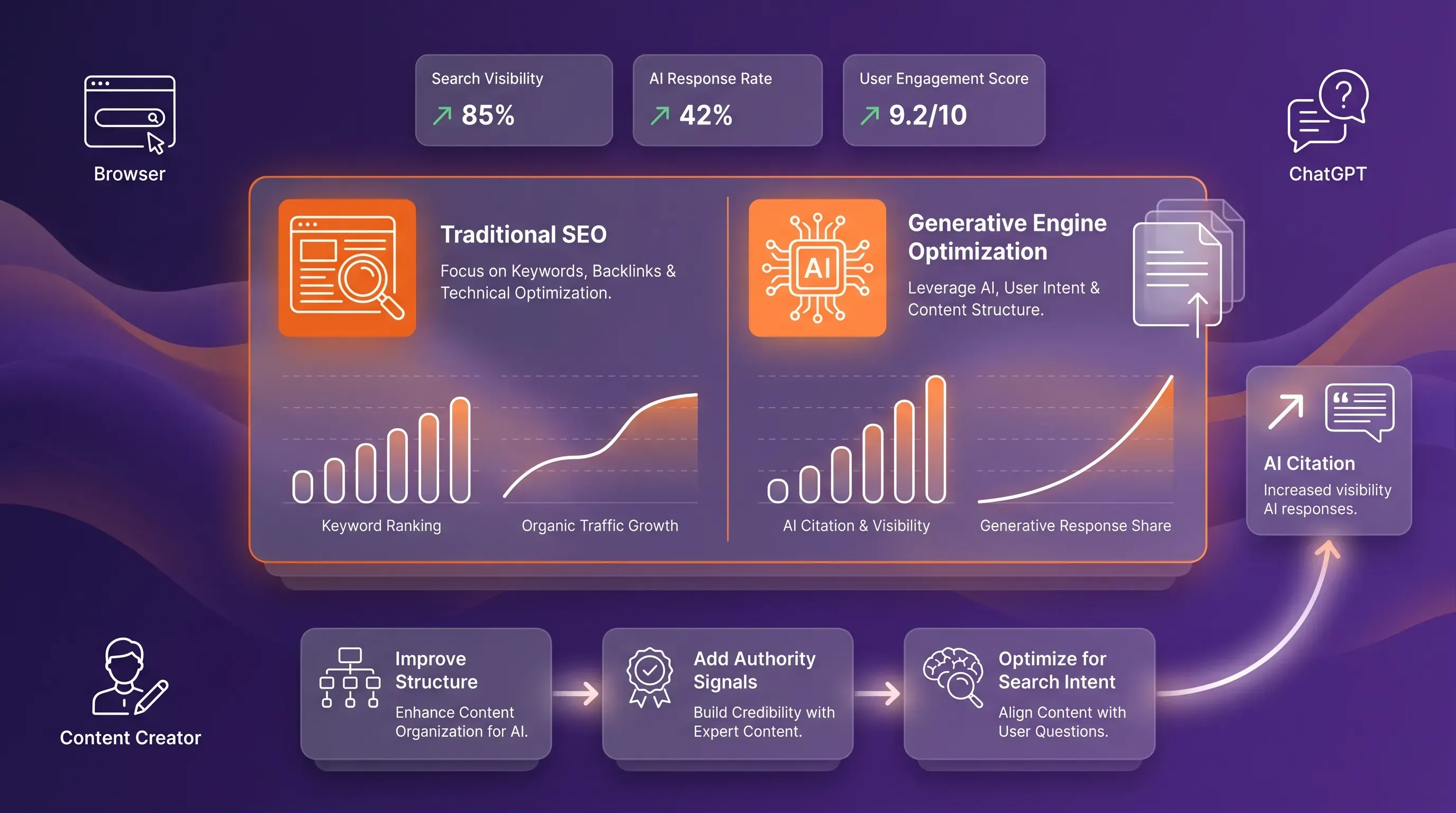
A vibrant SaaS dashboard comparing 'Traditional SEO' and 'Generative Engine Optimization' with layered cards and charts on a purple gradient background.

This article explains what generative engine optimization is and how it differs from the SEO you already run, with concrete tactics for earning visibility inside AI-generated answers. It skips the basics and focuses on the line between what changes and what carries over.

Why your traffic is leaking

Generative engine optimization matters now because your rankings can hold steady while your clicks quietly drain away. You open Search Console to a flat impressions line, while the click-through rate keeps drifting down month over month. Nothing in the old playbook explains it, because the old playbook assumed a ranking earns a click and left the AI answer layer unaccounted for.

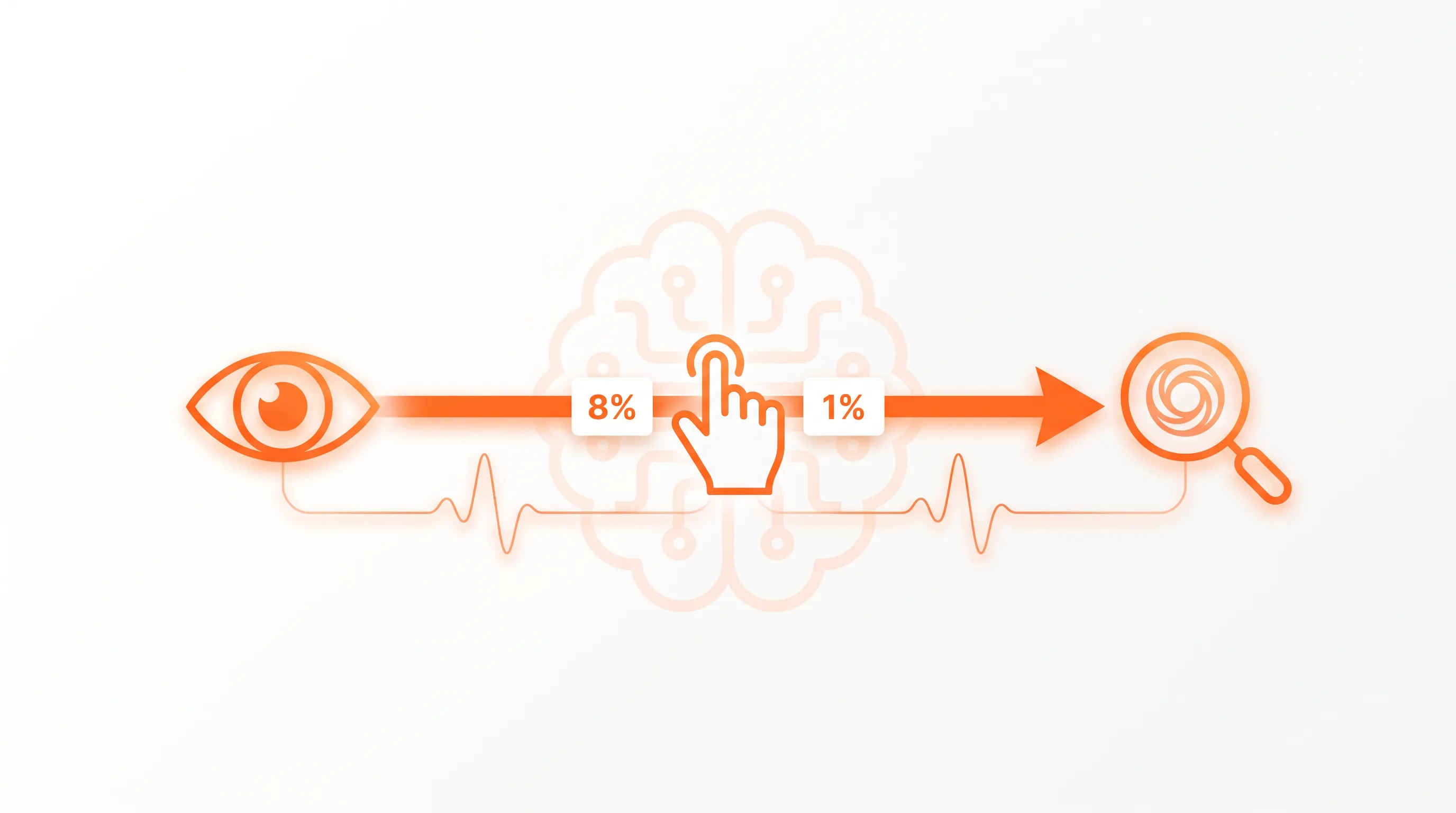
That assumption broke when Google started answering queries on the results page itself. A December 2024 analysis of 300,000 keywords by Ahrefs found position-one CTR fell from 3.7% to 1.6% when an AI Overview appears. Pew Research tracked the behavior directly. In a study of 900 U.S. adults sharing real browsing data, users who saw an AI summary clicked a traditional result only 8% of the time, against 15% when no summary appeared.

The answer box is satisfying the query before anyone reaches your page. Google is part of a larger shift: ChatGPT reached 800 million weekly active users by October 2025, which means a growing share of the questions your content used to catch are now being asked inside a chat window you never see.

So the work is to be the source the answer is built from. The rest of this piece shows how that process works and what to change on your highest-value pages first.

What generative engine optimization means

Generative engine optimization (GEO) is the practice of structuring your content so AI systems cite it and pull it into the answers they generate. You already optimize to rank a blue link. GEO optimizes to be the source behind the synthesized response, whether that response shows up in a Google AI Overview or a ChatGPT reply.

The term comes from a 2024 ACM SIGKDD paper by researchers at Princeton and IIT Delhi with the Allen Institute for AI, who built a benchmark and ran controlled experiments on what moves AI citation rates. That research gives the discipline its name and a measurable definition.

Here's what carries over from the SEO you already run. Crawlability still matters, because an engine can't cite a page it can't read. Authority still matters. Matching the real question behind a query still matters, more than ever. What's genuinely new is the unit of competition. You're no longer fighting for a rank position on a list. You're competing to have a specific passage extracted and attributed inside a generated paragraph.

The surfaces where this plays out are concrete:

  • Google AI Overviews and AI Mode, which sit above the traditional results.

  • Chat assistants like ChatGPT and Claude, where the user never sees a SERP at all.

  • Answer engines like Perplexity, which generate a response and footnote their sources.

All of this sits on top of your existing work. The pages that already earn trust in Google are your best raw material for earning citations in AI answers, which is why GEO is an evolution to manage.

Need help with your AI visibility?

Book a free consultation with our experts we'll help you determine exactly which services your organization needs.

How AI engines pick answers

You already know how crawling and indexing work, so go one level deeper. Most generative answers are built through retrieval-augmented generation (RAG). The system breaks your content into chunks of 200 to 1,000 tokens each. After each chunk becomes a vector embedding that captures its meaning, the system retrieves the chunks most relevant to a query and feeds them to the model to write the answer.

That detail changes everything about how you write. The engine retrieves a passage. If the answer to a question lives in fragments scattered across four paragraphs, separated by context the model has to stitch together, your chunk competes poorly against a source that states the answer cleanly in one place. The retrieval step rewards self-contained passages that make sense on their own.

Authority enters at the synthesis step, when the model decides which retrieved sources to name. NVIDIA describes RAG as giving models sources they can cite, like footnotes in a research paper, so users can check the claims. The model is choosing whom to credit, and it leans toward sources that read as trustworthy. A Semrush study of 230,000 prompts across ChatGPT and Perplexity found Reddit and Wikipedia among the most-cited domains, which tells you these systems weight perceived authority and authentic input heavily.

So the mechanics behind every tactic that follows reduce to two questions. Can the engine retrieve a clean, extractable answer from your page? And does your page carry enough authority that the model is willing to put your name next to the claim? Hold those two questions in mind, because every tactic below answers one of the retrieval mechanics.

Tactics for generative engine optimization

The tactics that move citation rates are familiar SEO edits with a new retrieval purpose. The same Princeton experiment found that statistics and expert quotations boosted AI visibility by up to 40% compared with unoptimized content. What follows breaks that into three moves you can apply to pages you already own. They build on your SEO workflow, so treat them as edits to existing content.

Match search intent optimization

Search intent optimization is the practice of aligning a page to the underlying question a query represents, and it's the single biggest lever for getting pulled into an AI answer. Engines retrieve passages that resolve the user's actual question, so a page that answers the literal keyword but misses the intent behind it gets passed over.

Start by reading the query as a question you need to resolve. "Best CRM for small business" is a request for a comparison that weighs price and the setup trade-offs a small team faces. Search intent optimization means you write the passage that directly resolves that question before you do anything else on the page.

The change is visible in a before-and-after. A page opening with "Our CRM platform delivers powerful tools for growing teams" answers nothing and gets retrieved for nothing. Rewrite the opening to "The best CRM for a small business depends on team size and budget. For teams under ten people, tools priced under $25 per seat with no setup fee cover most needs," and you've handed the engine an extractable answer. Good search intent optimization puts the quotable sentence first on the page.

Need help with your AI visibility?

Book a free consultation with our experts we'll help you determine exactly which services your organization needs.

Structure content for extraction

Given how RAG chunks and retrieves, formatting is no longer cosmetic. It decides whether a clean answer can be lifted from your page at all. The goal is to write passages that stand on their own when the surrounding context is missing.

Apply these structural choices to your highest-value pages:

  1. Lead each section with the direct answer in the first sentence, then add context and nuance underneath. The model retrieves the answer-first sentence and reads the rest as support.

  2. Write descriptive headings phrased as the question a user would ask, so the heading itself signals what the chunk resolves.

  3. Use short, self-contained definitions for any term a query might target, written so the definition makes sense lifted out of the page.

  4. Break comparisons and steps into lists, because a discrete list item is easier to retrieve cleanly than the same information dissolved into a paragraph.

Each choice ties back to the retrieval mechanics. A chunk of 200 to 400 words that delivers one complete idea competes far better than a sprawling section the model has to fragment and guess at. You're engineering passages that survive being pulled out of context, because that's exactly what the engine does to them.

Build citable authority signals

At the synthesis step, the model decides which sources to name, and authority is what tips that decision. This is where original data earns its keep. A page that states "organic CTR fell sharply" is paraphrasable without credit. A page that reports its own measured figure, with a clear method behind it, gives the model a specific claim it has to attribute to you.

Authority matters more here because attribution is a choice the engine makes. Named sources and visible sourcing all raise the odds your page is the one cited. The Princeton team measured this directly. Embedding expert quotations and adding clear statistics were among the strongest single moves they tested.

Two practical ways to add these signals to pages you already have:

  • Replace vague claims with a number and its source to clarify what was previously vague. "Many users abandon slow pages" becomes a cited statistic with a date and a study behind it, which gives the model something attributable.

  • Add a named expert quote where you currently assert something in your own voice. A line attributed to a person with a title and a reason to be trusted is more citable than the same point stated anonymously.

These edits cost an afternoon per page and they target the exact moment the engine is choosing whose name to print.

How to measure results

When clicks stop being the whole story, you need signals that capture influence the click never recorded. The honest starting point is that attribution in this space is incomplete, and pretending otherwise will only frustrate you. Free-tier ChatGPT users don't pass referrer data, so their visits land in your analytics as "Direct," indistinguishable from a bookmark. Build your measurement around that gap.

Three signals are worth tracking now:

  • AI citations. Monitor whether ChatGPT and Google AI Overviews name your content for the questions that matter to your business. Start with 20 to 30 high-intent prompts that map to your core topics.

  • AI referral traffic. In GA4, set up a custom channel group with regex filters that isolate sources like chatgpt.com and perplexity.ai. This won't catch everything, but it shows you the traffic that does carry a referrer and which pages it lands on.

  • Branded search lift and assisted visibility. When people encounter your name inside an AI answer and search for you afterward, that lift in branded queries is a lagging fingerprint of citations you couldn't otherwise see.

Set expectations accordingly. AI referral traffic still runs roughly 0.5% to 3% of total traffic for most sites, so don't judge the work by referral volume alone. Treat citations and branded lift as the leading indicators and referral clicks as a slow-moving confirmation that arrives later.

Where to start this week

Don't rebuild your site. Pick your highest-value existing pages, the ones already earning trust in Google, and treat them as your first candidates because they're your strongest raw material for citations. Work in order of effort against payoff.

Start with one page. Rewrite its opening so the direct answer comes first, with one cited statistic and one named quote in support, then break the key comparison into a list. That's an afternoon, and it touches retrieval and authority at once. The shift behind all of this is real but manageable. Gartner expects traditional search volume to drop 25% by 2026 as answer engines absorb queries, which is reason to act. Generative engine optimization is the calm, practical response to that change, and you can begin with a single page today.

Need help with your AI visibility?

Book a free consultation with our experts we'll help you determine exactly which services your organization needs.

Plan GEO by starting with pages that already have search value, then improve them with clear answers, structured sections, cited data, and expert signals. Since AI visibility still lacks fixed rules, track cited answers, referral traffic, and branded search to compare progress over time.

Check AI citations at least once a month for the prompts tied to revenue or qualified leads. Use the same prompt list each time, record the answer source, and note whether your page appears, gets cited, or is absent. This creates a trend you can act on.

Yes, older blog posts are often good GEO candidates if they already rank or attract backlinks. Start by adding answer-first paragraphs, current sources, and named quotes where claims need support. Then refresh headings so each section answers one specific user question.

No, you don’t need separate pages for each AI answer surface. A well-structured page with clear answers, reliable sourcing, and crawlable content can serve both search engines and chat-based tools. Build around the question the user asks, then make the answer easy to extract.

Report GEO progress with citation presence, prompt coverage, AI referral sessions, and branded search changes. Explain that referral traffic can undercount AI influence because chat tools don’t always pass source data. The client should see GEO as visibility tracking plus page improvement, not a click-only report.

Schedule a Meeting

Book a time that works best for you

You Might Also Like

Discover more insights and articles

A modern SaaS dashboard featuring a central 'LLM SEO Framework' card surrounded by four pillar cards, all on a deep purple gradient background.

LLM seo: a practical framework for AI visibility

This article gives you a vendor-neutral framework for LLM SEO, the practice of getting your brand cited inside AI-generated answers and included when those answers discuss your category. It explains source selection and measurement, with the carryover from your existing program built into the signal framework.

A luminous SaaS marketing illustration with a central UI card labeled 'AI Answer Engine Citations' surrounded by seven floating cards.

How to Improve Your AI Visibility and Get Cited by Answer Engines

This article explains the undefined mechanics of how AI answer engines decide which sources to name and link, then walks through the concrete moves that raise your odds of being cited. It treats AI visibility as its own discipline next to the SEO you already run and shows where the two overlap before ending with what to audit and how to measure progress.

A luminous SaaS dashboard with a deep purple gradient, featuring a central audit card and three overlapping cards with icons and charts.

Lighthouse agentic browsing: Google’s New AI Agent Readiness Audit Explained

This article explains the new Agentic Browsing category in Lighthouse: its checks and the workflow from running the audit to reading its unusual pass-ratio output. It connects each signal to how autonomous browsing agents behave, so you can decide where to spend your effort first.

A hero office desk scene with textured papers, matte stationery, and scattered items under warm natural light, showcasing organized chaos.

Market leader for 3d printing software: Cloud Fleet Management Alternatives

In this article, we examine the differences between consumer-grade slicing tools and enterprise-grade platforms to help organizations scale their additive manufacturing operations. We explain why scaling a print fleet requires hardware-agnostic management systems rather than single-brand solutions.