
Programmatic SEO tool for scaled page sets
Our Visibility Booster takes a spreadsheet of locations or categories and turns it into pages that rank in Google and get quoted by AI assistants. It also works with keyword pairs. The test that matters for any programmatic SEO tool is whether quality holds up once you have hundreds of pages, and our process is built around passing it. We suggest you bring one dataset to onboarding and judge the first pages yourself.
Trusted by

























Generate pages from structured data
Visibility Booster builds 200 to 500+ programmatic pages from your structured data, with one page per location or category. Keyword combinations also get their own pages. Each row in your sheet becomes a URL with its own heading and copy. Pages can be static, built once and served as plain HTML, or dynamic, filled from your data when someone requests them, and both kinds deploy on almost any stack.
Merging rows into a template is the easy part, and the real work happens between the sheet and the live URL. Our team handles the SEO content writing and checks the copy that changes from row to row. The pages go live on your own domain through a DNS connection.
What programmatic SEO does
Programmatic SEO publishes one template many times, with each copy filled from a different row of data, so you can target search queries that follow a repeating pattern. A query like "accountant in Leeds" has thousands of siblings, and no team can write all of them by hand. Zapier is the standard programmatic SEO example. Practical Programmatic estimates that its app pages bring in 2.6 million monthly organic visits.
The method only works when the pattern repeats and the data really differs from page to page. Swap a city name into identical copy and you get 300 near-duplicates. Before we build anything, we check that each row holds at least one fact a searcher would miss if the page didn't exist.
Quality rules at scale
The two controls for quality at scale are real differences between pages and a person who can stop a page before it goes live. Google drew the line in March 2024. It defines scaled content abuse as a case where many pages are generated "for the primary purpose of manipulating Search rankings and not helping users." The policy covers pages made by humans as well as by automation.
What makes each page different
Each page needs data that changes the answer. On a location page that means local prices, coverage or regulations. On a category page it means the products in that category, with their specs or use cases. When your columns can't fill a page with distinct facts, we merge those rows into one stronger page.
Who approves a page before it goes live
Our team adds a human review layer on top of the AI content generator workflow. You also approve every page in the dashboard before it's published. Drafts sit in a review queue, so a sheet upload never publishes straight to your site.
Location pages that rank
Location pages rank when every page answers a local question that the next city's page can't. A page for Munich needs Munich facts, in the language a Munich buyer searches in. We handle AI content creation in 135+ languages and regional variants, which matters when your locations cross borders.
Indexing is the first hurdle, because Google skips pages it reads as interchangeable. We check the Search Console coverage report 2 weeks after launch. Pages marked "crawled, currently not indexed" tell us the template needs more local substance.
Use-case pages that convert
Use-case pages convert when they show one buyer, such as a role or an industry, how the product solves their specific job. A page for "e-signature for HR teams" has to show HR documents and HR approval chains. Generic feature copy with a new heading doesn't do that.
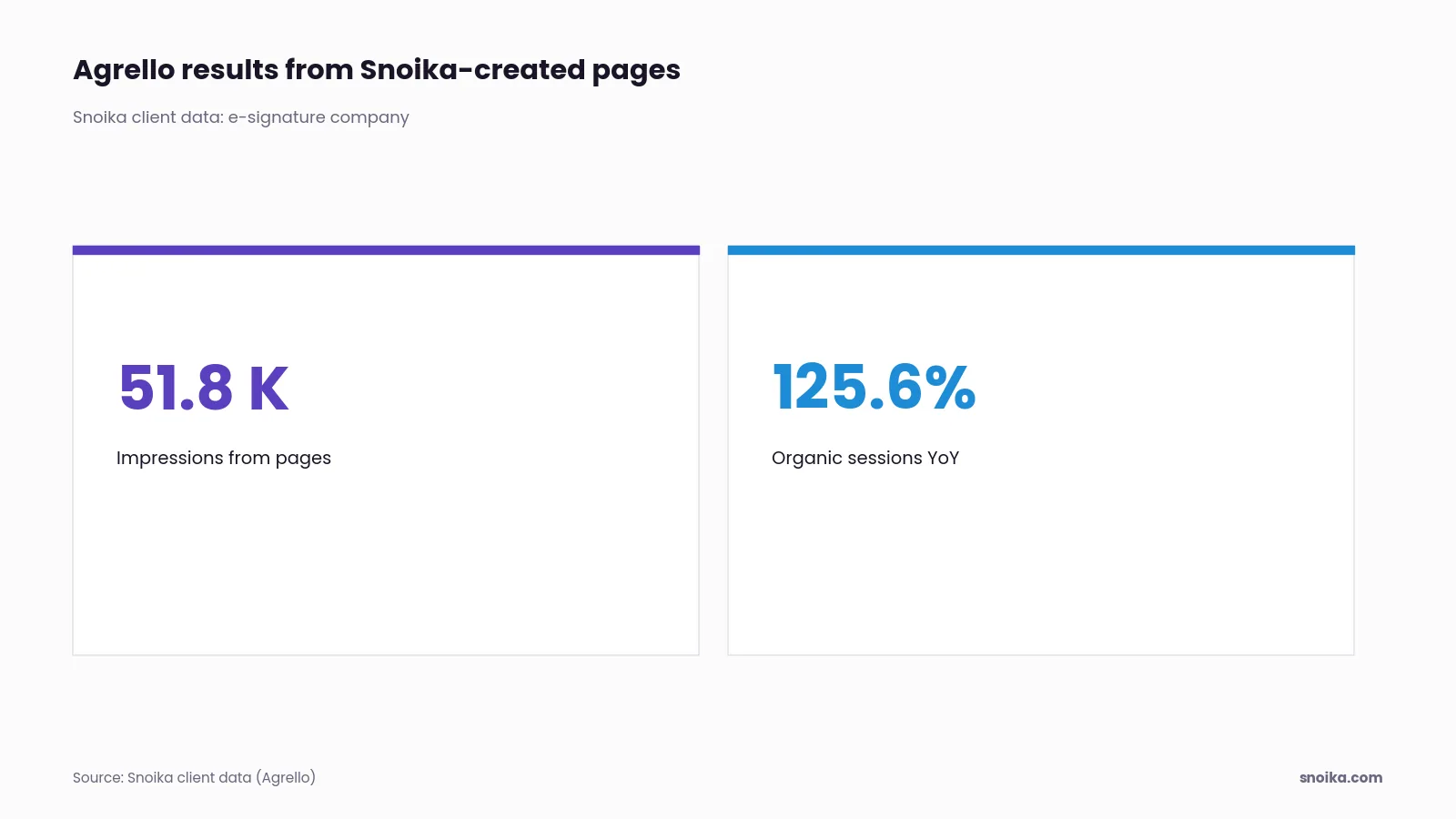
Agrello, an e-signature company, generated 51.8K impressions from Snoika-created pages and recorded +125.6% organic search sessions YoY. Impressions are only the first half of the job, though, so we only build a use-case page when your sales team can show a customer, or at least a credible workflow, for that segment.
Comparison pages built automatically
Comparison pages at scale work from an attribute table with one row per competitor and one column per criterion. We treat "X vs Y" pages as keyword combinations inside Visibility Booster, so they come from the same data pipeline as every other page type.
Comparison pages fail when the data goes stale, and a wrong figure on a "vs" page costs you more trust than having no page. So we date every competitor figure and schedule a refresh. We also present your own product on the same criteria as the others, because readers and AI assistants both discount pages that can't admit a weakness.
AI citation built in
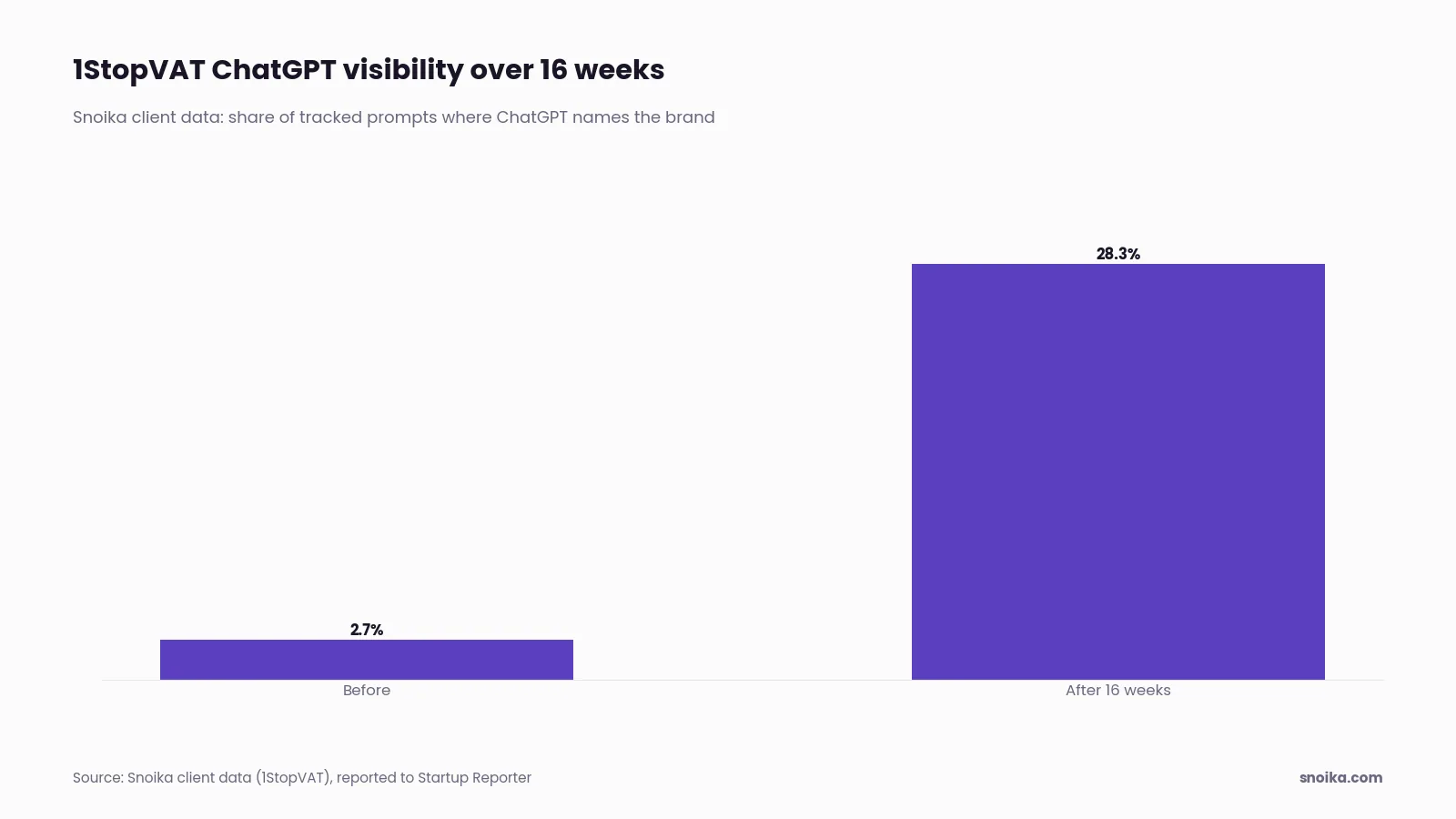
Every page set we build is measured in AI assistants as well as in Google. Weekly prompt sets track mentions, share of voice, sentiment and citations in ChatGPT and Google AI Overviews, which is where most AI search traffic happens. Snoika's founder Anton Vedeshin reported to Startup Reporter 1StopVAT's move from 2.7% to 28.3% ChatGPT visibility in 16 weeks.
Assistants cite pages that state facts plainly and can be checked. Rankings alone wouldn't tell you whether your 400 new pages ever reach an AI answer.
How data feeds the engine
You automate page creation from structured data through a content automation platform, connecting a clean dataset to a template and adding a review step before anything goes live.
Onboarding
We learn about your category, your buyers and your goals, and we set up access to Google Analytics 4 (GA4), Google Search Console, Google Tag Manager and, when we publish pages, your content management system (CMS).
Dataset
You supply one row per page. Each column holds a fact that changes the content.
Template with content map
We match the template to the queries the research found.
Review
Drafts wait in the dashboard until you approve them.
Publishing
Pages go live on your own domain through a DNS connection. Your CMS stays as it is and nothing gets migrated.
Who it suits
Our service suits B2B teams without in-house SEO staff who need AI visibility tracked. A team runs the work, with human review and your approval, and AI citation tracking is included. Plans are on the pricing page.
We suggest a pilot on one page type with clean data behind it, say 200 location rows or 50 use cases, before you commit to the full set. One pilot shows whether the pages get indexed and cited, which tells you more than any programmatic SEO tool feature list.
FAQ
Snoika's Visibility Booster turns a spreadsheet into 200 to 500+ location, category or keyword-pair pages on your own domain. Our team reviews the copy that changes from row to row, and each row needs real local facts rather than a city-name swap.
We build "X vs Y" pages as keyword combinations inside Visibility Booster, from an attribute table with one row per competitor and the same criteria for each. We date competitor figures and schedule refreshes so comparisons don't go stale.
The best fit depends on who can manage the work. A self-serve generator suits teams with an SEO lead and a writer, while our managed service with human review suits B2B teams without in-house SEO staff.
We connect a dataset with one row per page to a template and hold drafts in the dashboard for your approval. Rows that can't support distinct content get merged, and approved pages go live on your own domain through a DNS connection.