
SEO audit services with fixes done for you
Our SEO audit services find the technical problems that keep your pages out of Google and out of AI assistants. Then we fix them on your site and test each change after release. You also see the results tracked against where you started. Our search engine optimization (SEO) audits end with the changes live, not with a report waiting for developer time.
Trusted by

























Audit plus fixes together
At Snoika, we hand over a prioritized fix list, or we make the fixes ourselves once we have access. Automated SEO audit tools and audit-only consultants stop at the report, and when nobody acts on a report it returns nothing. If you only need one diagnosis and your developers have time to act on it, a one-off SEO audit may be all you need.
We're built for teams without free developer time who want visibility measured after the fixes. Snoika combines SEO with Generative Engine Optimization (GEO) and Answer Engine Optimization (AEO) in one platform. The team that audits your site also runs the platform, with a human review layer on top of automated workflows.
What the audit covers
A full technical SEO audit covers every layer a crawler touches. It checks server response codes and the reason Google Search Console gives for each page it won't index. Ours adds AI crawler access, and we group the checks the way your fixes will be grouped.
Crawl access
These checks decide whether search engines can find and keep your pages.
- Response codes, redirects and redirect chains
- Robots.txt and robots directives
- Canonicals and pagination
- XML sitemaps
- Every Search Console indexing reason
- Server logs
Page structure
Once a page is crawled, these checks decide how well it's understood.
- URL structure
- Titles and meta descriptions
- Headings
- Duplicate and thin content
- Keyword cannibalization
- Internal links and orphan pages
- Hreflang for language versions
- Structured data
Performance checks
These checks cover speed and rendering. They also assess whether your data can be trusted.
- Core Web Vitals and speed
- Mobile and accessibility
- JavaScript rendering and images
- HTTPS and security headers
- HTML validity
- Google Analytics 4 (GA4) and Google Tag Manager tracking
- Backlink profile
- AI crawler access and llms.txt
We weight the checks to your site. Hreflang checks are unnecessary for a 40-page brochure site with one language, while an ecommerce catalog with faceted navigation needs most of its audit devoted to canonicals and crawl waste. Our technical SEO checklist includes the server logs and indexing reasons that cheap audits skip.
How fixes get implemented
We fix issues in order of impact and test each change on staging where your setup allows it. We check each change again after release. The order matters because one bad redirect rule can undo weeks of good work.
Rank by impact
Anything that blocks crawling or indexing goes first. Cosmetic warnings go last or get dropped.
Batch by system
CMS edits go out separately from template code. Server rules get their own batch too, so a problem traces back to one change.
Test on staging
We check redirects for loops and canonicals for wrong targets before anything reaches production.
Release, then recheck
After launch we crawl the affected URLs again and compare them with the audit.
Some fixes require us to rewrite a thin page or fill a content gap that your competitors already cover. Those pages go live on your own domain through a DNS connection, with no migration and on any CMS. You approve each page in the dashboard before it's published.
AI crawler visibility audited too
Yes, our audit checks whether AI crawlers can reach and read your site, which a standard technical audit leaves out. AI assistants can only cite pages their crawlers can fetch, and four settings decide that.
Rules per AI bot
A single blanket disallow in robots.txt written years ago can shut out the bots behind ChatGPT, so we check the rules for each AI bot.
Firewall blocks
Cloudflare introduced default blocks for AI crawlers on July 1, 2025, and it manages traffic for 20% of the web. A site can be open in robots.txt and still closed at the firewall.
JavaScript rendering
Vercel's analysis of real crawler traffic found that ChatGPT's crawler fetched JavaScript files in 11.50% of requests without running them, and concluded that "none of the major AI crawlers currently render JavaScript." If your product details load client-side, those bots see an empty page.
llms.txt
We check that llms.txt, a proposed file that points language models to your key pages, exists and lists the right URLs.
Why audits without fixes stall
Audits stall because their recommendations land in a developer backlog that's already full of product work. In a poll by SEO consultant Kristina Azarenko, 56% of SEOs said fewer than 40% of their recommendations get implemented. Barry Schwartz, executive editor of Search Engine Roundtable, reported the result and added: "Often, a lot of what they recommended does not get implemented because of issues outside of their control."
Tickets go unowned, they say "fix canonicals" without naming the template or the exact tag, and when a fix does ship, nobody checks it, so the next release quietly brings the error back. That's why we own the changes ourselves and recheck every fix after release.
What we need from you
To fix SEO issues, we need edit access to every system where those issues live. On the first call we learn about your category, your buyers and your goals, so the fixes go after the pages that bring in customers. Onboarding starts with GA4, Search Console and Tag Manager access, plus CMS access when we'll publish pages, and the rest comes in when the fixes reach that layer.
| Access | Level | What we fix |
|---|---|---|
| CMS | Admin | Titles, headings, internal links, content |
| Code repository, or your developer | Plus a staging site | Templates, rendering, structured data |
| Hosting or server settings | Edit | Redirects, response codes, security headers |
| CDN or firewall rules | Edit | AI crawler blocks, caching |
| DNS | Edit | HTTPS, publishing pages on your domain |
Site systems
Data accounts
Server logs and old redirect maps take the longest to find, and the audit can't fully check crawling without them. If your developer would rather keep the repository closed, that works: we send exact changes for them to ship, then check the result.
Results you can measure
After the fixes go live, we track indexing, Core Web Vitals, crawl errors and AI visibility in the Snoika app, so you can compare each change with its baseline. We measure AI visibility in ChatGPT and Google AI Overviews with weekly prompt sets that track mentions, share of voice, sentiment and citations. Plans are on the pricing page.
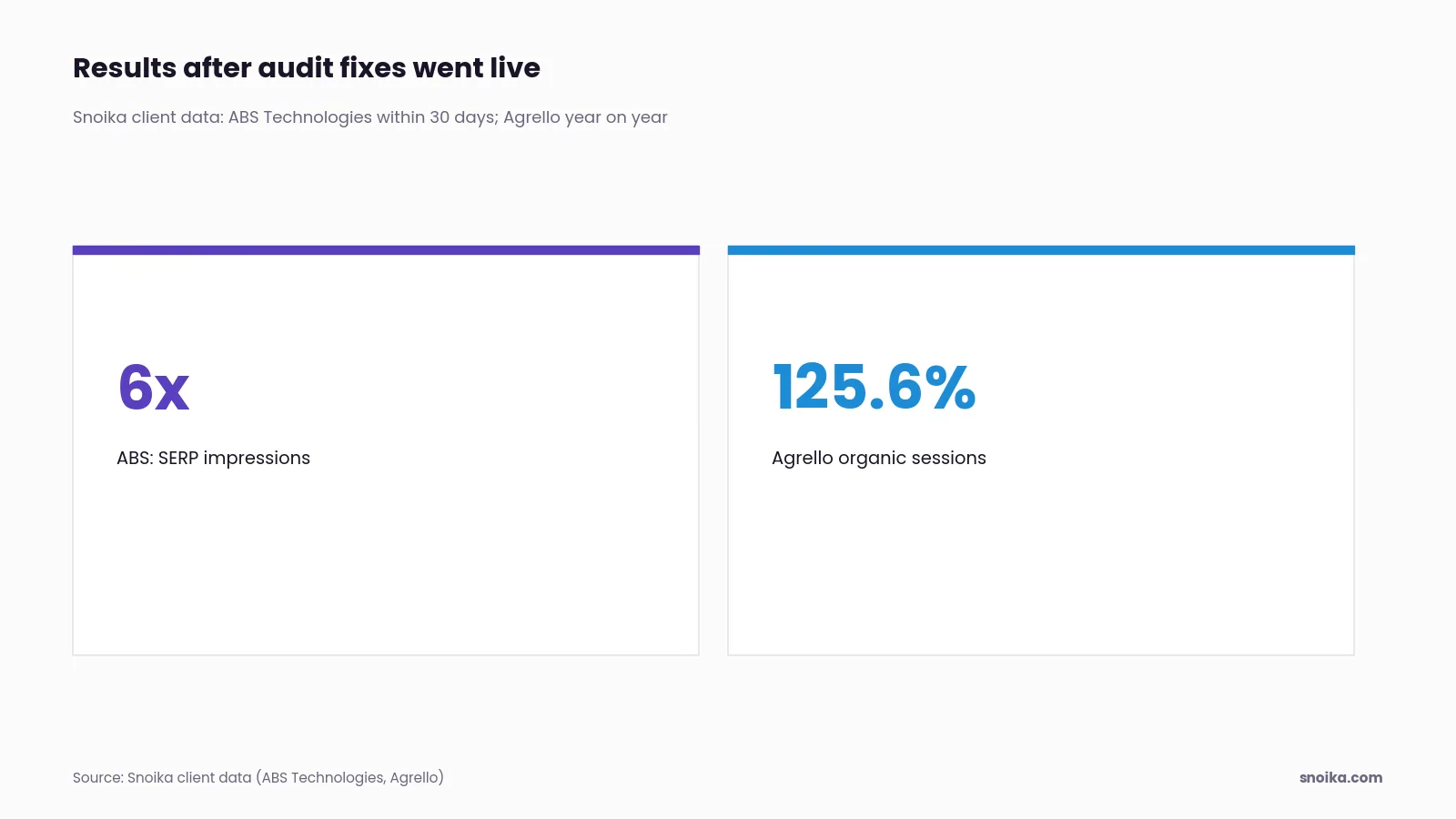
For ABS Technologies, 6x SERP impressions came with "improved keyword indexability and significantly increased search visibility within the first 30 days." In e-signature, Agrello's organic search sessions grew +125.6% YoY. How fast results come depends on how often Google recrawls your site, so a small site moves sooner than a large catalog, and we record your baseline before the first fix ships so we can show what changed.
When to run another audit
We recommend a full audit again after any change to how your site is built or served. In between, a lighter check every quarter keeps small regressions from piling up.
Redesign
A domain change or new website design.
Platform switch
A move to a new CMS or framework.
New languages
New language versions of the site.
Index drop
A drop in indexed pages you can't explain.
New CDN settings
CDN or firewall changes, which can block AI crawlers without warning.
Continuous tracking catches crawl errors as they appear. A full audit goes further, because it rereads server logs and the backlink profile, and tracking can't do that.
FAQ
Snoika's seo audit services include the fixes: we hand over a prioritized fix list or make the changes ourselves, then recheck each one after release. Automated tools and audit-only consultants leave implementation to your team.
Our audit checks crawling and indexing, page content and structure, performance and rendering, tracking and the backlink profile, with server logs explaining crawler behavior. We weight the checks to your site's setup.
Ours does, though many technical audits don't. We check the robots rules for each AI bot, firewall blocks, whether content is readable without JavaScript and whether llms.txt points to the right pages.
Timing depends on how often search engines recrawl your site and how large it is, so a small site moves sooner than a large catalog. We record a baseline before the first fix ships and compare indexing and AI visibility against it.