
Digital marketing ROI with AI visibility
Digital marketing ROI is the return your marketing earns, minus what it costs, divided by that cost. With AI visibility in the model, the return also includes buyers who found you through ChatGPT or Google AI Overviews without clicking anything. To measure it, track how often AI answers mention and cite your brand. Then tie those mentions to pipeline through referral data and the source buyers report themselves.
 Denys SuliatytskyiHead of Growth, Snoika · 8 min read

























AI visibility in ROI models
To measure AI search ROI from visibility, add a visibility layer that sits between your spend and your pipeline. You track it every week and connect it to revenue over the length of your sales cycle. You need this layer because clicks now undercount influence. In a 2025 Pew Research Center study, Google users who saw an AI summary clicked a result in 8% of visits. Users who saw no summary clicked in 15% of visits. A brand cited in that summary has shaped a decision the session data never shows.
SparkToro and Similarweb found that 68.01% of US searches ended without a click in the first four months of 2026, up from 60.45% in 2024. A model built only on sessions will show falling organic returns, even when the brand is winning more answers.
The model's visibility layer counts how often AI answers name and cite you for the prompts your buyers ask. To connect that visibility to outcomes, the outcome layer counts AI referral sessions and buyers who say an AI assistant sent them. It also tracks the pipeline those buyers create. How long the lag between the layers runs depends on your category. Low-cost tools can show results within weeks, but enterprise deals take quarters. Before you change spend, record a baseline for both layers. Without that baseline, you can't say whether anything moved.
Dark pipeline distorts ROI
Dark pipeline is revenue that untracked channels create but attribution software credits to direct traffic or branded search. It makes AI search content look unprofitable. According to Gartner's 2017 Digital B2B Buyer Survey, B2B buyers spend only 17% of their time meeting potential suppliers. Dreamdata's 2026 benchmark report found the average journey now runs 272 days, and 81% of it happens before a lead enters the pipeline.
A buyer who asked ChatGPT for a shortlist and later typed your URL shows up as "direct" in a last-touch report. The AI answer gets no credit for that deal. Then a budget review cuts the content that earned the citation, and the "direct" line shrinks a few quarters later without anyone knowing why.
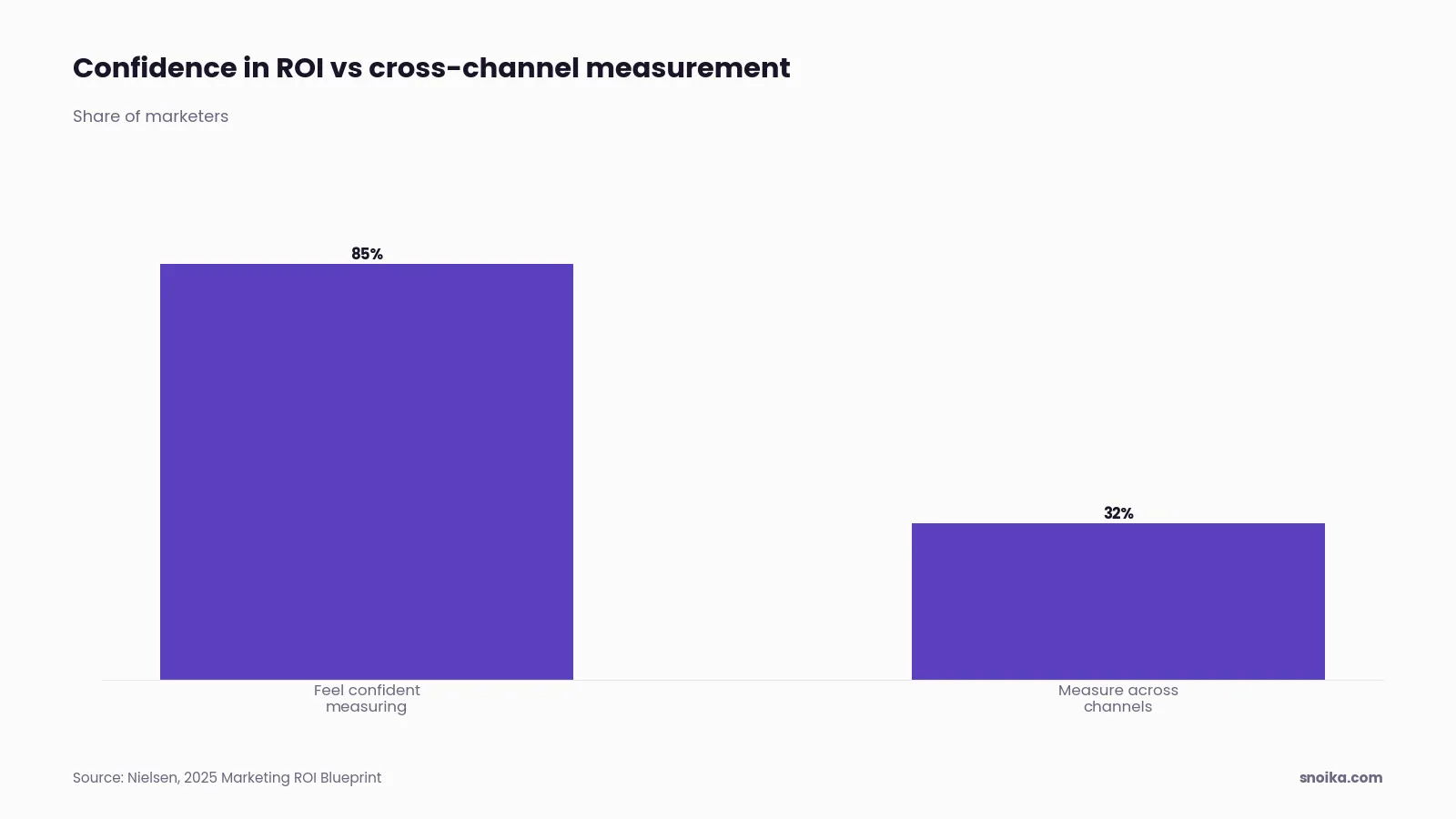
Chris Walker, founder of Refine Labs, saw the size of the gap in his own numbers. Multi-touch attribution showed LinkedIn's ROI as 93% lower than what buyers reported themselves. "You will NEVER succeed in dark social if you are only using software-based attribution because it's heavily biased," he wrote. Nielsen's 2025 Marketing ROI Blueprint found that 85% of marketers feel confident about measuring ROI, yet only 32% of marketers measure it across channels. Check what share of your closed-won deals is credited to "direct". If that share keeps rising while your visibility grows, you're looking at dark pipeline.
Key AI search ROI metrics
Two sets of metrics capture AI citations in an ROI model. A fixed set of prompts you run every week supplies visibility metrics, while your analytics and your CRM supply outcome metrics. You need both because visibility predicts revenue and outcomes prove it.
Which visibility metrics to track
LLM visibility metrics come from asking AI assistants the same buyer prompts on a schedule and recording what comes back. Keep the prompt set stable. If you change the prompts, the trend line stops meaning anything.
| Metric | What it counts | Role in the ROI model |
|---|---|---|
| Mention rate | Share of prompts where the answer names your brand | Main leading indicator |
| Share of voice | Your mentions divided by all brand mentions in the category | Shows position against competitors |
| Citation rate | Share of answers that link to your pages as a source | Predicts referral traffic |
| Sentiment | Whether mentions are positive, neutral or negative | Flags answers that hurt conversion |
| Prompt coverage | Share of buying-stage prompts where you appear | Shows gaps in your content |
Mention rate
- What it counts
- Share of prompts where the answer names your brand
- Role in the ROI model
- Main leading indicator
Share of voice
- What it counts
- Your mentions divided by all brand mentions in the category
- Role in the ROI model
- Shows position against competitors
Citation rate
- What it counts
- Share of answers that link to your pages as a source
- Role in the ROI model
- Predicts referral traffic
Sentiment
- What it counts
- Whether mentions are positive, neutral or negative
- Role in the ROI model
- Flags answers that hurt conversion
Prompt coverage
- What it counts
- Share of buying-stage prompts where you appear
- Role in the ROI model
- Shows gaps in your content
Snoika uses weekly prompt sets in ChatGPT and Google AI Overviews to track mentions and share of voice. Those prompt sets also measure sentiment and citations. The company focuses on those two surfaces because it sees most AI search traffic there. Whatever tool you use, check which assistants it covers and how often it runs the prompts.
Which outcome metrics tie to revenue
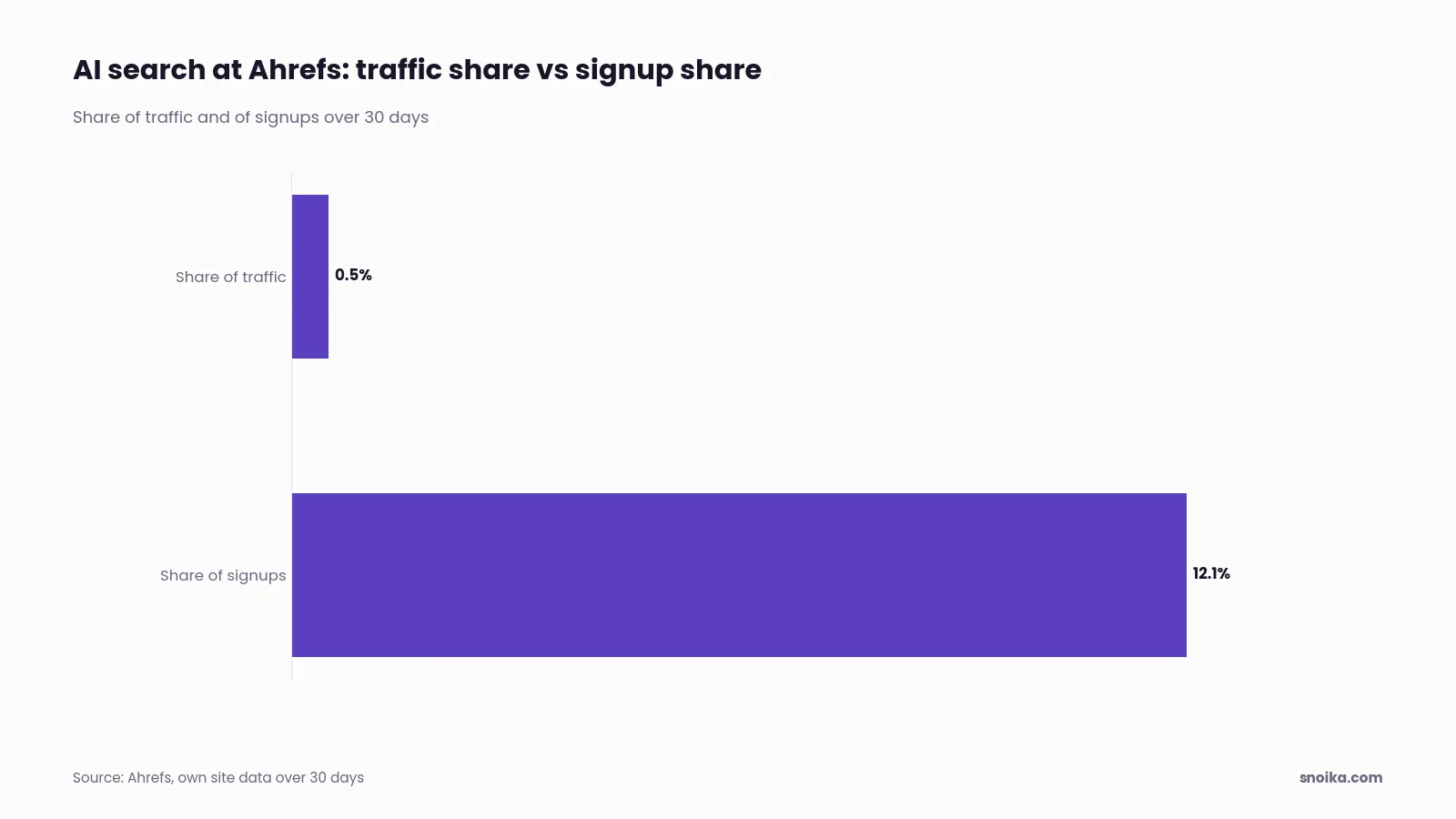
Outcome metrics turn visibility into money. Track AI referral sessions and how often they convert. Add the share of new leads who name an AI assistant as their source, and watch branded search volume in Google Search Console. At Ahrefs, AI search sent 0.5% of traffic but produced 12.1% of signups over 30 days. A 2025 Semrush study put the average AI search visitor at 4.4 times the value of a traditional organic visitor, measured by conversion rate. Low AI referral volume with a high conversion rate is the normal pattern, so read the two numbers together.
The digital marketing ROI formula
The formula is ROI = (attributed return − marketing cost) ÷ marketing cost × 100. For a B2B SaaS company, use gross profit as the attributed return. Revenue-based ROI flatters any channel that sells low-margin deals.
In an illustrative example, a team spends €40,000 on AI search content and visibility tracking in one quarter. Closed-won deals sourced or influenced by AI total €150,000 in revenue at an 80% gross margin, which is €120,000 in gross profit. ROI = (€120,000 − €40,000) ÷ €40,000 × 100 = 200%. Calculated on revenue instead, the same quarter shows 275%.
Count every cost the program uses. That covers content production and tool subscriptions. Add agency fees as well. Staff time counts too, at a loaded hourly rate. Teams leave out internal review hours, and that is why their in-house programs look cheaper than they are.
The attribution window changes the answer more than any other input. Set it to about twice your average sales cycle. Count deals still in progress at pipeline value multiplied by your historical win rate, and label that figure as forecast. Then check that cost and return cover the same period. If one quarter's spend is set against another quarter's revenue, the result is wrong.
Attributing AI-driven pipeline
You get AI search attribution by combining referral data with the source buyers report themselves, and then checking both against trends in branded search. ChatGPT doesn't always pass referral data, and Patrick Stox, Product Advisor at Ahrefs, has written about issues "related to them not sending referral data." Set up the system in this order:
- Separate AI referrals in Google Analytics 4 (GA4). Create a custom channel group with a regex that matches chatgpt.com and perplexity.ai. Extend the regex to match gemini.google.com and copilot.microsoft.com, and put the group above the default "Referral" group.
- Ask buyers directly. Make "How did you hear about us?" a required, open-text field on demo and contact forms. Have sales repeat the question on the first call.
- Carry the source into your CRM. Store both the GA4 channel and the self-reported answer on the contact and on the opportunity, so the source survives until the deal closes.
- Define two credit levels. Mark a deal "AI-sourced" when the buyer names an AI assistant. Mark it "AI-influenced" when an AI referral session appears anywhere in the journey.
- Watch the indirect signals. In Google Search Console, compare branded impressions and direct traffic with your weekly mention rate. When visibility rises and branded demand follows a few weeks later, that supports the link.
- Test incrementality once a year. Pause new content on one topic cluster or in one market for a quarter, then compare its pipeline with a similar cluster you kept running.
This needs analytics and tag access from day one. When Snoika onboards a client, it asks for access to GA4 and Google Search Console. It also asks for Google Tag Manager access, plus access to the content management system (CMS) when it will publish pages. Without that access, you can't build an attribution baseline.
Benchmarks for B2B SaaS
A good digital marketing ROI is about 5:1 revenue to cost, and 10:1 is exceptional. In B2B SaaS, finance teams care more about the ratio of customer lifetime value to customer acquisition cost (LTV:CAC) and the months it takes to pay back acquisition cost. Your margins and contract size shift each of these rules of thumb.
| Benchmark | Floor | Median | Strong | Source |
|---|---|---|---|---|
| Marketing ROI (revenue to cost) | 2:1 | n/a | 5:1 strong, 10:1 exceptional | Guac Digital, 2025 |
| LTV:CAC ratio | 3:1 | 4.1x median LTV:CAC | 7.8x top quartile | Aleph and Benchmarkit, 2026 |
| CAC payback | Under 18 months | 16 months median payback | 6 months or less | Aleph and Benchmarkit, 2026 |
| LinkedIn ads ROAS | n/a | 121% ROAS in 2025 | n/a | Dreamdata, 2026 |
Marketing ROI (revenue to cost)
- Floor
- 2:1
- Median
- n/a
- Source
- Guac Digital, 2025
LTV:CAC ratio
- Floor
- 3:1
- Median
- 4.1x median LTV:CAC
- Strong
- 7.8x top quartile
- Source
- Aleph and Benchmarkit, 2026
CAC payback
- Floor
- Under 18 months
- Median
- 16 months median payback
- Strong
- 6 months or less
- Source
- Aleph and Benchmarkit, 2026
LinkedIn ads ROAS
- Floor
- n/a
- Median
- 121% ROAS in 2025
- Strong
- n/a
- Source
- Dreamdata, 2026
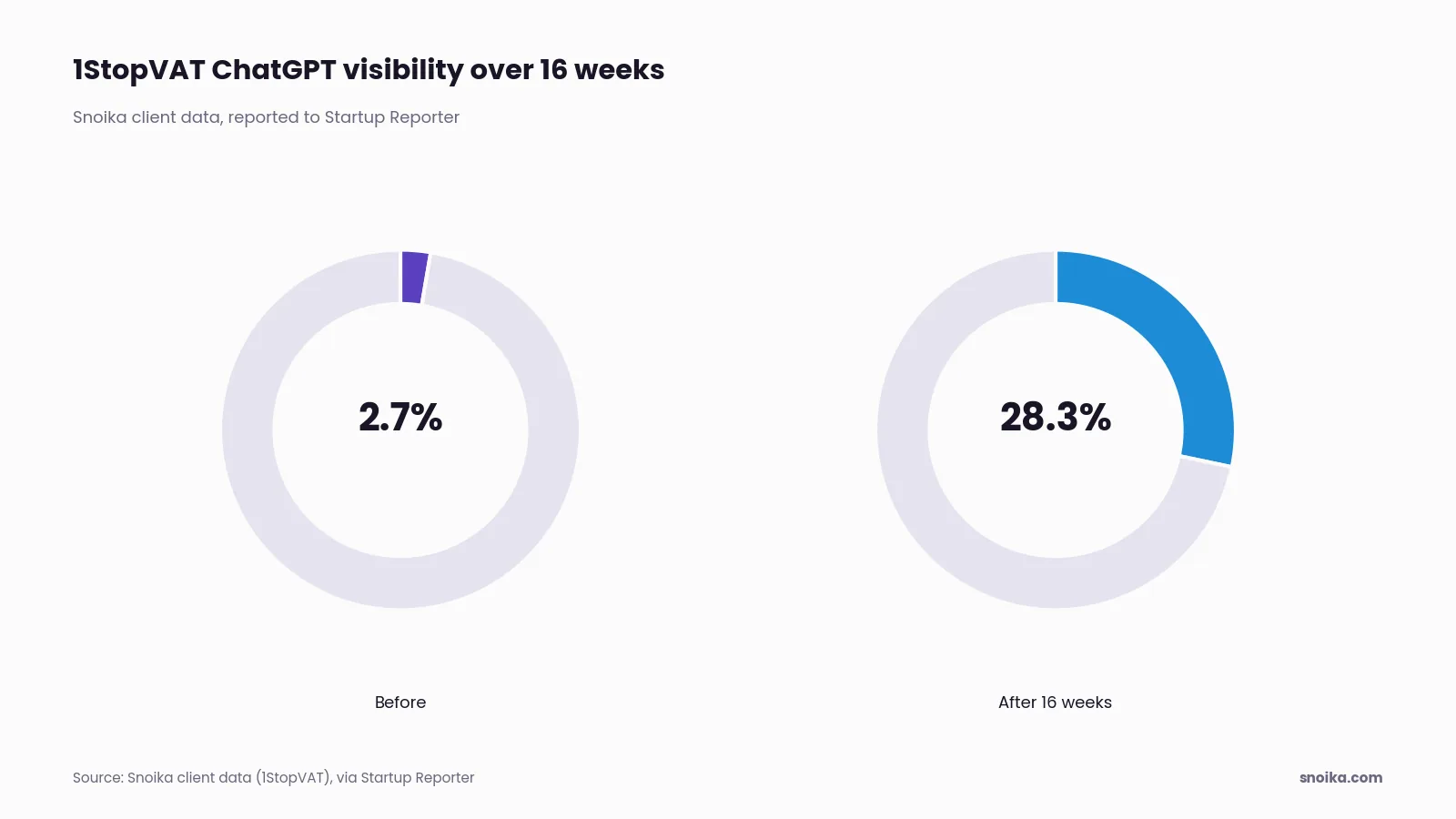
AI visibility has no industry benchmark yet. Your own baseline is the fairest comparison. Snoika's founder Anton Vedeshin reported to Startup Reporter 1StopVAT's move from 2.7% to 28.3% ChatGPT visibility in 16 weeks. Vespia, a fintech SaaS, recorded a 220% increase in AI brand mentions. And Agrello, in e-signature, grew organic search sessions by 125.6% year over year. Treat these as possible outcomes and keep them out of your forecast.
Tools that track citations
You can track AI citations with a monitoring-only tool or an all-in-one platform. An agency or an in-house team can also handle the tracking. The right choice depends on who will act on the data once you have it. Monitoring tells you where you're missing from AI answers. Someone still has to write and publish the pages that fix it.
| Option | Tracks AI citations | Creates and publishes content | Cost (2026) | Suits |
|---|---|---|---|---|
| Monitoring-only tool | Yes, usually across several assistants | No | Varies by prompt volume | Teams with writers who need data |
| Agency | Sometimes, often monthly | Yes | Varies by retainer scope | Teams that want a hands-off service |
| In-house team | Only with a tool added | Yes | Salaries plus tools | Large teams with SEO staff |
| Snoika (all-in-one platform) | Yes, with weekly prompt sets | Yes, in 135+ languages | Plans on the pricing page | Teams that want tracking and execution in one place |
Monitoring-only tool
- Tracks AI citations
- Yes, usually across several assistants
- Creates and publishes content
- No
- Cost (2026)
- Varies by prompt volume
- Suits
- Teams with writers who need data
Agency
- Tracks AI citations
- Sometimes, often monthly
- Creates and publishes content
- Yes
- Cost (2026)
- Varies by retainer scope
- Suits
- Teams that want a hands-off service
In-house team
- Tracks AI citations
- Only with a tool added
- Creates and publishes content
- Yes
- Cost (2026)
- Salaries plus tools
- Suits
- Large teams with SEO staff
Snoika (all-in-one platform)
- Tracks AI citations
- Yes, with weekly prompt sets
- Creates and publishes content
- Yes, in 135+ languages
- Cost (2026)
- Plans on the pricing page
- Suits
- Teams that want tracking and execution in one place
Starter comes to €12,896 a year and Growth to €25,896 before the yearly-billing discount of up to 10%. A monitoring-only tool costs less if you already have writers who can act on the gaps. An agency suits you if you want to buy a result. Before you sign, check how often it reports and whether it tracks AI answers at all.
Snoika puts the platform and the service under one team, with people reviewing the automated work. Through a DNS connection, it publishes pages on your own domain. It works on any CMS without a migration. You approve each page in the dashboard before it goes live. That matters for ROI, because the citations and the traffic build up on your domain.
A board-ready ROI report
A board-ready ROI report fits on one page. It leads with the return figure, then shows how visibility turned into pipeline. Boards need to know what the money produced and what you're asking for next. Build the page in this order:
- Headline return. Gross-profit ROI for the period, with the attribution window stated.
- Pipeline split. Show AI-sourced and AI-influenced pipeline, each with its win rate. Report all other pipeline separately with its win rate.
- Visibility trend. Your share of voice against your top two competitors, quarter over quarter.
- The bridge. Show how changes in mention rate preceded changes in AI referrals and self-reported AI leads. Then show how pipeline changed after those signals.
- Spend and request. What you spent and what you propose for next quarter, with the result you expect.
Directors understand leads and users better than share of voice, so put a business number next to every number in your visibility reporting. 3DPrinterOS reached #1 visibility in ChatGPT for industry-specific queries and turned AI search into 3–4 qualified inbound leads a day. 3DOS reached top ChatGPT visibility for its targeted industry queries and doubled its registered users. Results like these give the board a reason to believe the visibility numbers. Before the meeting, check that every figure on the page matches the CRM, because one number that doesn't reconcile will undermine the rest.
What to do next
Set your baseline this week, before you change any budget. Run your buyer prompts to record your mention rate and share of voice. Add the AI option to your "How did you hear about us?" field. Every week without a baseline is a week of influence you can never put into your digital marketing ROI later. Self-reported data also only starts building once the field goes live.
We track brand visibility in ChatGPT and Google AI Overviews. We also create and publish the content that wins citations, with a human review on every page. The usual first step is a free AI visibility report. Talk to an AI search expert to see where your brand stands.
FAQ
Connect weekly AI visibility tracking to attributed gross profit, then subtract marketing costs and divide by those costs. Multiply by 100 for percentage ROI. Include buyers who report finding you through AI, since referral traffic alone misses journeys without clicks.
Use citation rate to measure how often AI answers link to your pages, alongside mention rate for appearances without links. Keep the weekly prompt set unchanged. Compare these trends with AI referral conversions and buyer-reported AI leads to connect visibility with business outcomes.
Keep each buyer's reported source and referral data attached to their opportunity until it closes. Classify buyer-reported AI discovery as AI-sourced and AI referral visits as AI-influenced. Use the closed deal's gross profit when calculating return.
A useful digital marketing roi benchmark is 5:1 revenue to cost, but it's a rule of thumb rather than a universal target. It isn't the same as gross-profit ROI. Your margins and contract size affect the comparison, while AI visibility needs its own baseline.
Judge results over your sales cycle rather than a fixed monthly deadline. Low-cost tools can show results within weeks, while enterprise deals take quarters. Track visibility weekly and set the attribution window to about twice your average sales cycle.