How AI models work
A large language model (LLM) is a neural network that has read trillions of words and learned to predict the next small piece of text, called a token. That skill is the core answer to how do LLMs work. An assistant such as ChatGPT builds its reply one token at a time. When the question needs fresh facts, it searches the web first and writes from the pages it finds.
 Artem LozinskyOperations and product, Snoika · 11 min read

























How LLMs choose brands
An AI assistant recommends brands based on their frequency in the text it learned from and in the pages it retrieves for your question. It has no ranked directory of vendors. During training, the model sees the same brand names come up again and again next to phrases like "VAT compliance software" or "3D printer management" in reviews and forum threads. Comparison articles repeat these pairings too. Those repeated pairings turn into strong statistical links. So when you ask for a recommendation, the names with the strongest links to your category are the most likely tokens to come next.
Web retrieval adds a second layer on top of that memory. If the assistant searches before it answers, the pages it pulls in can confirm a brand the model already knows or bring in one it has never seen. Off-site mentions matter more than links here. In an Ahrefs study of 75,000 brands, branded web mentions showed a correlation of 0.664 with AI Overview visibility, while backlinks came in at 0.218. A brand that people write about, linked or not, is a brand the model can name.
Expect the answers to change from one run to the next. SparkToro, the audience research company co-founded by Rand Fishkin, ran nearly 3,000 prompts and found a less than 1 in 100 chance that ChatGPT or Google's AI would give the same list of brands twice. The report's authors wrote, "If you ask an AI tool for brand/product recommendations a hundred times nearly every response will be unique." A single screenshot of a ChatGPT answer proves almost nothing.
Check how often your brand appears across a large, repeated set of prompts. Snoika's tracking works this way. It runs weekly prompt sets in ChatGPT and Google AI Overviews, where most AI search traffic happens. It measures mentions and share of voice. Its measurements also cover sentiment and citations. A percentage built from hundreds of answers holds steady in a way a single "position" never will.
How LLMs generate answers
A large language model generates an answer one token at a time. After it predicts a token and adds it to the text, it predicts the next one from everything written so far. A token is a word or part of a word. OpenAI's documentation estimates that 100 tokens equal about 75 words of English. Your question becomes a string of tokens, and the model's job is to continue that string in the most plausible way.
The architecture behind this is the transformer, which eight Google researchers introduced in the 2017 paper "Attention Is All You Need". Its key mechanism, attention, lets the model weigh every earlier token when it picks the next one. That's how it keeps track of the fact that "it" in sentence four refers to the product named in sentence one. At each step the model produces a probability for every token in its vocabulary. A setting called temperature controls how often it picks a less likely option instead of the top one. That randomness is the reason two people asking the same question get different wording and different brand lists.
Prediction is not the same as looking something up. Andrej Karpathy, a founding member of OpenAI, wrote in December 2023, "In some sense, hallucination is all LLMs do. They are dream machines." When the "dream" lines up with reality, we call the result an answer. When it doesn't, we call it a hallucination, but the model did exactly the same thing both times.
Assistants reduce the risk by grounding the model in real documents. In retrieval-augmented generation (RAG), the system fetches relevant pages and places them in the model's context. The model then writes from those pages. Grounding changes what the model writes while preserving how it writes. So when you read an AI answer about your brand, check whether it cites a source. An answer with no citation came from memory, and memory can be months out of date or simply wrong.
How LLMs are trained
LLMs are trained in two broad stages. First the model learns language and facts from a huge body of public text. Then it learns to behave like a helpful assistant from human examples and ratings. The first stage decides what the model knows, while the second decides how it answers.
Pretraining on public text
Pretraining is next-token prediction at enormous scale. As the model reads text, it guesses each next token and checks the real one. It adjusts billions of internal weights to guess better next time. Meta trained Llama 3 on over 15 trillion tokens from public sources, more than seven times the data used for Llama 2. Nobody hand-codes facts into the model. A brand ends up "known" only because the training text mentioned it often enough, in consistent contexts, for the pattern to stick.
Every pretrained model has a knowledge cutoff, the date its training data ends. Anything published after that date is invisible to the model's memory. If your company launched or rebranded after the cutoff, the model can't know about it unless the assistant searches the web. The same applies if your company entered a new market after the cutoff. So a brand that is new or recently renamed depends almost entirely on retrieval.
Fine-tuning with human feedback
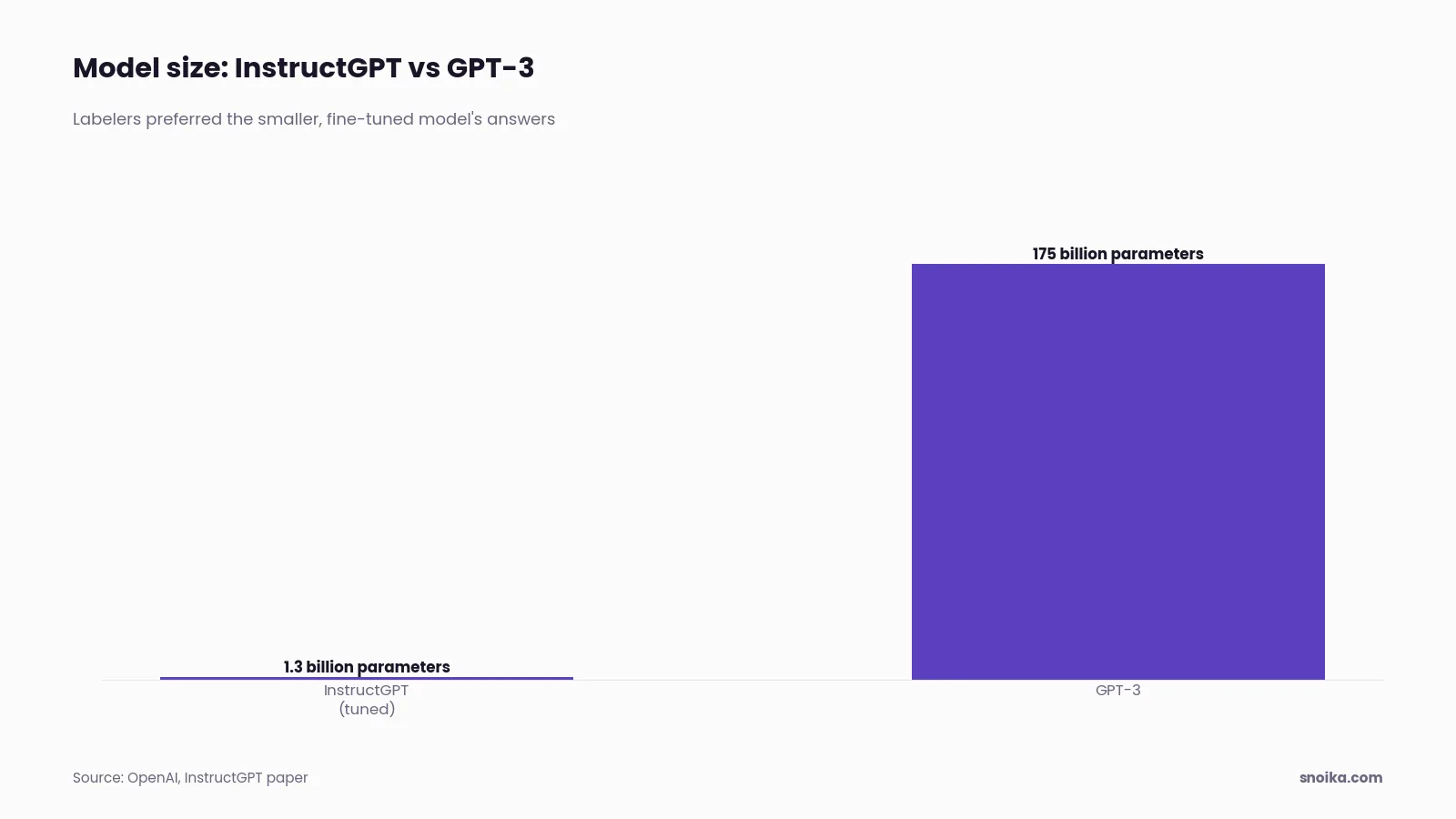
A raw pretrained model continues text, but it doesn't reliably follow instructions. Providers fix that with fine-tuning. Human trainers write example answers and then rank the model's outputs. The model is tuned toward the answers people prefer. This method is called reinforcement learning from human feedback (RLHF). OpenAI's InstructGPT paper showed that labelers preferred answers from a 1.3B-parameter tuned model over those from the 175B-parameter GPT-3, which is over 100 times larger.
Fine-tuning shapes tone and caution more than knowledge. It's why assistants hedge on medical questions and present a recommendation as a short list with pros and cons. Providers retrain and update their models on their own schedules, and each update can shift which brands a model mentions. That's one reason AI visibility has to be measured over time instead of checked once.
When assistants search the web
An AI assistant searches the web when your question needs information that is newer or more specific than its training data holds. Prices and news trigger a search. Product comparisons and "best of" lists for the current year also trigger searches. The same applies to local queries. General explanations don't. OpenAI's help center says ChatGPT "may search the web automatically" when a question would benefit from current information, and users can also turn search on by hand.
The search itself rarely uses your exact words. The same OpenAI page explains that ChatGPT rewrites a question into one or more targeted queries before it sends them to search partners. At Google I/O 2025, Elizabeth Reid, Head of Search at Google, said of AI Mode, "It calls on our custom version of Gemini to break the question into different subtopics, and it issues a multitude of queries simultaneously on your behalf." Google calls this query fan-out. One buyer question can become eight searches, and your page only needs to match one of them to be considered.
Whether a search happens depends on the product and the plan. The user's settings and the phrasing also affect that decision. "What is VAT?" will probably come from memory. "Which VAT compliance tools work for EU marketplace sellers in 2026?" will probably trigger a search. To test your own category, write down the questions your buyers actually type. Run those questions and note which ones come back with citations. Those cited prompts are the ones your published pages can win. For the others, only your wider reputation in the training data can help.
How LLMs rank sources
AI systems rank sources at the level of passages. A passage scores well when it matches the question or one of its fan-out sub-queries and the model can quote it cleanly. The retrieval system first pulls a set of candidate documents from a search index. Then it scores chunks of those documents on how closely their meaning matches each query. The model writes its answer from the top chunks and attaches citations to the pages they came from.
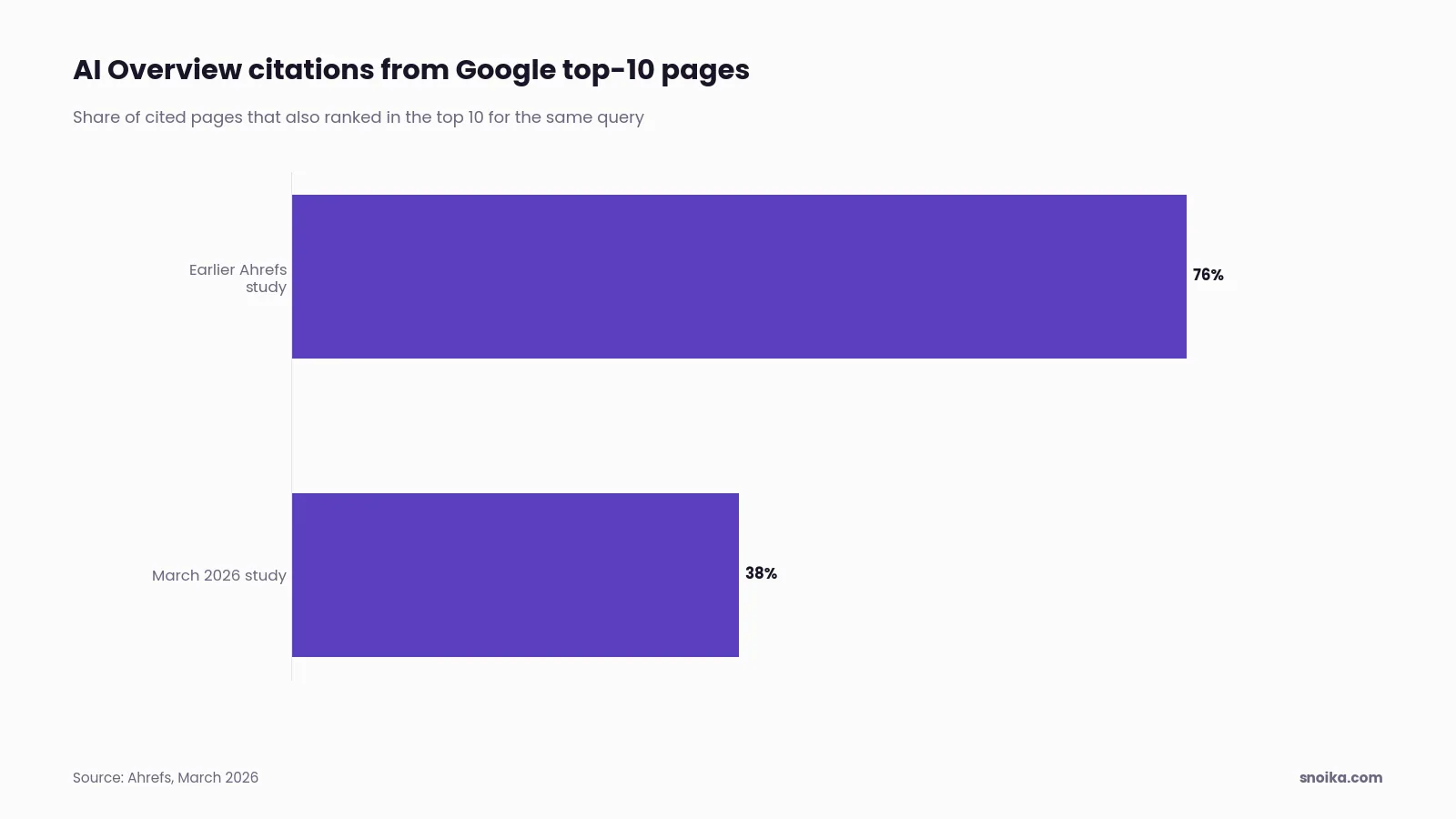
Classic search rankings help you get into the candidate set, but they no longer decide the citation. An Ahrefs analysis of 863,000 keywords and 4 million AI Overview URLs, published in March 2026, found that 38% of cited pages also ranked in Google's top 10 for the same query. In the company's earlier version of the study, that figure was 76%. Fan-out explains much of the gap. A page that ranks 40th for the main query can rank first for a sub-query the system generated quietly.
In the same Ahrefs data, YouTube URLs made up 18.2% of the citations that didn't rank in Google's top 100 at all, so a transcript can earn a citation that a blog post misses. Different AI models also lean on different indexes and favor different domains, which the table further down covers.
First, check whether each section of your own pages answers one specific question in its first sentences, so the passage stands on its own when lifted out. Second, do you rank anywhere in the top 100 for the sub-questions buyers ask as well as for the head term? A page that is invisible to classic search rarely makes it into the candidate set.
What makes content AI-visible
Content becomes AI-visible when a retrieval system can find a passage that matches a specific question and quote it without much rewriting. The four properties below decide most of that, and you can check each one on any page.
The answer sits near the top
Models cite the opening of a page far more than the rest of it. Kevin Indig, a growth advisor who writes the Growth Memo newsletter, analyzed 18,012 verified ChatGPT citations and found that 44.2% of citations came from the first 30% of the page. He calls the pattern a "ski ramp," with a steep drop after the first third. Put the definition or number in the first two sentences of the page and of every section. If the answer is a recommendation, put it there too.
Facts a model can quote
Specific claims with sources get cited more than general statements. Researchers from Princeton and partner institutions tested this in their paper on generative engine optimization (GEO). They found that added citations or quotations can lift source visibility by over 40% across queries. Added statistics also contributed to visibility gains. Quotation addition was the strongest single method in their tests. A sentence like "setup takes 3 days" is easy to quote. A sentence like "setup is fast and painless" gives a model nothing to work with.
One question per section, with the entity named
Retrieval works on chunks, so each chunk has to make sense on its own. Name your product and your category in full within each section instead of relying on "it" or "our solution" from three paragraphs earlier. A heading that states the sub-question, followed by a direct answer, gives the system a clean match. Long essays that drift between topics produce chunks that match nothing well.
Coverage in the buyer's language
Assistants answer in the language of the question, and they prefer sources in that language when good ones exist. A German buyer asking in German is matched against German passages first. Snoika creates content in 135+ languages and regional variants for this reason. A brand with strong English pages and nothing in Polish or Portuguese leaves those answers to whoever did write in those languages.
Get cited by AI
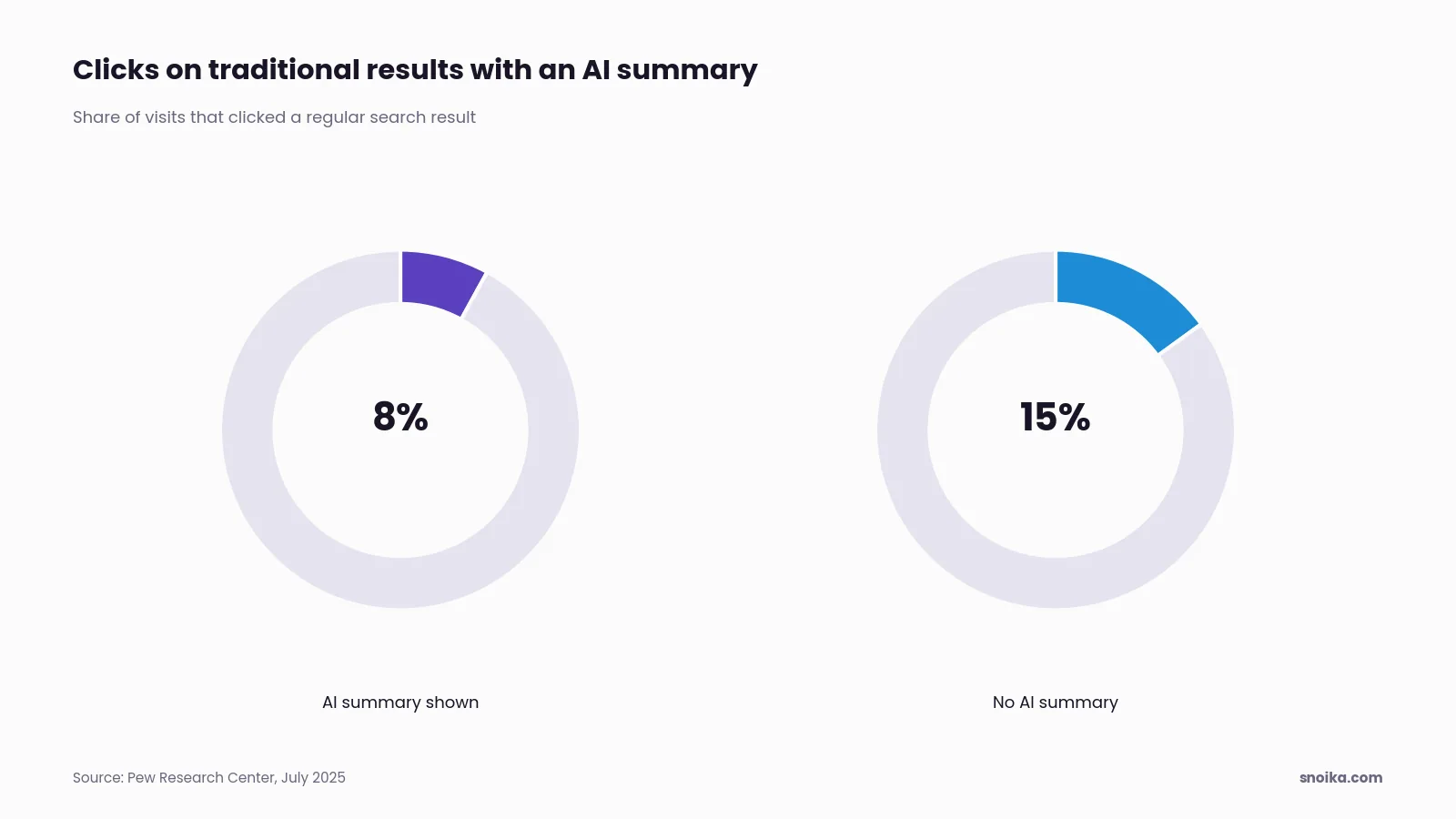
A brand gets cited by AI when other sites mention it often and its own pages give the clearest answer to the questions buyers ask. Citations matter more than they used to because fewer people click through. Pew Research Center tracked 900 US adults in March 2025 and found that users clicked a regular search result in 8% of visits when an AI summary appeared, against 15% without one. If the summary answers the buyer, the brand named inside it is the one they remember.
Work through these LLM SEO steps in order:
- Open the door to AI crawlers. Check your robots.txt file. OpenAI runs two separate crawlers: OAI-SearchBot surfaces sites in ChatGPT search, while GPTBot collects content for model training. You can allow the first and block the second. Blocking OAI-SearchBot by mistake removes you from ChatGPT's citations entirely.
- Build a baseline of buyer prompts. Write down the questions your buyers ask at each stage, such as "what is" and "best tool for." Add "X vs Y" comparisons too. Run them in each assistant you care about and record who gets mentioned and cited. Repeat the runs, because a single pass is noise.
- Earn mentions on sites you don't own. Industry publications and review platforms feed both training data and retrieval. Podcasts and community threads do too. Because off-site mentions track AI visibility more closely than backlinks do, a named mention in a trade article is worth pursuing even without a link.
- Publish answer pages on your own domain. Answer one buyer question in each page's first lines, with quotable facts below. Hosting matters here because citations build authority for the domain that holds the page. Snoika publishes on the client's own domain through a DNS connection. It works on any CMS without a migration.
- Measure the share of answers each week. Compare your mention rate against your competitors on the same prompt set, and watch the trend. ChatGPT SEO results take weeks to show. Snoika's founder Anton Vedeshin reported to Startup Reporter 1StopVAT's move from 2.7% to 28.3% ChatGPT visibility in 16 weeks.
Guides by assistant
Each major AI search engine pulls its web results from a different index, so being visible in one doesn't guarantee being visible in the others. According to a breakdown by Hitit Medya, ChatGPT now largely uses its own search infrastructure after relying on Bing. The same breakdown identifies Bing as Copilot's source and Brave Search as Claude's. Anthropic added Brave Search to its Claude subprocessor list on March 19, 2025.
| Assistant | Where web results come from | Crawler or index to check | What to check first |
|---|---|---|---|
| ChatGPT | OpenAI's own search infrastructure, with Bing as an earlier source | OAI-SearchBot allowed in robots.txt | Your pages show as cited sources for buyer prompts |
| Google AI Overviews and AI Mode | Google Search index, with query fan-out | Standard Googlebot indexing | Rankings for sub-questions, not only the head term |
| Gemini | Google Search | Standard Googlebot indexing | Same pages as AI Overviews, tested in the Gemini app |
| Microsoft Copilot | Bing index | Bing Webmaster Tools submission | Your key pages are indexed in Bing |
| Claude | Brave Search | Brave index (URL submission form) | Your homepage and top pages appear in Brave results |
| Perplexity | Its own index | PerplexityBot allowed in robots.txt | Citations for comparison and "best of" prompts |
ChatGPT
- Where web results come from
- OpenAI's own search infrastructure, with Bing as an earlier source
- Crawler or index to check
- OAI-SearchBot allowed in robots.txt
- What to check first
- Your pages show as cited sources for buyer prompts
Google AI Overviews and AI Mode
- Where web results come from
- Google Search index, with query fan-out
- Crawler or index to check
- Standard Googlebot indexing
- What to check first
- Rankings for sub-questions, not only the head term
Gemini
- Where web results come from
- Google Search
- Crawler or index to check
- Standard Googlebot indexing
- What to check first
- Same pages as AI Overviews, tested in the Gemini app
Microsoft Copilot
- Where web results come from
- Bing index
- Crawler or index to check
- Bing Webmaster Tools submission
- What to check first
- Your key pages are indexed in Bing
Claude
- Where web results come from
- Brave Search
- Crawler or index to check
- Brave index (URL submission form)
- What to check first
- Your homepage and top pages appear in Brave results
Perplexity
- Where web results come from
- Its own index
- Crawler or index to check
- PerplexityBot allowed in robots.txt
- What to check first
- Citations for comparison and "best of" prompts
Treat the table as a starting map. Providers change their search partners and crawlers without much notice, and ChatGPT's own move away from Bing shows how fast a row can go out of date. Check each provider's crawler documentation every quarter, and confirm in your server logs that the bots you allow actually visit. A page that never gets crawled can't be cited, however well it's written.
What to do next
Your next step is to measure before you change anything. Run your real buyer questions across the assistants your customers use and repeat each prompt a number of times. Record your share of mentions and citations next to your top competitors. That baseline turns a question like how do LLMs work into a list of specific gaps, such as a blocked crawler or a missing comparison page. Those gaps also include markets where nobody writes about you in the local language. Run the same prompts again after each major model update, because the answers can shift overnight.
We test those prompts weekly and track how the share moves over time. Our Free Trial tests 10 AI prompts weekly on 1 AI platform, which is enough to get your baseline. Start free trial
FAQ
An AI assistant draws recommendations from patterns in its training text and, when it searches, the pages it retrieves. Repeated associations between a brand and a category make that brand more likely to appear, but recommendations vary between runs.
A brand is more likely to appear when other sites mention it and relevant pages provide answers the assistant can quote. For source citations, make each section answer a specific buyer question directly and support factual claims with sources.
Large language models generate answers by predicting one word or word fragment at a time, using the text already available. For anyone asking “how do llms work,” the key distinction is that predicting plausible text doesn't guarantee factual accuracy.
An assistant may search when a question needs current or specific information, such as today's prices or local recommendations. Search availability depends on the product and settings. A general explanation is more likely to come from the model's training.
AI visibility changes can take weeks to appear, and there isn't a fixed timeline. Search-based answers can draw on newly retrieved pages, while changes to training-based answers depend on model updates. Compare mention rates weekly using the same repeated questions.