
The complete guide to AI SEO
AI SEO is the work of making a brand show up inside the answers that AI assistants give, as well as in Google's classic results. It addresses whether assistants like ChatGPT and Google AI Overviews can find and trust your pages, and how often they name your brand when a buyer asks for options. As in classic search, the goal is to be the source a buyer meets first.
 Jevgenia PogadajevaCFO, Snoika · 11 min read

























AI SEO explained
AI SEO extends Search Engine Optimization (SEO) from ranked links to generated answers. You'll also see it called Generative Engine Optimization (GEO) or Answer Engine Optimization (AEO). The labels differ, but the job is the same. When a model writes a reply, you want it to cite your brand with an accurate description and recommend it over a competitor.
Classic SEO aims for a click through a position on a results page, while AI SEO wins a mention inside an answer that ends the search. Pew Research Center tracked the browsing of 900 US adults and found that users clicked a result link in 8% of visits when an AI summary appeared, against 15% when none did. In the same study, just 8% of one- or two-word searches produced an AI summary, while 53% of searches with 10 words or more did. So rank tracking for short keywords misses the long, conversational questions where AI answers live.
For a B2B company, AI SEO decides whether you make the shortlist a buyer builds before they ever visit your site. G2's March 2026 survey of 1,076 software buyers found that 51% of B2B buyers now start their research in an AI chatbot more often than in Google, up from 29% in April 2025. And 69% said they picked a different vendor than they'd planned because of what the chatbot told them. Sam Altman, CEO of OpenAI, said at DevDay 2025 that ChatGPT had reached 800 million weekly users.
The two disciplines still overlap more than they compete. Google's AI features draw on its own index, and ChatGPT's search draws on pages that its crawler can reach. A site that's slow or hard to crawl fails at both. We treat classic SEO as the floor that AI SEO stands on.
How AI assistants pick sources
AI assistants select sources in two passes as they search for candidate pages and choose the passages that answer the question most directly. They favor brands the wider web already talks about. Each pass has its own failure point, so it helps to check them one at a time.
Can the assistant reach your page?
An assistant can only cite what its crawler can read. OpenAI's documentation says that sites which won't appear in answers because they block OAI-SearchBot can still show up as plain navigation links in ChatGPT search. That crawler is separate from GPTBot, the one OpenAI uses for model training. You can allow search and refuse training. Google works differently, because its assistants use one index with classic Search. Its Search Central guide describes a "query fan-out" technique, where AI Overviews and AI Mode issue multiple related searches across subtopics to build one response. Your page can be cited for a sub-question the buyer never typed.
Is the passage worth quoting?
AI models lift passages, and they prefer passages that make sense on their own and carry evidence. Researchers from Princeton and Georgia Tech worked with colleagues at IIT Delhi to test content changes across 10,000 queries. Their KDD 2024 paper found that added citations and quotations improved source visibility in generated answers. With statistics also among the changes tested, the gains reached up to 40%. In practice, that means you open each section with the answer and put the number in the same sentence. Then you name where it came from.
Does the rest of the web agree?
A model repeats claims it finds in more than one place. If your site says you're the leading payroll tool for agencies, the claim carries little weight without support from review sites or forum threads, or from coverage in trade articles. We cover this in the off-site section below.
To get your brand cited by ChatGPT, work through all three passes. Let OAI-SearchBot crawl your site. Publish pages that answer buyer questions in quotable passages. Then earn mentions on the third-party sites the model already trusts. Skip any one of those and the other two lose most of their effect.
The AI SEO workflow
An AI SEO program starts with a baseline and access fixes before pages are planned and published. Off-site mentions feed the next round of measurement, and the cycle repeats. Here's how we run it, in order.
- Onboard and set a baseline. Every engagement we run starts with onboarding. We establish the goals as we learn about the category and its buyers. We ask for access to Google Analytics 4 (GA4) and Google Search Console. We also request Google Tag Manager access, along with access to the content management system (CMS) when we'll publish pages.
- Audit technical access. Check robots.txt for AI crawlers and confirm key pages are indexed. Make sure the main content renders as text and not only through scripts.
- Build the prompt set. List the questions buyers actually ask an assistant, from sales calls and Search Console queries. Group them by stage, so you track "what is X" separately from "best X for Y".
- Map the content. Turn the prompts into a plan of pages, with one clear job per page. The next section but one covers this.
- Write and publish. Each page answers its question in the first lines, then backs it with sourced figures. Through a DNS connection, we publish on the client's own domain. That works on any CMS and needs no migration, and the client approves each page in a dashboard before it goes live.
- Earn off-site mentions. Work on reviews and comparisons at the same time as the pages, since both feed the same answers. Pursue press coverage alongside that work.
- Measure weekly and refresh. Rerun the prompt set and compare share against competitors. Then update the pages that slipped.
Teams that write content before step 2 can publish for months into a site that blocks the crawler they're trying to reach.
Tracking AI visibility
You track AI visibility by running a fixed set of buyer prompts on a schedule and counting how often each assistant names you. One test tells you almost nothing, because answers change from run to run. SparkToro ran the same 12 prompts 60 to 100 times each and found a less than 1-in-100 chance that ChatGPT or Google's AI would return the same brand list twice. Rand Fishkin, SparkToro's co-founder, wrote that treating these tools as sources of consistency is "provably nonsensical."
What does hold steady is the share of runs that include your brand. Our tracking measures four things across ChatGPT and Google AI Overviews, which is where most AI search traffic happens, with prompt sets rerun every week:
- Mentions: how often the brand appears in answers
- Share of voice: your mentions as a portion of all brand mentions in the category
- Sentiment: whether the answer describes you favorably and accurately
- Citations: which of your pages the assistant links as a source
Compare visibility tracking with your analytics, where visits from ChatGPT search results show up as their own source in GA4 because OpenAI adds utm_source=chatgpt.com to referrals.
Check the prompt set before you trust any chart. If it's full of questions that contain your brand name, you'll score well and learn nothing. Unbranded category questions are the ones a new buyer asks.
Content maps for AI SEO
A content map ties each buyer question to one page and organizes the pages into topic groups with links between them. It replaces the classic keyword list. Assistants break questions into sub-questions, so a map needs pages that define a topic and answer comparisons, with cost questions covered too. A single page aimed at one high-volume phrase won't do that.
We build maps from research. Sales call notes reveal buyer objections, while Search Console supplies the long queries that already reach the site. We use competitor citations to identify which questions rivals are winning. Match "how does X work" questions to guides and "X vs Y" questions to comparisons. Cost questions get pricing pages.
Google's guide to generative AI features warns that creating separate content for every fan-out variation violates its spam policy on scaled content abuse. It calls that "an ineffective long-term strategy." So one strong page that answers a cluster of close questions beats ten thin ones.
To check a map, read the page titles in order. A buyer should be able to follow them from first question to purchase decision, and no two pages should answer the same question.
Off-site signals that count
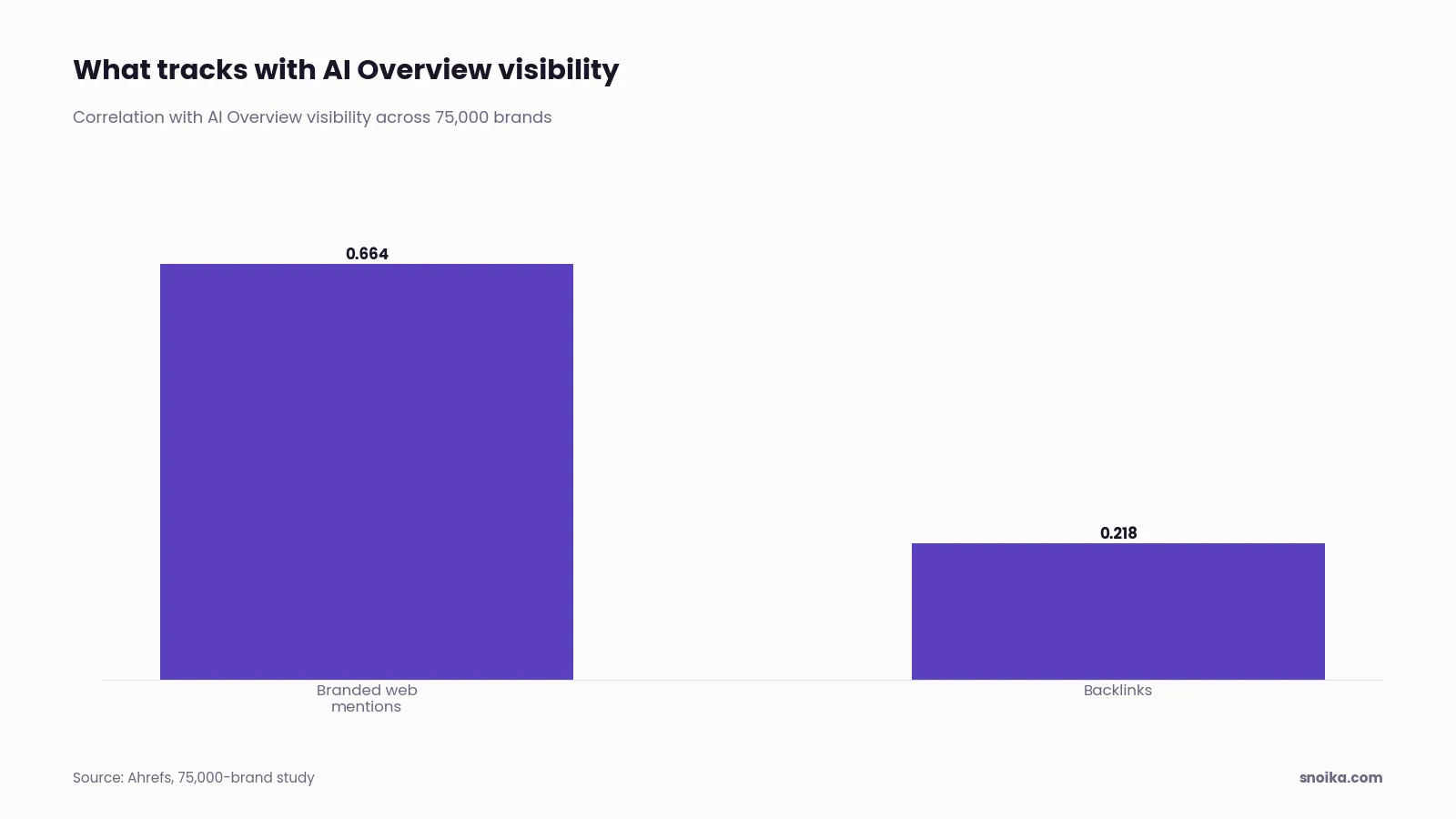
The off-page SEO signal that counts most is how often other sites mention your brand by name, linked or not. Ahrefs studied 75,000 brands and found that branded web mentions correlated with AI Overview visibility at 0.664, against 0.218 for backlinks. Branded anchor text came second, and branded search volume third. The top three factors all measure activity off your site.
Pew found that Wikipedia and YouTube rank among the sources Google's AI summaries link to most. Reddit completes the top three, and together the group made up 15% of cited sources in the summaries Pew examined. For B2B brands, review platforms and trade publications fill a similar role. "Best tools for X" roundups are another source for these brands.
Software brands gain from review profiles with current features and pricing, while professional services firms gain from trade-press bylines and case studies published by clients. In both cases the facts have to match everywhere, because a model that finds two different prices for you risks quoting the wrong one.
Audit this by asking an assistant to describe your company and its competitors. Then trace each claim in the answer back to the page it came from. Outdated or wrong claims point to the sources you need to fix first.
In-house or with a partner
You can run AI SEO in-house with a content team and someone who owns digital PR, provided you have technical access to the site. Most of the work is classic content marketing skills applied to a new target. In-house teams lack the measurement layer, and manual reruns of hundreds of prompts a week across assistants don't scale.
An AI SEO agency makes sense when you need tracking and content output faster than you can hire for them. The trade-off is control. Ask how a partner's SEO automation is checked. At Snoika, we built one platform that audits sites and tracks visibility in Google and AI assistants. It also builds content maps for the content it creates and publishes. The same team runs the platform and the SEO solutions, and human reviewers check the output of the automated workflows.
Whichever route you pick, ask these questions before you commit:
- Which assistants are tracked, and how often are prompts rerun?
- Who approves pages before they go live?
- Do pages publish on your domain, so the authority stays with you?
- How is off-site work handled, and by whom?
- What does a report show beyond mention counts?
Mid-sized teams work well with an in-house vs agency hybrid that keeps strategy and approvals in-house while they buy tracking and production capacity.
What AI SEO costs
The cost of AI SEO depends on scope, with low prices for monitoring alone and higher costs for an AI marketing agency retainer that covers content production and off-site work.
| Option | Price | What it covers |
|---|---|---|
| Snoika | Plans on the pricing page | 10 AI prompts tested weekly, 1 AI platform monitored, basic competitor tracking, chat support |
| Snoika | Plans on the pricing page | 100 AI prompts tested weekly, 3 AI platforms monitored, basic competitor tracking, email support, monthly AI visibility report |
| Snoika | Plans on the pricing page | 500+ AI prompts tested weekly, all AI platforms monitored, advanced competitor tracking and intelligence, priority support, monthly report, dedicated account manager |
| Snoika Enterprise | Custom | Unlimited prompts, all AI platforms, custom integrations and API, multi-brand management, executive dashboards, 99.9% SLA guarantee |
| GEO add-on to an SEO retainer | $900+ per month on average | AI search work billed on top of an existing SEO contract (GoodFirms) |
| Specialist GEO agency | $5,000 to $20,000+ monthly | From content-only programs up to full technical, content and PR work (Optimist) |
Snoika
- Price
- Plans on the pricing page
- What it covers
- 10 AI prompts tested weekly, 1 AI platform monitored, basic competitor tracking, chat support
Snoika
- Price
- Plans on the pricing page
- What it covers
- 100 AI prompts tested weekly, 3 AI platforms monitored, basic competitor tracking, email support, monthly AI visibility report
Snoika
- Price
- Plans on the pricing page
- What it covers
- 500+ AI prompts tested weekly, all AI platforms monitored, advanced competitor tracking and intelligence, priority support, monthly report, dedicated account manager
Snoika Enterprise
- Price
- Custom
- What it covers
- Unlimited prompts, all AI platforms, custom integrations and API, multi-brand management, executive dashboards, 99.9% SLA guarantee
GEO add-on to an SEO retainer
- Price
- $900+ per month on average
- What it covers
- AI search work billed on top of an existing SEO contract (GoodFirms)
Specialist GEO agency
- What it covers
- From content-only programs up to full technical, content and PR work (Optimist)
When you compare them with monthly agency quotes, multiply the weekly price by about 4.3.
Prompt volume drives the price of tracking, and the number of pages drives the price of AI content creation. Competition also affects the page count, since a narrow B2B niche with five real competitors needs far fewer pages than a consumer category with fifty. Before you sign, ask what a quote includes. A low monthly fee that covers only monitoring tells you where you stand, but it won't change it.
AI SEO by industry
AI SEO follows the same mechanics in every industry. What changes in industry specific SEO is which questions buyers ask and which sources the assistants trust for them.
B2B software
Software buyers ask for comparisons and shortlists, so the pages that get cited are "X vs Y" breakdowns and honest category guides. Review platforms carry heavy weight here. Keep feature lists and pricing current on your site and on every profile, because assistants quote both.
Fintech and other regulated sectors
Assistants are more cautious with money and legal topics and lean on official and well-established sources. Pages for financial advisors need precise, dated facts with the regulation named and linked. A vague claim about compliance gets passed over for a government page that states the rule.
Manufacturing and industrial tech
The questions here are technical and narrow, with low search volume and high deal value. With few competing answers, a detailed page on a specific process or file format can become the main source for an industry query.
Brands selling across markets
Assistants answer in the user's language and cite local sources. A brand that publishes only in English is invisible to buyers who ask in German or Spanish. We create content in 135+ languages and regional variants. Any team should translate the pages buyers act on and track prompts in each market's language.
Results from real brands
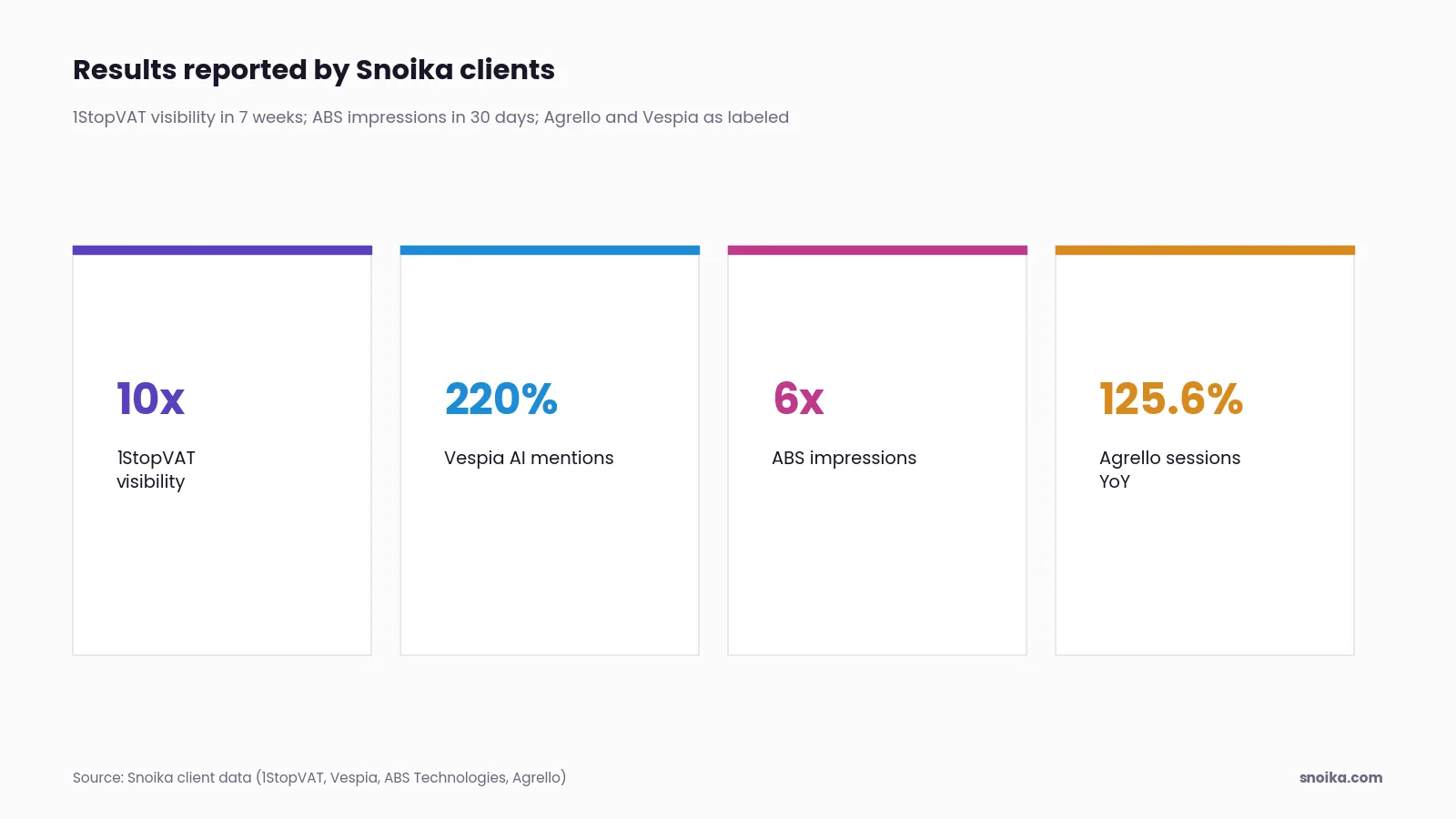
Results from AI SEO show up as more brand mentions and a higher share of ChatGPT answers. Downstream gains include more inbound leads and sign-ups. Here's what brands in our case studies recorded, in the wording they reported:
| Brand | Sector | Reported result |
|---|---|---|
| 1StopVAT | Tax and fintech | 10x growth in ChatGPT visibility in 7 weeks |
| 3DPrinterOS | 3D printing software | #1 visibility in ChatGPT for industry-specific queries, 3–4 qualified inbound leads/day |
| Vespia | Fintech SaaS | 220% increase in AI brand mentions |
| Agrello | E-signature | +125.6% organic search sessions YoY, 51.8K impressions from Snoika-created pages |
| 3DOS | Manufacturing tech | Top visibility in ChatGPT for targeted industry queries, 2x registered users growth |
| ABS Technologies | Technology | 6x SERP impressions, improved keyword indexability within the first 30 days |
1StopVAT
- Sector
- Tax and fintech
- Reported result
- 10x growth in ChatGPT visibility in 7 weeks
3DPrinterOS
- Sector
- 3D printing software
- Reported result
- #1 visibility in ChatGPT for industry-specific queries, 3–4 qualified inbound leads/day
Vespia
- Sector
- Fintech SaaS
- Reported result
- 220% increase in AI brand mentions
Agrello
- Sector
- E-signature
- Reported result
- +125.6% organic search sessions YoY, 51.8K impressions from Snoika-created pages
3DOS
- Sector
- Manufacturing tech
- Reported result
- Top visibility in ChatGPT for targeted industry queries, 2x registered users growth
ABS Technologies
- Sector
- Technology
- Reported result
- 6x SERP impressions, improved keyword indexability within the first 30 days
Read results like these with the tracking section in mind. A visibility figure only means something next to its prompt set and time frame. Ask any provider for both, along with a business metric such as leads or registrations, before you compare numbers.
What to do next
Your first move is a baseline. Write down 20 questions a new buyer in your category would ask an assistant. Run each one several times in ChatGPT and Google to note who gets named. Leave your brand name out of every question. The result identifies technical access gaps or shows whether pages and mentions are missing; each gap needs a different fix. A baseline also gives your AI SEO work a starting number to beat.
We run that baseline for brands before we build and publish the pages. Weekly tracking then shows the change. If you'd like to talk through your own results, book a call with our team.
FAQ
For a B2B company, ai seo means helping its pages appear as sources in AI answers when buyers research suppliers. It supports inclusion in buyer shortlists before a website visit, making comparison pages and accurate third-party profiles relevant.
Traditional SEO focuses on positions in search results and website clicks, while AI SEO also targets mentions within generated answers. Both depend on accessible, useful pages. Measuring AI visibility requires repeated tests of buyer questions because rankings alone don't show whether assistants recommend a brand.
Start by allowing OAI-SearchBot to crawl your pages. Publish direct answers to buyer questions with evidence that makes each passage useful on its own. Support those pages with accurate third-party mentions, such as coverage in trade publications.
Monitoring costs depend on prompt volume, while content costs depend on page count. Check whether a quote includes off-site work before comparing prices.
One reported case showed increased visibility in seven weeks, but that isn't a general deadline. Track the same buyer questions weekly and check leads or registrations alongside mentions to assess progress.


