The complete guide to AI content creation
AI content creation means using large language models (LLMs) to draft and adapt web content. People set the content marketing strategy, and people sign off on the result. The model writes fast, but it doesn't know your buyers or your facts unless you tell it. The quality of that process determines whether pages rank in Google and get cited by AI assistants or end up in a pile that search engines ignore.
 Jevgenia PogadajevaCFO, Snoika · 13 min read

























AI content creation explained
In AI content creation, software drafts and people decide. An LLM predicts the next word from patterns in its training data, so it can write fluent text on almost any subject. It can't choose which subjects matter to your business, and it can't tell a real statistic from a made-up one. Those jobs stay with people. How well people do them sets the quality of everything the model writes.
Ryan Law, Director of Content Marketing at Ahrefs, led an analysis of 900,000 pages created in April 2025 and found that 74.2% of new pages contained AI-generated content. A second Ahrefs study looked at 600,000 pages ranking in Google's top 20. It found that 81.9% of ranking pages mixed AI and human writing, and only 4.6% were pure AI. So you're probably using AI somewhere already. The process around that use determines the quality of your AI content marketing.
To create SEO content with AI, follow six steps in order. Each one has its own section below:
- Build a content map from keyword and prompt research, so every page has a reason to exist.
- Write a brief for each page that sets the query and the reader. Specify the facts the model may use.
- Draft with the model and provide your voice rules and source material every time.
- Have a human editor check facts and claims before anything goes live. The editor must also check voice.
- Publish at a steady pace on your own domain.
- Measure search traffic and AI citations, then update the pages that underperform.
An AI blog writer covers step 3. The other five steps decide whether that draft deserves to be published at all.
Planning from a content map
A content map lists every page you plan to publish, grouped by topic. Each page on it is tied to its target searches and AI prompts. Planning from a map prevents the most common failure in AI content writing, which is producing whatever is easy to generate instead of what buyers look for. Once drafting costs almost nothing, the plan is the only thing between you and a hundred pages nobody needed.
A good map groups pages into topic clusters, each with one broad page and narrower pages that answer specific questions and link back to it. Every row names the target query and the intent behind it. It also sets the page type, so a how-to guide doesn't end up competing with your product page for the same term. Maps now include prompts people type into ChatGPT as well as Google keywords. Those prompts are longer and phrased as full questions, so they call for a page that keywords alone wouldn't show you.
A local accountant's map fits on a single sheet, while a software company with dozens of integrations needs hundreds of rows. When we build a map for a client, we start with onboarding. We learn who the buyers are and what the business needs search to deliver, and only then do the keyword research.
Before you draft, check that each row has its own intent. Merge any rows that would answer the same question, because two pages fighting for one query split the ranking signals between them. Then mark which pages need first-hand expertise the model can't supply. Those pages get an interview or expert notes before drafting starts.
Briefs that guide AI
The brief tells the model what one specific page must do, and it has more effect on draft quality than any other input. A model fills every gap in its instructions with a plausible guess. A tight brief reduces the gaps that lead the model to produce generic pages.
A working brief for AI SEO content covers:
- The target query and the intent behind it
- Who the reader is and what they already know
- The outline, with the headings the page must carry
- The questions the page has to answer
- The facts, figures and sources the model may use
- Claims the page must never make, such as guarantees or competitor comparisons
- Target length and any required formats, such as a table or numbered steps
A programmatic page uses a template brief with variables that change from row to row. An opinion piece or industry analysis needs the expert's raw thinking, such as interview notes or a call transcript. Without that material the model has nothing original to write from, and the page ends up restating what the top ten results already say.
Before you hand a brief to the model, check whether it gives a competent freelance writer who has never heard of your company enough information to produce the right page. The model needs that same context to succeed. Add the missing context and run the test again.
Drafting in your brand voice
To keep brand voice consistent in AI content, document it as rules and examples for the model to use with every draft. Have editors check against the same document. "Friendly but professional" means nothing to a model. It can follow instructions to use 'you' for the reader and keep sentences under 30 words. A rule against calling competitors by name is equally clear. Rules like these are testable, so an editor can also check a draft against them.
A useful voice document pairs rules with examples. Its rules specify which person you write in and the spelling standard. They also define the level of formality and the words you never use, with instructions on how to handle claims. The examples are two or three paragraphs of your best real writing labeled as the target. Models copy examples more reliably than they follow descriptions. Save both as reusable instructions so every draft starts from the same place instead of from whoever happened to write the prompt that day.
The model needs your product facts and your own data to write about your business. Quotes from your people give it more material to work from; a topic alone produces the average of the internet. For long pages, draft section by section and include the brief each time, because quality drops as a single generation gets longer.
A regulated financial firm's voice rules need strict controls on claims and disclaimers, while a consumer brand has room for more personality and a looser rhythm. Either way, check for drift every few weeks by reading recent drafts side by side. Stock AI openers and constant hedging are early signs of drift. Repeated sentence shapes are another warning. When you spot one, fix the voice document instead of only the draft, so the same problem doesn't come back next week.
Human review before publishing
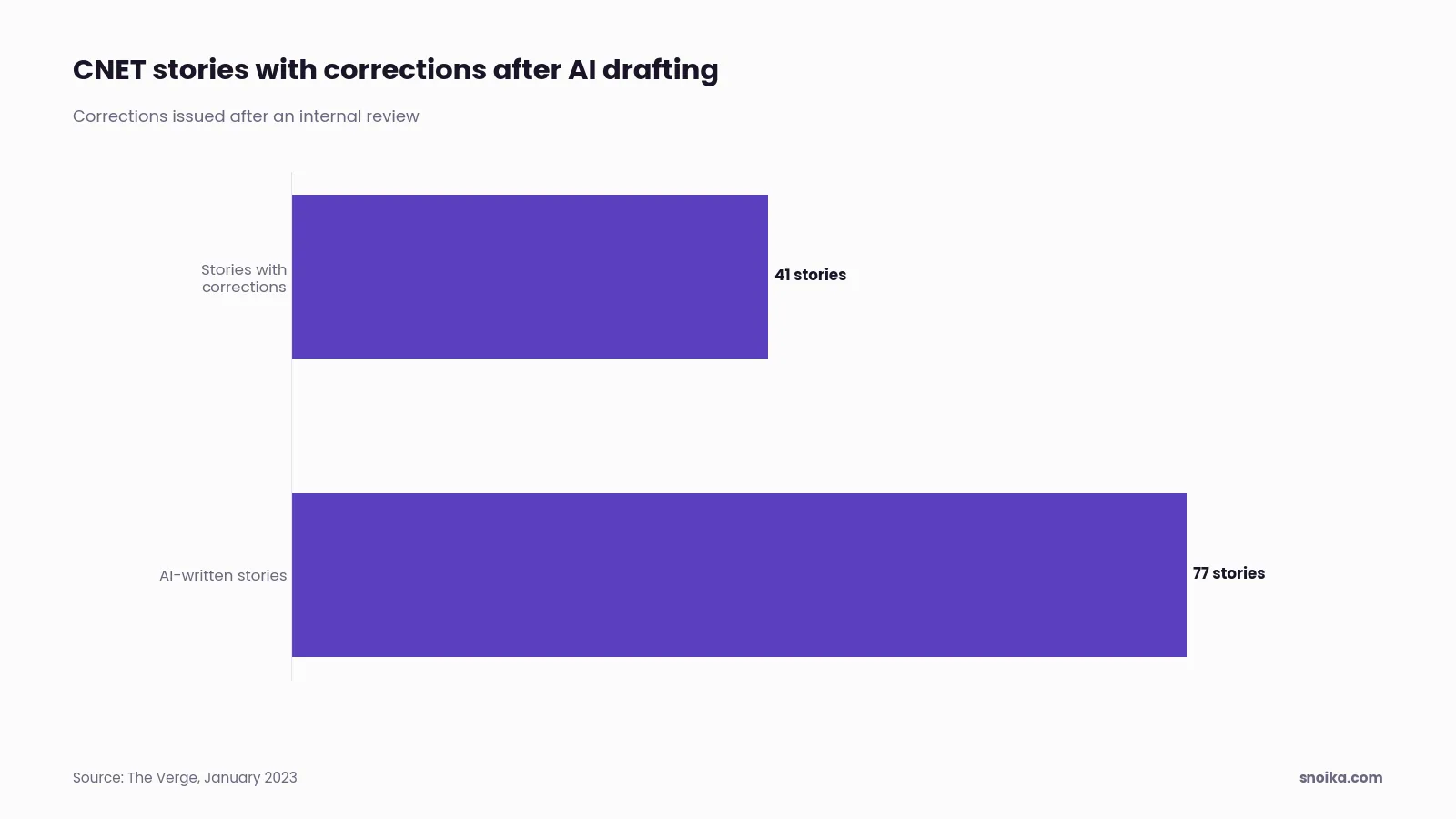
Yes, every AI-generated page needs human review before it goes live. Models state false things in the same confident tone as true ones, and only a person who knows the subject can tell them apart. CNET learned this in public. After an internal review, editor-in-chief Connie Guglielmo's team issued corrections on 41 of 77 stories written with an AI tool, The Verge reported in January 2023.
A trained editor can review a product how-to. Health and legal pages need a subject expert as well, as do financial pages. Google's guidance asks creators to show E-E-A-T, which combines Experience and Expertise with Authoritativeness and Trustworthiness. A named expert who has checked the page is one of the clearest ways to show it. We built our own workflow on this principle: the team that runs the platform also runs the content writing services, and a human review layer sits on top of every automated workflow. Reviewers check four things.
Facts, figures and sources
Every number and date needs a source the reviewer has opened and read. The same requirement applies to every quote. Models invent citations that look real, with plausible journals and believable URLs. They also pull outdated figures from training data. If a figure has no verifiable source, cut it. A page with fewer numbers that are all true does better than a page full of statistics nobody can trace.
Claims the business can stand behind
Next, the reviewer reads every statement about the company and its products. Models add features that don't exist and promise outcomes no one approved, because confident marketing copy is common in their training data. Each claim should match something the business can prove. In regulated fields, compliance should sign off too.
Voice and readability
The reviewer reads the draft against the voice document and cuts the inflated openers and restated conclusions that models add by default. Paragraphs that say nothing new also go. Reading the page aloud helps. Sentences that make you run out of breath are too long, and passages that sound like an advert need rewriting.
Links and on-page SEO
Check that the title tag and meta description match the target query and that the headings follow the brief. Verify that every outbound link works and points to the source it claims. Internal links to related pages in the same cluster go in at this stage. Without them, a good page sits isolated from the rest of the site.
Multilingual content at scale
To create multilingual SEO content with AI, research keywords separately in each target language and write or adapt each page for that market. Have a native speaker review it before you connect the language versions with hreflang tags. Translating your English page word for word fails because people in each market search in their own phrasing. The literal translation of your English keyword differs from the term Germans or Brazilians type.
CSA Research surveyed 8,709 consumers in 29 countries. It found that 76% of online shoppers prefer buying products with information in their own language, and 40% will never buy from websites in other languages. AI has made reaching those readers affordable. A model adapts a page in minutes, while a translation agency takes days.
The workflow runs in this order:
- Research keywords and AI prompts in each language with local search data instead of translated English terms.
- Adapt each page's brief with local examples and regulations. Specify the market's currencies and units as well.
- Draft in the target language from the adapted brief, or adapt the English page with the new brief attached.
- Have a native speaker who knows the subject review a sample of every batch, and every page in regulated topics.
- Publish each language on its own URL and add hreflang annotations so Google serves the right version.
Google's documentation recommends separate URLs per language instead of switching languages with cookies or browser settings. Its guide to localized versions of pages explains that hreflang tells Google the pages are variants of the same content. Google detects the language itself, with its own algorithms. Brazilian and European Portuguese differ in vocabulary and spelling, as do Mexican and Spanish Spanish, so content localization also requires attention to regional variants. We produce content in 135+ languages and regional variants, and in our experience the variant decision changes more pages than any other choice in a localization plan.
Before launch, check that every hreflang tag points both ways and that each page lists itself. Missing return links are the most common reason Google ignores a hreflang setup.
Programmatic pages done right
Programmatic SEO pages are templated pages built from a dataset, one page per row. They work when every page carries real data the searcher couldn't get from a generic summary. Zapier is the standard example. It built a page for each app integration it supports, and a teardown by MADX estimates those integration pages drive about 16 percent of its organic traffic. Each page describes a connection that actually exists, with triggers and actions specific to that pair of apps.
Programmatic pages go wrong when the only thing that changes between pages is a keyword. A thousand "best plumber in [city]" pages with identical text and a swapped city name give nobody anything. Danny Sullivan, Google's Search Liaison, put the line plainly in an interview with Search Engine Roundtable: "None of it matters in terms of if you're doing it at scale period. That is your issue if you're doing it primarily for ranking purposes."
A dataset with prices or specifications provides substance for thousands of programmatic pages. Availability data or local figures also support pages at that scale, while city names alone provide too little information to support a page. An AI programmatic SEO tool helps by writing the text that explains each row's data in plain language, and by varying that text where the data differs.
Run three checks before you publish a set:
- Pick ten random pages and remove the variable. If the pages read the same, they're thin.
- Set rows with too little data to noindex or leave them out.
- Have an editor review the template and a sample from every batch, as you would any other AI draft.
- Plan updates, since stale data on templated pages goes wrong across the whole set at once.
Publishing on a schedule
Publish at a steady rate that your review team can keep up with. Don't release hundreds of drafts in one batch. Review capacity is the real limit in AI content operations, because drafting is nearly free and checking isn't. A cadence your editors can actually meet keeps quality level and gives you clean data on what each batch achieved.
Publish the broad page for each cluster before the narrower pages that link to it, so each new page joins a structure that already exists. After each batch, go back to older pages and add links to the new ones. A page with no internal links pointing to it takes longer to be found and passes nothing to the pages around it.
A subfolder such as yoursite.com/blog builds authority for your main domain, while a separate subdomain or a third-party website builder builds authority elsewhere. Our content automation platform publishes on the client's own domain. Pages go live through a DNS connection. This works on any content management system (CMS) without a migration. The client reviews and approves each page in a dashboard before it goes live. For ABS Technologies, that setup delivered 6x SERP impressions and improved keyword indexability within the first 30 days.
After each release, confirm that the sitemap updated. Do the new URLs show as indexed in Google Search Console's URL inspection tool? Are the pages crawlable without login walls or blocked scripts? Then set a date to refresh each page, because content with dated figures loses ground once the figures go stale.
Measuring what content earns
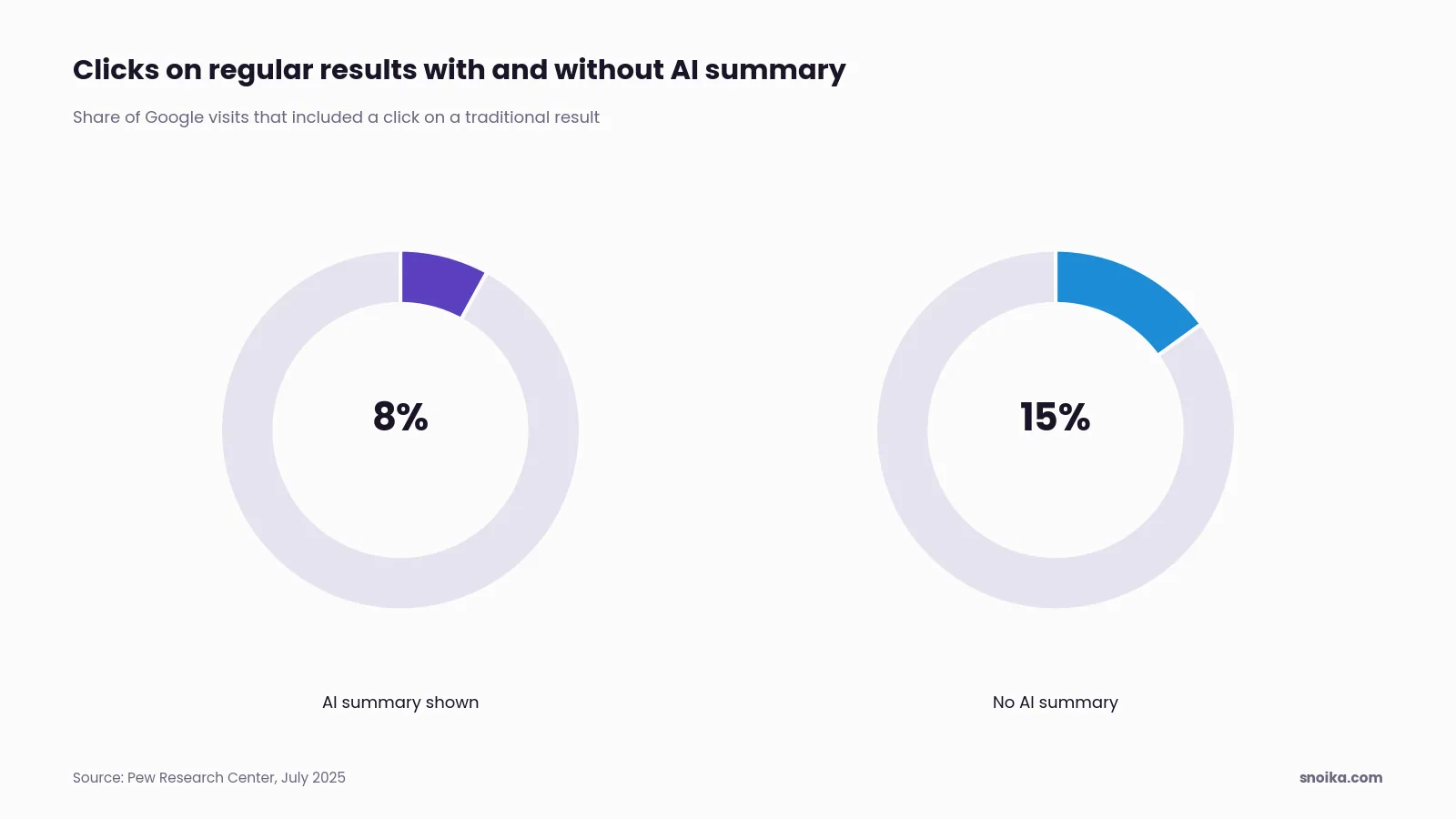
Measure the visibility and visits content earns from Google. Track its mentions and citations in AI assistants as well. Traffic alone now undercounts results. Pew Research Center tracked the browsing of 900 US adults in March 2025. Users who saw a Google AI summary clicked a traditional result in 8% of visits, compared with 15% when no summary appeared. A page can shape a buyer's decision through an AI answer and never get the click.
| Metric | What it tells you | Where to find it |
|---|---|---|
| Impressions | Whether Google shows the page for its queries | Google Search Console |
| Clicks and click-through rate | Whether the title and snippet win the visit | Google Search Console |
| Organic sessions and conversions | Whether visitors take the action you want | Google Analytics 4 (GA4) |
| AI mentions | How often assistants name your brand for target prompts | Prompt tracking |
| Share of voice | How your mentions compare with competitors' | Prompt tracking |
| Citations | Whether assistants link to your pages as sources | Prompt tracking |
| Sentiment | How assistants describe you when they mention you | Prompt tracking |
Impressions
- What it tells you
- Whether Google shows the page for its queries
- Where to find it
- Google Search Console
Clicks and click-through rate
- What it tells you
- Whether the title and snippet win the visit
- Where to find it
- Google Search Console
Organic sessions and conversions
- What it tells you
- Whether visitors take the action you want
- Where to find it
- Google Analytics 4 (GA4)
AI mentions
- What it tells you
- How often assistants name your brand for target prompts
- Where to find it
- Prompt tracking
Share of voice
- What it tells you
- How your mentions compare with competitors'
- Where to find it
- Prompt tracking
Citations
- What it tells you
- Whether assistants link to your pages as sources
- Where to find it
- Prompt tracking
Sentiment
- What it tells you
- How assistants describe you when they mention you
- Where to find it
- Prompt tracking
The first three rows need access to your analytics. Our onboarding asks clients for GA4 and Google Search Console access for that reason. We also request Google Tag Manager access, plus CMS access when we'll be publishing. The AI rows need a fixed set of prompts, run on a schedule. Our tracking uses weekly prompt sets in ChatGPT and Google AI Overviews, where most AI search traffic happens, to measure mentions and share of voice. It also measures sentiment and citations.
Search impressions move within weeks of indexing. Sessions and conversions take longer, and a new domain moves more slowly than an established one. Snoika's founder Anton Vedeshin reported to Startup Reporter 1StopVAT's move from 2.7% to 28.3% ChatGPT visibility in 16 weeks. In e-signature, Agrello saw +125.6% organic search sessions YoY and generated 51.8K impressions from Snoika-created pages.
Before you publish anything, record a baseline for every metric in the table. Then report results by cluster. A single page tells you little, but a cluster shows whether a topic is worth more investment.
Google policies on AI content
Google allows AI-generated content and judges it by quality and purpose. Its February 2023 guidance says it plainly: "Appropriate use of AI or automation is not against our guidelines." The same post says that using automation mainly to manipulate rankings breaks its spam policies, however the content is produced. On topics such as health and finance, Google says its systems place even greater emphasis on signals of reliability.
The policy that matters most for AI work is scaled content abuse, added in March 2024. Google defines it as cases where "many pages are generated for the primary purpose of manipulating Search rankings and not helping users." The policy applies to content produced through automation or by human writers, even when the two are combined. The value of the page and the reason it was made determine whether it counts as spam.
The March 2024 update also added policies against expired domain abuse and site reputation abuse. Expired domain abuse is buying an old domain for its ranking history. Site reputation abuse is hosting low-value third-party pages on a trusted site. Both show up in AI content schemes, so treat any plan that depends on borrowed authority as a risk.
To stay inside the policy, assess whether each page would be worth publishing if search engines didn't exist, a test Google keeps returning to. Pages that answer real readers' questions with accurate, original information meet that test. Pages created solely to fill keyword slots violate the policy regardless of how they were written.
What to do next
Pick one topic cluster and run the whole SEO workflow on it before you scale. Build the map and write the briefs for that cluster. Draft its pages, then put them through a content approval workflow before publication. Measure the cluster once it is live. It will show you where your process breaks while the cost of a mistake is still small. Record your AI visibility before the first page goes live. Without a baseline, you can't separate the effect of your content from changes in the assistants themselves.
We handle AI content creation from content map through publishing and tracking, with human review on every page. To try it, start free trial.
FAQ
Plan pages around researched searches and give each one a brief with approved sources. Draft with your voice rules, then have a human check accuracy and readability. Publish reviewed pages steadily on your own domain, and use search performance and AI citations to decide what needs updating.
Give the model the same written voice rules and sample paragraphs with every draft. Make rules testable, such as a sentence-length limit or words to avoid. If editors spot recurring problems across drafts, update the shared instructions rather than fixing each page in isolation.
Yes, every AI-generated page needs human review before publication. The reviewer should verify sources and remove claims the business can't prove, then check the draft against editorial requirements. Regulated topics also need subject expertise and compliance checks where applicable.
Research searches in each target language, then give AI a brief adapted to that market. Have a native speaker who knows the subject review the content before publication. Use separate URLs for language versions and connect them with hreflang tags that identify the intended language or region.
The cost of ai content creation depends on page volume and the preparation and review each page needs. Expert input and native-language review add work where needed. Budget for ongoing updates as well as the initial drafts, since checking and maintaining content takes time.