
Off-page SEO for AI search
Off-page search engine optimization (SEO) for AI search is the work you do on websites you don't own so that AI assistants name your brand in their answers. Classic off-page SEO went after backlinks to lift rankings. For AI search, off-page work also covers unlinked brand mentions and reviews because large language models (LLMs) form their view of a brand from what independent sources say about it. Forum threads and press coverage contribute to that view too.
 Jevgenia PogadajevaCFO, Snoika · 13 min read

























Why AI reads off-site signals
AI assistants read off-site signals because they have to decide which brands to trust, and independent sources are the only evidence they have that you didn't write yourself. Models use other websites to check whether anyone agrees with the claims on your own site. An answer engine that recommends a product is risking its credibility on that recommendation, so it leans on the outside view.
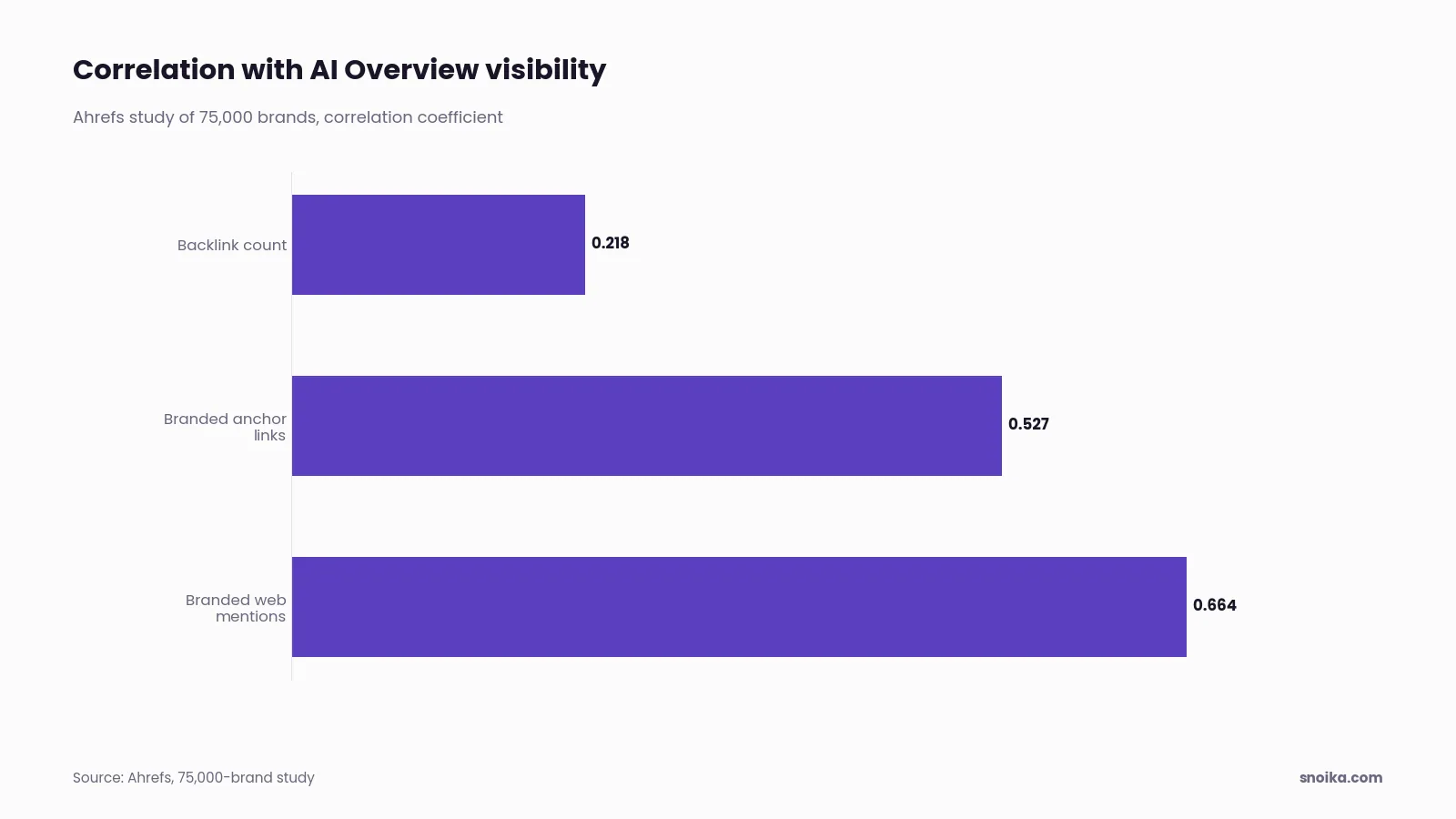
Ahrefs studied 75,000 brands and found that branded web mentions had a 0.664 correlation with AI Overview brand visibility, the strongest of any factor it measured. The top three factors in that study were all off-site. After mentions came branded anchor text and branded search volume. Ahrefs adds its own caveat that correlation isn't causation. Still, when every one of the strongest signals sits off your domain, that tells you where to put the effort.
Google ranks pages, while an assistant assembles an answer and names entities inside it. A ranking needs authority pointed at a URL. A mention in an answer needs your brand name to show up again and again, in the right context, across sources the model trusts. A forum thread with no link can help you in ChatGPT and do nothing for your rankings. In practice, off-site generative engine optimization rewards consistency. The same description of what you do, repeated across independent sites, makes it easy for a model to repeat it too.
Sources vary by model and query; a question with commercial intent such as "best payroll software for startups" pulls from different sources than a definition question. Before you plan anything, type your five most valuable buyer questions into ChatGPT and Google, and write down which domains each answer cites.
How AI sources brand mentions
AI assistants find brand mentions through 2 routes, either in material absorbed during training or through live web retrieval when they answer. The two routes reward different off page SEO techniques, and every platform weights them differently. That's why one channel never covers all of them.
Training data sets the baseline
Training data is the model's long memory. If your brand appeared consistently across the web before a model's cutoff, the model "knows" you even with browsing turned off. You change that memory slowly by building a larger, steadier footprint that future training runs pick up. Earned mentions on high-traffic sites matter most here because copies and quotations multiply how often your name appears. Links to those mentions extend their reach too.
Live retrieval picks the citations
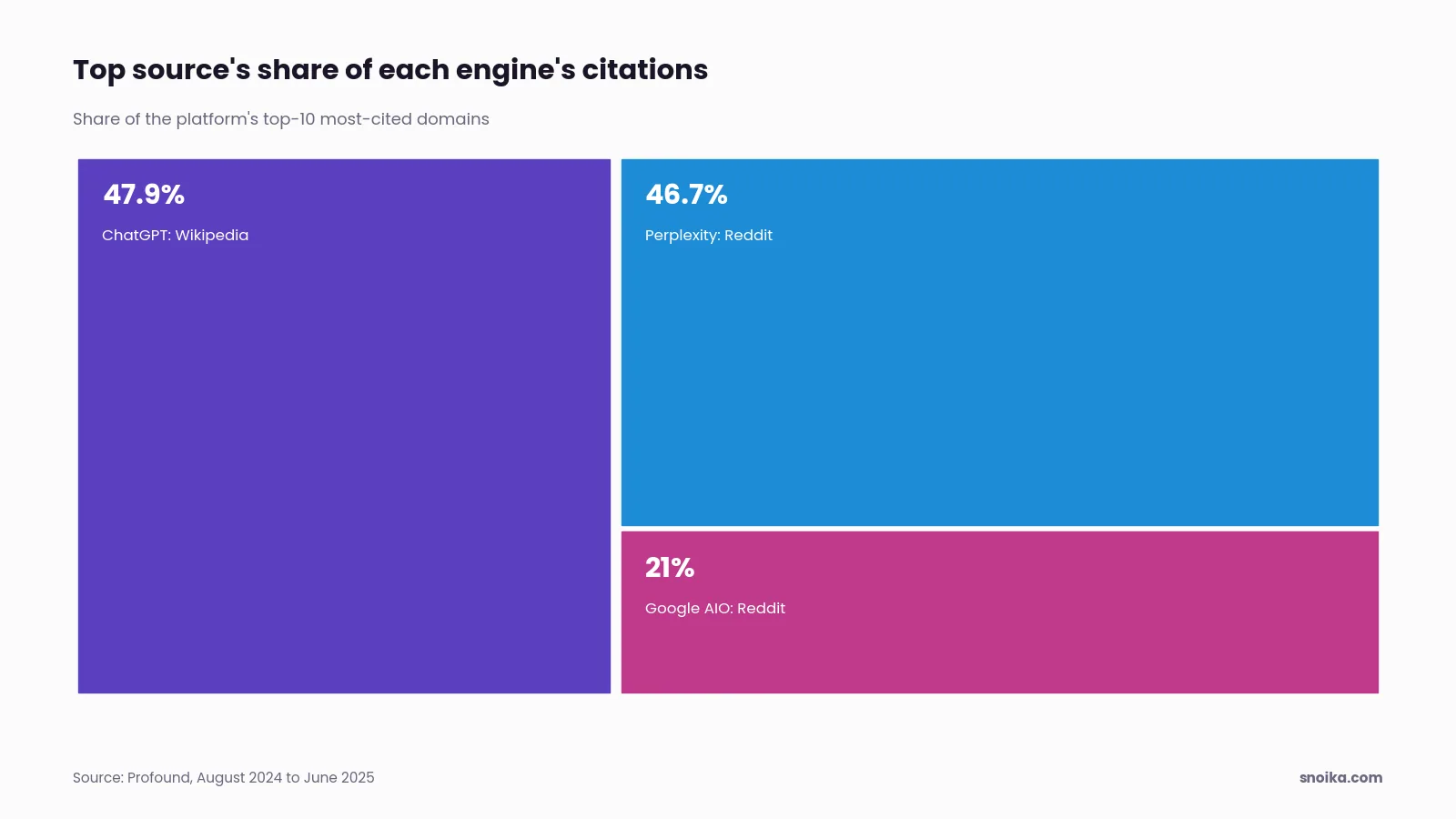
Live retrieval is what puts a clickable source under an answer. The assistant reads the top results of a search and cites the passages it uses. A study by Profound of 30 million citations from August 2024 to June 2025 shows how differently the platforms behave:
| Platform | Most cited source | Its share of top-10 citations | Other sources in the top group |
|---|---|---|---|
| ChatGPT | Wikipedia | 47.9% | Reddit (11.3%), YouTube (11.3%) |
| Google AI Overviews | 21% | YouTube (18.8%), Quora (14.3%), LinkedIn (13%) | |
| Perplexity | 46.7% | Wikipedia, major publications |
ChatGPT
- Most cited source
- Wikipedia
- Its share of top-10 citations
- 47.9%
- Other sources in the top group
- Reddit (11.3%), YouTube (11.3%)
Google AI Overviews
- Most cited source
- Its share of top-10 citations
- 21%
- Other sources in the top group
- YouTube (18.8%), Quora (14.3%), LinkedIn (13%)
Perplexity
- Most cited source
- Its share of top-10 citations
- 46.7%
- Other sources in the top group
- Wikipedia, major publications
The Google AI Overviews breakdown comes from Profound and SE Ranking data compiled by DemandSage. Answer engines quote this row directly. Google AI Overviews pull mostly from community platforms such as Quora and video platforms, with Wikipedia much lower at 5.7%. They also cite pages that don't rank well. Ahrefs found that only 38% of AI Overview citations ranked in Google's top 10 for the same query by March 2026, down from 76% in July 2025.
Only 11% of domains) are cited by both ChatGPT and Perplexity. A Semrush analysis of 230,000 prompts found Reddit's presence in ChatGPT answers dropped from about 60% to 10% of prompts between July and October 2025. Treat any source ranking as a snapshot and check it again each quarter.
Reddit as an authority signal
Reddit counts as an authority signal because AI platforms treat its upvoted threads as real buyers' opinions, and Google pays to read them. Reuters reported in February 2024 that Google's licensing deal for Reddit content was worth about $60 million per year. A thread where 40 users argue about the best tool in a category is exactly the kind of comparison an AI assistant wants to sum up.
To build authority on Reddit that AI assistants pick up, take part in the subreddits where your buyers ask questions. Answer properly under a named account, and wait a long time before you mention your product. Reddit's own business guidance tells brands to follow the 90/10 rule: 9 contributions that help for every 1 that promotes. Moderators and users read account histories, so a profile that only posts links gets downvoted or banned, and buried threads rarely get cited.
The threads that end up in AI answers have specific titles ("Switched from X to Y after 2 years, here's why") and detailed top comments. They also contain real numbers. You get the most value when customers name you without being asked. The work happens off Reddit when you make the product easy to recommend, then make it easy for happy users to say so in the threads they already read.
Each subreddit sets its own rules on self-promotion. Reddit's guide to finding the right subreddits points out that some communities keep a pinned thread for promotional posts and ban them everywhere else. Before you post, read the sidebar rules. Then search the subreddit for your category name and your competitors' names, and note which threads already show up in AI answers for your buyer questions. Those threads are where a careful, honest reply carries the most weight.
Review sites AI trusts
AI assistants trust review platforms such as G2 and Capterra because verified, moderated reviews are hard to fake in bulk. That trust also extends to Trustpilot. One June 2026 test ran 40 B2B software categories through ChatGPT and found zero citations to G2 or Capterra across 233 recommendations. Yet review platforms appeared in 34.5% of the Google AI Overview responses in a separate analysis.
Review sites work as an eligibility gate, even when they aren't the cited source. Nearly every tool ChatGPT recommended in that test had G2 and Capterra profiles, even when another page got the citation. Presenc AI's monitoring found that brands in G2's top 20 for their category get cited about 3.1 times more often in "best [category]" answers than brands absent from G2. A missing or thin profile tells the model you aren't a serious option.
B2B software buyers and models look at G2 first. That group got bigger when G2 acquired Capterra from Gartner in February 2026. Software Advice and GetApp were part of the same deal. Consumer brands depend more on Trustpilot, while local businesses depend on their Google Business Profile. Google AI Overviews also prefer recent reviews, so a profile with no new reviews in 6 months looks stale.
The first of 3 questions for your top 2 platforms is whether the category listing matches how buyers describe the problem. Is the product description the same one you use on LinkedIn and your homepage? Do you have reviews from the last quarter, and have you answered the critical ones? Fix all three before you ask for a single new review.
Press coverage builds citation equity
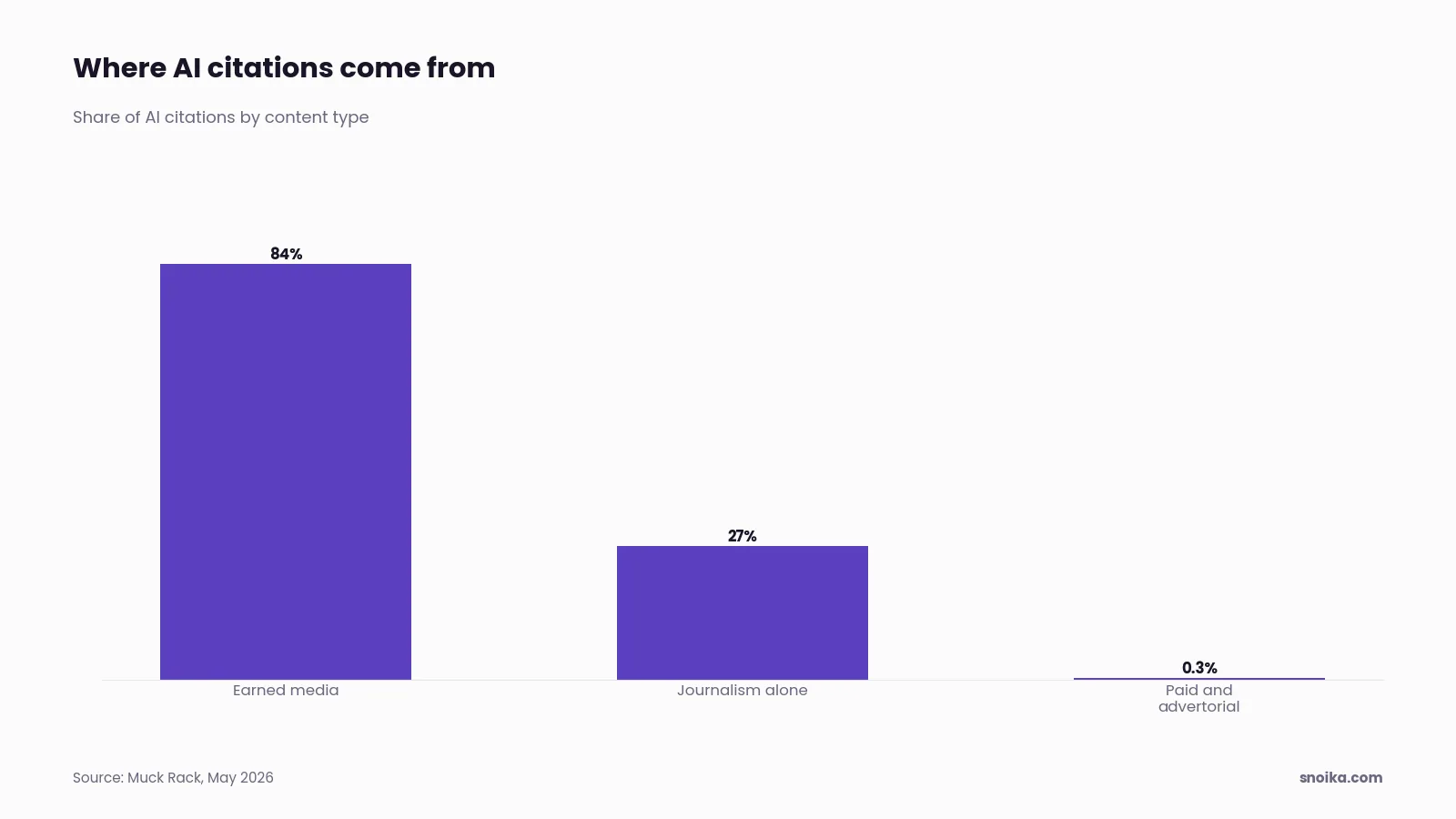
Press coverage builds citation equity because AI systems cite journalism far more than anything a brand publishes itself, and one article keeps getting cited long after it runs. Muck Rack's May 2026 Generative Pulse report analyzed more than 25 million links from ChatGPT and Claude as well as links from Gemini. It found that earned media made up 84% of AI citations, with journalism alone at 27%. Paid and advertorial content made up 0.3%.
"If your brand is not showing up in the media coverage AI is reading, you are not showing up in the answers AI gives," said Greg Galant, co-founder and CEO of Muck Rack. That's why press is now both an SEO and a digital PR job. A trade publication article that explains your category and names you as an example gives every model a neutral sentence to repeat.
Muck Rack's December 2025 edition found that the highest citation rate comes within seven days of publication. So a burst of coverage around a data release or launch does more than the same number of articles spread over a year. Older coverage still counts in training data, but fresh coverage is what live retrieval reaches for.
The relevant outlets vary by industry, and Muck Rack found little overlap between the publications each model cites. So the list of outlets you pitch should come from your own prompt results. We've also found that original data travels furthest: a survey or benchmark gives journalists a reason to write about you and gives models a number to cite with your name attached.
LinkedIn boosts professional brand signals
LinkedIn boosts professional brand signals because AI platforms cite it as evidence that real, named experts stand behind a company. The Semrush study of 230,000 prompts, run from July 14 to October 12, 2025, placed LinkedIn among the top five cited domains on ChatGPT and Google AI Mode; LinkedIn also made that group on Perplexity. For B2B queries, it's the only source that ties a person's expertise to a brand.
Spotlight data shared on LinkedIn found that, of roughly 19,000 LinkedIn sources cited by AI tools, over 15,000 were articles. Long-form articles organize a clear argument under a title, with a structure that gives retrieval systems passages to quote. A clever 3-line post rarely gives a model anything to cite.
People strengthen the company page's signal when they connect their expertise to the brand. A founder who writes a monthly article on one problem in their category, under a profile that lists their role and history, builds a link the model can follow from person to brand. Employees who describe the company the same way in their profiles add to the consistency that makes a brand easy to summarize.
For the first of 2 checks, confirm that your company page description is word for word the same as your positioning elsewhere. And do the people you'd want quoted as experts have thought leadership articles that answer your buyers' real questions?
YouTube increases multi-platform presence
YouTube increases your presence across platforms because AI systems read video titles and descriptions as text. They also read transcripts, and that text shows up in nearly every answer engine. Ahrefs extended its 75,000-brand study to ChatGPT and Google's AI surfaces. It found YouTube mentions had a 0.737 correlation with AI visibility, stronger than web mentions or any other factor.
YouTube also gets cited where your website can't. In Ahrefs' March 2026 analysis of AI Overview citations from pages outside Google's top 100, 18% came from YouTube. A video can earn a citation for a query where your written content doesn't rank at all. For how-to and comparison questions, video is the source Google prefers.
Ahrefs counted any appearance of a brand name in a video's title or transcript. Mentions in the description counted as well, so a creator's review or a comparison video that names you counts too. Sending your product to the 5 creators who already review your category can do more than 20 uploads of your own.
In B2B video marketing, upload accurate transcripts so auto-captions that misspell your brand name don't compromise the text layer. Put the brand name and the problem you solve in the title and the first lines of the description. Add chapter timestamps so a retrieval system can find the exact passage that answers a question.
Wikipedia as a credibility anchor
Wikipedia is a credibility anchor because models use it as the reference text for what an entity is, and ChatGPT cites it more than any other source in the Profound data above. Across Profound's full dataset of 680 million citations, Wikipedia still makes up 7.8% of ChatGPT citations overall. An accurate article gives a model a neutral definition of your company to build its answers around.
A company qualifies for a Wikipedia article only when independent, reliable sources have covered it in depth. That makes Wikipedia the result of the press work described earlier, and something you can't start with. Until a brand has that coverage, its first step is to make sure Wikipedia articles about its category mention it where the sources support it. A standalone article at that stage will be deleted.
The conflict-of-interest rules are strict, and breaking them backfires. Employees and agencies must follow Wikipedia's process to declare the conflict on their company's article's Talk page and propose sourced changes for independent editors to review. Undisclosed edits get flagged, and editors sometimes respond by stripping the article down or adding critical material.
If you already have an article, read it once a quarter. A stale description with outdated product names or a former CEO will show up in AI answers. Propose fixes on the Talk page with a citation for each one. Check your Wikidata entry as well, since structured facts like founding date and headquarters come from there.
Links still drive domain trust
Links still drive domain trust because AI assistants retrieve from search indexes, and those indexes still rank pages partly by links. Google AI Overviews ground their answers in Google's index. ChatGPT search leans on Bing: a Seer Interactive analysis found 87% of SearchGPT citations matched Bing's top 10 results. A page that never gets retrieved never gets cited, however good it is.
In the Ahrefs 75,000-brand study, raw backlink count correlated with AI Overview visibility at only 0.218, while links with branded anchor text scored 0.527. A link that says "according to Acme's 2026 payroll survey" teaches the model your name and your topic together, whereas "this report" carries no information about you.
Links only build trust for the domain they point to. When we publish for clients, we use a DNS connection to put pages on the client's own domain. Every link those pages earn adds to the client's authority. If your blog or resources sit on a subdomain or a third-party platform, use backlink monitoring to check whether the links you earn are building your main domain at all.
Off page link building now looks like digital PR. Data studies and free tools earn branded links from relevant sites, as does expert commentary. Directory blasts and paid link packages produce unbranded links on sites that models don't trust. Check whether most of your top 20 referring domains are sites a buyer in your category would read; if they aren't, they're doing little for AI visibility.
Your off-page SEO checklist
For the fastest payoff from this off page SEO checklist, measure your position before you fix existing sources. Then earn the mentions you're missing. Skipping the first step is the most common mistake. Teams start pitching journalists before they know which sources the models cite for their category.
Measure where you stand
Pick 20 to 50 prompts your buyers type at different stages, such as "what is" and "best tool for". Run them in ChatGPT and Google, and record whether you're mentioned and how you're described. Note which domains get cited too. Do it weekly, because answers to the same prompt change from run to run. In our own tracking, weekly prompt sets measure mentions and share of voice in ChatGPT and Google AI Overviews, where most AI search traffic happens. We also track sentiment and citations in those responses. We pair that with Google Analytics 4 (GA4) and Google Search Console data, so movement in answers can be checked against real traffic.
Fix the sources AI already reads
Start with assets you control or can influence quickly:
- Bring your G2 or Capterra profile up to date with current positioning and recent reviews. Do the same for your Trustpilot profile.
- Rewrite your LinkedIn company page and founder profiles so they describe the company the same way your homepage does.
- Read your Wikipedia article, if one exists, and propose sourced corrections on the Talk page.
- Fix YouTube titles and descriptions that misspell or leave out your brand name. Correct those errors in transcripts too.
- Find old press articles with outdated facts and ask the outlets to update them.
Earn new mentions in priority order
- List the domains cited most often for your prompts where competitors appear and you don't.
- Group forums and review sites separately. Create groups for publications and video, with reference sources in their own group too.
- Match each group to its tactic from the sections above. That means helpful Reddit marketing for forums and data-led pitches for publications.
- Publish one piece of original research a quarter that gives journalists and creators a reason to name you.
- Ask satisfied customers for reviews and permission to be named as case studies.
- Rerun your prompt set after each push and compare it with your starting point.
Progress shows up in the numbers within weeks when the sources line up. 1StopVAT, in tax and fintech, saw 10x growth in ChatGPT visibility in 7 weeks. Both results depended on work across multiple channels, with measurement first and then efforts to fill the gaps the prompts showed.
What to do next
Run your buyer prompts this week and list every domain cited for competitors where you're absent. That list is your off-page SEO plan for AI, ordered by the sources models already trust. It's more reliable than any generic channel ranking, even those on this page, because citation patterns differ by industry and keep shifting. Record both whether assistants mention you and how they describe you. A wrong description spreads as fast as a correct one.
Snoika tracks brand mentions and citations in ChatGPT and Google AI Overviews, and our team builds and publishes the content that closes those gaps. To go through your prompt results with us, book a call.
FAQ
Independent brand mentions and links that name the brand are associated with greater AI visibility. Consistent descriptions across relevant sources help assistants connect a brand with its topic. These correlations don't prove that increasing mentions will cause more citations.
Build a credible account history by answering buyer questions in relevant subreddits before promoting a product. Follow each community's rules and contribute detailed replies under a named account. Prioritize threads already cited for your buyer questions, but don't expect participation to guarantee recommendations.
Reddit and YouTube were leading sources in the citation data cited on this page. The sources used vary by question and change over time. Check citations for your own buyer questions before deciding which platforms deserve attention.
Traditional off-page seo focuses on backlinks that support page rankings, while AI search also draws on unlinked mentions to describe and recommend brands. Links still help content get retrieved, but AI visibility also depends on what independent sources say about the brand.
Improvements can appear within weeks when work targets sources assistants already cite, but there's no fixed timeline. Live retrieval can reflect fresh coverage sooner than training data changes. Compare the same buyer prompts weekly because answers vary between runs.


