
Inbound lead generation from AI search
Your buyers now ask ChatGPT for a shortlist before they visit your site, and the vendors it names get the demo requests. Snoika makes AI search a working channel for inbound lead generation. We publish the pages AI assistants cite and count the leads those pages bring in. To see where your brand shows up in AI answers today, get a free AI visibility report.
Trusted by























AI search as inbound source
AI assistants are now where B2B buyers build their shortlists, so AI SEO belongs in your inbound plan alongside organic search. In a March 2026 G2 survey of 1,076 software buyers, 51% of B2B buyers said they favor an AI chatbot over Google to start research, up from 29% in April 2025. The same report found that 69% picked a different vendor than they had planned because of what a chatbot told them.
In 2024, Alan Antin, Vice President Analyst at Gartner, said GenAI tools were "becoming substitute answer engines" for queries people used to type into search engines. An assistant names three or four vendors and explains why it picked them. If you're left out, there's no second page to fall back on.
How buyers prompt AI assistants
Buyers write prompts as full sentences that include their own context, and that context decides which vendors get named. A search query such as "e-signature software" becomes a prompt such as "which e-signature tool suits a 40-person fintech in Germany that needs qualified signatures?" The assistant then filters vendors by company size, country and use case. Most buying prompts fall into four patterns:
- Category shortlists — For example, "best inventory software for small manufacturers."
- Alternatives — Buyers ask for alternatives to a named vendor.
- Head-to-head comparisons — Buyers compare two products directly.
- Problem-first questions — Buyers describe a problem and never mention a product category.
SaaS buyers ask for alternatives, while professional services buyers favor questions that describe a problem. We run weekly prompt sets in ChatGPT and Google AI Overviews, where most AI search traffic happens, and measure mentions, share of voice, sentiment and citations for each prompt. Our AI visibility tool runs your buyers' own prompts, because generic category terms won't show you much.
Content that earns AI citations
AI assistants cite pages that answer a specific question in their first lines and back the answer with evidence. The Princeton and IIT Delhi paper that coined the term generative engine optimization (GEO) found that adding cited sources and statistics can lift visibility up to 40% in AI-generated answers. The authors also noted that results vary by subject area, so we test formats in your own category before we scale them.
We pick formats only after we've mapped the prompts. Our content map covers the whole website and pairs keyword research and a SERP check of every target with the prompts to target in AI assistants. Its review of existing pages identifies which to update or merge, along with those to redirect or delete.
Comparison pages
These pages answer the prompts closest to a purchase. We put the comparison in a table with the same attributes for every option and say plainly who each option suits. Assistants lift those lines into their answers.
Answer-first guides
Each section opens with the direct answer, then the explanation. An assistant can quote that first sentence on its own. If the answer only appears in paragraph four, it's harder to extract.
Pages with original figures
Your own data and prices give an assistant something to cite that it can't find elsewhere. Named sources do the same, so we build them into the pages we write.
Capturing AI-referred visitors
We turn AI search traffic into inbound leads by putting the next step on the page the assistant cites. That's a deep page, because your homepage rarely gets cited. These visitors have already compared options before they arrive. A June 2025 study found the average AI search visitor is 4.4 times as valuable as an organic visitor, measured by conversion rate.
The most common mistake is a cited guide with no call to action at all. So we place the demo request or trial sign-up on the cited page itself and keep the form short. The offer matches the prompt, such as a comparison and a trial for someone who asked for alternatives.
Attributing leads to AI referrals
We attribute inbound leads to AI referrals by segmenting AI referrers in Google Analytics 4 (GA4) and counting lead events per landing page. Our onboarding connects GA4, Google Search Console and Google Tag Manager, then sets it up in this order:
- 1AI channel groupCreate a GA4 channel group for AI referrers such as chatgpt.com, perplexity.ai and gemini.google.com.
- 2Lead eventsFire a Google Tag Manager event on every form submission and demo booking.
- 3Page-level reportsReport leads by landing page, so you can see which cited page produced each one.
- 4Discovery fieldAdd a "How did you hear about us?" field that includes AI assistants as an option.
The fourth step matters because assistant apps don't always pass a referrer, so those visits show up as direct traffic.
B2B inbound strategy for AI
Our B2B inbound strategy for AI starts with buying prompts and then publishes pages for them on your own domain, in each market where demand exists. We start with the prompts where AI assistants already name your competitors, because those buyers are ready to compare vendors. Your domain is what gets cited, so content on third-party platforms builds less authority for you. Pages we create go live on your own domain through a DNS connection, with no migration and on any CMS, and you approve each page in the dashboard before it goes live.
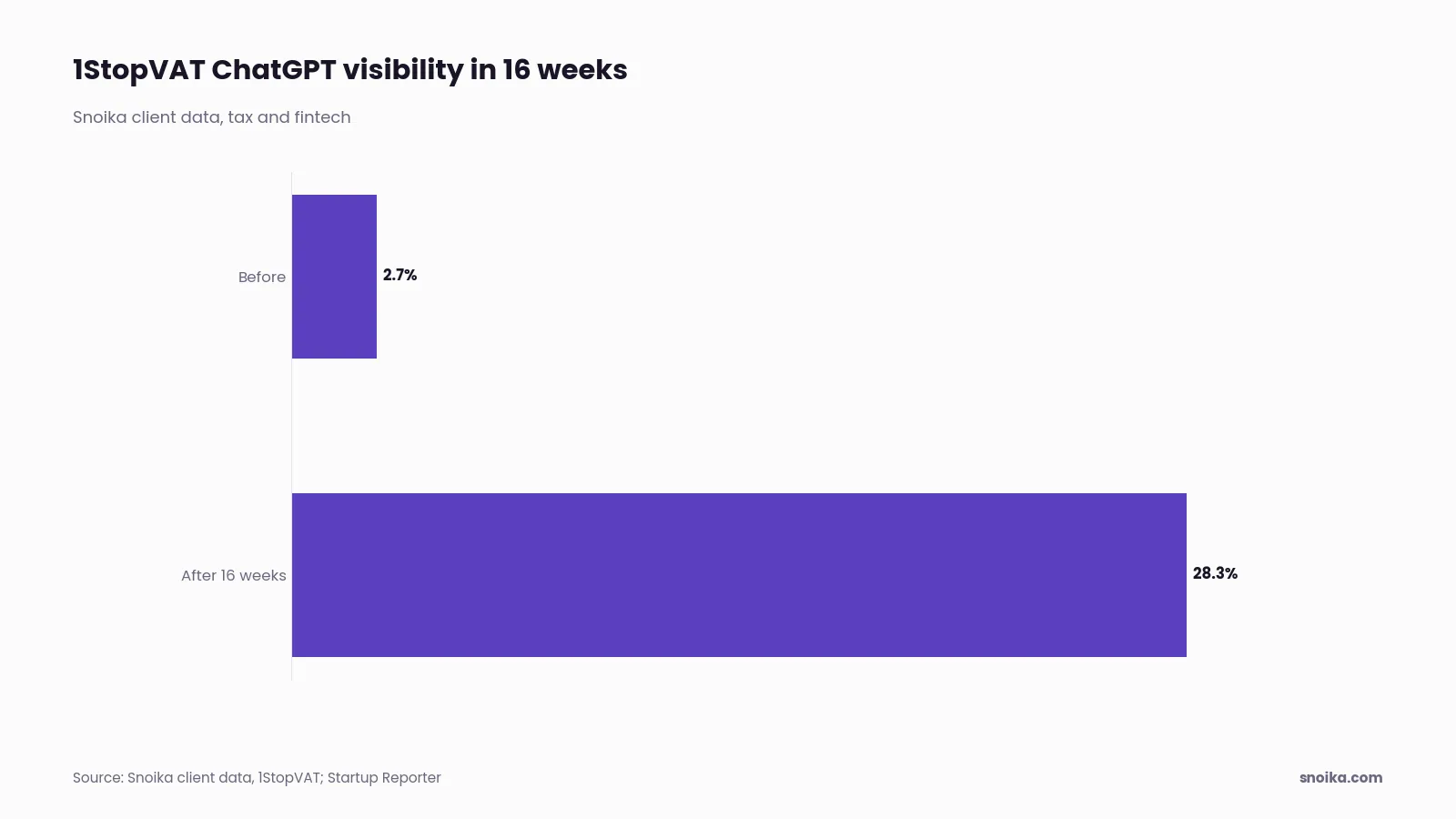
A prompt in German or Polish names a different shortlist than the same prompt in English. Our SEO content writing covers 135+ languages and regional variants. Snoika's founder Anton Vedeshin reported to Startup Reporter 1StopVAT's move from 2.7% to 28.3% ChatGPT visibility in 16 weeks.
What Snoika covers
Snoika covers the three jobs that get B2B companies cited by ChatGPT and turn those citations into leads. One team handles all three:
A monitoring-only tool tells you where you stand but leaves the content and attribution work to you. If you already have writers and analysts, an in-house team plus tracking can work. If you don't, a platform with SEO solutions and services fills the gap. Plans are on the pricing page.
Measuring inbound pipeline from AI
We measure inbound pipeline from AI by following visibility in tracked prompts through to AI-referred sessions, then leads per page through to qualified pipeline. If visibility rises but sessions stay flat, the cited pages aren't earning clicks. If sessions rise but leads don't, the problem is on the page.
We review the chain weekly but judge it over a quarter. 3DPrinterOS recorded an 87% increase in LLM brand mentions and reached #1 visibility in ChatGPT for its industry queries before AI-driven discovery settled at 3–4 qualified inbound leads a day. We report on qualified leads as well as raw form fills, because sales will judge the channel on those.
We measure inbound pipeline from AI by following visibility in tracked prompts through to AI-referred sessions, then leads per page through to qualified pipeline.
FAQ
Snoika tracks your mentions for buyer prompts in AI assistants, creates the pages they cite and sets up lead attribution. One team covers all three jobs, so visibility gains connect to leads.
We place the next step on the page the assistant cites and match it to the visitor's buying question. Forms stay short, and if AI visits rise without more leads, we revisit the page's offer and form.
Comparison pages and answer-first guides give assistants passages they can quote. We choose the format from the buyer's prompt, back the answer with original figures or named sources, and test formats in your category before scaling.
We group AI referrers in Google Analytics 4 and track form submissions by landing page through Google Tag Manager events. A discovery-source field with an AI-assistant option catches visits that arrive as direct traffic.
We review performance weekly but judge results over a quarter. Reports follow visibility through to visits, then to qualified leads, because that's the number sales will judge the channel on.