
SEO guide for growing companies
Search engine optimization (SEO) is the work of getting your pages to rank for searches your buyers already make, so they reach you without a paid click. Growing companies start the first two of four SEO jobs when they choose topics with real demand and write the page that answers each one best. Then keep the site technically clean and earn links that prove trust. This SEO guide takes those jobs in the order you'll do them.
 Jevgenia PogadajevaCFO, Snoika · 13 min read

























How SEO drives organic growth
SEO drives growth because organic search is the largest traffic channel for most websites, and a page that ranks keeps bringing visits after the work on it stops. BrightEdge measured this across thousands of domains and found organic search delivered 53% of trackable traffic in 2019, up from 51% in 2014. That figure is several years old, so treat it as a guide. Your own number is in Google Analytics 4 (GA4) and Google Search Console.
An ad's traffic depends on continued spending and stops the day the budget runs out. A ranking page costs money to build and update. Because visits carry no per-visit charge, its cost per lead falls the longer it ranks. Backlinko's analysis of 4 million search results found the #1 result gets 27.6% of clicks, about 10 times the share of the #10 result.
Tim Soulo, CMO at Ahrefs, reported that 96.55% of pages in the Ahrefs index get zero traffic from Google. He traced it to pages with no search demand or no backlinks. Pages that miss what the searcher wanted also get no traffic. So the growth comes from choosing and building pages with care. Publishing more pages doesn't produce it. Before you plan anything, open Search Console and check how many of your pages earned a single click in the last 3 months. The answer is humbling, and it tells you where to start.
How Google ranks pages today
Google ranks pages with automated systems that decide which indexed pages best answer a query and which of those it can trust. Before any of that happens, Googlebot has to crawl the page and add it to the index. A page that isn't indexed can't rank, however good it is.
Google's guide to ranking systems names the main parts. The helpful content system, launched in 2022 to reward "original, helpful content written by people, for people," became part of the core ranking systems in March 2024. Link analysis, of which PageRank is a part, is still a core system too. Google uses it to judge what a page is about and how much other sites vouch for it. And page experience counts, though a fast page with thin content won't outrank a slower page that answers the question properly.
In practice, Google weighs relevance first. A page matches the intent of a "CRM pricing" query when it provides the price table the searcher wants. Google then assesses quality through the author's identity and evidence of first-hand experience. Citations from other sites also inform that assessment.
Ahrefs tracked 1 million new URLs and found only 1.74% reached the top 10 within a year, down from 5.7% in 2017. The same study found 72.9% of top-10 pages are more than 3 years old. New sites and new topics take months to rank. Updating a page that already ranks is faster than publishing a new one.
Keyword research for real demand
Keyword research finds the searches your buyers make at each stage of a purchase, then gives each search its own page. A search counts as real demand when it has measurable volume and the intent behind it matches something you sell. Volume alone tells you little. A term with 50 searches a month from people comparing vendors can be worth more than a term with 5,000 searches from students.
Run the research in this order:
- List the problems buyers bring to sales calls, in their own words. Your sales and support teams hear these phrases every week.
- Put those phrases into a keyword tool and note volume and difficulty for each one. Record the related terms the tool suggests too.
- Search each term in Google and read the top results. The format that ranks shows the intent Google has settled on. A guide or comparison reflects that intent, as does a product page or calculator.
- Group terms that share one intent into a cluster. One cluster gets one page, which stops two of your pages from competing for the same query.
- Tag each cluster as problem-aware or solution-aware, with a separate tag for searches that compare vendors.
- Rank the clusters by how close they sit to a sale, then by how hard the competition looks, based on competitor keyword research.
The priorities in step 6 direct you toward vendor-stage searches that reach people who are already choosing. Examples are "[category] software for [industry]" and "[competitor] alternatives." Searches for "[product] pricing" reach buyers at this stage too. These pages convert at the highest rate, so they belong first in the queue even when their volume looks small. Problem-stage guides have lower conversion rates. But they earn links and get quoted in AI answers. They also put your brand in front of buyers months before a deal.
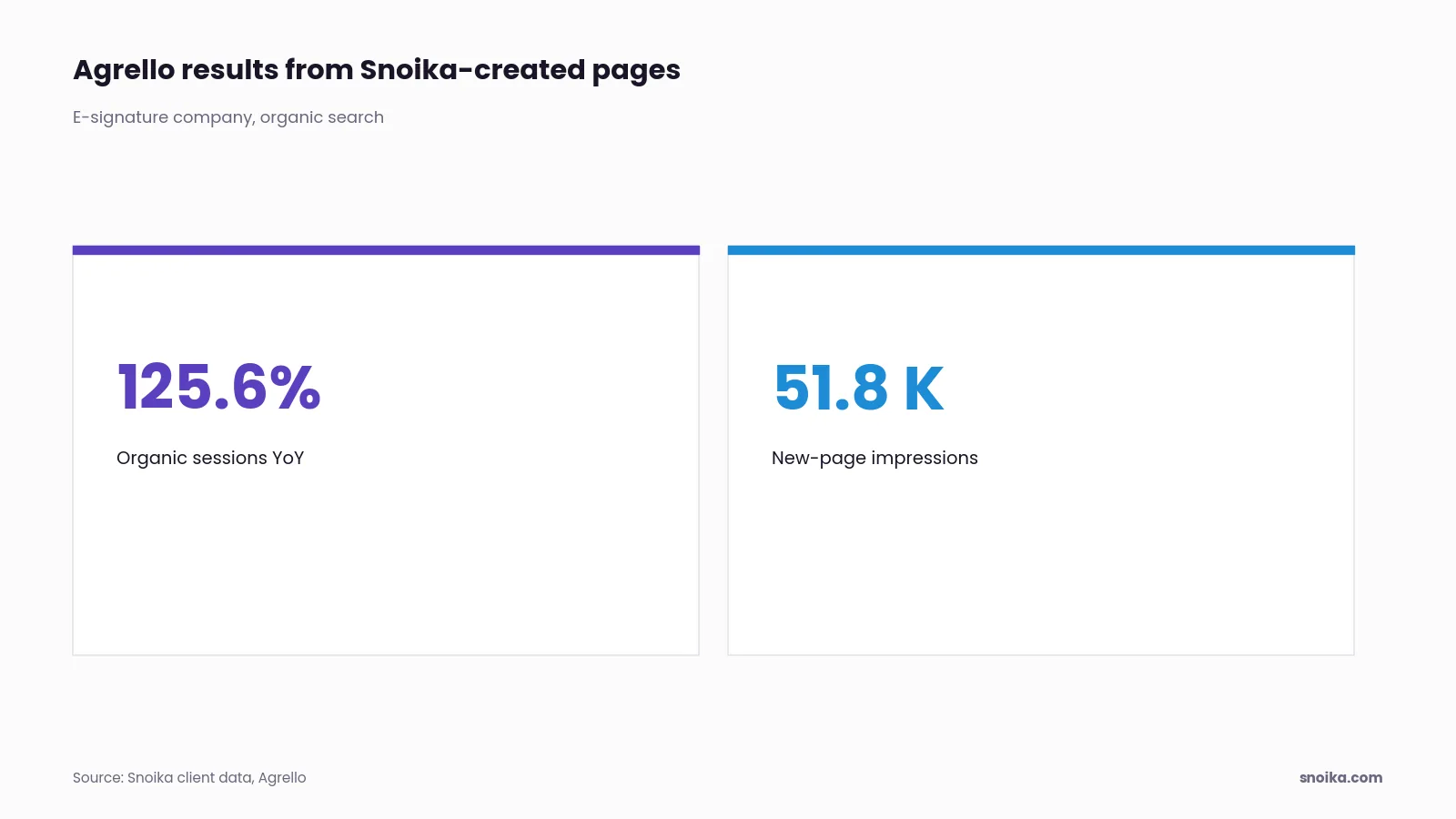
Agrello, an e-signature company, recorded +125.6% organic search sessions year over year, and the pages Snoika created for it generated 51.8K impressions. A planned cluster of pages beats a pile of one-off posts in B2B SEO. Keep one check on every brief before writing starts. If you can't name the page a reader should visit next, and the action they'd take there, the keyword doesn't belong on your list.
On-page signals that decide rankings
On-page signals tell Google what a page is about and whether it answers the query better than the other results. The strongest signal is intent match. Get that wrong and the other signals won't save the page.
Put the main term and a reason to click in the title tag, one of the elements Google reads first. Backlinko's data, as reported by OuterBox, shows titles of 40 to 60 characters earn about 33% higher click-through than longer or shorter ones, mostly because they don't get cut off. The H1 states the topic plainly. Answer the main question outright in the first paragraph, because both readers and Google decide quickly whether the page is worth the scroll.
Below that, check these SEO best practices on every page:
- Subheadings that each answer one sub-question, so a reader who skims finds their part fast.
- Internal links from related pages, with anchor text that describes the target page.
- A named author with real experience of the subject, plus sources for every figure.
- Structured data that matches what's visible on the page. Article or Product markup can fit the page's content; Organization markup can describe the organization shown there.
- Image SEO with descriptive file names and alt text.
- A meta description that sums up the answer, even though Google sometimes rewrites it.
A pricing page needs a table and clear terms, while a guide needs examples and steps. Read the top 3 results for your term and note what they cover that you don't. Then write the version with first-hand detail they lack. Copying their outline gets you a page that's equal to theirs, and an equal page has no reason to outrank an older one.
Technical SEO checks to pass
The technical issues that hurt rankings most are the ones that stop Google from crawling or indexing your pages. Slow loading and duplicate URLs come next. A block in robots.txt or a stray "noindex" tag can wipe out a section of the site overnight, and nobody notices until traffic drops. Speed problems do slower damage, but they cost conversions every day.
Can Google crawl and index each page?
Open the Pages report in Search Console and read the reasons Google gives for pages it hasn't indexed. "Crawled, currently not indexed" points to thin or duplicate content. "Blocked by robots.txt" and "Excluded by noindex tag" point to settings someone changed during a redesign. Check that your XML sitemap lists only pages you want indexed and that it returns no errors. For sites that build content with JavaScript, use the URL Inspection tool to check whether Google sees the rendered text or an empty shell.
After ABS Technologies' keyword indexability improved, its search visibility rose sharply within the first 30 days, and SERP impressions grew 6x. Indexing fixes show results faster than any other SEO work, because the pages already exist and just weren't being counted.
Does the site load fast on mobile?
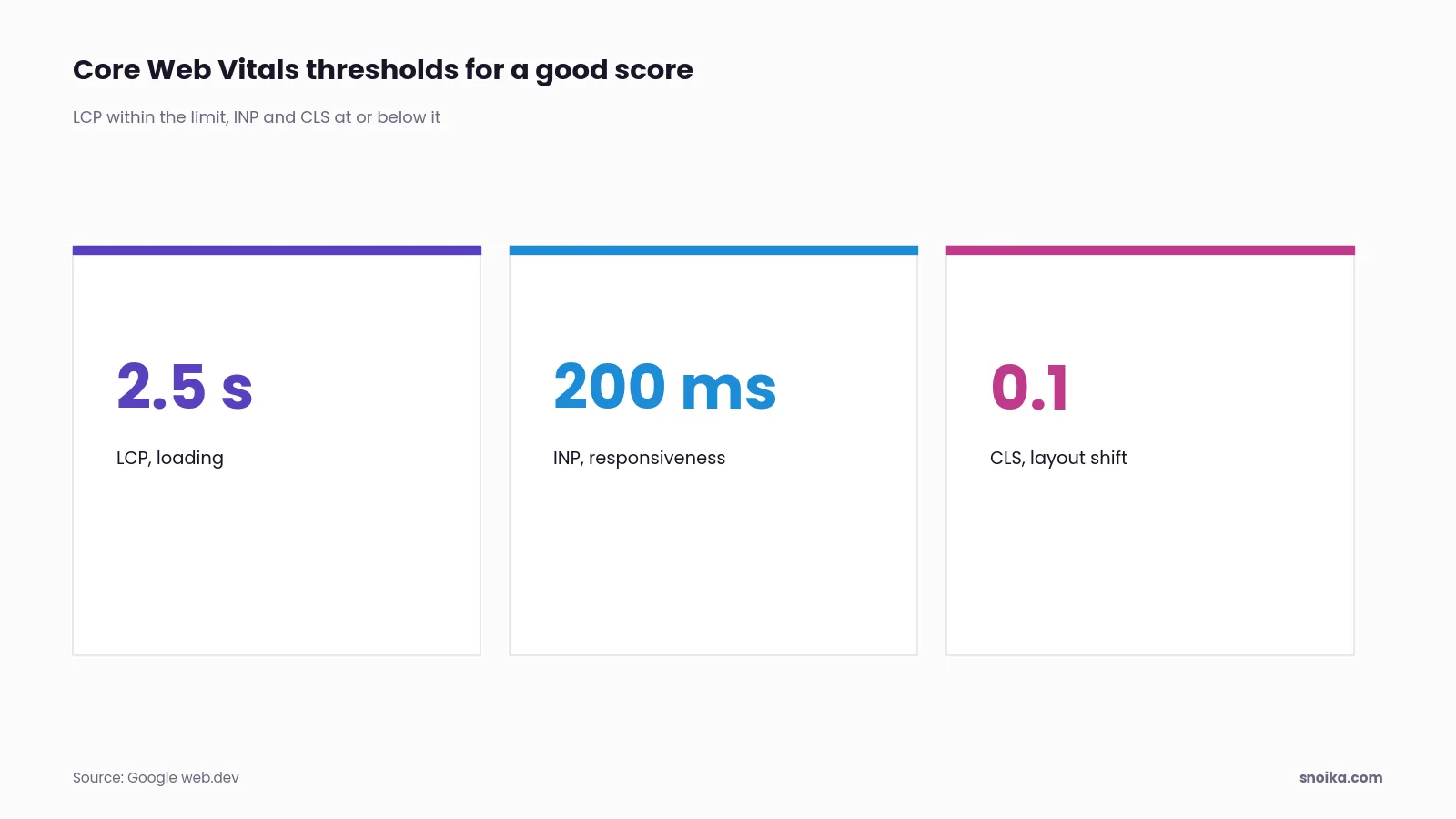
Google measures speed with Core Web Vitals based on real visits from Chrome users. Google's web.dev documentation defines a good Largest Contentful Paint (LCP) as within 2.5 seconds and a good Interaction to Next Paint (INP) as 200 milliseconds or less. The good threshold for Cumulative Layout Shift (CLS) is 0.1 or less. Mobile is where most sites fail, so read the mobile report first. Oversized hero images and heavy third-party scripts are the usual causes.
Does each page exist at one URL only?
Duplicate URLs split ranking signals between copies of the same page. Filters and tracking parameters create duplicate URLs. So do http or www variants. Give every page a canonical tag that points to the one version you want ranked, and send redirects straight to the final URL in a single hop.
Use this table as your pass or fail list:
| Check | What failure looks like | Where to check | Pass condition |
|---|---|---|---|
| Indexing | Key pages listed as "not indexed" | Search Console, Pages report | Every page you want ranked is indexed |
| Robots and noindex | Sections blocked after a redesign | robots.txt file, URL Inspection | No blocks on pages meant to rank |
| LCP | Main content appears late | Search Console, Core Web Vitals report | 2.5 seconds or less |
| INP | Taps and clicks respond slowly | Core Web Vitals report | 200 ms or less |
| CLS | Layout jumps while loading | Core Web Vitals report | 0.1 or less |
| Canonicals | Same page ranks at two URLs | Crawl report, page source | One canonical URL per page |
| Redirects | Chains of 2 or more hops | Site crawler | Single hop to the final URL |
| Broken links | Internal links return 404 errors | Site crawler | Zero broken internal links |
Indexing
- What failure looks like
- Key pages listed as "not indexed"
- Where to check
- Search Console, Pages report
- Pass condition
- Every page you want ranked is indexed
Robots and noindex
- What failure looks like
- Sections blocked after a redesign
- Where to check
- robots.txt file, URL Inspection
- Pass condition
- No blocks on pages meant to rank
LCP
- What failure looks like
- Main content appears late
- Where to check
- Search Console, Core Web Vitals report
- Pass condition
- 2.5 seconds or less
INP
- What failure looks like
- Taps and clicks respond slowly
- Where to check
- Core Web Vitals report
- Pass condition
- 200 ms or less
CLS
- What failure looks like
- Layout jumps while loading
- Where to check
- Core Web Vitals report
- Pass condition
- 0.1 or less
Canonicals
- What failure looks like
- Same page ranks at two URLs
- Where to check
- Crawl report, page source
- Pass condition
- One canonical URL per page
Redirects
- What failure looks like
- Chains of 2 or more hops
- Where to check
- Site crawler
- Pass condition
- Single hop to the final URL
Broken links
- What failure looks like
- Internal links return 404 errors
- Where to check
- Site crawler
- Pass condition
- Zero broken internal links
Run the full technical SEO check every quarter, and again after any redesign or migration. A CMS change also calls for a full check.
Building authority with links
Links from other sites build authority because Google still reads each one as a vote that your page deserves trust. PageRank is part of Google's core systems, as covered above. Links also help Google find pages at all. Google's SEO Starter Guide says "the vast majority of the new pages Google finds every day are through links."
A single link from a respected trade publication in your field outweighs dozens from unrelated directories. Relevance matters as much as the size of the linking site, so a niche industry blog can do more for you than a general news site with no connection to your market.
These are the off-page SEO methods that earn links without breaking Google's rules:
- Publish original data, such as a benchmark survey or an analysis of your own product usage. Journalists and bloggers link to numbers they can't find elsewhere.
- Pitch expert commentary to reporters who cover your industry.
- Ask partners and integration providers to list you on their partner pages.
- Find broken links on industry resource pages and offer your page as a replacement.
- Turn unlinked mentions of your brand into links with a short email to the site owner.
Bought links and link exchanges break Google's spam policies. They can cost you rankings once Google detects the pattern. When a link-building offer guarantees a number of links per month, assume it's selling the kind Google penalizes.
Check your link profile in a backlink tool every month. Watch the number of referring domains and compare it against the 3 competitors who outrank you for your most valuable terms. The gap shows how much authority you need to build and identifies sites where competitors have links you have yet to earn.
How SEO feeds AI answers
AI answers draw on the same pages that rank in search, so content that ranks well is the content AI Overviews and assistants cite. To get into Google's AI Overviews, a page has to be indexed and eligible to show with a snippet. According to Google's documentation on AI features, "There are no additional technical requirements," so a page needs no special schema or AI text file.
Danny Sullivan, a director at Google Search, said "Good SEO is good GEO, or AEO, AIO, LLM SEO, or LMNOPO" at WordCamp US in September 2025. Generative engine optimization (GEO) and answer engine optimization (AEO) both aim to get your brand cited inside AI-generated answers.
In AI SEO, the format of the page decides whether an AI system can quote it. AI Overviews pull short, self-contained passages. Pages that put a direct answer in the first sentence under each heading give the system a clean passage to lift. A named figure with its source is easier to quote than a vague claim. Outside Google, assistants such as ChatGPT also weigh what third-party sites say about you. Reviews and comparison articles that mention your brand feed their answers. Forum threads that mention it also contribute.
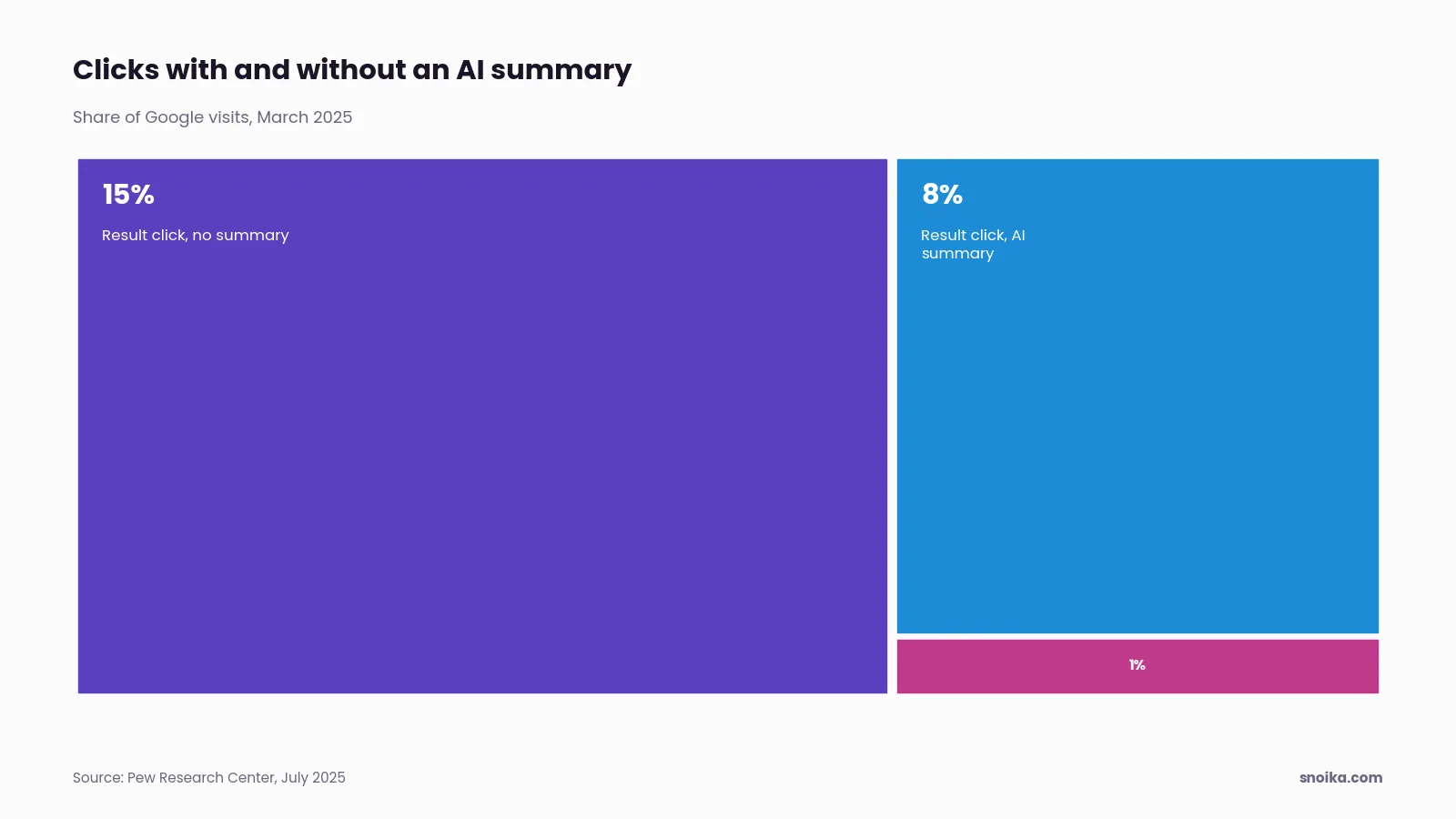
A Pew Research Center study of 900 US adults found that 18% of Google searches in March 2025 produced an AI summary. Users who saw one clicked a regular result in 8% of visits, against 15% for users who didn't. Only 1% clicked a link inside the summary. Ahrefs found AI Overviews are associated with a 58% lower click-through rate for the top-ranking page. So being cited matters even when nobody clicks, because the buyer still reads your name.
You have to measure this AI visibility separately from rankings. Snoika's tracking runs weekly prompt sets to measure mentions and share of voice in ChatGPT and Google AI Overviews, where most AI search traffic happens. It also measures sentiment and citations. Snoika's founder Anton Vedeshin reported to Startup Reporter 1StopVAT's move from 2.7% to 28.3% ChatGPT visibility in 16 weeks. If you track nothing else, list the 20 questions buyers ask before they buy. Put each one into ChatGPT and Google every month and record whose names appear.
Measuring SEO impact on revenue
You measure SEO's effect on revenue by following organic visitors from their first visit to a closed deal and reporting the pipeline they create. Traffic and rankings are leading signals. They tell you the work is moving, but a finance team will judge SEO on leads and revenue.
Search Console is the first of 3 connected tools in this setup and shows which queries produced impressions before the visit. It also records clicks. GA4 records what visitors do on the site and marks the actions that matter as key events, such as demo requests and trial sign-ups. Your CRM then has to record the original source of each lead, so that a deal closed 4 months later still traces back to organic search. Search Console counts clicks from AI Overviews inside the overall Performance report under "Web", which combines them with other search clicks.
Report these metrics, in this order of weight:
| Metric | Where it comes from | What it tells you |
|---|---|---|
| Organic pipeline value | CRM, by original source | Revenue SEO is influencing |
| Organic key events | GA4 | Leads and sign-ups from search visits |
| Conversion rate by page | GA4 | Which pages turn visits into leads |
| Clicks and impressions | Search Console | Demand you're reaching before the visit |
| AI share of voice | Prompt tracking | How often AI answers name you against competitors |
Organic pipeline value
- Where it comes from
- CRM, by original source
- What it tells you
- Revenue SEO is influencing
Organic key events
- Where it comes from
- GA4
- What it tells you
- Leads and sign-ups from search visits
Conversion rate by page
- Where it comes from
- GA4
- What it tells you
- Which pages turn visits into leads
Clicks and impressions
- Where it comes from
- Search Console
- What it tells you
- Demand you're reaching before the visit
AI share of voice
- Where it comes from
- Prompt tracking
- What it tells you
- How often AI answers name you against competitors
A B2B deal with a 6-month sales cycle takes 2 quarters to show up as revenue, so report pipeline value monthly and closed revenue quarterly. AI search adds leads that don't always arrive through a tracked click. 3DPrinterOS turned AI search into a steady inbound lead source, with 3 to 4 qualified inbound leads a day. To catch leads like these, add a "How did you hear about us?" field to your forms and count answers that name ChatGPT or another assistant.
SEO roadmap for growing companies
Fix tracking and technical health first so you can build pages for buyers close to a purchase on that foundation. Only then widen into educational content and links. That order puts the fastest returns first. It also means each later phase builds on a site Google can already read.
- Weeks 1 to 4: set up measurement and fix the foundation. Connect Search Console and GA4 with Google Tag Manager. Define key events and confirm the CRM records lead source. Run the technical checks above and fix indexing problems before anything else.
- Months 2 to 3: build the pages that sell. Write or rewrite product and pricing pages for the vendor-stage clusters from your keyword research. Do the same for comparison and "alternatives" pages. Improve existing pages that rank in positions 5 to 15, because a small lift there brings the quickest new clicks.
- Months 3 to 6: build topic clusters. Publish problem-stage guides that link to your commercial pages. Put a direct answer under each heading so AI Overviews can quote it.
- Months 4 to 9: earn authority. Release one piece of original data and pitch it to industry media. Secure partner listings and reclaim unlinked brand mentions.
- Ongoing: refresh and monitor. Update top pages every 6 to 12 months with current figures. Check rankings in rank tracking tools and track AI mentions monthly. Cut or merge pages that earn nothing.
- When the home market works: expand by language. Translate your best-converting pages first, then do international keyword research, because buyers in each market search in their own terms.
Budget and team size change the pace more than the order. A team with one marketer covers steps 1 and 2 in a quarter, while a larger team runs steps 3 and 4 in parallel. Snoika creates content in 135+ languages and regional variants, yet a translated page still needs local keyword research before it can rank. At the end of each quarter, compare organic pipeline against the plan and move effort toward whichever page type produced the most leads.
Next steps
Before you write a single new page, spend one hour in Search Console. Check which of your pages Google has indexed, and which indexed pages earned no clicks in 90 days. That list tells you whether your first job is fixing access or improving content, and it stops you from adding pages to a site Google can't fully read. Run it again in 3 months to measure progress against this SEO guide.
We audit websites and track your visibility in Google and AI assistants. Our team also publishes reviewed content on your own domain. Start free trial.
FAQ
Prioritize tracking and indexing fixes before publishing new pages. The seo guide then puts purchase-focused pages ahead of educational content. If existing pages rank in positions 5 to 15, improve those alongside new commercial pages.
Your pages must be indexed and eligible to appear with a search snippet to qualify for AI Overviews. Put a direct, self-contained answer under each heading and cite sources for figures. Special AI files or extra schema aren't required.
Problems that prevent crawling or indexing cause the greatest harm because affected pages can't rank. Check indexing reports for accidental blocks before tackling slow mobile loading or duplicate URLs. Repeat these checks after a redesign or platform change.
Turn searches that signal purchase intent into pages matching what buyers expect, such as pricing or comparison pages. Group terms with the same intent on one page, then track that page's lead conversions and the resulting pipeline.
SEO revenue depends on ranking progress and your sales cycle, rather than a fixed deadline. New pages can take months to rank. For a six-month sales cycle, report pipeline monthly and closed revenue quarterly so early progress isn't judged only by completed deals.


