
In-house vs agency marketing for B2B teams
In the in house vs agency marketing decision, a hybrid suits most B2B teams. Strategy and brand voice stay with your own staff, and an agency or platform supplies execution capacity. A fully in-house team fits once one channel brings in steady pipeline and the work fills a person's week, while an agency alone fits when you need specialist skills quickly and can't yet justify a full-time salary.
 Artem LozinskyOperations and product, Snoika · 8 min read

























B2B hybrid model explained
A B2B (business-to-business) hybrid model splits marketing so your employees own the decisions and outside partners do agreed parts of the work. In-house marketing means the people who plan and produce campaigns are on your payroll. The Association of National Advertisers (ANA) defines an in-house agency as "a department, group, or person that has responsibilities that typically are performed by an external advertising or other MarCom agency." Its 2023 study found that 82% of ANA members had one, up from 42% in 2008.
In the same survey, 92% of respondents still used outside agencies alongside their in-house capabilities. ANA CEO Bob Liodice said that "the growth of in-house capabilities has clearly changed the client/agency relationship over the past 15 years." So most large marketers had already settled on a hybrid. The open question is where to draw the line.
A hybrid works through a written split of ownership. Your team owns positioning and the budget, with the customer data in your CRM also under its control. The partner takes defined, repeatable work such as content production or technical audits, and both sides report against the same pipeline numbers. A 2-person team hands off almost all production, while a team of 10 brings in only specialists. Before you choose an agency, check that the contract names the deliverables and that you own every account and file the partner creates.
Total cost comparison
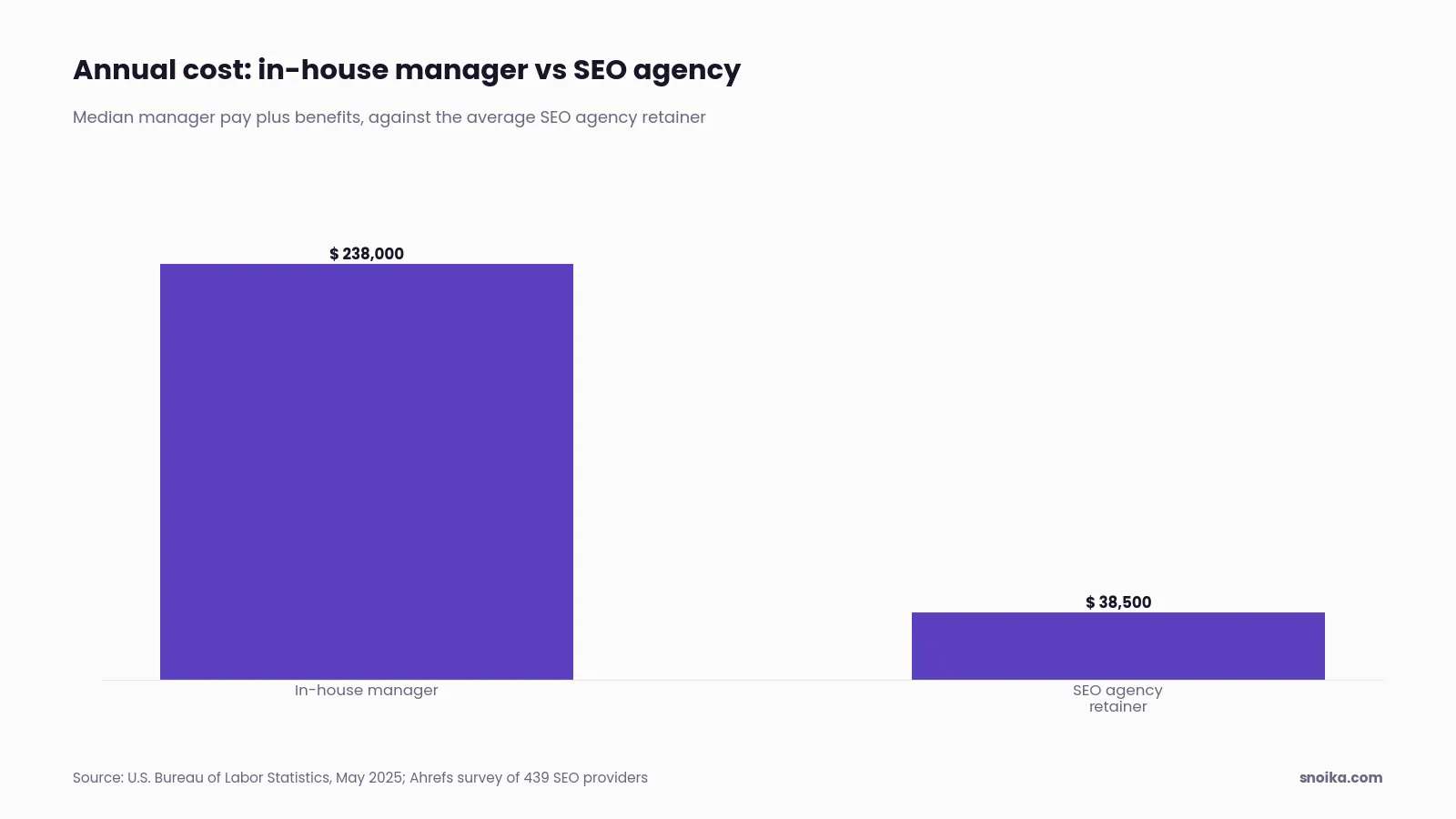
A full-time hire costs several times more per year than an average agency retainer. What the salary buys is a person who works on your business all week and remembers it. Compare full annual costs, because the sticker prices hide most of the difference.
What an in-house marketing team costs
The salary is only part of the cost of an in-house team. The U.S. Bureau of Labor Statistics (BLS) puts the median pay for marketing managers at $166,790 in May 2025. Benefits made up 30% of total compensation in private industry in June 2026, which means wages are 70%. Divide the median salary by 0.7 and one manager costs your company about $238,000 a year. The Society for Human Resource Management (SHRM) reported an additional recruiting expense in 2026, with a median cost per hire of $1,300 for nonexecutive roles and $15,000 for executives. And every specialist you add after the manager brings their own salary plus the same benefits load.
What an agency or platform costs
An agency's price is the retainer, and the hidden cost is the time your staff spend managing the agency. Ahrefs polled 439 search engine optimization (SEO) providers and found an average agency retainer of $3,209 a month, with 63% of providers charging between $500 and $5,000. At the enterprise level, agencies took 20.7% of 2025 marketing spend in Gartner's survey of 402 marketing leaders.
| Option | Price (2025–2026) | Annual figure | What you get | Costs on top |
|---|---|---|---|---|
| In-house marketing manager | $166,790 median salary | About $238,000 with benefits | One full-time person | Hiring and tools |
| SEO agency retainer | $3,209 per month average | About $38,500 | An agreed scope of hours | Your time managing scope |
| Snoika | Plans on the pricing page | About €12,900 | 100 AI prompts tested weekly, 3 AI platforms monitored, monthly AI visibility report | Internal review time |
| Snoika | Plans on the pricing page | About €25,900 | 500+ AI prompts tested weekly, all AI platforms monitored, dedicated account manager | Internal review time |
In-house marketing manager
- Price (2025–2026)
- $166,790 median salary
- Annual figure
- About $238,000 with benefits
- What you get
- One full-time person
- Costs on top
- Hiring and tools
SEO agency retainer
- Price (2025–2026)
- $3,209 per month average
- Annual figure
- About $38,500
- What you get
- An agreed scope of hours
- Costs on top
- Your time managing scope
Snoika
- Price (2025–2026)
- Plans on the pricing page
- Annual figure
- About €12,900
- What you get
- 100 AI prompts tested weekly, 3 AI platforms monitored, monthly AI visibility report
- Costs on top
- Internal review time
Snoika
- Price (2025–2026)
- Plans on the pricing page
- Annual figure
- About €25,900
- What you get
- 500+ AI prompts tested weekly, all AI platforms monitored, dedicated account manager
- Costs on top
- Internal review time
Brand control
In-house teams keep the tightest control of brand voice, because the writers sit next to sales and product and hear how customers talk. Agencies drift toward a generic house style, and the drift is worse when the account changes hands. Reduce that risk with a written style guide for the partner and final approval by a named person on your side.
Ownership deserves as much attention as tone because where your content lives and who controls the accounts decide whether a breakup with a partner costs you your search history. Snoika's SEO solutions publish on the client's own domain. Its DNS connection works on any CMS and needs no migration. The client reviews and approves each page in a dashboard before it goes live. Make sure the contract gives your company ownership of the analytics properties and the ad accounts, with the content's intellectual property transferred to you on payment.
Speed to market
An agency can start producing within weeks, while a new hire first has to be found and then trained. SHRM's 2026 data put the median time to fill at 39 days for nonexecutive roles. That clock stops before the new person has learned your product or your buyers.
Agencies have a ramp-up of their own, though it's shorter. A good partner spends the first weeks learning your market before it writes anything. Snoika's onboarding, for example, covers the category and its buyers before it turns to the goals. It then asks for access to Google Analytics 4 (GA4) and Google Search Console. Access to Google Tag Manager is also required, along with the CMS when Snoika will publish pages. Once your team is up and running, your own staff can fix a headline in 10 minutes, while an agency change goes through a ticket and a review cycle.
Your approval chain limits a partner's speed if legal reviews every page. So ask any candidate how long it takes from brief to live page, and measure your own team against the same number.
Accountability gaps
Hybrid setups fail because nobody owns the final result. The agency reports rankings and traffic, while your team reports pipeline. When the two numbers point in different directions, each side blames the other, and the budget review becomes an argument about attribution.
Gartner found that 39% of CMOs plan to cut agency budgets, with unproductive agency relationships their top target for savings. Chief marketing officers (CMOs) retain partners whose numbers tie to revenue and cut those whose reports have no clear connection to results.
Assign each metric to one person on your side to close the accountability gap. Pull every report from your own analytics, so both teams look at the same data. Then write outputs into the contract, such as pages published or audits delivered, and review them monthly against pipeline. If a partner won't report from your data, you've learned something before the first invoice.
AI search changes the split
AI assistants now answer buyer questions before anyone clicks, and that adds a skill most in-house teams and classic SEO agencies don't have yet. Pew Research Center tracked Google searches by 900 U.S. adults in March 2025. When an AI summary appeared, users clicked a traditional result in just 8% of visits, compared with 15% when no summary appeared.
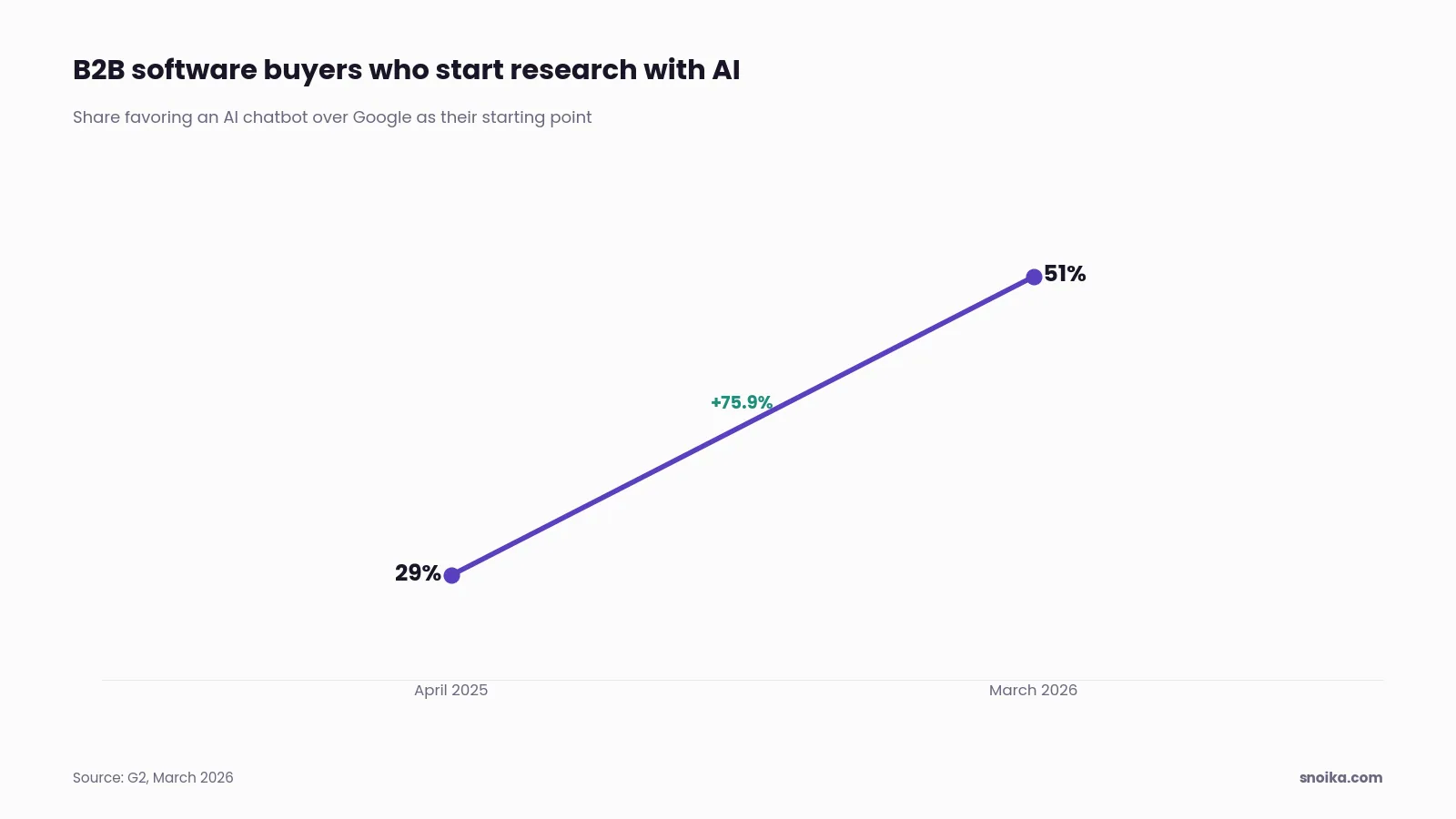
G2 surveyed 1,076 software buyers in March 2026 and found that 51% of B2B software buyers favor an AI chatbot over Google as their research starting point, up from 29% in April 2025. If buyers shortlist vendors inside ChatGPT, a ranking report no longer tells you whether you were on that shortlist.
This AI SEO work is generative engine optimization (GEO) and answer engine optimization (AEO). For separate GEO and AEO measurement, Snoika runs prompt sets every week in ChatGPT and Google AI Overviews to track mentions and share of voice. It also records sentiment and citations. Snoika's founder Anton Vedeshin reported to Startup Reporter 1StopVAT's move from 2.7% to 28.3% ChatGPT visibility in 16 weeks. 3DPrinterOS gained a steady source of 3–4 qualified inbound leads/day through AI search.
Ask any partner, or your own SEO lead, to report AI visibility separately from organic traffic. Without that measurement, teams have to guess their AI visibility.
When to keep SEO in-house
Keep SEO in-house when search is your main source of pipeline and the work depends on product knowledge that changes every week. For a founder, the move from agency to in-house makes sense when outside spend on search is close to the cost of a hire and there's enough steady work to fill a full-time week. An average retainer runs about $38,500 a year, against roughly $238,000 for a loaded marketing manager. So the numbers favor a partner for longer than most founders expect.
These signs mean SEO belongs inside:
- Your product changes faster than an agency brief can keep up with.
- Sales asks for new comparison or use-case pages every week.
- You already pay more than one outside partner for overlapping search work.
- Your search data feeds product and pricing decisions, so it needs to sit next to them.
The in house seo vs agency answer flips for specialist or occasional work. Technical migrations rarely fill a full-time role; the same holds for AI visibility tracking and multilingual content. Snoika creates content to reach buyers across markets in 135+ languages and regional variants, a range few internal teams can staff. A common pattern is to keep the SEO strategist in-house and buy production and tracking from outside.
Scaling a hybrid model
You scale a hybrid by moving work across the line on purpose, one function at a time. Follow these steps in order:
- Write down every marketing task and who does it today, even when nobody officially owns the work.
- Mark each task as decision work or production work. Decision work stays inside.
- Hand off one production function with a 90-day target that you measure in your own analytics.
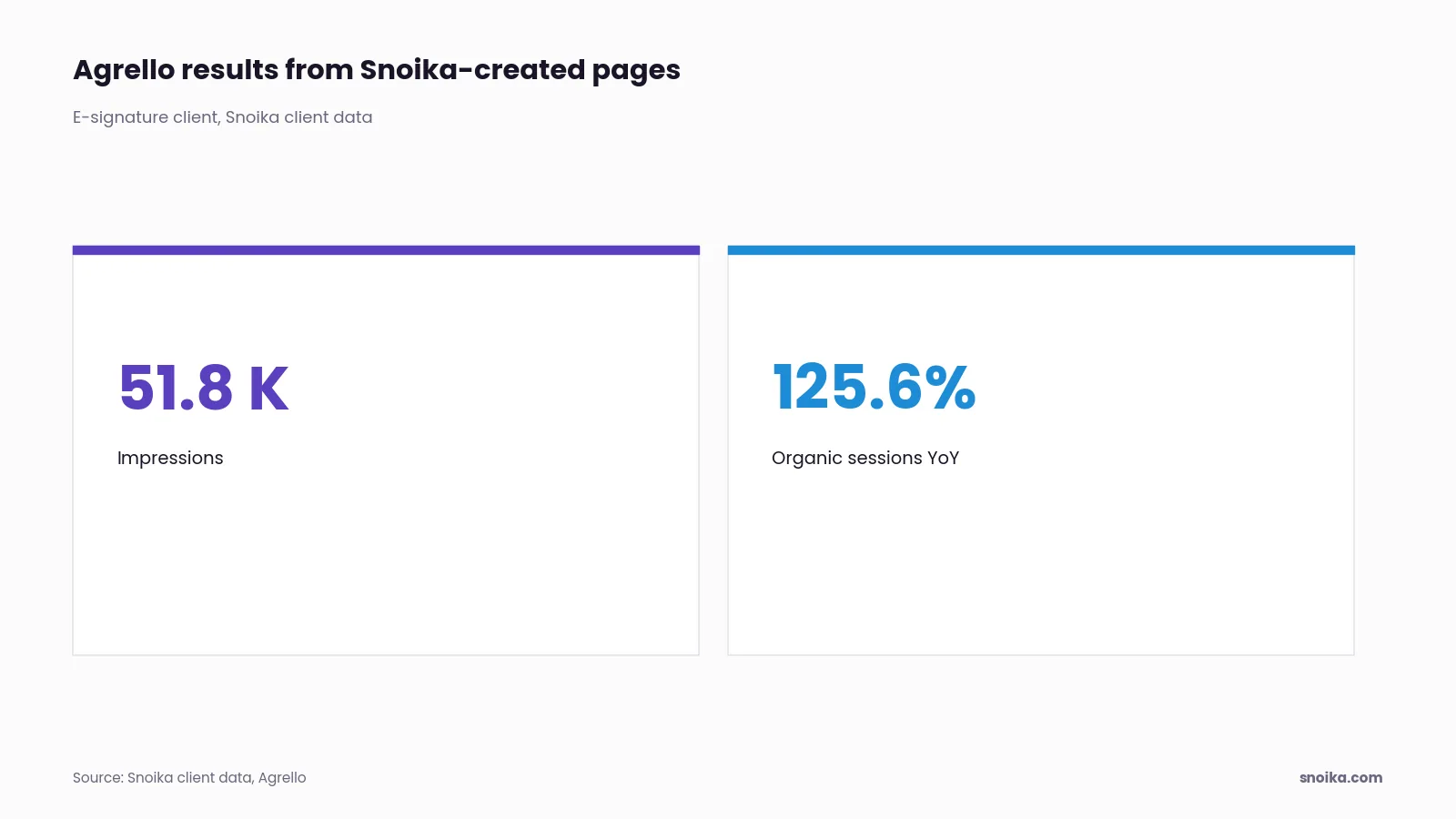
- Check whether results can be traced to specific pages or campaigns. Agrello, in e-signature, saw +125.6% organic search sessions YoY and generated 51.8K impressions from Snoika-created pages, so the output was traceable to its source.
- Bring a function in-house only when its volume justifies a salary. Add a partner when a new channel opens that your team can't staff.
Growth complicates a hybrid because a company with 3 brands or 5 markets needs separate reporting for each, or the totals hide which brand is losing visibility. Look again at the split at least once a year. Last year's decision was based on last year's search channels.
Which category fits you
For most B2B teams the in house vs agency marketing answer is a hybrid. Keep strategy and approval inside, and buy production and AI search tracking from outside until the volume justifies a hire. This quarter, measure how often AI assistants name your brand for the questions your buyers ask. That number shows whether your current split covers the channel where B2B shortlists now form. We run SEO for B2B companies alongside GEO and AEO on a platform with a human review layer. Every engagement starts with onboarding and a free AI visibility report. To find out where your brand stands, talk to an AI search expert.
FAQ
In-house marketing means employees on your payroll plan and produce campaigns. Your team keeps day-to-day responsibility for the work, while outside specialists can still handle defined tasks.
A hybrid model keeps marketing decisions inside the company and assigns defined production work to outside partners. Put that split in writing, name an internal owner for each metric, and assess both teams against the same pipeline data.
Total cost depends on headcount and salaries, with benefits added for each employee. The page estimates about $238,000 annually for one marketing manager including benefits. Recruiting and tools cost extra, so that figure isn't a complete team budget.
In the in house vs agency marketing decision, move in-house when a channel generates steady pipeline and its workload fills a full-time week. For search, outside spending approaching the cost of a hire is another signal. Occasional specialist work can stay external.
Check that your company owns the accounts and files the agency created. Confirm control of analytics properties and ad accounts, plus whether content ownership transfers on payment. Keeping published content on your own domain reduces the risk of losing search history.


