
GEO framework in four layers
A GEO framework is a plan that splits generative engine optimization (GEO) into four layers, worked from the bottom up. Technical access comes first, so AI crawlers can fetch your pages. Content structure lets engines lift clean answers from those pages. Authority signals give engines a reason to trust your brand over a rival's, and measurement shows whether ChatGPT and Google AI Overviews name you at all. Each layer only pays off when the one beneath it holds.
 Jevgenia PogadajevaCFO, Snoika · 7 min read

























Four layers of GEO
A layered GEO framework stacks four kinds of work in the order engines meet your brand. An engine needs to fetch and parse a page before it can quote its content. And a quotable page from a brand nobody else mentions rarely beats a known competitor. Measurement goes on top because it tells you which of the lower layers is failing.
| Layer | Question it answers | What you check | Typical fix |
|---|---|---|---|
| Technical access | Can AI crawlers fetch and read the page? | robots.txt, CDN bot rules, raw HTML | Allow search crawlers, render key text on the server |
| Content structure | Can an engine lift a clean answer? | Answer-first sections, tables, sourced figures | Rewrite sections to open with the answer |
| Authority signals | Does the wider web vouch for the brand? | Third-party mentions, reviews, video coverage | Earn coverage on sites engines already cite |
| Measurement | Is the brand mentioned or cited? | Weekly prompt sets, share of voice, AI referrals | Tie each change to the layer it touched |
Technical access
- Question it answers
- Can AI crawlers fetch and read the page?
- What you check
- robots.txt, CDN bot rules, raw HTML
- Typical fix
- Allow search crawlers, render key text on the server
Content structure
- Question it answers
- Can an engine lift a clean answer?
- What you check
- Answer-first sections, tables, sourced figures
- Typical fix
- Rewrite sections to open with the answer
Authority signals
- Question it answers
- Does the wider web vouch for the brand?
- What you check
- Third-party mentions, reviews, video coverage
- Typical fix
- Earn coverage on sites engines already cite
Measurement
- Question it answers
- Is the brand mentioned or cited?
- What you check
- Weekly prompt sets, share of voice, AI referrals
- Typical fix
- Tie each change to the layer it touched
How much weight each layer needs depends on your site. A JavaScript-heavy product site loses most at layer one, while an established publisher has access sorted and struggles with authority in a new category. So before you write a GEO plan, find the lowest layer that's broken and start there.
Technical access for crawlers
AI crawlers can index your site once your server lets them in and the text they need sits in the raw HTML. Most failures come down to a blocked bot or content that only appears after JavaScript runs. Work through these checks in order:
- Open robots.txt to the search crawlers. OpenAI's crawler documentation says sites that opt out of OAI-SearchBot "will not be shown in ChatGPT search answers". The training crawler, GPTBot, is a separate setting, so you can block training and still appear in search.
- Check your CDN and firewall rules. Cloudflare began blocking AI crawlers by default for new domains on July 1, 2025. A site can have a clean robots.txt and still turn bots away at the edge.
- Render core content on the server. A 2024 Vercel and MERJ log study concluded that "none of the major AI crawlers currently render JavaScript". ChatGPT's crawler downloaded script files in about 11.5% of requests and never ran them. Gemini is the exception, since it borrows Googlebot's rendering.
- Keep Googlebot unblocked. AI Overviews come out of Google Search, and Google says its Google-Extended token has no effect on Search inclusion.
- Publish on your own domain. Pages on your own domain inherit its crawl history. Snoika publishes client pages this way, in a folder such as /blog or /articles connected through DNS, with no migration on any CMS.
To test your own site, fetch a page with JavaScript disabled. If the answer text disappears, so does your chance of being quoted; the same applies to prices and tables.
Content structure engines parse
To get AI to surface your brand, structure each page so a model can pull one self-contained answer from it and credit you for it. Engines pull passages that match the prompt, so every section has to make sense on its own.
Open every section with the answer
Put the direct answer in the first sentence under each heading, then the reasoning. A section that opens with background forces the model to dig, and it'll take a rival's cleaner passage instead. Phrase headings as the question or subject a buyer would type.
Put facts where a model can lift them
Use tables with a header row for comparisons and numbered lists for steps. Definitions work best as one plain sentence that names the term and says what it is. Formats like these survive extraction intact, while dense paragraphs get cut mid-thought.
Back claims with figures and named sources
The Princeton-led paper that coined the term GEO found that citing sources and adding quotations can boost visibility by up to 40% in generative engine responses. Adding statistics was another technique behind that visibility boost. The authors also found the effect varied by domain. Check every number on your page against a named source, and name that source in the sentence.
Write one page per question, in the buyer's language
A page that answers one question well gets cited more readily than a page that half-answers ten. Buyers also prompt in their own language. Snoika produces content in more than 135 languages and regional variants for that reason, because an English page rarely wins a prompt written in German.
Authority signals that earn citations
Engines cite brands that the rest of the web already talks about. An Ahrefs study of 75,000 brands found that branded web mentions had a 0.664 correlation with AI Overview visibility, against 0.218 for referring domains. Mentions matter more than links, and that changes where you spend your outreach time.
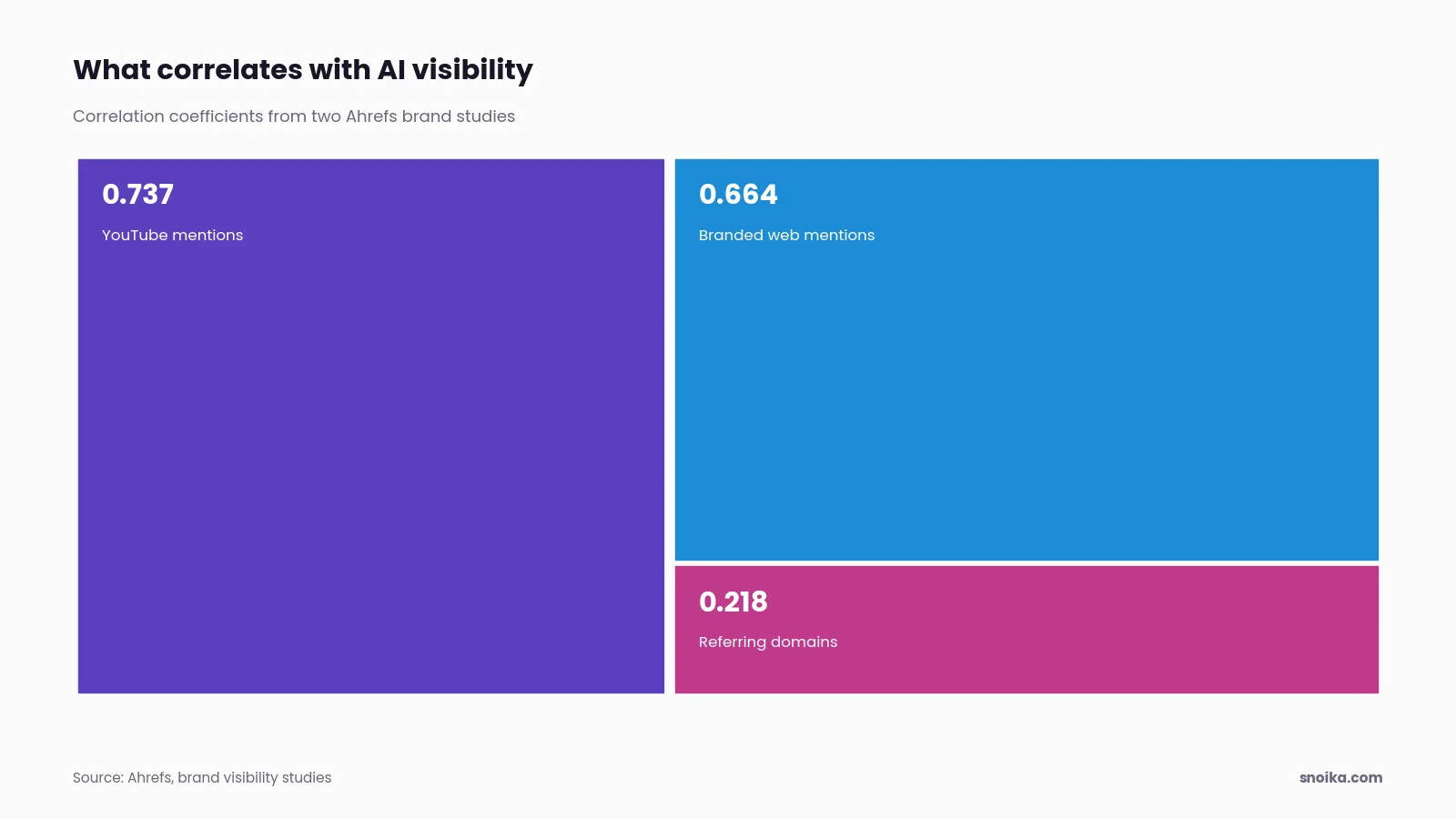
A follow-up by Ahrefs examined ChatGPT alongside Google's AI Mode and AI Overviews and put YouTube mentions at about 0.737, the strongest factor tested. These findings establish a correlation between brands' appearances in answers and discussion across independent sites and in video.
A fintech buyer's assistant leans on review sites and industry press, while a developer tool gets cited from forums and documentation. Vespia, a fintech SaaS, recorded a 220% increase in AI brand mentions after its coverage widened. To check your own position, ask an assistant to list the top vendors in your category. Then look up which sites it cites and whether your brand appears on any of them.
Measuring GEO performance
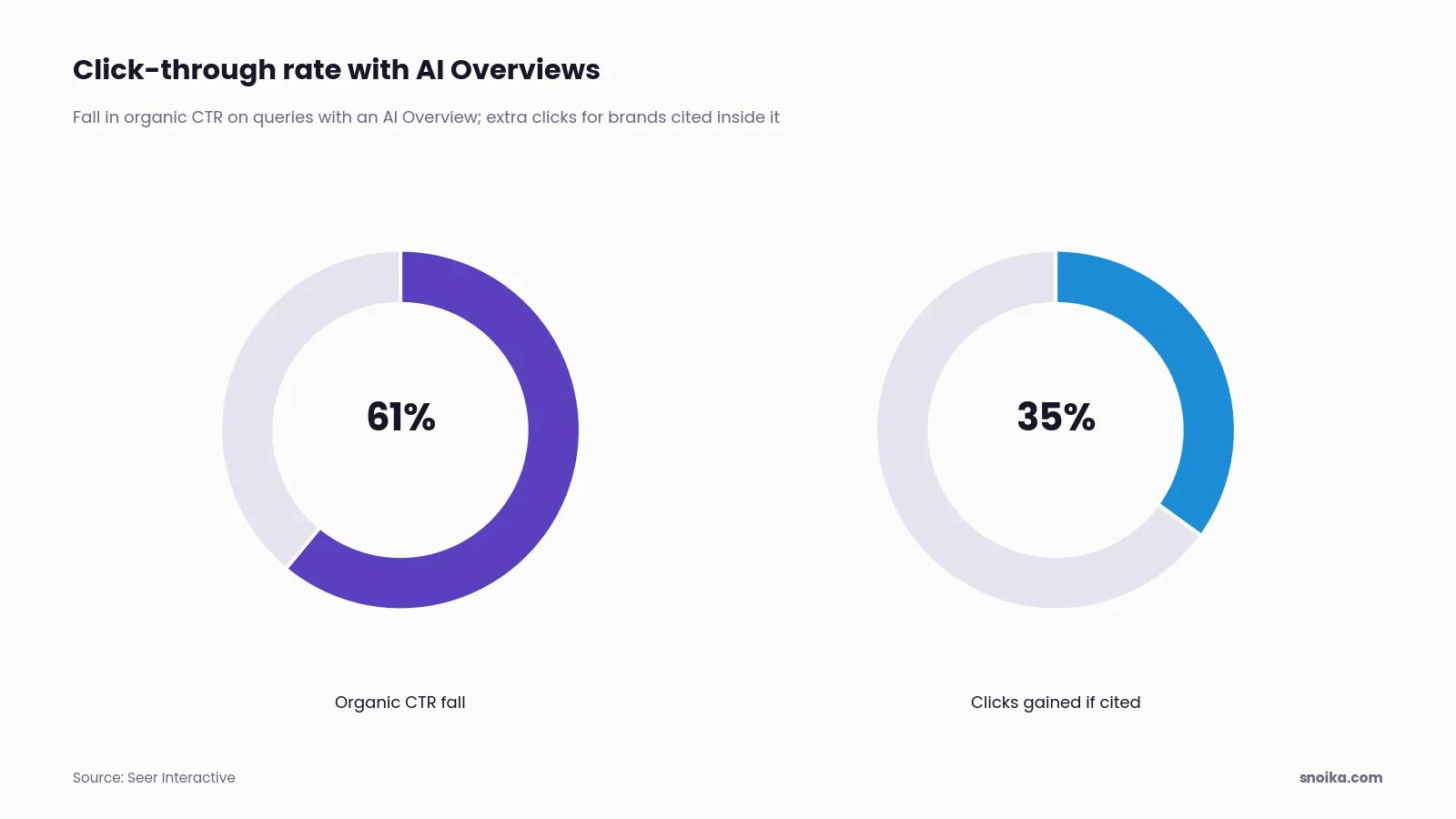
You know GEO is working when your brand shows up more often in answers to a fixed set of buyer prompts, tracked weekly against competitors. Rankings and sessions alone won't tell you. Seer Interactive found organic click-through rate fell 61% on queries with AI Overviews, while brands cited inside the overview earned 35% more organic clicks. Fewer clicks can sit alongside rising visibility.
Track these per engine, on the same prompts every week:
- Mentions, meaning how often the brand is named in an answer
- Share of voice against named competitors
- Sentiment of the sentence that mentions you
- Citations that link to your pages
- Referral sessions in analytics
Snoika uses weekly prompt sets to track mentions and share of voice in ChatGPT and Google AI Overviews, where most AI search traffic happens. Its tracking also covers sentiment and citations. For referrals, OpenAI adds utm_source=chatgpt.com to referral URLs, so you can segment that traffic in Google Analytics 4 (GA4).
Expect the trend line to move over months. Snoika's founder Anton Vedeshin reported to Startup Reporter 1StopVAT's move from 2.7% to 28.3% ChatGPT visibility in 16 weeks. Run the same prompts across that whole window, or the numbers won't compare.
GEO vs SEO differences
Generative engine optimization tries to get your brand named inside a generated answer, while search engine optimization (SEO) tries to rank a page that people click. Both GEO and SEO need crawlable pages and accurate content; AI Overviews draw on Google's index. SEO measures success by a position in a list, while GEO measures it by a mention or citation in a paragraph.
Links still drive rankings, while off-site mentions weigh more for AI answers. Keyword density does little for GEO, since a model picks passages for clarity and evidence. And because SEO reports in clicks, it can look worse just as GEO is improving.
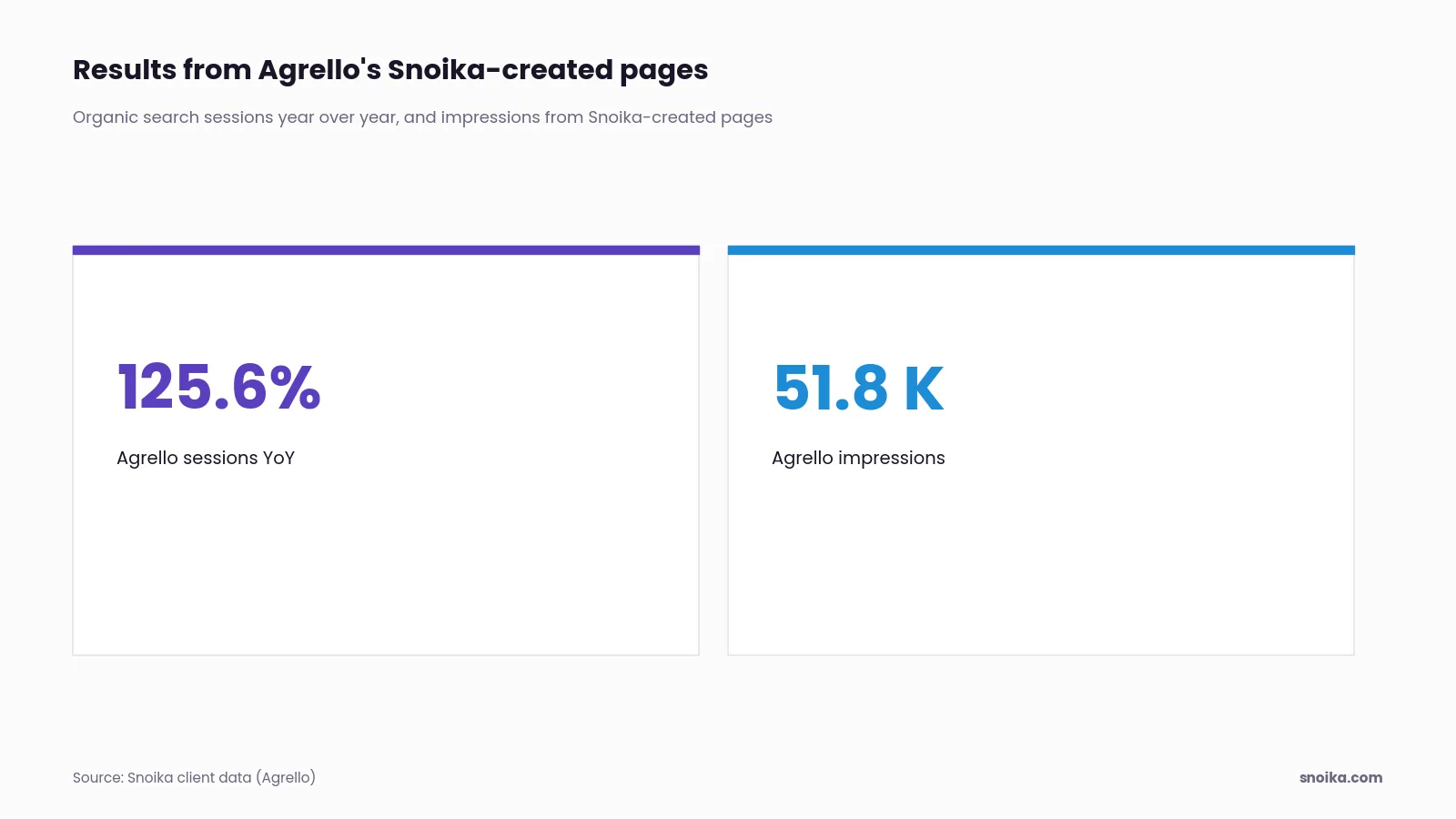
In practice, one well-built page serves both. Agrello, in e-signature, saw +125.6% organic search sessions YoY, and its Snoika-created pages generated 51.8K impressions. Keep both in one plan, measured separately.
How AEO fits
Answer engine optimization (AEO) is the part of this work that formats content as direct answers. It began with featured snippets and voice assistants and now covers AI Overviews. In the four-layer model, AEO lives mostly in the content layer's answer-first sections, where engines can lift tables and definitions.
Generative engine optimization extends beyond content to crawler access and authority signals. Its measurement also covers chat assistants that never show a results page. Treat AEO as a set of writing habits among your GEO best practices.
Prioritizing work across layers
Work in the order where each fix unblocks the next, and log a baseline before you change anything. Technical fixes take days to unlock the layers above them, while authority takes months to develop and needs an early start even though it pays off last.
- Record a baseline. Run your prompt set and note mentions and citations per engine.
- Fix access. Clear robots.txt and CDN blocks, then confirm key pages render without JavaScript.
- Rewrite your highest-value pages. Start with the pages that answer the prompts buyers use when they compare vendors.
- Fill content gaps. Add one page per unanswered buyer question.
- Start authority work. Target the sites your category's answers already cite.
- Review weekly and reassign effort. Move time toward whichever layer the data shows is weakest.
ABS Technologies demonstrated early technical gains with 6x SERP impressions and improved keyword indexability within the first 30 days. Authority gains come later, so set expectations with your team before step 5 starts.
Next steps
Run your baseline this week, before you touch the site. Pick 20 to 30 prompts a buyer would type when they compare options in your category. Run each one in ChatGPT and Google AI Overviews, and write down who gets named and which pages get cited. That list shows you the weakest layer of your GEO framework, and it gives you the yardstick to judge every later change. Snoika audits sites and tracks brand visibility across AI assistants. It builds content maps from what that tracking finds. To see where your brand stands today, get a free AI visibility report.
FAQ
Open each section with a direct answer that makes sense on its own. Use question-based headings and tables for comparisons. Check whether a passage still answers the question when separated from the rest of the page, and attribute figures to named sources.
Allow search crawlers through robots.txt and your site's firewall rules, then ensure key text appears in the raw HTML. Test pages with JavaScript disabled. If the answer text disappears, server-side rendering is a priority before rewriting content.
Track mentions and citations for the same buyer prompts every week, with results separated by engine. Compare your visibility against competitors and record which changes you made. Falling website traffic alone doesn't mean GEO is failing, because visibility can rise while clicks decline.
Yes, search access and training access can use separate crawler controls. The page identifies separate settings for these purposes, so blocking a training crawler doesn't necessarily exclude your pages from search answers. Check each crawler's documented purpose before changing access rules.
Expect visibility trends from a geo framework to develop over months, although technical fixes can take days to unblock further work. Timing depends on which layer needs attention. Authority takes months to develop, so an access fix and an authority campaign need different expectations.
Keep reading
All articles

