
GEO best practices for AI-first growth
GEO best practices help AI assistants such as ChatGPT and Google AI Overviews read your pages and trust them as sources to quote. The first of the four practices is to let AI crawlers fetch your pages as plain HTML. Each answer needs to be easy to lift out of the page. Other sites need to talk about your brand. And you track how often AI answers mention you instead of tracking clicks.
 Artem LozinskyOperations and product, Snoika · 8 min read

























GEO for AI-first growth
Generative engine optimization (GEO) means shaping your content so AI answers use it as a source. The click is no longer the main prize. Pew Research Center tracked 900 US adults in March 2025 and found that people clicked a regular result in 8% of visits with an AI summary. Without a summary, they clicked in 15% of visits. When the answer is written on the results page, the brands named in it win the visit, even if nobody clicks.
Researchers from Princeton and IIT Delhi tested citation tactics in a benchmark of content changes and found that GEO can raise visibility by up to 40% in generative engine responses. Adding citations and quotations produced some of the biggest gains. Adding statistics was also among the most effective changes. The same paper warns that results differ by domain. So test each tactic in your own category before you roll it out across the site.
Crawlability for AI bots
To set up your site for AI crawlers, allow their search bots through both robots.txt and your firewall. Serve your main content as plain HTML. Each AI company runs more than one crawler, and each one has its own job. OpenAI's documentation says sites that block OAI-SearchBot won't appear in ChatGPT search answers. GPTBot is a separate crawler that collects training data, and you can allow or block it on its own. Plenty of publishers allow the search bot and block the training bot.
Rendering trips up more sites than robots.txt does. A Vercel and MERJ analysis of real crawler traffic found that GPTBot downloaded JavaScript in 11.5% of requests but never ran it, and ClaudeBot didn't run it either. Those crawlers never see prices or specs that only load in the browser. The same applies to answers loaded that way. Gemini is the exception, since it uses Googlebot's rendering.
To check your own site, request a key page with JavaScript turned off. Then read your server logs for AI user agents and look at your content delivery network (CDN) for bot-blocking rules you didn't set yourself.
Content structure signals
AI assistants quote passages that make sense on their own, so open each section with the answer and put the evidence after it. A model building a response pulls a few sentences, not the whole page. If the answer sits in paragraph four, behind a story, the model takes it from a competitor who stated it first.
Write headings that name the subject they cover. Put a figure next to the claim it supports, and name the source in the same sentence, because the Princeton results above favor exactly that kind of passage. Use a table when a reader would compare items on the same attributes. Keep terms consistent so the model connects your product name to the category you want to own.
A buyer asking in German or Spanish gets an answer built from pages in that language, so English-only content leaves those prompts to someone else. Snoika creates content in 135+ languages and regional variants for this reason.
Schema that AI reads
No schema type is written for AI answers. The markup that helps is the standard set that describes who you are and what the page contains. Google's own guide to generative AI features states that no special schema.org markup is needed. It still recommends structured data for rich results. Fabrice Canel, Principal Product Manager at Bing, said at SMX Munich in March 2025 that schema markup helps Microsoft's large language models understand your content.
Add these schema types first.
- Organization, with your official name, logo and sameAs links to your profiles
- Article, with author and dates
- Product or Service, with prices and descriptions that match the page
- BreadcrumbList, which shows where the page sits on the site
- FAQPage, only where the page really answers questions
Check that every value in the markup matches the visible text, which Google lists as a requirement. Then inject the markup server-side. JSON-LD added by client-side JavaScript runs into the rendering problem described above.
Off-site citation building
AI answers trust what other sites say about you more than what you say about yourself, so build mentions on the sites models already cite. In the Pew study, 15% of AI summary sources came from Wikipedia and two other platforms, YouTube and Reddit. Industry press and review sites fill much of the rest, and which ones matter depends on your category.
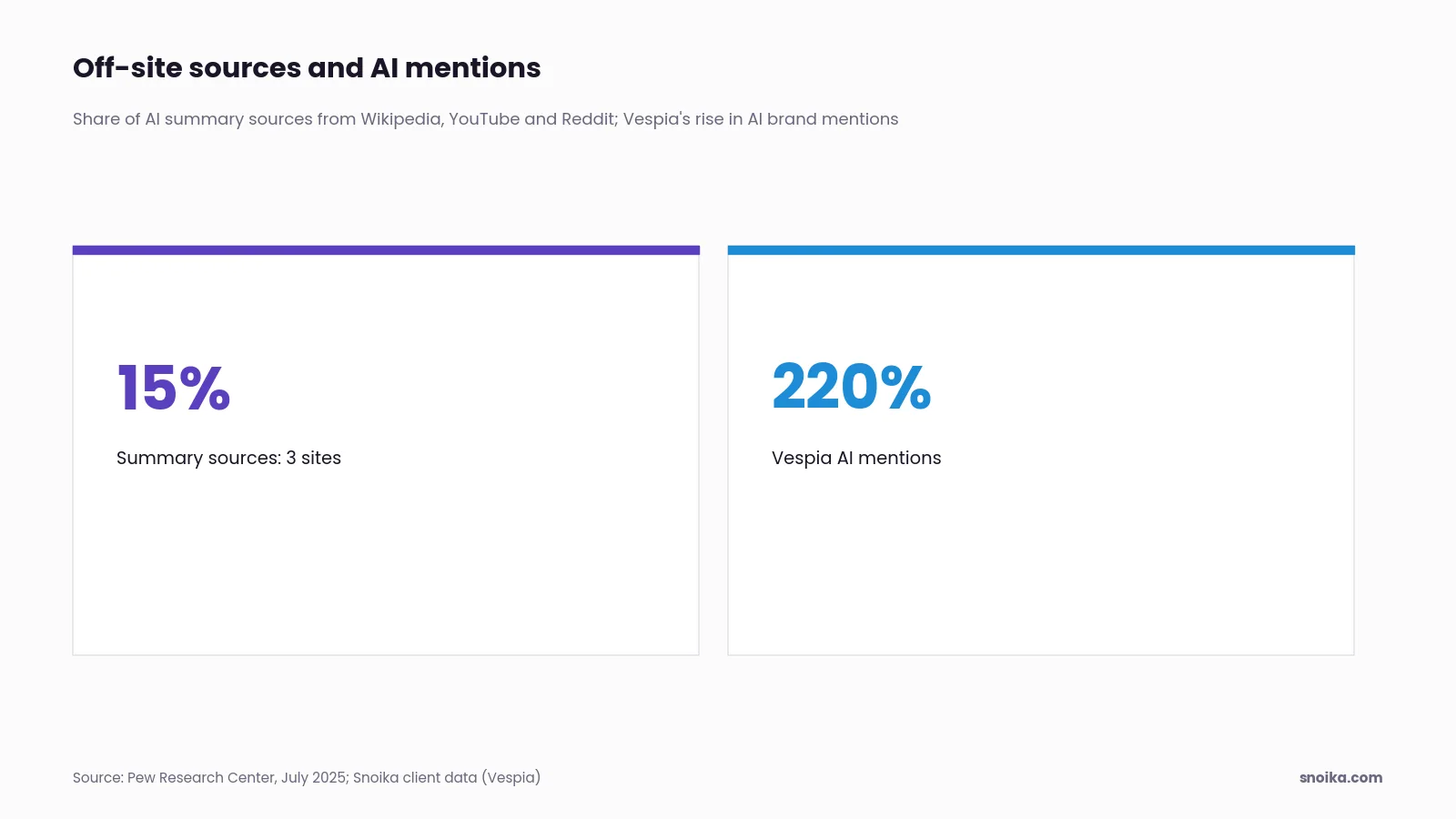
Start by running your target prompts and listing every domain the answers cite. Those domains are where you pitch. Send data journalists can quote, and offer comments on stories already in progress. Get your profiles listed and up to date on the review sites in your category. Vespia, a fintech SaaS, recorded a 220% increase in AI brand mentions in a niche small enough for a handful of placements on the right domains to shift the answers. The scale of that effect varies by sector.
AEO alignment tactics
Answer engine optimization (AEO) means matching your pages to the questions people actually type into assistants, and those questions are longer than search keywords. A buyer asks "which VAT compliance service handles EU marketplace sellers". Write the page so its headings and first sentences answer prompts like that one.
Google says AI Overviews use query fan-out, which runs several related searches across subtopics before a response is written. So one page that covers the main question and its obvious follow-ups gets more chances to be pulled in. A useful AEO tip is to collect the follow-up questions your sales team hears and answer each one in the section where it belongs, without adding a separate question-and-answer block.
Measuring AI visibility
You measure whether generative engine optimization is working by running a fixed set of prompts every week and tracking how often each answer names or cites you, compared with competitors. Traffic alone misses most of the effect, because AI answers satisfy the reader on the spot.
Which metrics to track
Track mentions and share of voice against named competitors as two of your four numbers per platform. The other two are sentiment and the citations that link to your domain. Snoika's tracking uses weekly prompt sets to measure exactly these in ChatGPT and Google AI Overviews, where most AI search traffic happens. Add GA4 referral traffic from AI assistants and leads that mention AI search, so visibility ties back to revenue. 3DPrinterOS, for example, turned AI search into a steady source of 3–4 qualified inbound leads/day.
How to read the results
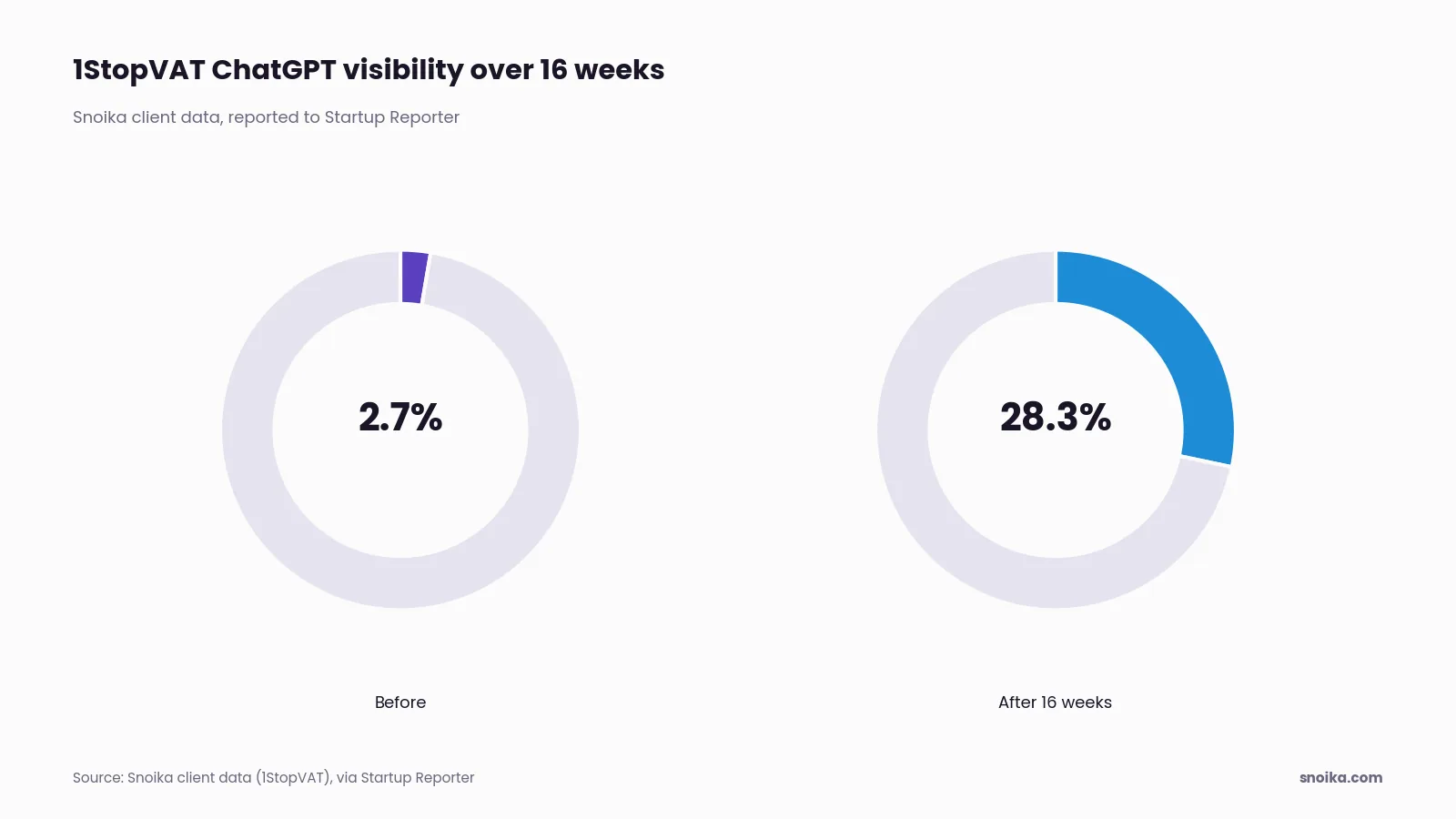
Read visibility as a share over many runs, never as a rank. SparkToro, the audience research company founded by Rand Fishkin, ran the same prompts up to 100 times each and found under a 1 in 100 chance of getting the same brand list twice. The order changed more frequently than the brand list did. The share of runs that mention you held steadier. That is why a trend over weeks means something. Snoika's founder Anton Vedeshin reported to Startup Reporter 1StopVAT's move from 2.7% to 28.3% ChatGPT visibility in 16 weeks.
GEO implementation framework
Each of the five steps in a GEO strategy depends on completion of the previous step.
- Set the baseline. Pick 50 to 100 prompts your buyers ask and run them across your target assistants. Record your mention share and the domains that get cited.
- Fix access. Correct robots.txt, firewall rules and rendering on the pages that matter, and add matching schema.
- Map and write content. Build a content map from the prompts where competitors appear and you don't. Then write answer-first pages for them.
- Earn mentions. Pitch the domains from your baseline that AI answers cite most.
- Measure weekly and revise. Rewrite pages that stay uncited after six to eight weeks, and expand topics that start to show up.
Data access affects the speed of step 1; Snoika's onboarding, for example, asks for GA4 and Google Search Console access. It also asks for Google Tag Manager access, plus CMS access when pages will be published. At step 3, Snoika's pages go live on your own domain through a DNS connection without migration, after you approve each page in the dashboard.
Who runs your GEO program
Choose a provider based on how much of the five-step GEO framework you can staff yourself. A 2026 cost guide from a US digital agency puts agency GEO services at $1,500 to $50,000+ per month, and monitoring software at $50 to $1,000+ per month.
| Option | Typical cost (2026) | Covers | Leaves to you | Suits |
|---|---|---|---|---|
| In-house team | Staff salaries plus tools | All steps, if you hire the skills | Hiring and tooling | Large teams with SEO staff already |
| Agency | $1,500 to $50,000+ per month | Strategy, content, outreach | Tracking checks and approvals | Companies that want to hand off the whole program |
| Monitoring-only tool | $50 to $1,000+ per month | Measurement | Access fixes, content and outreach | Teams with writers who only need data |
| Snoika (platform plus services) | Plans on the pricing page | Audit, tracking, content maps, content and publishing | Approving pages | Teams that want tracking and execution under one provider |
In-house team
- Typical cost (2026)
- Staff salaries plus tools
- Covers
- All steps, if you hire the skills
- Leaves to you
- Hiring and tooling
- Suits
- Large teams with SEO staff already
Agency
- Typical cost (2026)
- $1,500 to $50,000+ per month
- Covers
- Strategy, content, outreach
- Leaves to you
- Tracking checks and approvals
- Suits
- Companies that want to hand off the whole program
Monitoring-only tool
- Typical cost (2026)
- $50 to $1,000+ per month
- Covers
- Measurement
- Leaves to you
- Access fixes, content and outreach
- Suits
- Teams with writers who only need data
Snoika (platform plus services)
- Typical cost (2026)
- Plans on the pricing page
- Covers
- Audit, tracking, content maps, content and publishing
- Leaves to you
- Approving pages
- Suits
- Teams that want tracking and execution under one provider
Snoika's Starter plan tests 100 AI prompts weekly across 3 AI platforms. Growth tests 500+ across all AI platforms and adds a dedicated account manager. A monitoring-only tool costs less if you already have writers. An AEO agency fits when you'd rather not run any part of it in-house.
Avoiding common GEO mistakes
Most GEO mistakes come from treating AI search as a new trick when SEO and GEO are the same discipline with a different output. Avoid these five recurring GEO mistakes.
- Blocking the wrong bot. One "disallow AI" rule can remove OAI-SearchBot along with GPTBot, and that takes you out of ChatGPT search.
- Counting on llms.txt. Google says it doesn't use llms.txt files or other special AI files for Search.
- Tracking rank positions. Given the SparkToro variance, a single "position 2 in ChatGPT" reading is noise.
- Shipping schema alone. Markup describes the page. It won't make a weak answer worth quoting.
- Publishing at volume with no review. Thin pages weaken models' trust in your domain.
Before any change goes live, check the robots.txt diff and run a spot test with JavaScript turned off.
Next steps
Start with the baseline. Until you know which prompts mention you and which domains AI answers cite in your category, every other GEO best practice is a guess about where to spend effort. Prompts where competitors appear and you don't make the best first targets, because the demand is already proven. We run that baseline as part of Snoika's audit and tracking work, and the same team writes and publishes the pages that close the gaps. To see where you stand in ChatGPT and Google AI Overviews today, get a free AI visibility report.
FAQ
Allow search crawlers through robots.txt and your firewall, then serve the main content as plain HTML. Check important pages with JavaScript disabled and inspect server logs for blocked requests. Search access and training access can be controlled separately.
Use standard schema that matches the visible content, such as Article for editorial pages or Product for product pages. There's no special AI schema. Deliver the markup server-side so crawlers don't need to run JavaScript to read it.
Run a fixed set of buyer prompts weekly and compare your mention share with competitors across repeated runs. Track citations to your domain separately. AI referral traffic and leads can connect visibility to business outcomes, but clicks alone miss exposure within answers.
Review and rewrite pages that remain uncited after six to eight weeks. Assess geo best practices using weekly trends from a fixed prompt set, since a single AI answer isn't a reliable measure of visibility.
Compare monthly fees alongside the work your team must handle. The cited 2026 guide lists monitoring software at $50 to $1,000+ monthly and agencies at $1,500 to $50,000+. Monitoring leaves implementation to your team, so include staff time when comparing total costs.
Keep reading
All articles

