
One search strategy for Google plus AI assistants
Running SEO and GEO as one strategy means a single team builds pages and entities for Google's ranked results and the answers AI assistants write, with shared metrics for both. Search engine optimization (SEO) earns rankings, while generative engine optimization (GEO) earns mentions or citations inside ChatGPT or Google AI Overviews. AI answers draw on the same crawlable, trusted pages that rank, so most of the work is shared. The two jobs split only at measurement and off-site reputation.
 Jevgenia PogadajevaCFO, Snoika · 12 min read

























Run SEO with GEO
To build one GEO strategy for Google and AI, treat GEO as a layer on top of the SEO program you already run. Keep one owner and one content plan, and report both channels in one dashboard. Each AI layer tracks brand mentions and page citations, which classic SEO never had to measure. It also records how assistants describe you. Everything underneath stays the same. The site still has to be crawlable and the pages still have to answer the question better than the alternatives. Off-site, the brand still needs other sites to vouch for it.
BrightEdge tracked AI Overview citations across 9 industries for 16 months and found that the share coming from pages that also rank organically grew from 32.3% to 54.5%. That's a strong case for a shared program. It also leaves close to half of citations going to pages that don't rank, which is why the GEO layer exists at all.
| Layer | What SEO needs | What GEO adds | Who owns it in a single program |
|---|---|---|---|
| Crawling and rendering | Googlebot can fetch and render pages | AI crawlers can read the raw HTML | Technical SEO |
| Content | Pages that match search intent | Passages an assistant can lift and quote | Content lead |
| Authority | Links from relevant sites | Brand mentions, linked or unlinked | PR and outreach |
| Entities | Structured data for rich results | One consistent brand entity across the web | Technical SEO |
| Measurement | Rankings, clicks, conversions | Mentions, share of voice, citations, sentiment | Analytics |
Crawling and rendering
- What SEO needs
- Googlebot can fetch and render pages
- What GEO adds
- AI crawlers can read the raw HTML
- Who owns it in a single program
- Technical SEO
Content
- What SEO needs
- Pages that match search intent
- What GEO adds
- Passages an assistant can lift and quote
- Who owns it in a single program
- Content lead
Authority
- What SEO needs
- Links from relevant sites
- What GEO adds
- Brand mentions, linked or unlinked
- Who owns it in a single program
- PR and outreach
Entities
- What SEO needs
- Structured data for rich results
- What GEO adds
- One consistent brand entity across the web
- Who owns it in a single program
- Technical SEO
Measurement
- What SEO needs
- Rankings, clicks, conversions
- What GEO adds
- Mentions, share of voice, citations, sentiment
- Who owns it in a single program
- Analytics
How much weight the GEO layer deserves depends on your category. In the same BrightEdge study, e-commerce overlap barely moved (0.6 percentage points), while education jumped 53.2 points. Before you change the budget split, check which of your top 50 commercial queries trigger an AI Overview. Then ask ChatGPT the 10 questions your buyers ask in sales calls. And if neither shows AI answers for your topics yet, keep the layer thin and watch it monthly.
Why one program wins
One program wins because the two channels reward the same assets. Split teams write two briefs for the same page and argue over which URL to create. They report two sets of numbers, and nobody can reconcile them. One team funds the work once and settles those conflicts in one planning meeting.
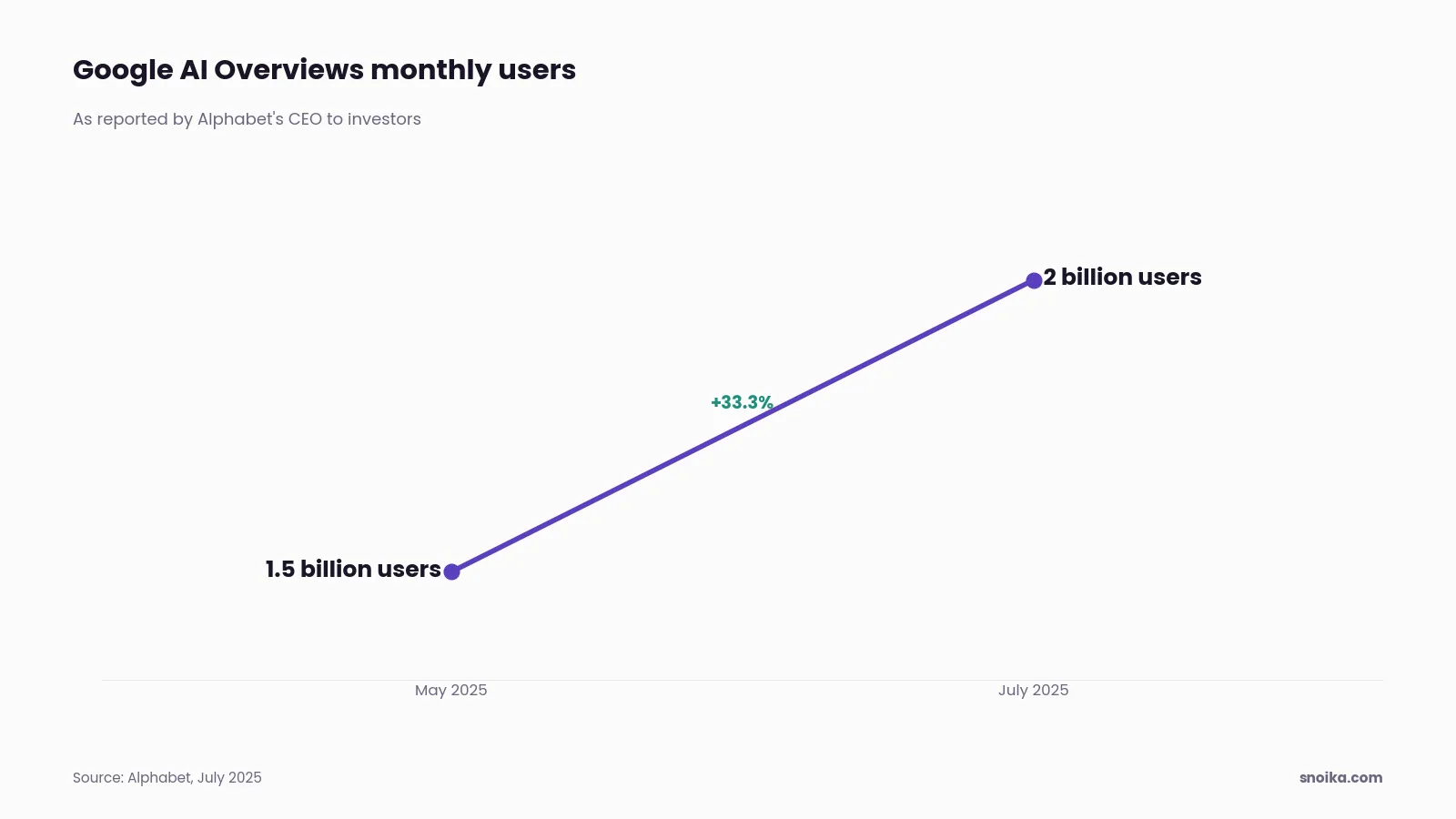
Neither channel is going away, so you can't move the budget across in one go. In February 2024, Gartner forecast a traditional search engine volume drop 25% by 2026. Alan Antin, a Vice President Analyst at Gartner, said, "Generative AI (GenAI) solutions are becoming substitute answer engines, replacing user queries that previously may have been executed in traditional search engines." Yet Google put AI answers inside its own results. Sundar Pichai, CEO of Alphabet, told investors in July 2025 that AI Overviews had reached 2 billion monthly users, up from 1.5 billion in May. A good share of "AI search" happens on Google's own results page.
Pew Research Center studied the browsing of 900 US adults and found that people who saw an AI summary clicked a traditional result in 8% of visits, against 15% when no summary appeared. A team that reports only clicks will read that as failure. A combined team also tracks brand mentions in the answers that replace clicks.
The visitors who do arrive from AI are worth more. Semrush found that the average AI search visitor is 4.4 times as valuable as a traditional organic visitor, measured by conversion rate. So fewer visits doesn't automatically mean less revenue. That only shows up when one team sees both channels side by side.
Shared content architecture
A shared content architecture is a set of topic hubs and supporting pages where every section opens with a direct answer. Google ranks the whole page, while an assistant can quote any one passage on its own. Build pages so that any H2 section still makes sense when it's lifted out of context.
Google has said plainly what it wants from pages in its AI features. Its Search Central team wrote in May 2025, "Focus on making unique, non-commodity content that visitors from Search and your own readers will find helpful and satisfying." Commodity content restates what 20 other pages already say, while non-commodity content adds first-hand data or a tested method. A clear opinion from someone who's done the work also qualifies.
Evidence-heavy writing also helps with generative engine optimization in particular. Researchers from Princeton worked with colleagues at Georgia Tech and IIT Delhi to test 9 rewriting methods across 10,000 queries and found that the best ones raised source visibility by up to 40%. Citations to sources and quotations from relevant people were among the most effective additions. Statistics also did the most to improve visibility. Those same edits make a page more useful to a human reader, so the SEO side gains as well.
Organize the architecture around topic hubs and sections that answer questions directly, following GEO best practices:
- One hub page per topic your buyers research, linking to the narrower pages under it.
- An answer of 40 to 80 words directly under each heading, before any background.
- Tables that compare prices or thresholds, because assistants extract rows cleanly.
- One page per question, so two URLs never compete for the same answer.
- A visible updated date and named sources on every figure.
Where the pages live matters too. Content builds authority for the domain that hosts it, so your own domain gains from your pages while a rented platform gains from theirs. Snoika publishes pages on the client's domain through a DNS connection. This requires no migration on any CMS. The client approves each page in a dashboard before it goes live. Whatever setup you use, check that new pages sit under your main domain and that the canonical tags point to them.
E-E-A-T signals assistants trust
To structure E-E-A-T for AI search, make each signal readable on the page and then confirm it on sites you don't control. Google's quality rater guidelines pair experience with expertise and authoritativeness with trust in E-E-A-T. Assistants have no rater, but they look for the same evidence when they decide which source to quote. Google's guidelines state, "Trust is the most important member of the E-E-A-T family because untrustworthy pages have low E-E-A-T no matter how Experienced, Expert, or Authoritative they may seem."
Experience: first-hand detail on the page
Experience means showing that someone actually did the thing. In a review, identify the version you tested and what broke, with photos you took as evidence. Include the numbers from your own project in a guide. Models can see the specific details that distinguish a practitioner's experience from generic content. Record the dated setup and the result in the text, because a text crawler needs readable words rather than an image caption.
Expertise: named authors with checkable credentials
Expertise starts with a byline that links to an author page. List the person's role and qualifications on that page. Add their other published work and links to their professional profiles. Mark it up with Person schema and connect it to your Organization. A named author whose title on your site matches LinkedIn and a conference speaker page gives a model one consistent identity to match. An anonymous "Admin" byline leaves that identity unspecified.
Authority: mentions on sites you don't own
Authority for AI depends more on being talked about than on links. Ahrefs studied 75,000 brands and found that branded web mentions had a correlation of 0.664 with AI Overview visibility, against 0.218 for backlinks. Correlation isn't proof of cause, but the gap is wide enough to change where outreach time goes. Expert quotes in trade press and reviews on category sites count even without links. Honest answers in community threads also count on those terms.
Trust: facts that match everywhere
Trust is the sum of small checks. Keep your company name and address consistent between your site and every directory or profile. Apply the same check to founding facts and prices. Cite sources for figures and use HTTPS. Show a real contact route, and correct errors in public. When an assistant finds two different prices for your product, it skips you or repeats the wrong one. Audit your top 20 third-party profiles once a quarter and fix every mismatch.
Knowledge graph as backbone
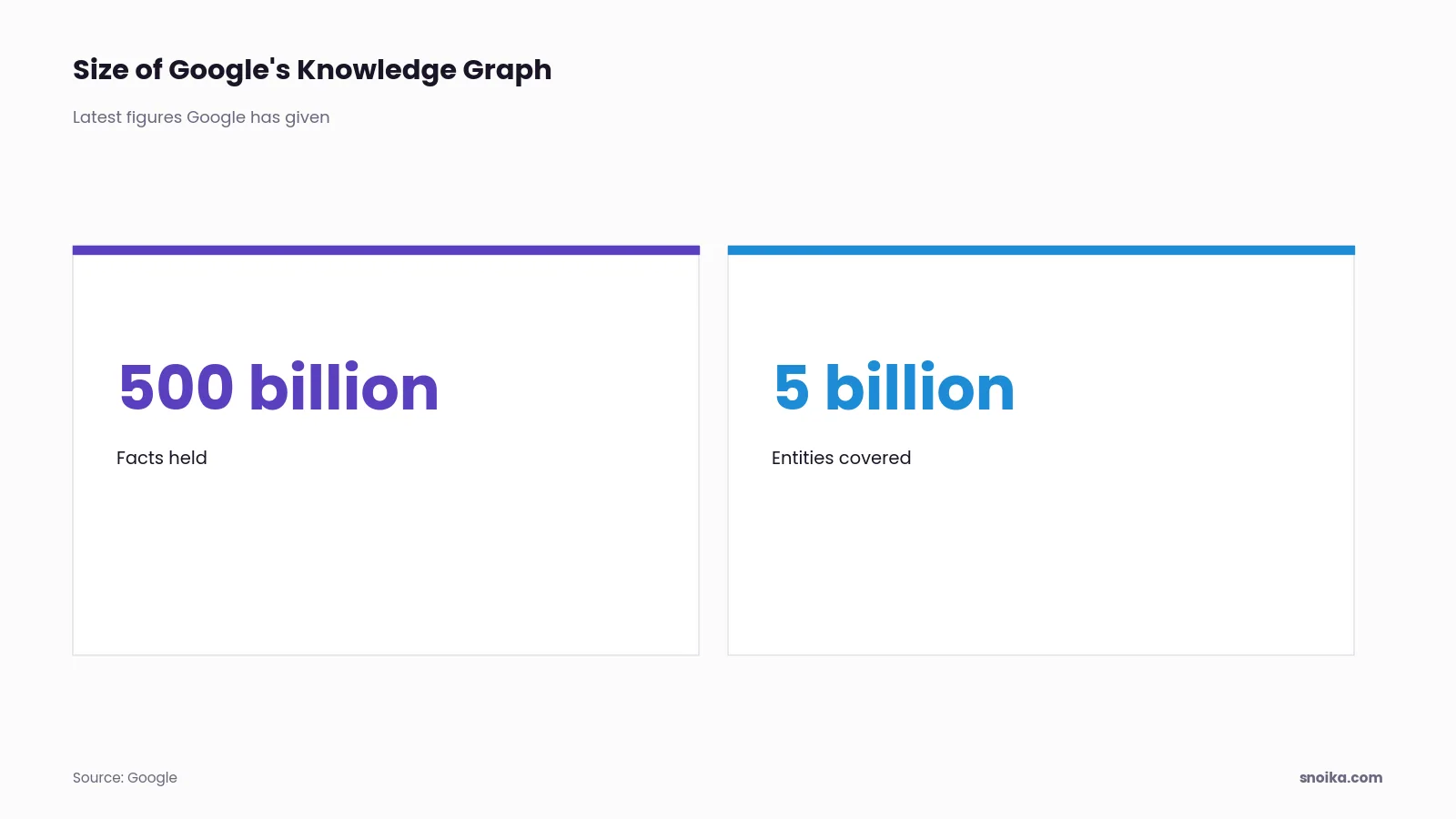
Knowledge graph work defines your brand as one entity through consistent facts and links that machines can connect, so it can appear in AI answers. Google's Knowledge Graph held 500 billion facts about 5 billion entities when Google last gave a figure. Google says it builds those facts from material across the web plus open and licensed databases. When your brand exists there as a single entity, Google's systems and the assistants grounded in them can tell you apart from a namesake and attach the right facts to you.
Keep the company's identity consistent across its own pages and outside profiles:
- Pick one "entity home" page, such as your About page, and keep the canonical description of the company there.
- Add Organization schema with your legal name and logo. Include the founders and a sameAs list that points to every official profile.
- Mark up people and products as their own entities and link them back to the Organization.
- Write one 2-sentence brand description and use it word for word on LinkedIn and Crunchbase. Repeat it unchanged in directories and press kits.
- Create or correct a Wikidata item if your company meets its notability rules.
- Use the same product and service names across every page, without synonyms.
What you can achieve varies with how well known you are. A brand with a Wikipedia article and press coverage mostly needs cleanup, while a young company has to build the entity from scratch. The young company's own site description carries most of the weight until other sources repeat it. For a check, ask two assistants "What is [your brand]?" and "Who founded [your brand]?". Wrong or vague answers point to the entity facts you need to fix first.
Hybrid measurement dashboard
Use an AI visibility dashboard to track how often assistants mention you and cite you. Record your share of answers against competitors alongside how assistants describe you. Report those figures next to your existing rankings and clicks, with conversions alongside them. Because one view covers both channels, the team can see when lost clicks are offset by mentions, and when they aren't.
SparkToro's Rand Fishkin and Gumshoe's Patrick O'Donnell had 600 volunteers run 12 prompts nearly 3,000 times to test AI recommendation consistency. The chance of getting the same brand list twice was under 1 in 100. Fishkin wrote, "AIs do not give consistent lists of brand or product recommendations." Run a fixed set of prompts on a schedule and report the percentage of answers that include you.
| Metric | What it tells you | Channel | Where it comes from | Review cadence |
|---|---|---|---|---|
| Brand mention rate | Share of tracked prompts where an assistant names you | AI | Prompt-tracking runs | Weekly |
| Share of voice | Your mentions against named competitors on the same prompts | AI | Prompt-tracking runs | Weekly |
| Citation count | How often your URLs appear as sources | AI | Prompt-tracking runs | Weekly |
| Sentiment | Whether the description is positive, neutral or negative | AI | Prompt-tracking runs | Monthly |
| AI referral sessions | Visits from chatgpt.com and similar domains | AI | GA4 referral report | Weekly |
| Rankings and impressions | Position and reach on target queries | Google Search Console | Weekly | |
| Organic clicks and CTR | Traffic Google still sends | Google Search Console | Weekly | |
| Conversions by source | Leads or sales from each channel | Both | GA4 with tagged events | Monthly |
Brand mention rate
- What it tells you
- Share of tracked prompts where an assistant names you
- Channel
- AI
- Where it comes from
- Prompt-tracking runs
- Review cadence
- Weekly
Share of voice
- What it tells you
- Your mentions against named competitors on the same prompts
- Channel
- AI
- Where it comes from
- Prompt-tracking runs
- Review cadence
- Weekly
Citation count
- What it tells you
- How often your URLs appear as sources
- Channel
- AI
- Where it comes from
- Prompt-tracking runs
- Review cadence
- Weekly
Sentiment
- What it tells you
- Whether the description is positive, neutral or negative
- Channel
- AI
- Where it comes from
- Prompt-tracking runs
- Review cadence
- Monthly
AI referral sessions
- What it tells you
- Visits from chatgpt.com and similar domains
- Channel
- AI
- Where it comes from
- GA4 referral report
- Review cadence
- Weekly
Rankings and impressions
- What it tells you
- Position and reach on target queries
- Channel
- Where it comes from
- Google Search Console
- Review cadence
- Weekly
Organic clicks and CTR
- What it tells you
- Traffic Google still sends
- Channel
- Where it comes from
- Google Search Console
- Review cadence
- Weekly
Conversions by source
- What it tells you
- Leads or sales from each channel
- Channel
- Both
- Where it comes from
- GA4 with tagged events
- Review cadence
- Monthly
Snoika's tracking runs weekly prompt sets in ChatGPT and Google AI Overviews, where most AI search traffic happens. It measures mentions and share of voice, along with sentiment and citation data. Build your prompt set around real buyer questions such as "best [category] for [use case]" and comparisons with named competitors. Include problem-first questions that never name a product. Check that the set stays fixed long enough to show a trend, and add new prompts as a separate group so they don't skew the baseline.
Moving from SEO to GEO
Most teams can add GEO to their existing SEO program over one quarter through the following GEO framework:
- Connect the data. Give the team access to Google Analytics 4 (GA4) and Google Search Console. Add Google Tag Manager access, plus CMS access if they'll publish. Snoika's onboarding asks for exactly these before any content work, together with a briefing on the category and buyers. The briefing also covers the goals.
- Take a baseline. Run 50 to 100 buyer prompts through the assistants your audience uses and record mention rate and share of voice. Record citations from those runs too. Pull 3 months of Search Console data for the same topics.
- Fix what crawlers can't read. Make sure key content appears in server-rendered HTML, and check robots.txt for AI crawlers you've blocked by accident.
- Clean up the entity. Fix your Organization schema and sameAs links. Correct your brand description on outside profiles.
- Rework the pages that already rank. Add direct answers under headings and tables with sourced figures. Name the authors. These pages are your fastest wins because they're already in the citation pool.
- Fill the prompt gaps. Write new pages for buyer questions where competitors get named and you don't.
- Build mentions off-site. Pitch data and expert comment to the publications assistants cite in your category.
- Report monthly on both channels and move effort toward whichever lever moved the numbers.
Teams that skip steps 2 and 3 waste the most time. Without a baseline, you can't show progress. And without readable HTML, the content work in step 5 never reaches most AI crawlers.
Gaps legacy SEO misses
Legacy SEO misses the places where AI systems read the web differently from Googlebot. Vercel and the consultancy MERJ analyzed real crawler traffic and concluded that "none of the major AI crawlers" currently render JavaScript. That finding applies to OpenAI's GPTBot and Anthropic's ClaudeBot. Google's Gemini is the exception because it uses Googlebot's rendering. A single-page app can rank well in Google and still look empty to ChatGPT's crawler. To test it, load a key page with JavaScript switched off and see what's left.
Keyword tools report what people type in 3 or 4 words. Buyers give assistants a paragraph about their company size and budget, with details about the tools they already use. Mine your sales call notes and support tickets for the full questions, and check community threads too. Write pages that answer those questions in the same terms.
Classic international SEO stops at the 3 or 4 markets with the most search volume. Assistants answer in whatever language the user writes in, and they favor sources in that language when they find them. Snoika creates content in 135+ languages and regional variants. Even a smaller team can add translated versions of its top 10 pages for each market it sells into.
A rank tracker reports position 3 and stops there. Read the full answer text for your top prompts every month to check whether an assistant calls your product "expensive and hard to set up" or repeats a pricing model you dropped 2 years ago. Trace any wrong claim back to the page or profile it came from.
Proving ROI across channels
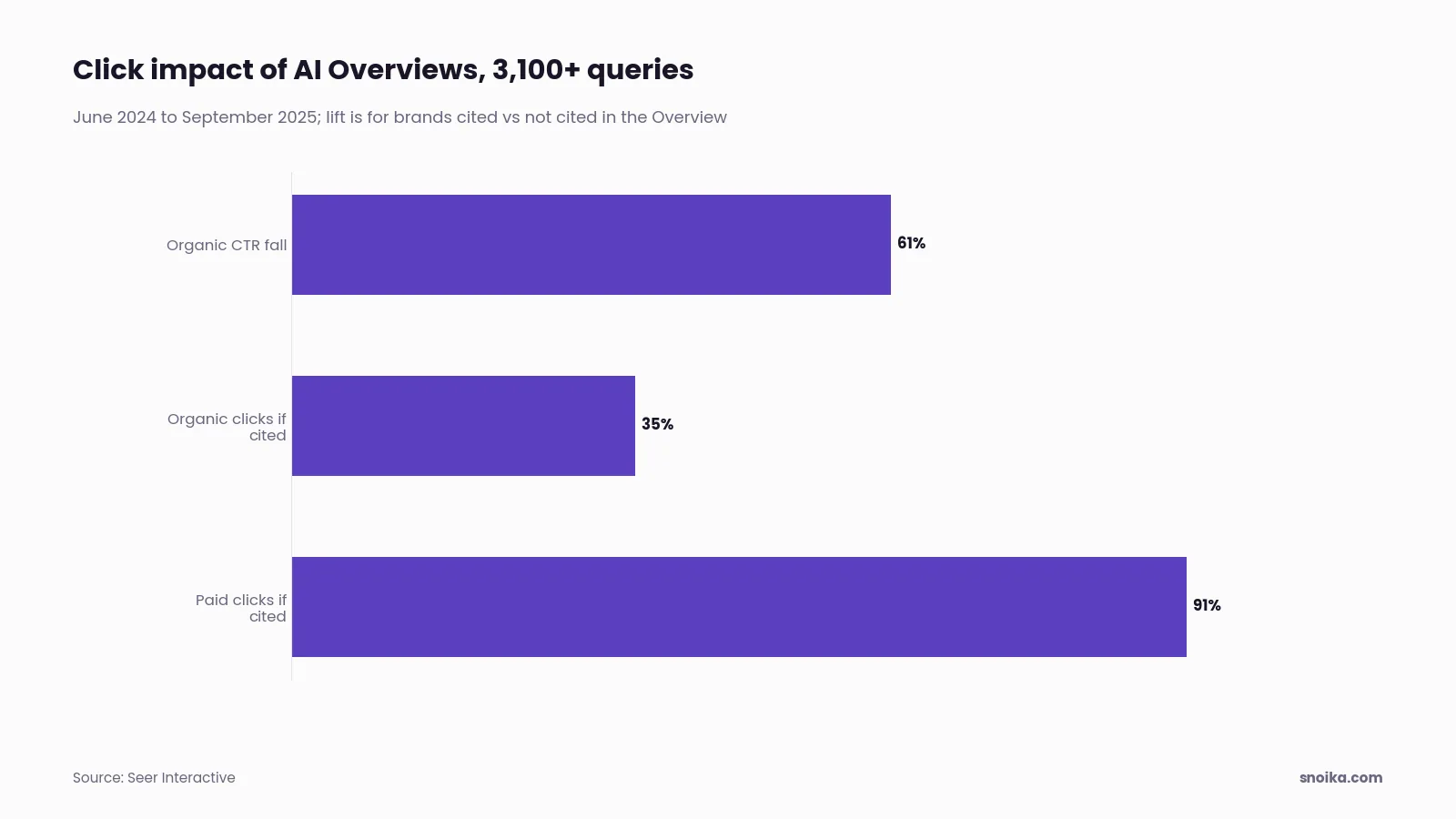
Prove ROI across channels in 2 steps by showing that mentions and citations went up, then that leads and revenue followed. Clicks alone understate AI's value, because the answer replaces the click. Seer Interactive studied 3,100+ queries from June 2024 to September 2025. On queries with AI Overviews, organic click-through rate fell 61%. But brands cited inside the Overview earned 35% more organic clicks and 91% more paid clicks than brands that weren't cited. A citation protects the traffic your SEO already earns.
Make the first of 3 attribution changes by adding a GA4 channel group for AI referrers. Add "ChatGPT or another AI assistant" as an option on the "How did you hear about us?" field in your forms. Watch branded search volume in Search Console, because people who meet you in an AI answer search your name next. Self-reported answers will catch buyers that referral data misses, since many people read the answer and type your URL by hand.
Snoika's founder Anton Vedeshin reported to Startup Reporter 1StopVAT's move from 2.7% to 28.3% ChatGPT visibility in 16 weeks. Pipeline takes longer to show. 3DPrinterOS achieved #1 visibility in ChatGPT for industry-specific queries and generated a steady 3–4 qualified inbound leads/day through AI search. Agrello, in e-signature, shows the combined effect on the Google side, with +125.6% organic search sessions YoY. Set expectations for visibility metrics within one quarter and pipeline within two. And report the cost of the work as one budget across both channels, so nobody books the same page twice.
What to do next
Take a baseline this week, before you change any page. Run 50 buyer prompts through ChatGPT and Google. Note where you appear and where competitors do. Pull the matching Search Console data next to it. That one table will identify technical or content gaps in your SEO and GEO, as well as reputation gaps. Use it to decide the first month of work. The baseline gives you a reference for later results.
At Snoika, we track brand visibility in Google and AI assistants. We use the gaps we find to plan and publish content that closes them. To see where you stand today, get a free AI visibility report.
FAQ
Track AI mention rate and citations alongside your existing search metrics. Compare your share of answers against competitors and review how assistants describe your business. Report rankings and clicks in the same dashboard, with AI referral visits connected to conversions by source.
Make first-hand evidence and author credentials readable on each page. Link bylines to author profiles that document relevant qualifications, and describe tested methods with dated results. Support those claims with independent mentions, while keeping business facts consistent across outside profiles.
Choose one About page as the main reference for your business identity, supported by Organization structured data. Connect official profiles through sameAs links and keep their descriptions consistent. Test whether assistants identify your business correctly, then fix the source facts behind wrong answers.
Allow one quarter to add AI search work to an existing SEO program. Set expectations for visibility changes within that quarter and pipeline impact within two quarters, rather than treating those periods as guarantees. Take a baseline before making changes so comparisons show progress.
The budget for seo and geo depends on how often AI answers appear for your category and where your visibility gaps are. Check your top 50 commercial queries and test 10 buyer questions in assistants. Keep AI-specific spending limited when those checks show little relevant activity.
Keep reading
All articles

