
Best AI visibility tools compared: what each one tracks for your brand
Peec AI is the strongest pure tracker among the AI visibility tools compared here (see Snoika vs Peec AI). It suits an in-house team that will act on the data itself. Enterprises with analysts get more depth from Profound (see Snoika vs Profound). If you want the gaps fixed as well as measured, Snoika is the only option on this list that also creates and publishes the content, and it costs more. Semrush and Ahrefs suit teams already paying for those suites. Otterly.AI is the cheapest paid way to start.
 Artem LozinskyOperations and product, Snoika · 9 min read











The best AI visibility tools
We ranked 7 tools by how well each one serves a B2B marketing team that needs to know where its brand appears in AI answers, and why. Prices are the published entry prices reported in 2026. Vendors change them, so check the pricing page before you buy. The table gives the short version, and the verdicts below explain the trade-offs.
| Tool | Entry price (2026) | Key features | Best fit |
|---|---|---|---|
| Peec AI | €85/month, 50 prompts | URL-level citations, auto-typed sources | In-house SEO and content teams |
| Profound | $99/month, ChatGPT only | Page-level citations, enterprise engine list | Enterprises with analysts |
| Snoika | €124/week | Tracking plus content creation and publishing | Teams that want gaps fixed |
| Semrush AI Visibility Toolkit | $99/month per domain, 25 prompts | AI tracking beside SEO data | Existing Semrush users |
| Otterly.AI | $29/month, 15 prompts | 4 engines on every plan | Solo marketers, small budgets |
| HubSpot AEO | $50/month, 25 prompts | Share of voice, free one-time grader | HubSpot customers |
| Ahrefs Brand Radar | $199/month per AI platform, plus an Ahrefs plan | Market-wide prompt database | Competitor research |
Peec AI
- Entry price (2026)
- €85/month, 50 prompts
- Key features
- URL-level citations, auto-typed sources
- Best fit
- In-house SEO and content teams
Profound
- Entry price (2026)
- $99/month, ChatGPT only
- Key features
- Page-level citations, enterprise engine list
- Best fit
- Enterprises with analysts
Snoika
- Entry price (2026)
- €124/week
- Key features
- Tracking plus content creation and publishing
- Best fit
- Teams that want gaps fixed
Semrush AI Visibility Toolkit
- Entry price (2026)
- $99/month per domain, 25 prompts
- Key features
- AI tracking beside SEO data
- Best fit
- Existing Semrush users
Otterly.AI
- Entry price (2026)
- $29/month, 15 prompts
- Key features
- 4 engines on every plan
- Best fit
- Solo marketers, small budgets
HubSpot AEO
- Entry price (2026)
- $50/month, 25 prompts
- Key features
- Share of voice, free one-time grader
- Best fit
- HubSpot customers
Ahrefs Brand Radar
- Entry price (2026)
- $199/month per AI platform, plus an Ahrefs plan
- Key features
- Market-wide prompt database
- Best fit
- Competitor research
1. Peec AI: the best dedicated tracker for in-house teams
Peec AI gives the clearest view of which sources AI engines use. It splits domains from URLs, and it separates pages a model retrieved from pages it actually cited. Brand plans start at €85 per month for 50 prompts across 3 models of your choice. A fourth model costs €30 to €140 a month, with the price set by your tier. Peec also measures without fixing anything, so your own team has to act on what it finds. Choose it if you have writers and an SEO lead ready to work from the data.
2. Profound: the deepest analytics for enterprise teams
Profound suits large teams that want detailed answer-engine data and have analysts to read it. It tracks citations at both the domain and the page level. But the entry price buys a narrow view. The Starter plan costs $99 per month for ChatGPT-only coverage and includes 50 prompts and 1 seat. Growth, at $399, adds Perplexity and Google AI Overviews. Gemini and Claude are Enterprise-only, so you'll need a sales call to see them.
3. Snoika: tracking plus the work that fixes the gaps
Snoika, the all-in-one AI SEO platform, is the only tool here that also fixes what its tracking finds. It audits the site and builds the content map. It then creates and publishes content on your domain. It also plans off-site work. Its reports include lead tracking, which links visibility to pipeline. The others on this list stop at the dashboard and give you recommendations. Plans start at €124 per week for AI + SEO Starter with 1 strategy slot. The engine list is also narrower, as the next section shows. So it makes sense when you'd otherwise pay a tracker plus a content agency.
4. Semrush AI Visibility Toolkit: best for teams already in Semrush
Semrush puts AI prompt tracking next to the keyword and audit data your SEO team already uses. The toolkit costs $99 per month and includes 25 tracked prompts. Each extra 50 prompts costs $60 a month, and there's no free trial. Pricing is per domain, so tracking 5 brands means paying 5 times. Extra users cost $45 a month on top.
5. Otterly.AI: the cheapest paid entry point
Otterly.AI is the lowest-cost way to begin tracking. Every plan includes ChatGPT and Google AI Overviews. Perplexity and Microsoft Copilot are also included on every plan. Lite costs $29 a month for 15 prompts, and Standard jumps to $189 for 100. Gemini and Google AI Mode are paid add-ons. Claude also costs extra, and these add-ons bring the real Lite price to $76 if you want all 7 engines. Fifteen prompts covers one product line at most.
6. HubSpot AEO: low-cost tracking for HubSpot customers
HubSpot AEO is the simplest choice if your CRM already runs on HubSpot. It costs $50 a month for 25 prompts across ChatGPT and Perplexity, with Gemini also covered by the plan. The price includes citation analysis and competitor share of voice. It doesn't cover Google AI Overviews, which matters if your buyers start in Google. It's also cheaper than any dedicated tool on this list except Otterly.AI.
7. Ahrefs Brand Radar: best for market-wide research
Ahrefs Brand Radar is built for researching any brand across Ahrefs' own database of AI prompts, more than for tracking your own prompt set (Snoika vs Ahrefs Brand Radar goes through the difference). It is also the most expensive way to get full coverage. You need an Ahrefs plan from $129 a month. Then Brand Radar costs $199 per AI platform, or $699 for the bundle of 6. That adds up to about $828 a month for everything.
How we scored each tool
We scored each tool on how well it helps a team act on its results. The length of its feature list didn't count. A good AI visibility tool covers the engines your buyers use and shows which URLs those engines cite. It should also measure competitors across repeated runs, because a single answer tells you little. Rand Fishkin, co-founder of SparkToro, tested this. His team found that ChatGPT or Google's AI gave the same list of brands in fewer than 1 in 100 responses to the same prompt. "AIs do not give consistent lists of brand or product recommendations," he wrote.
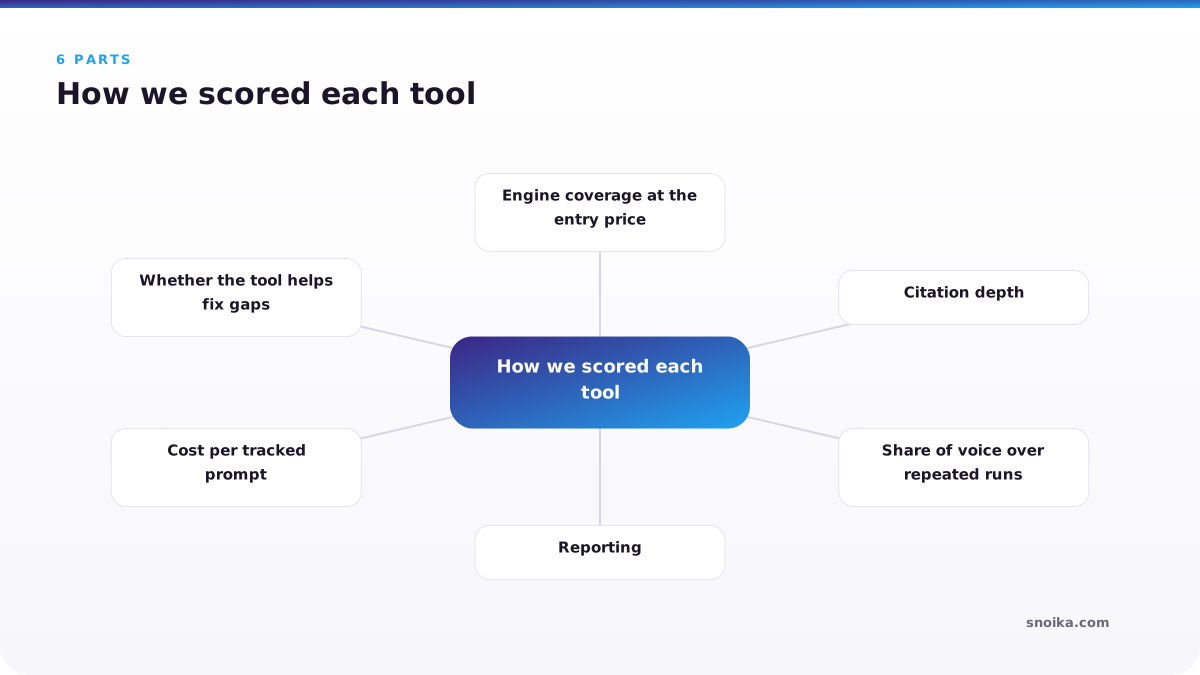
That finding shaped the criteria below:
- Engine coverage at the entry price, as opposed to coverage sold as add-ons
- Citation depth, down to the exact page cited for each prompt
- Share of voice over repeated runs, with a competitor list you control
- Reporting that a client or a board can read without a login
- Cost per tracked prompt, because prompt caps drive the real price
- Whether the tool helps fix gaps, or only reports them
So treat any tool that reports a single "rank" in an AI answer with suspicion. Frequency across runs is the number you can rely on.
Engines covered per platform
Engine coverage varies more than any other feature, and entry plans hide the gaps. ChatGPT and Google AI Overviews are the 2 engines worth covering first. ChatGPT reached 800 million weekly users in October 2025, according to OpenAI CEO Sam Altman. Google's AI Overviews reach over 2 billion monthly users, Digiday reported in July 2025.
| Platform | Engines at entry price | Engines at extra cost |
|---|---|---|
| Peec AI | 3 models you choose | More models per tier, up to 13 on Enterprise |
| Profound | ChatGPT | Perplexity and AI Overviews on Growth, Gemini and Claude on Enterprise |
| Snoika | ChatGPT, Google AI Overviews | None listed |
| Semrush | ChatGPT, Google AI, Gemini, Perplexity | None listed |
| Otterly.AI | ChatGPT, AI Overviews, Perplexity, Copilot | Gemini, AI Mode, Claude |
| HubSpot AEO | ChatGPT, Perplexity, Gemini | None listed |
| Ahrefs Brand Radar | 1 platform per $199 | Bundle of 6 for $699 |
Peec AI
- Engines at entry price
- 3 models you choose
- Engines at extra cost
- More models per tier, up to 13 on Enterprise
Profound
- Engines at entry price
- ChatGPT
- Engines at extra cost
- Perplexity and AI Overviews on Growth, Gemini and Claude on Enterprise
Snoika
- Engines at entry price
- ChatGPT, Google AI Overviews
- Engines at extra cost
- None listed
Semrush
- Engines at entry price
- ChatGPT, Google AI, Gemini, Perplexity
- Engines at extra cost
- None listed
Otterly.AI
- Engines at entry price
- ChatGPT, AI Overviews, Perplexity, Copilot
- Engines at extra cost
- Gemini, AI Mode, Claude
HubSpot AEO
- Engines at entry price
- ChatGPT, Perplexity, Gemini
- Engines at extra cost
- None listed
Ahrefs Brand Radar
- Engines at entry price
- 1 platform per $199
- Engines at extra cost
- Bundle of 6 for $699
Snoika tracks ChatGPT and Google AI Overviews only, because that's where most AI search traffic happens. That covers the bulk of B2B buyer questions. But if your buyers are developers who live in Claude, or researchers who start in Perplexity, the narrow list leaves blind spots. Before you buy any tool, ask 5 recent customers which assistant they used during evaluation, and match the engine list to their answers; our guide to evaluating LLM visibility tools has the full checklist.
Citation tracking depth
AI visibility tools track citations at 3 levels of depth, and citations are one of the four metrics in our AI visibility guide. The shallowest level records whether your brand name appears. The next records which domains the answer cited. The deepest records the exact URL cited for each prompt. You need URL-level data to know which page to update. Peec AI goes furthest here because its approach to separating sources from citations shows you every URL a model touched and the ones it actually referenced. The same review notes that Semrush lists cited domains and URLs per prompt in its Sources tab.
Snoika records mentions and citations week by week, with the cited pages attached to those records. It also tracks share of voice and sentiment, alongside a view of where competitors sit in the same answers. Its prompts come from your content map or from custom prompts you add. Because the prompts come from the same map that plans your pages, a cited page shows whether a planned article is doing its job. A gap points to the article that's missing.
Weekly and daily cadences suit different needs. Daily data catches sudden drops but adds noise, given how much answers vary from run to run. Weekly data smooths that noise into a trend you can report on. For either cadence, check that the tool keeps the raw answer text, because you need the answer behind a citation count to audit it.
Competitor share of voice
Share of voice is the percentage of tracked answers that mention your brand, compared with each competitor, across the same prompt set. It works as a trend more than a snapshot. HubSpot AEO and Semrush report it, as does Peec AI. They differ in how they build the competitor list, though. Some tools detect every brand an answer names, and others track only the rivals you enter.
The number's value depends on the sample size. Fifteen prompts on Otterly Lite gives a rough signal for one category, while 100 prompts across 3 engines gives a figure you can defend in a quarterly review. Ask each vendor how many times it runs every prompt per cycle. Then check whether you can filter share of voice by engine. A brand can lead in ChatGPT and barely appear in AI Overviews.
Reporting for B2B teams
Peec AI and Otterly.AI offer client-ready reporting. Snoika also offers it, though the details differ across these tools. Profound publishes no white-label option. Peec AI sells agency plans with white-label reporting from $245 a month, client logins included. You can build branded dashboards yourself with the Looker Studio connector included in Otterly.AI's Standard plan. Profound has deep analytics but no white-label or client portal on its published plans.
In Snoika, an agency runs every client brand from 1 workspace. Each brand is its own project with its own prompt set and competitor list. The project also has its own content map and reports, which can go out under the agency's name. That separation matters once you pass 5 or 6 clients, because shared prompt lists start to leak competitor data between accounts.
In-house B2B teams have a different need: a report the CFO accepts. Check whether the tool exports raw data to your BI stack. Also check whether it connects AI referrals to leads, since mention counts alone rarely survive a budget meeting.
Free vs paid tiers
Free AI visibility tools provide a one-time snapshot; paid tiers track the same prompts over time. HubSpot's AI Search Grader is a free one-time diagnostic of how ChatGPT and Perplexity describe your brand. It also checks Gemini's description. Snoika offers a free brand AI visibility checker and a free AI visibility report, and neither needs access to your accounts. These tools tell you whether you have a problem before you spend anything.
A snapshot captures only one point in time, and a single result is unreliable because AI answers vary from run to run. Paid entry starts at $29 a month on Otterly.AI. HubSpot lets you track 25 prompts free before its $50 plan starts, while Semrush offers no trial at all. Run a free check first. If your brand is missing from answers in your core category, a paid tracker is worth the cost. If you already show up well, a quarterly free check may be enough for now.
Where smaller platforms fall short
Smaller AI search monitoring tools have 2 shortcomings in their prompt caps and add-on pricing. Otterly.AI is the clearest case. If you outgrow 15 prompts on Lite, the next step costs a jump of $160 a month, and Lite can't buy a 100-prompt pack. Claude coverage costs $29 a month on Lite and $439 on Premium. The low sticker price rarely survives your first expansion.
The deeper limit is that a tracker only reports the gap. Someone still has to write the pages and fix the site. The third-party mentions that engines cite also have to be earned. Vespia, a fintech SaaS company, recorded a 220% increase in AI brand mentions after working with Snoika, which does that content work as well as the tracking. Before you sign up with any monitoring-only tool, name the person who will act on its findings each week.
How to pick your stack
To monitor your AI visibility, define the questions your buyers ask and track them on the right engines over time. Read the cited pages every cycle. Follow this order:
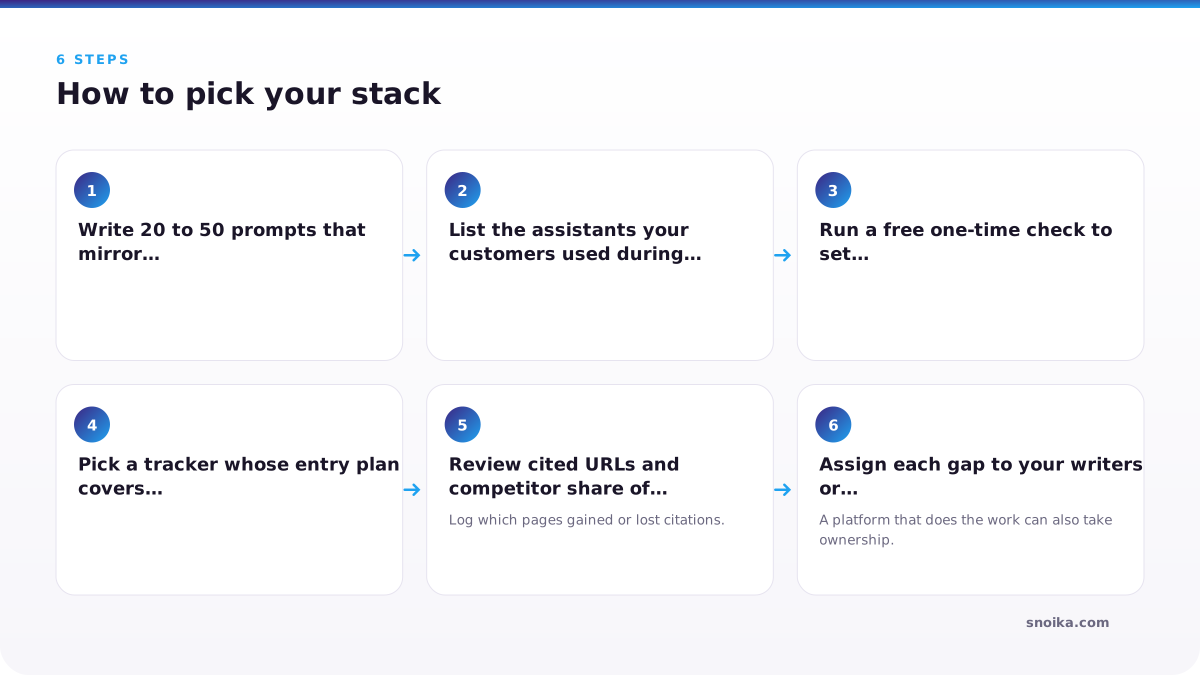
- Write 20 to 50 prompts that mirror real buyer questions, taken from sales calls and support tickets.
- List the assistants your customers used during evaluation, and drop the engines nobody mentions.
- Run a free one-time check to set a baseline before you pay.
- Pick a tracker whose entry plan covers your prompt count and your engines without add-ons.
- Review cited URLs and competitor share of voice each week. Log which pages gained or lost citations.
- Assign each gap to your writers or an agency. A platform that does the work can also take ownership.
An AI module added to an existing Semrush or Ahrefs account is 1 of 3 stacks teams use, with one login for both. A team with writers pairs Peec AI with its own content process. A team without spare writers accepts a higher price for a platform that tracks and publishes.
Picking from this list
Write your prompt list before you open a single trial. Every tool here prices by prompts or engines, so a list of 30 real buyer questions turns 7 vague options into 2 or 3 you can compare on cost. Load that same list into each shortlisted tool for the same week so you can compare the cited URLs each one reports. If the tools disagree on citations, choose the one that shows the raw answers, because you can check its numbers. Among AI visibility tools, the one you can audit is the one worth keeping.
Trackers are one part of the stack: for tools that also help pages rank, see the best AI SEO tools and the best LLM SEO tools.
FAQ
Track the same buyer questions across the AI assistants your customers use. Start with 20 to 50 prompts drawn from sales calls or support tickets, then review cited pages and competitor share of voice weekly. Keep raw answers so you can check the results.
Choose ai visibility tools that cover your buyers’ preferred assistants and show the exact pages cited. Check whether they retain raw answers and measure mentions across repeated runs. Compare total costs for your prompt count, including any engine add-ons.
Tracking ranges from recording brand mentions to identifying the exact URLs cited for each prompt. Domain-level reports identify the website, while URL-level reports identify the page to review. Some tools also distinguish pages an assistant retrieved from pages it cited.
Peec AI offers white-label reporting on agency plans starting at $245 a month, including client logins. Otterly.AI supports custom branded dashboards through its Standard-plan Looker Studio connector, which requires setup. Profound lists no white-label reporting or client portal on its published plans.
Weekly reviews suit trend reporting, while daily checks help catch sudden drops. AI answers vary between runs, so avoid treating one result as a stable ranking. Compare mention frequency across repeated runs before deciding which pages need attention.
Keep reading
All articles

