Snoika vs Ahrefs Brand Radar for AI visibility tracking
Choose Ahrefs Brand Radar if you already work in Ahrefs and have writers ready to act on what it finds. Choose Snoika if you want tracking and content work in one place, with researched pages that undergo review before they go live on your own domain. Ahrefs Brand Radar provides research, while Snoika also does the follow-up work. The right choice depends on who on your side will make the changes.

























Snoika vs Ahrefs compared
Ahrefs Brand Radar shows where your brand shows up in AI answers and leaves the next step to you. Snoika tracks the same kind of signal, then plans, writes and publishes the content meant to improve your visibility.
| Attribute | Snoika | Ahrefs Brand Radar |
|---|---|---|
| What it is | All-in-one SEO, GEO and AEO platform with services | AI visibility add-on to an Ahrefs plan |
| Signals tracked | Mentions, share of voice, sentiment, citations | Mentions, share of voice, cited domains and pages |
| Sentiment | Yes | No |
| Prompt source | Weekly prompt sets built for your category | Large search-backed prompt index, plus custom prompts |
| Content creation | Content maps, writing, human review, publishing | None inside the tool |
| Content languages | 135+ languages and regional variants | Not applicable |
What it is
- Snoika
- All-in-one SEO, GEO and AEO platform with services
- Ahrefs Brand Radar
- AI visibility add-on to an Ahrefs plan
Signals tracked
- Snoika
- Mentions, share of voice, sentiment, citations
- Ahrefs Brand Radar
- Mentions, share of voice, cited domains and pages
Sentiment
- Snoika
- Yes
- Ahrefs Brand Radar
- No
Prompt source
- Snoika
- Weekly prompt sets built for your category
- Ahrefs Brand Radar
- Large search-backed prompt index, plus custom prompts
Content creation
- Snoika
- Content maps, writing, human review, publishing
- Ahrefs Brand Radar
- None inside the tool
Content languages
- Snoika
- 135+ languages and regional variants
- Ahrefs Brand Radar
- Not applicable
If nobody on your team writes content today, we'd read the content rows first. They matter more than the size of the prompt database.
What each tool tracks
Both tools count brand mentions in AI answers, but they reach those counts in different ways. Ahrefs builds Brand Radar on a pre-collected index, which Astiva's August 2026 comparison describes as a 475M+ search-backed prompt database. You can search that index by brand or topic and see share of voice against competitors, which is useful for market research across a whole category. For custom prompts, NBound Research defines one check as one prompt on one engine in one location.
We track a smaller set of prompts on purpose. Snoika measures mentions, share of voice, sentiment and citations in ChatGPT and Google AI Overviews through prompt sets that run every week. We build those prompts during onboarding, from your category, your buyers and your goals, so they read like the questions your buyers actually ask. A wide index tells you more about the category, while a tight prompt set tells you more about your own pipeline.
Content creation vs monitoring
Ahrefs Brand Radar focuses on monitoring, and the Am I Cited review of the tool says it offers no optimization recommendations or action items, "leaving you to figure out how to improve visibility on your own." Plenty of Ahrefs users close that gap with their own writers, but the data still has to become a brief and a draft before a page goes live. Snoika does that work for you:
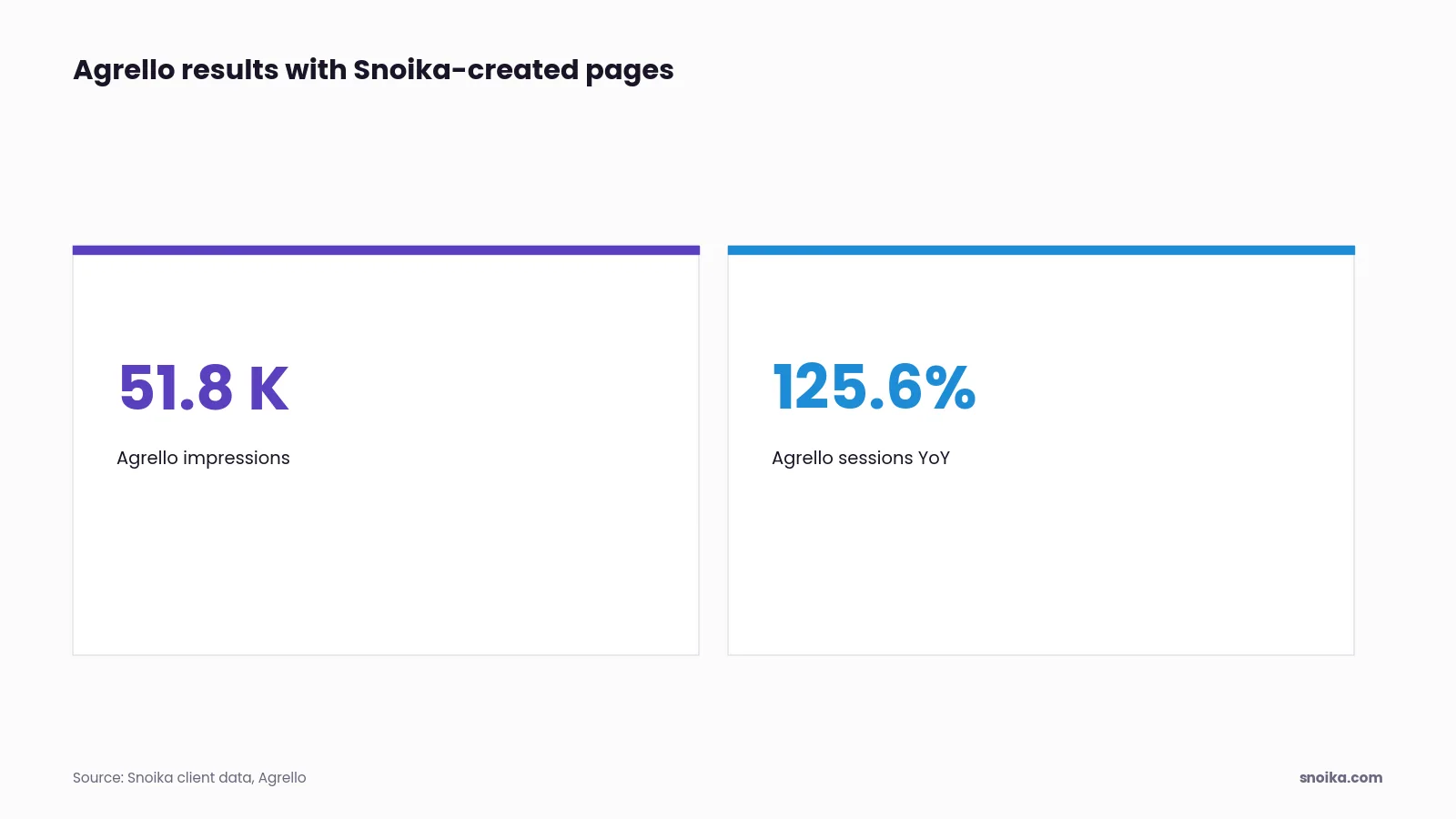
For Agrello, an e-signature company, Snoika-created pages generated 51.8K impressions, and organic search sessions grew +125.6% year over year.
AI sources each covers
Third-party reviews list broad engine coverage for Ahrefs, including Google AI Overviews and AI Mode, ChatGPT, Perplexity, Gemini and Copilot. According to meev's review, Grok coverage followed between December 2025 and April 2026. During that period, Ahrefs also added YouTube, TikTok and Reddit indexes.
Snoika's AI visibility tool centers on ChatGPT and Google AI Overviews, where most AI search traffic happens, and our larger setups monitor all AI platforms. ChatGPT alone had 800 million weekly users when Sam Altman, OpenAI's CEO, announced the figure in October 2025. We start from the engines your buyers actually use, so the coverage you get is coverage you act on.
Which team fits each
Ahrefs Brand Radar fits teams that already have Ahrefs and writers, while Snoika fits teams that need the content work done.
Teams that fit Ahrefs
Ahrefs Brand Radar fits SEO teams that already work inside Ahrefs and have the writers to act on the data. Its AI mentions sit next to backlinks and keyword data, so analysts can connect citations to the pages they already manage. Agencies doing category research get the most out of the big index.
Teams that fit Snoika
Snoika fits teams that want a result more than a dashboard, because we plan, write and publish the pages. Companies selling across borders also get content in 135+ languages and regional variants. Teams without a writer can check their visibility first through a free AI visibility report, and plans are on the pricing page.
Gaps Ahrefs leaves open
Ahrefs Brand Radar doesn't cover sentiment, and it doesn't cover the step from insight to action. Am I Cited's review also raises concerns about gaps in its conversational-engine data.
No sentiment analysis
Brand Radar counts how often AI mentions you, but it can't tell you how. The getairefs review says it has no sentiment analysis, so you won't see whether an answer recommends you or warns buyers away. A negative mention still counts as a mention, so Snoika tracks sentiment next to mention counts.
Mention count accuracy
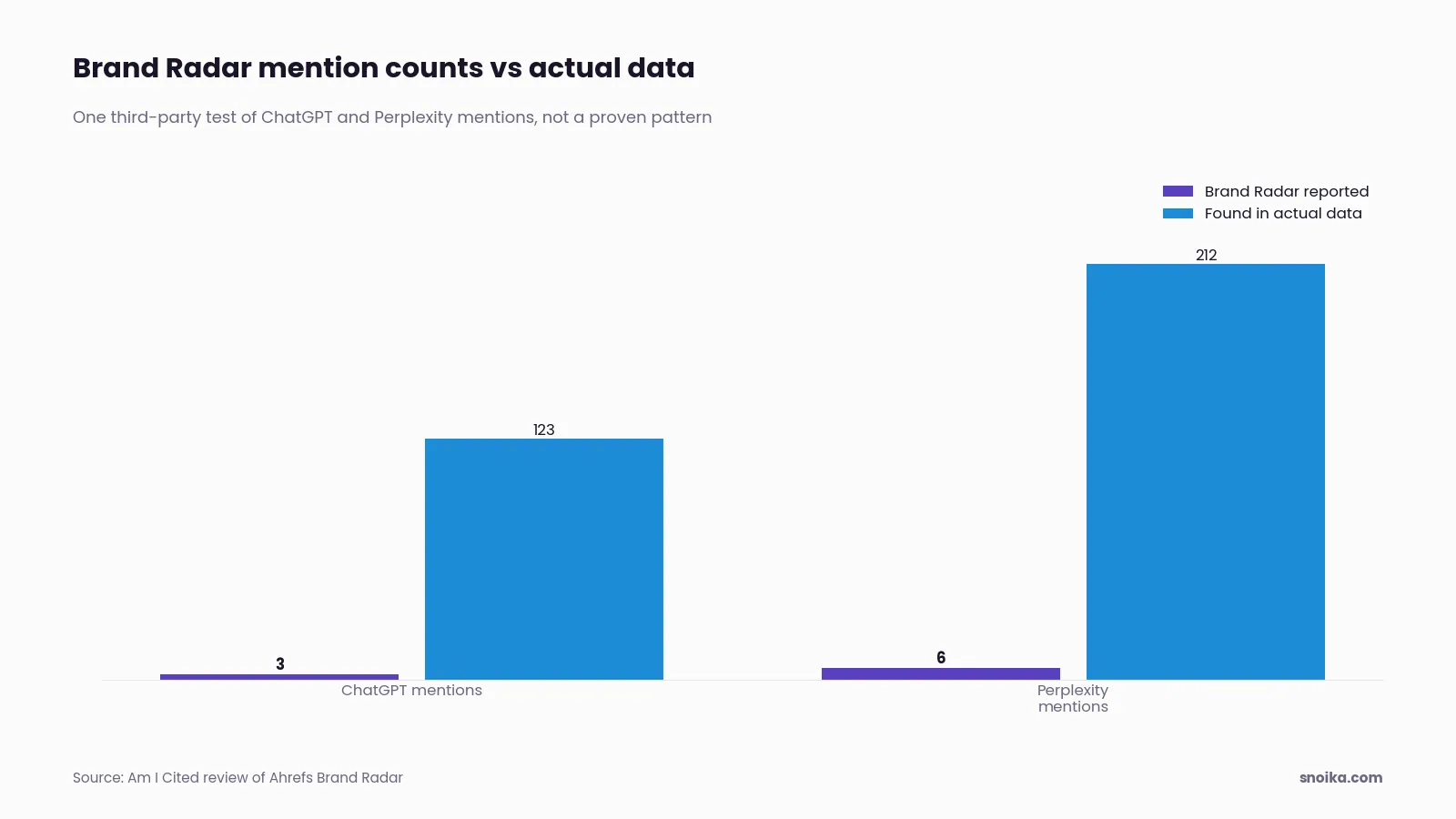
In Am I Cited's testing, Brand Radar reported 3 ChatGPT mentions against 123 found in the actual data, and 6 Perplexity mentions against 212. EWR Digital's assessment, quoted by Ekamoira, also points to "documented accuracy issues." One test doesn't prove a pattern, so we recommend checking a sample of answers by hand before you base a report on any tool's numbers, ours included.
Alternatives to Ahrefs tracking
The Ahrefs alternatives split into lighter trackers and platforms that also do the content work. On the tracker side, Otterly AI adds sentiment analysis, Peec AI tracks AI visibility as a standalone tool, and Semrush sells its AI Toolkit as a separate add-on.
Snoika belongs in the second group, along with AI SEO tools that link monitoring to content. Our advice for testing any of them, Snoika included: run the same 10 prompts through each one and compare the results with what you see when you ask the AI engines yourself.
When to choose Snoika
Choose Snoika if you need to raise your AI visibility, not only measure it. Ahrefs tracking makes most sense for existing subscribers who want AI data next to their SEO data, and a team that stays with it should make one person own the step from data to published page.
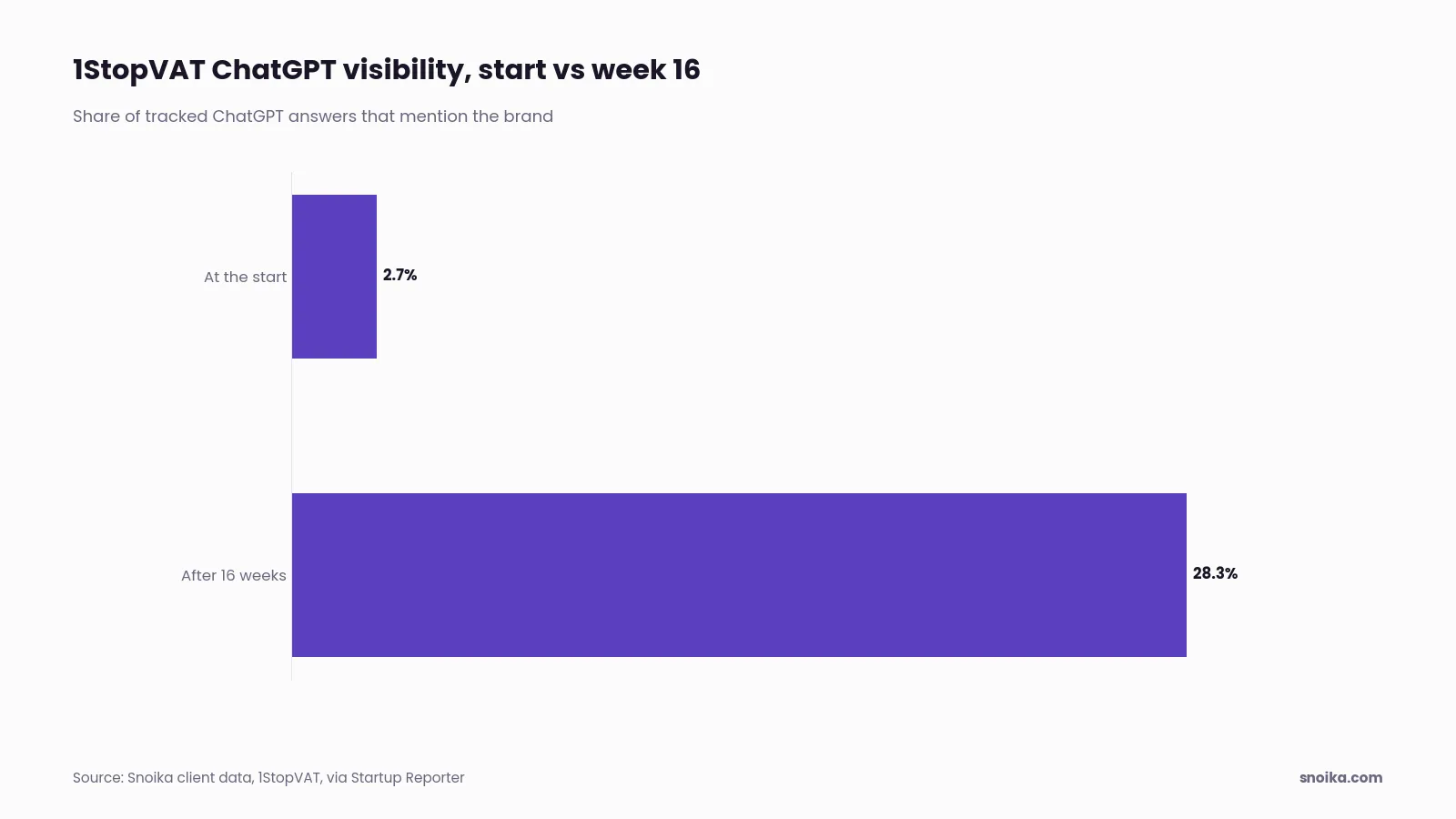
Alan Antin, Vice President Analyst at Gartner, wrote that "GenAI solutions are becoming substitute answer engines." That's why we measure your share of those answers and then publish the pages that change it. Snoika's founder Anton Vedeshin reported to Startup Reporter 1StopVAT's move from 2.7% to 28.3% ChatGPT visibility in 16 weeks. Gains like that came from publishing pages, which a dashboard alone can't do.
FAQ
No. The tool monitors visibility but doesn't create content or provide optimization recommendations. Your team has to turn its findings into briefs and drafts, while Snoika writes, reviews and publishes those pages for you.
It doesn't assess sentiment or carry out content improvements, so mention totals can't tell you whether an AI answer recommends your brand or warns against it. Snoika tracks sentiment alongside mentions, share of voice and citations.
A DNS connection and your approval of each page in the dashboard. The pages go live on your own domain through that DNS connection, with no migration and on any CMS.
We recommend running the same 10 prompts through each tool and comparing the reported mentions with answers you inspect directly in the AI engines. That gives you a sample check, although a single test doesn't establish a consistent accuracy pattern.
Other comparisons