
Is SEO dead in the age of AI search
AI search changes where buyers read answers, but ChatGPT and Google AI Overviews still build those answers from pages that search engines crawl and rank. Generative engine optimization (GEO) is the work of getting your brand cited inside those answers, and it sits on top of SEO. You're deciding how much GEO to add to your search budget, and when.
 Jevgenia PogadajevaCFO, Snoika · 6 min read

























SEO is not dead
SEO is alive because search volume keeps growing while AI answers spread. In early 2025, Google said it handles more than 5 trillion searches a year, and that commercial queries rose after AI Overviews launched. Sam Altman, CEO of OpenAI, said at DevDay in October 2025 that ChatGPT had 800 million weekly users. Both things are true at once, because buyers add AI tools to their research and keep searching.
The predictions of collapse haven't come true yet. In February 2024, Gartner forecast that traditional search volume would drop 25% by 2026. Alan Antin, Vice President Analyst at Gartner, called generative AI "substitute answer engines." That deadline has arrived, and search still handles 5 trillion queries a year. SEO will still exist in five years. The work will lean further toward being the source that both search engines and AI models trust.
Where AI search hurts traffic
AI search does take organic clicks, and most of the loss falls on informational queries. Pew Research Center tracked the browsing of 900 US adults in March 2025. Users clicked a traditional result in 8% of visits when an AI summary appeared, against 15% when none did. Ahrefs found in its December 2025 data that an AI Overview went with a 58% lower clickthrough rate for the top-ranking page, up from 34.5% in its April 2025 study.
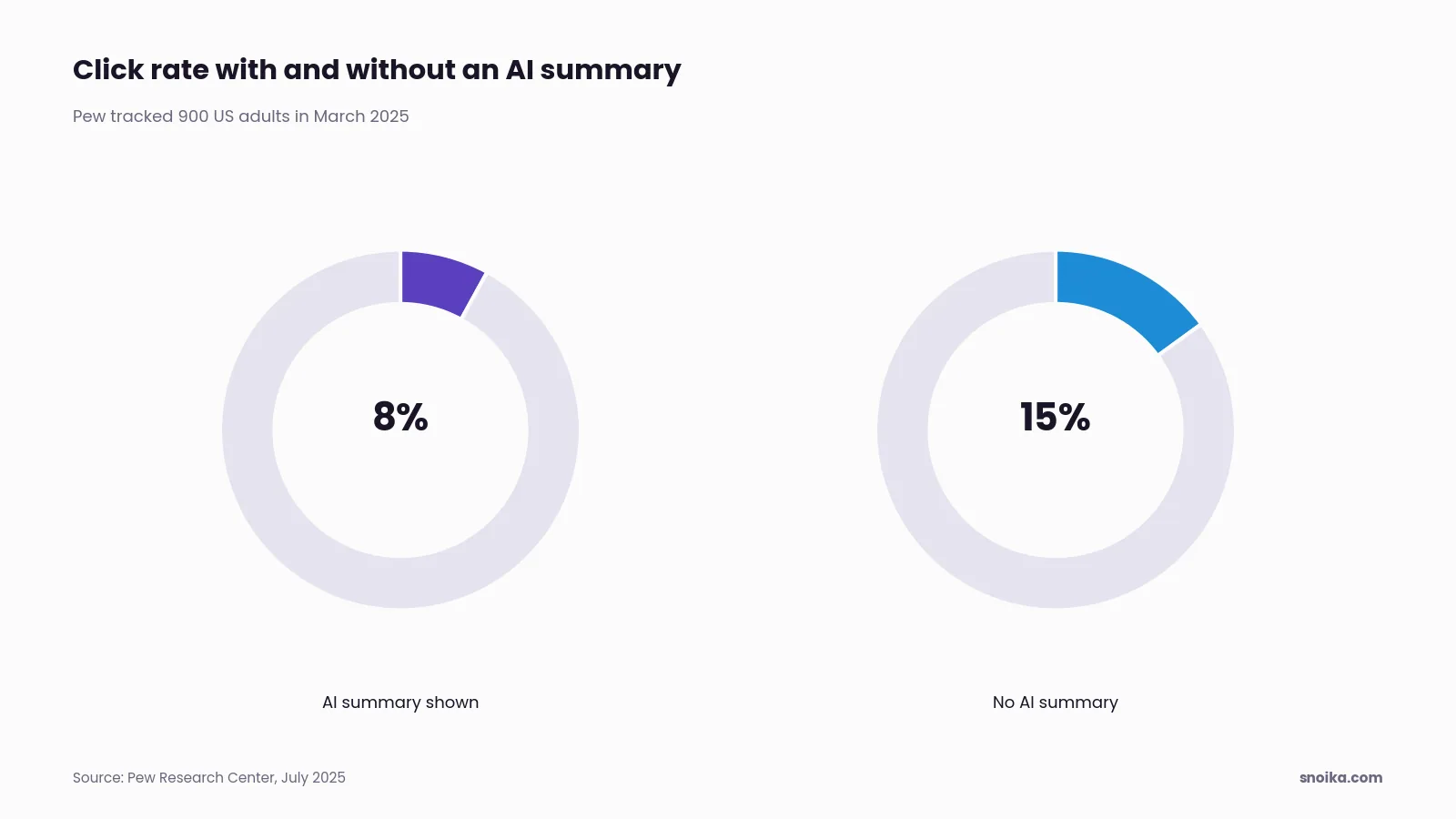
So AI search is probably eating into part of your organic traffic, but only on certain kinds of query. Semrush found that over 88% of AI Overview queries had informational intent. The traffic loss falls more heavily on glossaries and beginner's guides than on pricing pages.
You can check your own exposure in Google Search Console. Filter for queries where impressions held steady while clicks fell, then sort that list by intent. If the drop sits in top-of-funnel articles, AI Overviews are the likely cause. If it hits branded or product queries, look for a ranking loss or a broken tracking tag before you blame AI.
GEO extends SEO
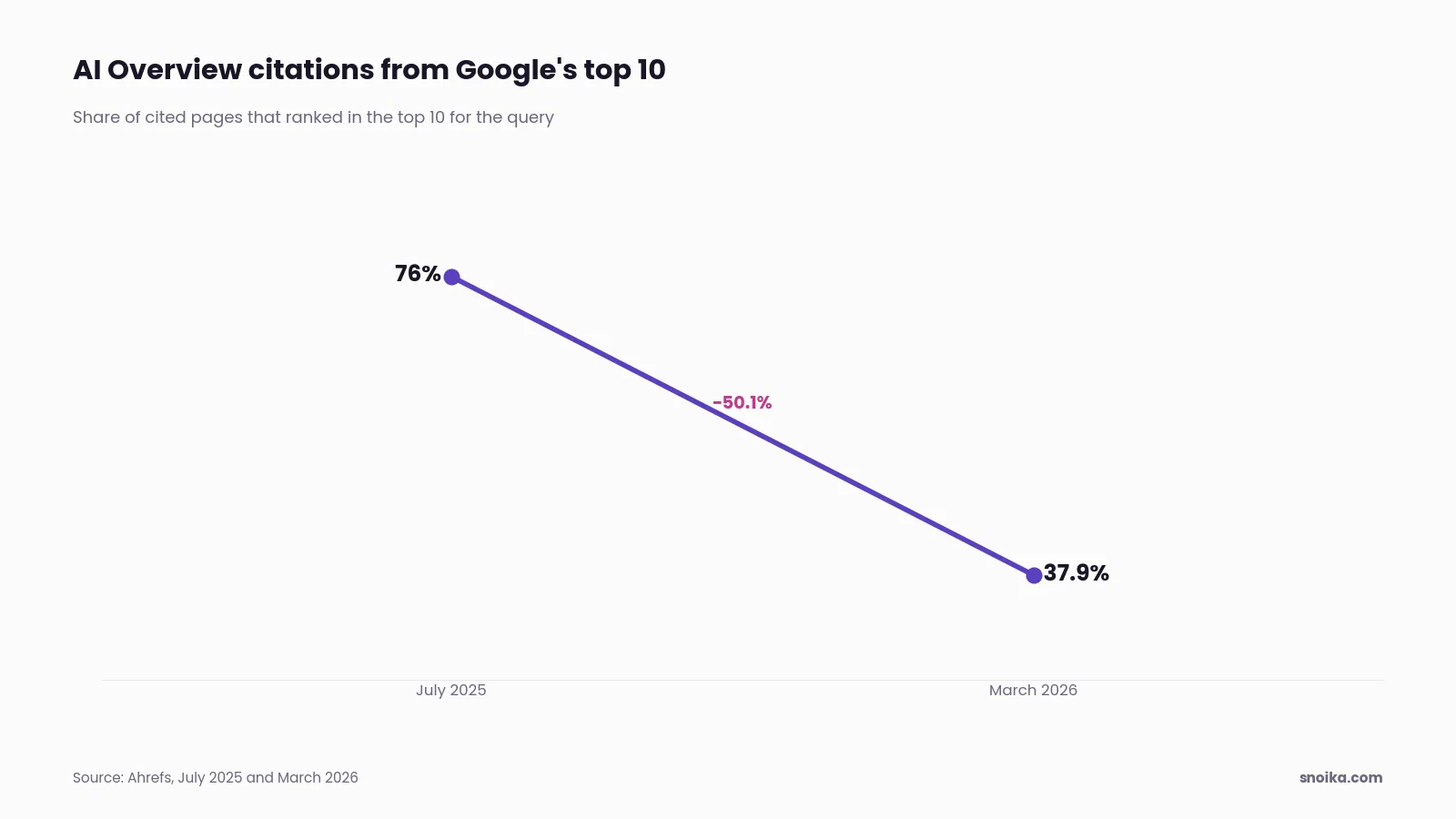
Generative engine optimization extends SEO because AI answers draw on the same index that SEO already works on. In July 2025, Ahrefs found that 76% of AI Overview citations came from pages ranking in Google's top 10. Its March 2026 rerun put the share at 37.9% from the top 10. The drop came because Google now breaks a query into sub-queries and cites pages that rank for those. Google had indexed the cited pages in both studies and judged them relevant.
Danny Sullivan, a director in Google Search, said in 2025 that "Good SEO is good GEO." GEO is a layer on top of SEO, and it fails when the base underneath is weak.
To get cited by AI while keeping SEO, change how your pages are written and where your brand shows up. Answer the question in the first sentence under each heading. Put figures and named sources on the page, so a model can lift a claim along with its evidence. Earn mentions on the third-party sites AI tools already cite. Agrello, an e-signature company, recorded +125.6% organic search sessions YoY and generated 51.8K impressions from Snoika-created pages.
What still earns clicks
Searches where the buyer has to visit a page to act or to verify still earn clicks. They fall into three groups, and each needs a different check.
Commercial and transactional queries
Queries with buying intent have a much lower rate of AI Overviews. In the same Semrush analysis, high-value keywords with a cost per click above $2 stayed largely free of AI Overviews. Pages for "pricing" or "demo" keep their blue-link value, so they deserve the same SEO attention they had before. The same applies to "[product] vs [product]" pages.
Answers that need verification
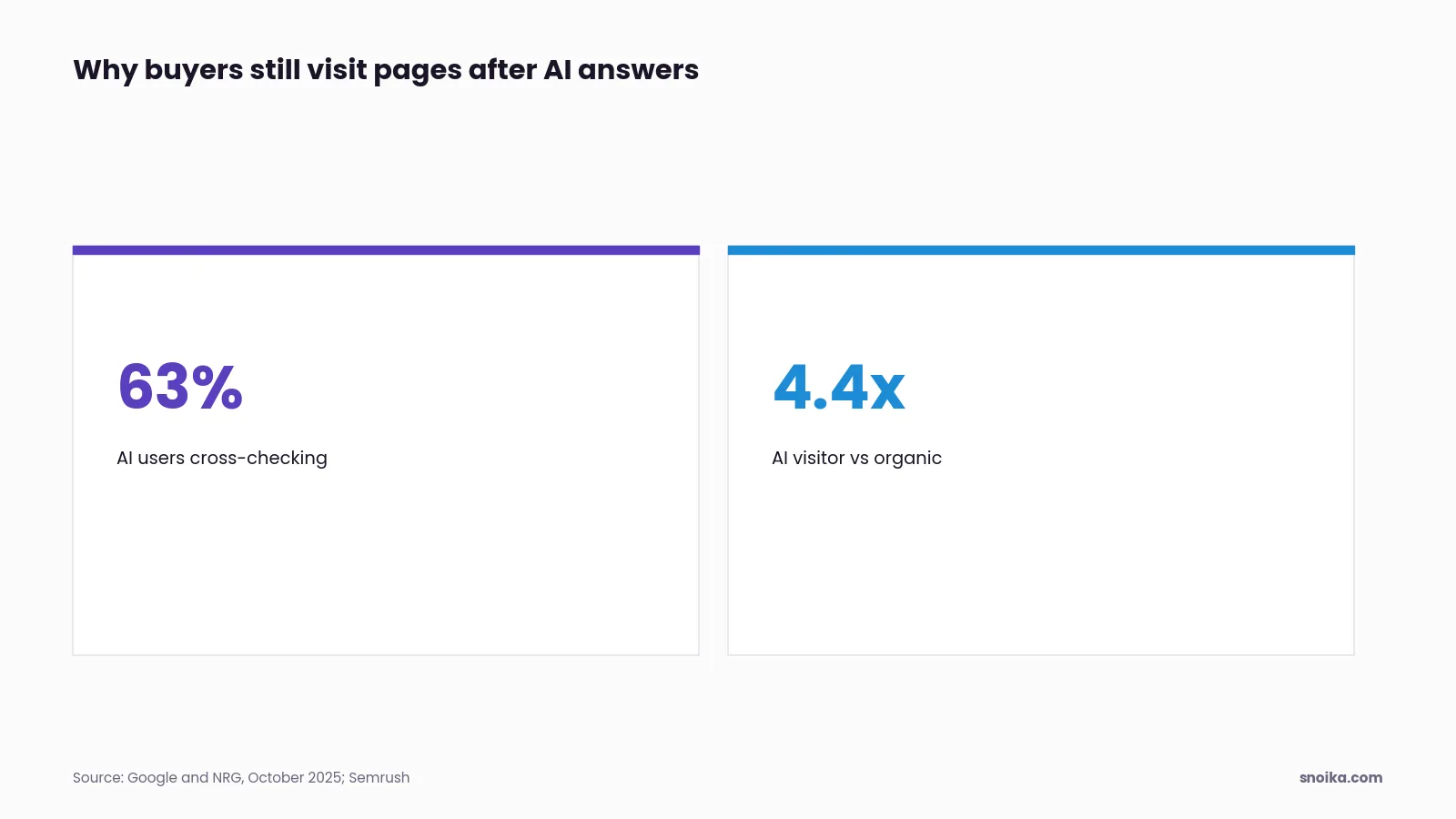
Google's 2025 study with NRG of 2,063 B2B buyers found that 63% of AI-tool users used Google Search to cross-check the AI's output. Pages with original data or working calculators win that second visit. Pages with full specifications earn those verification visits too.
Branded searches after an AI mention
When an AI answer names your brand, the buyer searches for it next. Semrush estimated that the average AI search visitor is worth 4.4x an organic visitor, based on conversion rates, as those visitors arrive further along in the buying process.
Testing your GEO readiness
You test GEO readiness by finding out whether AI tools can reach your pages and whether they already mention you.
- Write 20 to 50 prompts that match how your buyers ask for vendors and comparisons in your category. Include prompts about fixes as well.
- Run each prompt in ChatGPT and in Google with AI Overviews. Record whether your brand or competitors appear, along with the URLs cited.
- Open your robots.txt file and confirm it doesn't block OpenAI's search crawler (OAI-SearchBot) or Googlebot.
- Read your 10 highest-traffic pages and mark any heading whose first sentence fails to answer it.
- List the third-party sites that keep getting cited, then note which of them mention you.
If crawl blocks keep your brand out of answers, start with a technical fix; if your brand is missing from cited review sites, prioritize outreach before new content.
Monitoring AI surfaces
Monitoring AI surfaces means rerunning the same prompts on a schedule, because a single check goes stale within days. Ahrefs puts the chance of an AI Overview changing between observations at 70%. Record these four measures in each run.
- Mentions: how often the answer names your brand
- Share of voice: your mentions against your competitors'
- Sentiment: whether the answer describes you favorably
- Citations: which of your URLs the answer links
Snoika tracks those four in ChatGPT and Google AI Overviews, where most AI search traffic happens, with weekly prompt sets. Snoika's founder Anton Vedeshin reported to Startup Reporter 1StopVAT's move from 2.7% to 28.3% ChatGPT visibility in 16 weeks.
Don't judge the channel on referral clicks alone. Conductor found that AI referrals made up 1.08% of website traffic across 10 industries. Most AI influence shows up later, as branded searches or direct visits.
A defer-test-invest matrix
The matrix sorts your situation into one of three budget moves, based on signals you can measure this month. Read across each row and count which column describes you best.
| Signal | Defer | Test | Invest |
|---|---|---|---|
| Buyers mention AI tools in sales calls | Rarely | Sometimes | Often, by name |
| Your brand in your own prompt test | Not relevant to deals | Absent while competitors appear | Present but outranked, or rising |
| Share of pipeline from informational content | Small | Moderate | Large |
| State of your SEO base | Broken crawl or thin content | Sound | Sound and growing |
| Budget move | Fix SEO first | Monitoring plus a few rewritten pages for one quarter | Dedicated GEO program |
Buyers mention AI tools in sales calls
- Defer
- Rarely
- Test
- Sometimes
- Invest
- Often, by name
Your brand in your own prompt test
- Defer
- Not relevant to deals
- Test
- Absent while competitors appear
- Invest
- Present but outranked, or rising
Share of pipeline from informational content
- Defer
- Small
- Test
- Moderate
- Invest
- Large
State of your SEO base
- Defer
- Broken crawl or thin content
- Test
- Sound
- Invest
- Sound and growing
Budget move
- Defer
- Fix SEO first
- Test
- Monitoring plus a few rewritten pages for one quarter
- Invest
- Dedicated GEO program
Most rows in the Defer column mean your money still belongs in SEO. A mix of Test answers calls for a quarter of tracked prompts and rewritten pages before you commit more. You invest when the prompt data already shows deals passing through AI answers.
Options for covering AI search
You can hire in-house or use GEO agency services to cover AI search. Tool-based options include a monitoring-only tool or a combined platform and service. The real difference between them is who does the work after the data arrives.
| Option | Cost (2026) | What you get | Suits |
|---|---|---|---|
| In-house hire | A role at $70,000 to $110,000 yearly plus tools | Full control, slow ramp-up | Teams with SEO staff already |
| Agency retainer | $1,500 to $50,000+ monthly | Strategy and delivery, quality varies | Teams without writers |
| Monitoring-only tool | From $29 a month | Data, with no one to act on it | Teams with capacity to act |
| Snoika | Plans on the pricing page | Tracking plus content, with a human review layer | Teams wanting one owner for SEO and GEO |
In-house hire
- Cost (2026)
- A role at $70,000 to $110,000 yearly plus tools
- What you get
- Full control, slow ramp-up
- Suits
- Teams with SEO staff already
Agency retainer
- Cost (2026)
- $1,500 to $50,000+ monthly
- What you get
- Strategy and delivery, quality varies
- Suits
- Teams without writers
Monitoring-only tool
- Cost (2026)
- From $29 a month
- What you get
- Data, with no one to act on it
- Suits
- Teams with capacity to act
Snoika
- Cost (2026)
- Plans on the pricing page
- What you get
- Tracking plus content, with a human review layer
- Suits
- Teams wanting one owner for SEO and GEO
The Free Trial monitors 10 prompts on 1 AI platform each week. Starter covers 100 prompts on 3 platforms, and Growth covers 500+ prompts on all of them. Through a DNS connection, Snoika publishes on your own domain. Pages go live only after you approve them. It writes in 135+ languages and regional variants, which matters for multi-market brands. If you already employ SEO writers, an in-house hire is the better pick; if all you lack is data, a monitoring tool is enough.
When to prioritize GEO
Put GEO first when buyers in your category ask AI tools for shortlists and those answers name competitors instead of you. Bain and Company found in 2025 that 80% of consumers rely on AI-written results for at least 40% of their searches. In its niche B2B market, 3DPrinterOS achieved #1 visibility in ChatGPT for industry-specific queries and turned AI search into a steady source of 3–4 qualified inbound leads/day.
In a GEO vs SEO split, put GEO second when your SEO base is broken or your buyers search for a local service. AI answers can't cite pages they can't crawl. A buyer looking for a plumber nearby picks from the map listings.
What to do next
Run a baseline before you move budget. Record who gets named today for the prompts your buyers ask, and repeat the test in four weeks. Because answers shift between runs, compare two snapshots for a trend you can defend in a budget meeting. With that data, "is GEO replacing SEO" turns into a practical question about how much to spend and on which pages. We start every engagement by learning your category and buyers. We also ask for GA4 and Google Search Console access so the baseline includes your organic data. To see where your brand stands in AI answers today, get a free report.
FAQ
It may be, especially if your traffic depends on informational articles. Check queries where impressions stayed steady but clicks fell, then compare their intent. Losses on branded or product searches warrant checking rankings and tracking before attributing the decline to AI.
Yes, based on the continuing role of crawlable pages in AI answers. That supports retaining SEO in a five-year plan, while reviewing spending as your traffic and AI visibility change. It doesn't guarantee that today's tactics will stay effective.
Build citation-focused improvements into your existing SEO work. On pages search engines can crawl, answer each heading's question immediately and support claims with named sources. Use prompt tests to identify which third-party sites merit attention because AI answers already cite them.
No. The answer to “is geo replacing seo” is that GEO builds on SEO. Prioritize crawl fixes and useful content before shifting budget. If that foundation is sound and competitors appear in relevant AI answers, a one-quarter GEO test can inform further spending.
Low referral traffic alone doesn't establish that GEO has failed. Track AI mentions and citations alongside your referral data. Compare them with trends in branded searches or direct visits, where AI influence can appear later, without assuming every increase came from AI.
Keep reading
All articles

