How ecommerce teams implement AEO for product pages

Content authorJevgenia Pogadajeva, MBA, MScPublished onReading time14 min read
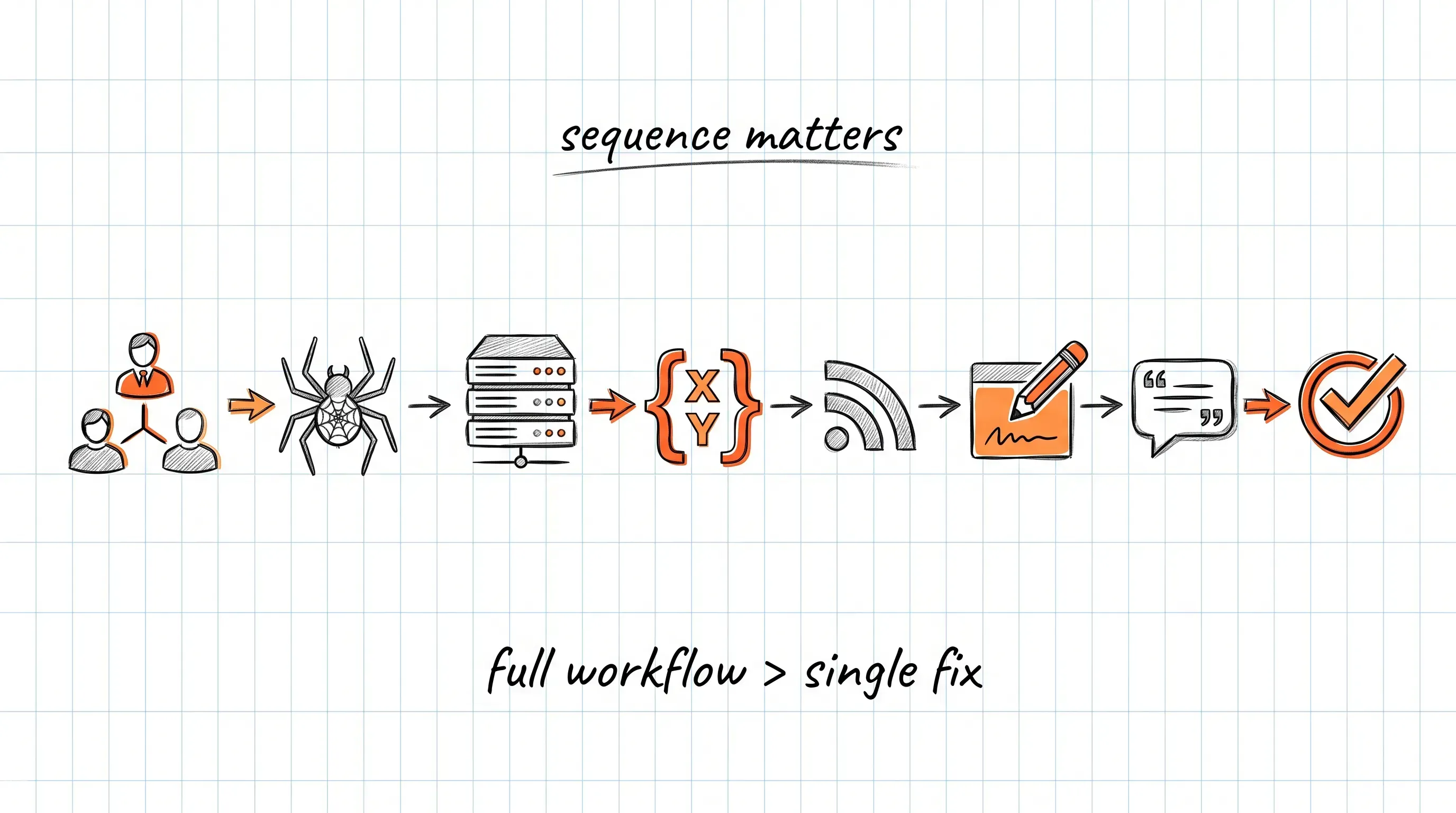
Hand-drawn wireframe flowchart on notebook paper showing AEO implementation workflow for ecommerce product pages with annotated icons.

This article gives you an ordered AEO workflow for making product pages readable and quotable inside AI answers. It covers crawler access and server-rendered facts. Schema and feed alignment then lead into content rewrites and citation tracking. The sequence matters more than any single fix.

Why product pages need a different playbook

AEO work on product pages fails when it starts with copywriting instead of access. The reason is mechanical: an answer engine can only quote what it can fetch and verify. Everything else in this workflow depends on that.

The commercial case for Answer Engine Optimization is no longer speculative. Adobe Analytics, which tracks more than a trillion visits to U.S. retail sites, found AI-referred traffic grew 393% year over year in Q1 2026. Shopify's Q1 2026 commerce data shows 55% of AI-referred sessions start on a product detail page, against roughly 20% for organic search.

So the visitor arrives already shortlisted. Your product detail page is what the model quoted and handed to a buyer who has stopped comparing. That's what this AEO workflow protects.

Set the AEO scope

Before touching a line of code, decide which prompts a product page can realistically win. Product pages get cited when a prompt names something specific, such as a model number or a compatibility question. Broad research prompts behave differently.

BrightEdge found the split between engines is sharp on shopping queries. Retailer domains take roughly 36% of ChatGPT's citations but only about 4% in Google AI Overviews, where YouTube reviews and Reddit threads dominate. If you're chasing AI Overviews with product copy alone, you're competing in a room your page wasn't invited to.

Answer engine optimization basics

Answer Engine Optimization works on retrieval. The engine fetches a page and extracts text from the HTML it receives to decide whether a passage is specific enough to quote with a citation attached. Conventional ecommerce SEO gets you into the indexes these systems query without guaranteeing the extraction step succeeds.

Perplexity documents two separate agents for this, PerplexityBot for indexing and Perplexity-User for on-demand fetches. Its retrieval layer combines semantic methods and LLM ranking rather than keyword matching, and complex questions get decomposed into sub-queries fetched independently. Each of those sub-queries is a separate chance for your page to be pulled in or passed over.

Verification is the part most ecommerce SEO work underestimates in AEO. When a model states a price or a stock status, it needs a source it can point at. A claim that only exists in your JavaScript state object or your merchant feed gives it nothing to cite.

Match pages to prompts

Map the prompt types before you make technical changes, because the mapping determines who does the work. Comparative prompts ("best X for Y") and attribute prompts ("is this waterproof") pull product pages into AI answers, and use-case prompts do the same. Everything broader belongs to a category page or a buying guide, which is how a Generative Engine Optimization guide would split the work.

Build the map like this:

  • Named-product and attribute prompts go to the product detail page, owned by merchandising and the content team.

  • Category and comparison prompts go to category copy and guides, owned by editorial.

One agency's audit of this problem describes the failure precisely: a merchandiser rewrites forty descriptions and waits six weeks with nothing to show, because the work was competent but aimed at the wrong page. Do the mapping first and you skip that six weeks.

Allow AI crawlers

Now check whether the engines can reach you at all. This is the fastest fix in the AEO workflow and the one most often skipped, because robots.txt looks fine while something else at the edge returns a 403.

OpenAI runs GPTBot for training and OAI-SearchBot for ChatGPT Search retrieval and citation. ChatGPT-User handles on-demand fetches, and you can control all three independently in robots.txt. Anthropic mirrors that structure with ClaudeBot and Claude-SearchBot, plus Claude-User. OpenAI's documentation confirms operators can allow OAI-SearchBot while disallowing GPTBot, which is the canonical pattern for wanting search presence without contributing to model training.

The edge layer is where most storefronts quietly lose, long before a Generative Engine Optimization guide reaches content. Cloudflare, which handles traffic for about 20% of the web, made AI-crawler blocking the default for new domains on July 1, 2025. More than a million customers had already switched on one-click blocking before that. If your storefront was onboarded after that date, your robots.txt says Allow and your network edge says no.

Verify access without loosening anything that matters. Curl a live product URL with each bot's user-agent string and confirm a 200 with real content in the body. Then check your Web Application Firewall (WAF) logs for 403s against those agents. Keep checkout and cart paths disallowed, along with account and internal search paths. Those pages are worthless to an answer engine and dangerous to expose.

Need help with your AI visibility?

Book a free consultation with our experts we'll help you determine exactly which services your organization needs.

Expose product facts

Once the crawlers get through, the next question is what they actually receive. Open a product URL and search the raw HTML for the price and the stock status. The description and the spec values should be there too, along with a line of review text. If any of those only appear after the page hydrates, the engine never sees them.

Vercel and MERJ's server-log analysis, published on December 17, 2024, found that none of the major AI crawlers render JavaScript. That set includes OpenAI's three bots and ClaudeBot, plus Meta-ExternalAgent and Bytespider. The crawlers download JavaScript files without executing them. ChatGPT's crawler requested .js files on around 11.5% of fetches and Claude's on nearly 24%, and ran none of them.

This is where headless and single-page storefronts break. Ryan Siddle, Managing Director of MERJ, put the consequence plainly in that research: "AI crawlers, while rapidly scaling, continue to face significant challenges in handling JavaScript and efficiently crawling content. Brands must ensure that critical information is server-side rendered."

Googlebot renders JavaScript, so a client-rendered page can hold position one while returning an empty shell to every AI crawler that fetches it. SEO analyst Glenn Gabe tested this directly on a fully client-side rendered site in August 2025 and reported that ChatGPT could not read the content because the page relied on JavaScript rendering. Perplexity and Claude returned the same blank.

Server-side rendering or static generation for product templates fixes it, a prerequisite for a AEO guide. Watch for the partial cases too, such as a spec block behind a tab that loads on click or a variant price fetched from an API after selection. Each one is a fact you own that the model can't quote.

Align visible data

With facts in the HTML, the next job in AEO is making them consistent everywhere they appear. Google's structured data guidelines are explicit that you shouldn't mark up content that isn't visible to readers of the page. John Mueller applied that directly to gated pricing: if a price is visible only after login, it must not appear in structured data.

Treat JSON-LD as a mirror of visible copy. Every price and availability state in your markup should be readable in the page body by someone with JavaScript disabled, along with every dimension and material. That single rule solves both the schema-policy problem and the extraction problem at once.

Variants deserve their own attention. If selecting a color changes the SKU and price without changing the URL or the server-rendered content, every configuration except the default is invisible. Give each meaningful variant a crawlable URL with its own facts in the HTML, and keep those facts identical to what your merchant feed submits.

Complete product schema

Build the Product and Offer markup out properly. Google's merchant listing documentation requires name and image, plus offers with price and priceCurrency. Availability and brand unlock full merchant listing eligibility, as do aggregateRating and identifiers. Price must be a plain number string, so "19.99" and never "$19.99".

Include these on every product page:

  1. Product identifiers: SKU (Stock Keeping Unit) plus GTIN (Global Trade Item Number) in numerical form or MPN (manufacturer part number) when no manufacturer GTIN exists. Google's product data specification notes that products with a GTIN submitted without one may have limited visibility.

  2. brand as a Brand object and a description. Include width and height for the specific variant, plus depth and weight. Color and size go in as well, as does material.

  3. Offer fields: price and priceCurrency, plus availability and itemCondition. Include priceValidUntil and the canonical url.

  4. aggregateRating with ratingValue and reviewCount, matched to reviews a visitor can actually read on the page.

FAQPage needs a caveat. Google added a deprecation notice to its FAQ structured data documentation on May 7, 2026, and FAQ rich results no longer appear in Search. The type is still valid schema.org and harmless to keep, but the reason to publish questions on a product page is the visible answer text.

Validate every source

For Answer Engine Optimization, run the markup through the Rich Results Test and the Schema Markup Validator first, then do the harder reconciliation by hand. Compare the schema price against the visible price and the schema availability against live inventory. Check the spec values against the current manufacturer sheet and all of it against what your feed submits.

The cost of skipping this step is immediate. Google's Preemptive Item Disapproval fires the moment its crawl detects a gap between feed data and either the landing page or the schema.org Offer markup, with no warning period and no grace. Clearing the disapproval requires a corrected feed with matching server-rendered markup, plus a manual review that takes up to seven business days.

Make reconciliation a deployment gate. Block the feed export when price or availability fail validation. Do the same for identifiers and image URLs, and run a nightly diff between feed values and rendered page values. Catching a mismatch yourself costs an hour, while catching it after a disapproval costs a week of Shopping visibility.

Need help with your AI visibility?

Book a free consultation with our experts we'll help you determine exactly which services your organization needs.

Rewrite product content

Only now does copy matter in AEO, and the change is a shift in how the first paragraph works. Open with a declarative definition of what the thing is and what it is made of. State the sizes and the intended use. Benefit-led opening lines give a model nothing to lift, because "engineered for all-day comfort" is not a fact anyone can verify or attribute.

The research supports specificity over persuasion in a Generative Engine Optimization guide. The GEO study by Pranjal Aggarwal and colleagues from Princeton and Georgia Tech and from the Allen Institute for AI and IIT Delhi, presented at KDD 2024 across a 10,000-query benchmark, found that adding statistics lifted visibility by up to 41% and that citing sources in the text lifted lower-ranked pages by as much as 115%. Numbers and named sources are what these systems reach for.

Add a spec table in real HTML. Put measurements and materials in it. Add capacities and power requirements, plus compatibility ranges, all with units. A table row is a self-contained fact, which is exactly the unit a retrieval system extracts.

Comparisons belong on the page too, when you can make them honest. Naming how this model differs from the previous generation, or which of your own sizes fits which use, answers the comparative prompts that pull product pages into answers. Write those as statements a model can quote without needing the surrounding paragraph for context.

Add customer questions

Publish three to five question-form H3 headings drawn from real support tickets and review complaints. Sizing and compatibility cover most of what buyers actually ask before purchase, as do care and returns, and each answer should stand alone in one short paragraph without pronouns pointing back to earlier text.

Write the answer directly under the heading and lead with the answer itself. "Runs about half a size small, so order up if you're between sizes" is quotable. "Fit varies by individual preference, and we recommend consulting the size guide" is not. Answer Engine Optimization rewards the first construction because it can be lifted whole and attributed.

Keep these questions specific to this product. A generic returns block copied across the catalog gives every page the same passage, and a retrieval system choosing between a thousand identical paragraphs has no reason to pick yours.

Strengthen supporting evidence

A product page rarely earns a recommendation by itself in AEO. It corroborates. When an engine assembles an answer to "best insulated bottle for cycling," it's weighing third-party reviews and forum threads, then confirming details against the merchant page.

Substantive customer reviews carry real weight here, because they contain the concrete language nobody writes in marketing copy: how it held up after six months or whether it fit a specific bike frame. Render that review text server-side rather than loading it through a widget, and note that Google's review guidelines require marked-up review content to be readily available to users on the same page, with undisclosed incentivized reviews excluded.

Third-party mentions do the rest of the work. Getting your specs quoted accurately in an independent review or a community thread gives the model a second source that agrees with your page, and agreement across sources is what turns a claim into something it will state confidently.

Fix AEO blockers

Most catalogs carry the same recurring AEO faults. Audit against this list, then assign each item to a person rather than to a team, because unowned checks stop running by the second quarter.

  • Blocked crawlers at the WAF or CDN despite a permissive robots.txt.

  • Thin descriptions under 50 words with no measurements or materials.

  • Missing GTIN or MPN on products the manufacturer has assigned one.

  • Stale prices where the schema and the feed disagree with the visible page.

  • Specifications describing a discontinued revision of the product.

  • Variant data reachable only through a JavaScript selector.

Set refresh cadences that match how fast each fact moves. Price and availability need continuous sync between feed and rendered page. Specifications need review whenever a supplier revision lands. Crawler access needs a monthly check, because CDN configuration changes and edge rule updates undo it without anyone filing a ticket.

Assign ownership explicitly. Development owns rendering and crawler access. Merchandising owns identifiers and spec accuracy, and content owns the descriptions and question blocks. A shared spreadsheet of who fixes what turns AEO from a project into a maintenance routine, which is the only form in which it survives.

Track AI citations

Measure what changed after each guide step. Build a prompt set of twenty to forty questions covering your named products and your top categories, plus the comparison phrasings buyers use. Run them monthly through ChatGPT and Perplexity. Run the same set through Google AI Overviews. Record every cited URL.

Traffic alone will mislead you here. AEO changes show up first as citation frequency, because a buyer can read your specs inside a chat window and never click through. Watching sessions instead of citations means missing the first eight weeks of progress, roughly the window in which retrieval-based engines pick up updated pages.

Connect each deployment to the citation record. If you server-rendered the spec table in week one and completed the schema in week three, you want to see which change moved the needle on which engine. That's the difference between a Generative Engine Optimization guide you followed and a process you can defend in a budget meeting.

Where to start

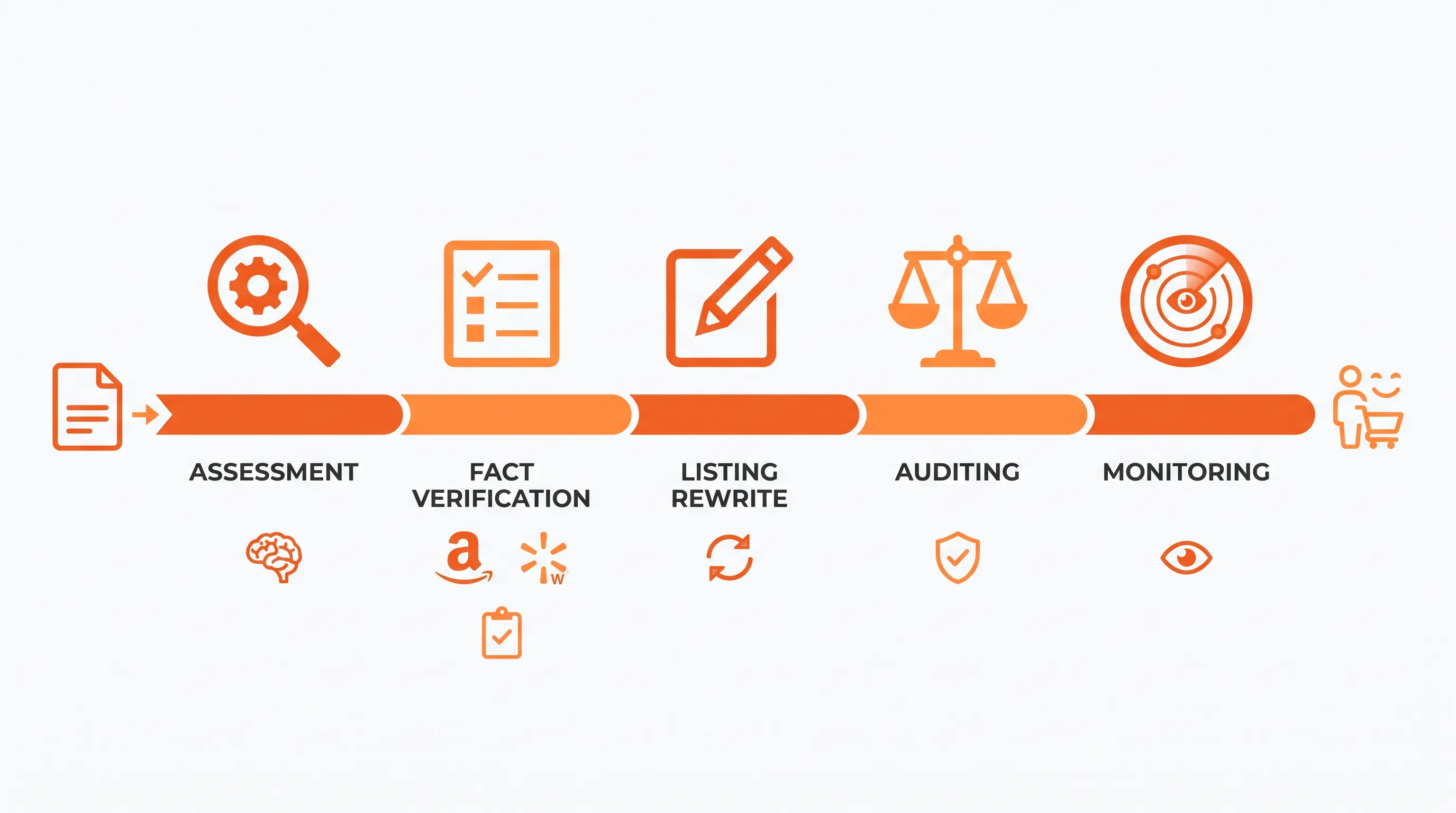
Work the AEO sequence in order. Unblock the crawlers and get the facts into raw HTML. Reconcile schema against page and feed, then rewrite the copy and the question blocks. Skipping to the copy is the most common and most expensive mistake, because a beautifully written page nobody can fetch changes nothing.

Snoika monitors how ChatGPT and Perplexity present your brand and products, and covers Gemini and Claude as well. It shows which prompts surface you and which competitors appear instead. Start a free trial and get a baseline before your next AEO sprint.

Need help with your AI visibility?

Book a free consultation with our experts we'll help you determine exactly which services your organization needs.

Request a live product URL with the crawler’s user-agent string, then confirm the response returns HTTP 200 and includes the price, availability, description, and specifications in the raw HTML. Check WAF and CDN logs for 403 responses. Test a representative variant URL as well, since default products can pass while variants fail.

No. A sale price in Product or Offer markup must also appear visibly on the product page. Keep the visible price, server-rendered HTML, structured data, and merchant feed identical. If a price requires login or a JavaScript interaction, don’t add it to schema until visitors can see the same value.

Update the rendered product page, Product schema, and merchant feed before publishing the supplier revision. Check identifiers, dimensions, materials, images, and compatibility details against the current manufacturer sheet. This prevents an outdated specification from being cited and avoids feed disapprovals caused by conflicting product data.

Measure citations monthly with the same set of named-product, attribute, and comparison prompts. AEO results often appear in citation frequency before referral sessions change, so record cited URLs by engine and connect them to deployment dates. Allow roughly eight weeks to assess whether updated pages have entered retrieval systems.

Snoika tracks how ChatGPT, Perplexity, Gemini, and Claude present products and brands for selected prompts. Use its results to identify cited pages and competing domains, then compare them with your deployment record. Start a free trial on Snoika to establish a citation baseline before an AEO update.

Schedule a Meeting

Book a time that works best for you

You Might Also Like

Discover more insights and articles

Minimalistic SaaS marketing illustration featuring a central ChatGPT icon with a violet background, brand icons interacting with a filter, and an auditor icon.

Why ChatGPT Mentions Competitors Instead of Your Brand: A Visibility Gap Audit

ChatGPT names competitors instead of your brand when it can't confidently identify your company and connect it to the prompt's category with sources it trusts. Some of that absence is random sampling. The rest is a real evidence gap, and you can separate the two by testing the same prompts repeatedly and recording what comes back.

A vibrant illustration featuring a glowing AI-brain icon at the center, surrounded by dynamic line icons and luminous badges in deep violet hues.

AI Brand Mention Tracking Limits: What to Know Before You Invest

AI brand mention tracking reliably shows you directional trends and relative presence over time. AI answers can differ between identical runs. They also personalize by user and change after model updates, so treat these numbers as confidence ranges and never report a single snapshot as fact.

Title:
15 best AI tools for SEO ranked for content keywords and competitors

Meta description:
Compare the best AI tools for SEO so you can find keyword gaps and analyze competitors without extra tool

15 best AI tools for SEO ranked for content keywords and competitors

This article ranks 15 best AI tools for SEO based on two jobs: finding worthwhile content keywords and exposing competitor openings. Each entry names one differentiator and the team it suits. Its limitation fixes its place, so you can pick one primary platform and add a specialist only when the data demands it.

A vibrant SaaS marketing visual featuring a central AI hub with glowing icons for ChatGPT, Claude, and Google AI, surrounded by citation nodes and traditiona…

Why ai citations reshape search visibility in 2026

This article explains why a page that ranks well in Google can still go missing inside AI answers, and what that means for ai brand monitoring and how you measure visibility now. It walks through how the major answer engines diverge and why generative engine optimization sits on top of your existing SEO. It also identifies where to start once ranking stops being the finish line.