
How to get cited by AI answer engines
To get cited by AI answer engines, a page has to be open to the engine's crawler and put a quotable answer near the top. It also needs facts the engine can't find anywhere else. ChatGPT and Google AI Overviews choose a small set of trusted pages from live web searches and name those pages next to the answer. At Snoika, we do this work as a platform with a service team on top. You can start with a free AI visibility report, and paid plans are billed weekly.
 Artem LozinskyOperations and product, Snoika · 8 min read

























Steps that earn AI citations
Earning AI citations takes seven moves, and their order matters because each one depends on the one before. Page rewrites are guesswork until you know which prompts matter, and engines will never read new pages if crawlers can't reach your site. Work through the list in this order:
- Measure your baseline. Write down the questions your buyers ask in your category and run them through ChatGPT and AI Overviews. Record which brands get named. Ten prompts will give you a quick read. A full category needs hundreds.
- Open your site to AI crawlers. Check robots.txt and confirm your main content shows up in the raw HTML. You're done when the search crawlers can fetch your key pages.
- Rewrite key pages answer-first. Put the direct answer under each heading, then the evidence for it.
- Publish something only you know. Use a figure from your own data, such as a test result or a benchmark.
- Cover the topic in full. Build a set of pages that together answer every question a buyer asks in your category.
- Earn mentions off your site. Independent pages that name your brand count heavily in source selection.
- Re-measure weekly. Run the same prompts again and compare the results.
We follow this sequence in our engagements, with onboarding to learn about your category and buyers. We also establish your goals at that stage. We'll ask for access to Google Analytics 4 (GA4) and Google Search Console. We'll also need access to Google Tag Manager, plus your content management system (CMS) if we'll be publishing pages for you. The same team runs both the platform and the GEO services, and people review what the automated workflows produce. With 3DOS, this work took the brand to top visibility in ChatGPT for targeted industry queries and doubled its registered users.
How source selection works
When search is on, an AI answer engine runs a live web search and reads the top results to select passages it trusts enough to cite. This retrieval step happens at the moment someone asks the question. So you can influence it today, even though the model's training data is fixed. Aravind Srinivas, CEO of Perplexity, told Stanford Graduate School of Business that his team built the product so that "every sentence in the answer needs to come from some source" with domain authority or a trust score.
Trust comes mostly from outside your own site. Ahrefs studied 75,000 brands and found that branded web mentions had a 0.664 correlation with AI Overview visibility, far above the 0.218 for backlinks. Pew Research Center found that Wikipedia and two other platforms made up 15% of AI summary sources. Engines favor sources mentioned elsewhere on the web.
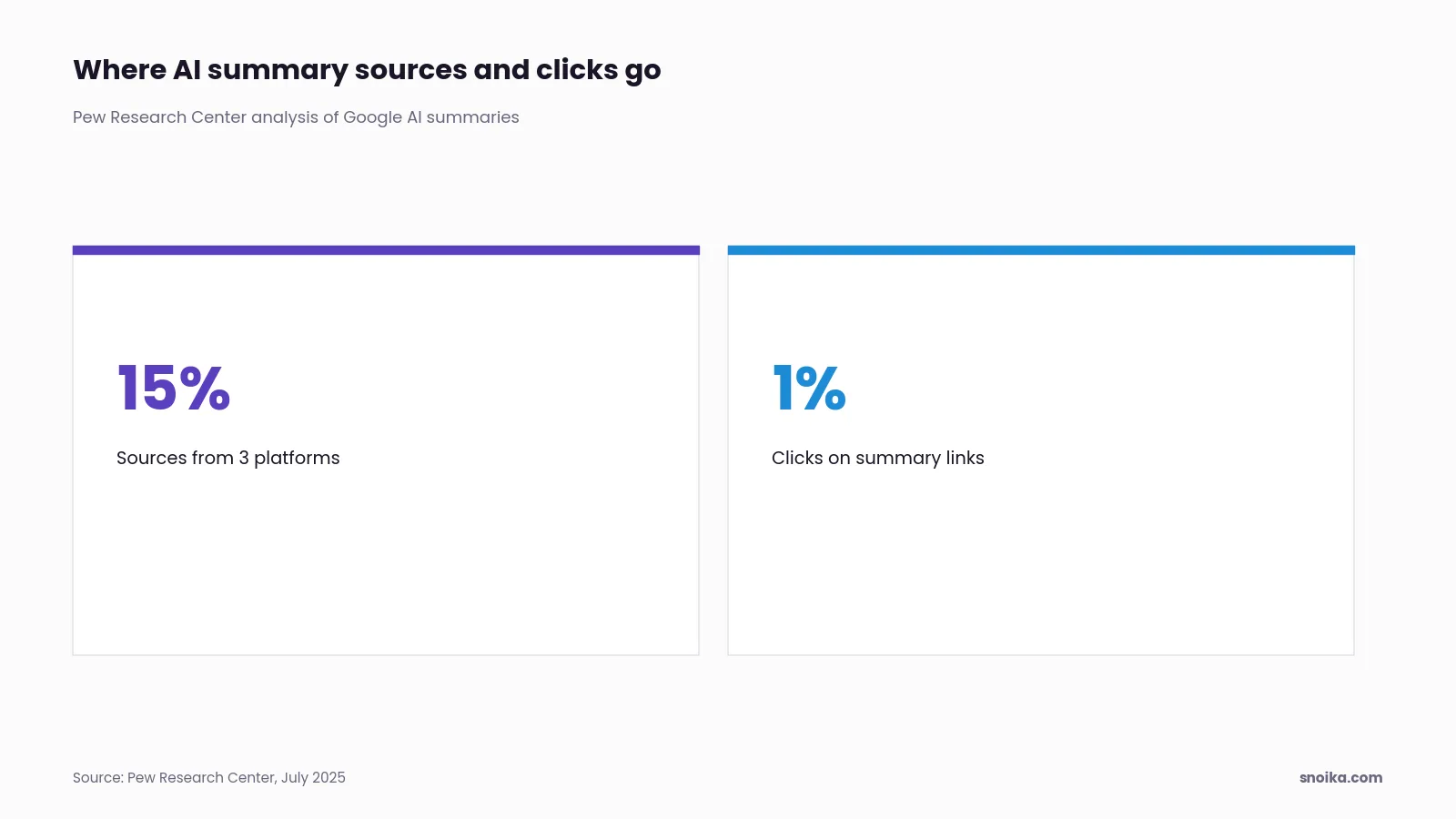
Being named in AI search results matters more than getting the click. In that same Pew study, users clicked a link inside the AI summary in only 1% of visits. That means the citation itself is where the reader meets your brand. To check where you stand, ask ChatGPT a category question with search turned on, then read the sources it lists. Those are the pages you need to match or beat.
Structure AI engines prefer
To structure a page so AI cites it, put a direct answer under each heading and keep every paragraph understandable on its own. Engines pull out passages. A passage that only makes sense with the paragraph above it is hard to quote.
Put the answer in the first lines
Lead with the conclusion, because that's where engines look first. Kevin Indig, a growth advisor, analyzed ChatGPT responses and found that 44.2% of citations came from the first 30% of a page. If your definition sits in paragraph eight, it's competing with every page that states it in paragraph one. Open each page with a sentence of 40 to 80 words that answers the title outright.
Write headings that match the question
Write each heading to match what a buyer types or asks. "Pricing for teams under 50" can be retrieved for a pricing question. "Our philosophy" can't. Under each heading, use the first sentence to answer the heading in plain terms. Explanation comes after that.
Use tables for comparisons and numbered lists for steps
If your page compares options against the same attributes, put them in a table. Engines can lift a row cleanly. A process the reader follows in order belongs in a numbered list. Prose still works best for reasoning, because a "because" needs a full sentence around it.
Before you publish, read only the first sentence under each heading. If those sentences answer the page's question on their own, the structure works.
Original data lifts citations
Original data makes a page more likely to be cited, because an engine has to credit the only source that holds a given number. Researchers at Princeton and Georgia Tech worked with colleagues at the Allen Institute for AI and IIT Delhi on a 2024 generative engine optimization study. It found that adding statistics and quotations can lift visibility by up to 40% in generative engines.
The research that earns AI citations uses numbers no other site publishes to answer a question buyers already ask. A payroll company can publish median processing times from its own platform, while a manufacturer can publish its test results. A small survey of your customers works if you describe the method and give the sample size. The scale varies between a B2B software firm with 1 benchmark worth publishing each quarter and a marketplace that releases fresh pricing data every month.
Most original data goes uncited because the numbers are locked inside a gated PDF that crawlers can't read or are stated with no method behind them. Put the headline figure in a sentence on an open HTML page, next to the date and the sample. Then check that the number appears near the top of the page as a plain, quotable claim.
Build topical authority
Topical authority is coverage. A site that answers every question in a category gets treated as a source for that category. One strong page on "VAT registration" loses to a site with separate, interlinked pages on registration and thresholds. That site's coverage also addresses deadlines and penalties on their own linked pages. Before we write anything, we build a researched content map. It shows which questions the category holds and which ones your site leaves unanswered.
Keep all of these pages on your own domain, because the domain is what builds the authority. We publish through a DNS connection. There's no migration, and it works with any CMS. You review and approve each page in the dashboard before it goes live. For Agrello, an e-signature company, the pages we created generated 51.8K impressions, and organic search sessions grew 125.6% year over year.
How much coverage you need depends on how specific the category is. Narrow industries can be covered quickly. 3DPrinterOS reached #1 visibility in ChatGPT for industry-specific queries and turned AI search into a steady source of 3–4 qualified inbound leads a day. If your buyers search in more than one language, each language is its own field to win. We create content in 135+ languages and regional variants.
Technical signals engines check
To get your content cited by ChatGPT, start by letting OpenAI's search crawler reach your pages. OpenAI's crawler documentation says sites that block OAI-SearchBot "will not be shown in ChatGPT search answers". That crawler is separate from GPTBot, which collects training data. You can allow search and block training if you prefer.
Beyond robots.txt, engines check whether they can read the content at all. A page that builds its text with client-side JavaScript looks empty to a crawler that doesn't run scripts. Structured data tells the engine whether a page is an article or describes a product. It also identifies pages about an organization. Accurate dates in your sitemap tell it what has changed. Every one of these matters less than one blocked directory, so audit access before anything else.
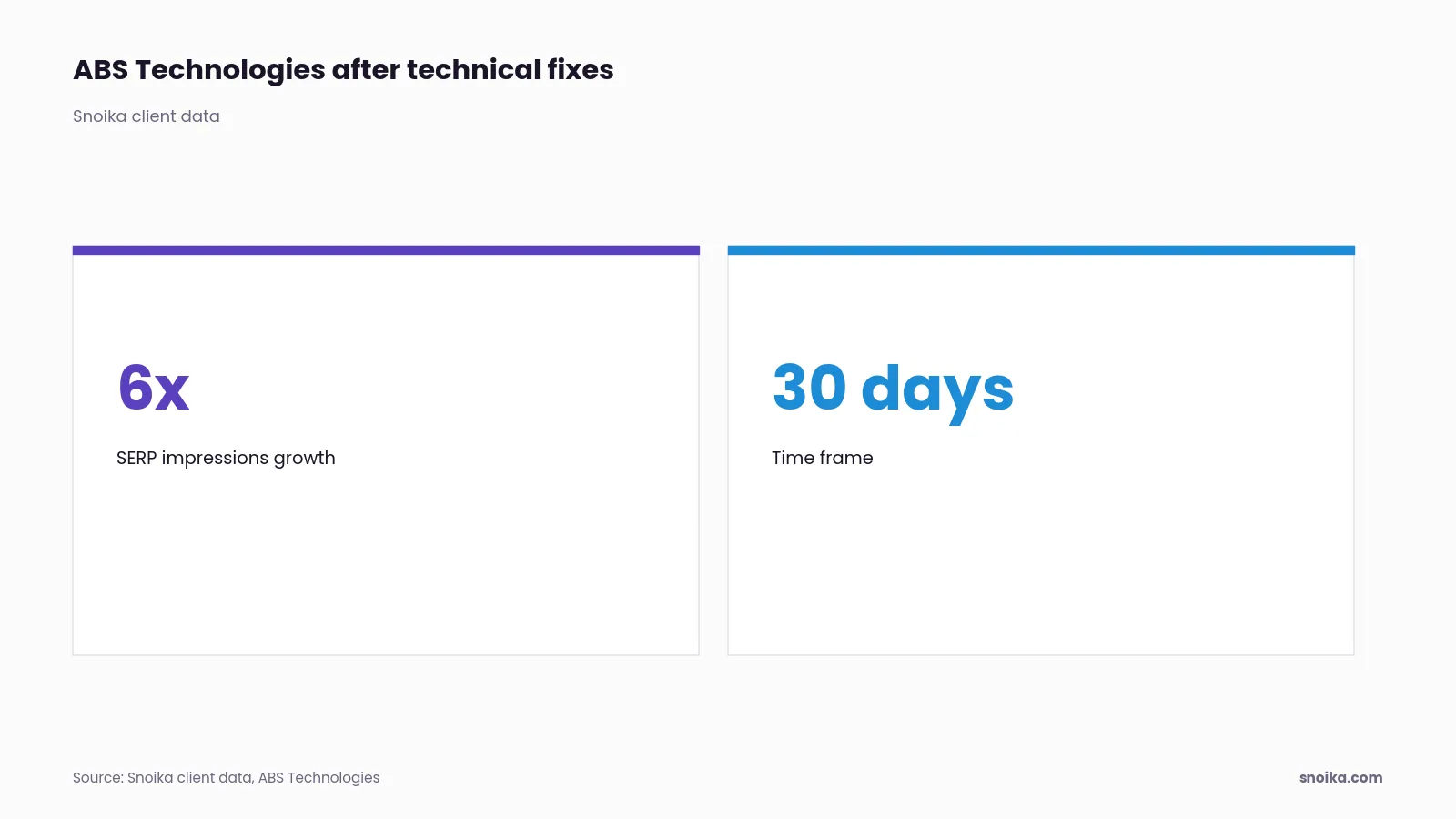
For ABS Technologies, technical fixes improved keyword indexability. SERP impressions grew 6x, and search visibility rose significantly within the first 30 days. To check your own site, fetch a key page as plain HTML and confirm the answer text is there. Then read your robots.txt for any line that disallows OAI-SearchBot.
Measure your citation visibility
You track whether AI tools cite you by running a fixed set of prompts on a schedule and recording each time your brand is mentioned or linked. Keep the prompts the same from week to week. If you change them, the trend line stops meaning anything. ChatGPT also adds a utm_source=chatgpt.com referral parameter to its links, so GA4 can show the visits that follow a citation.
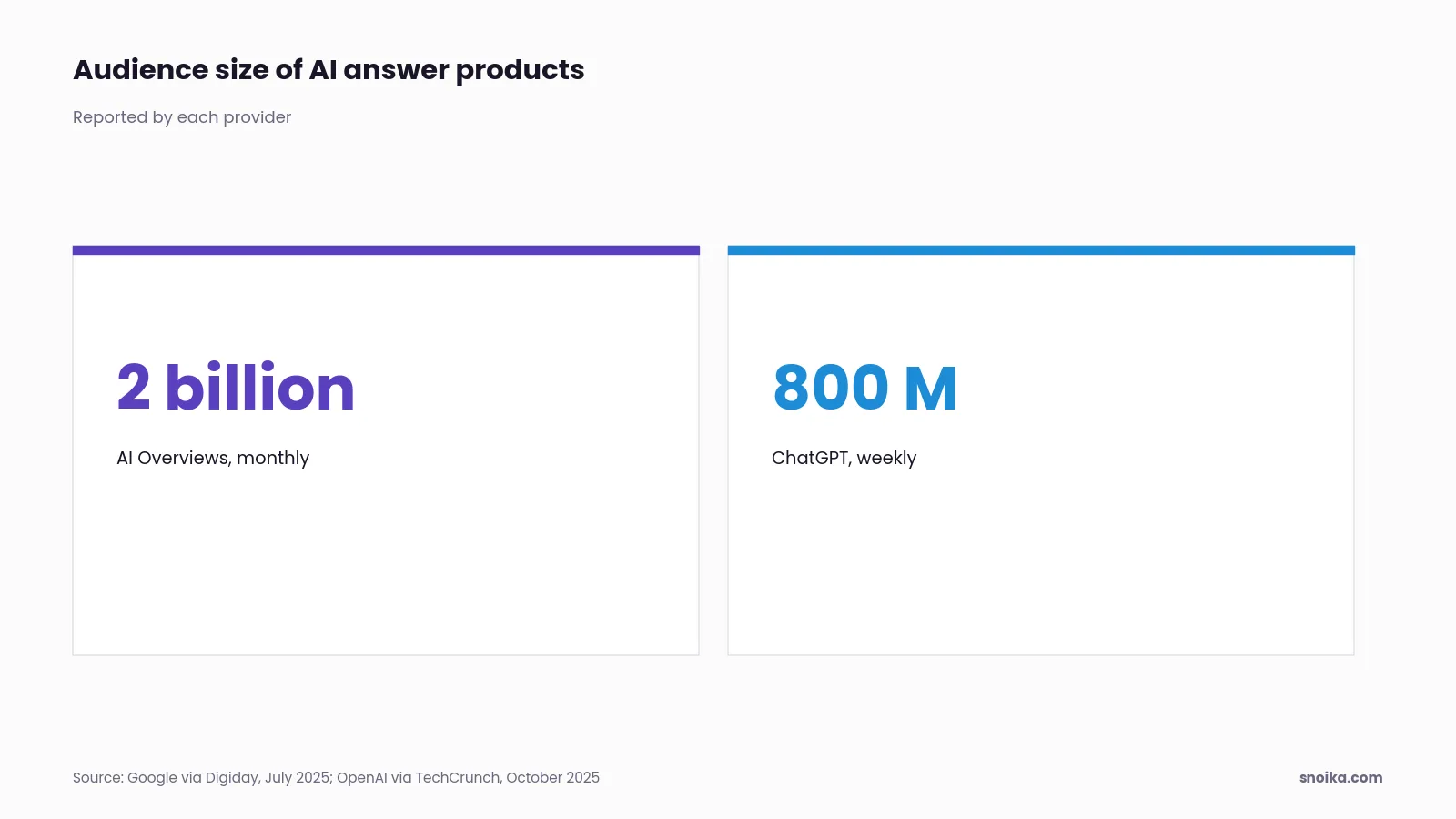
Our tracking runs weekly prompt sets in ChatGPT and Google AI Overviews, which is where most AI search traffic happens. It measures mentions and citations. It also tracks share of voice and sentiment. Google said AI Overviews had 2 billion monthly users in July 2025, and OpenAI reported 800 million weekly users for ChatGPT that October. Snoika's founder Anton Vedeshin reported to Startup Reporter 1StopVAT's move from 2.7% to 28.3% ChatGPT visibility in 16 weeks.
Plan size depends on how many prompts and platforms you want tracked:
| Plan | Price | AI prompts tested weekly | AI platforms monitored | Competitor tracking | Also includes |
|---|---|---|---|---|---|
| Plans on the pricing page | Plans on the pricing page | 10 | 1 | Basic | Chat support |
| Plans on the pricing page | Plans on the pricing page | 100 | 3 | Basic | Email support, monthly AI visibility report |
| (most popular) | Plans on the pricing page | 500+ | All | Advanced, with competitor intelligence | Priority support, monthly report, dedicated account manager |
| Enterprise | Custom | Unlimited | All | Multi-brand management | Custom integrations, executive dashboards, 99.9% SLA |
Plans on the pricing page
- Price
- Plans on the pricing page
- AI prompts tested weekly
- 10
- AI platforms monitored
- 1
- Competitor tracking
- Basic
- Also includes
- Chat support
Plans on the pricing page
- Price
- Plans on the pricing page
- AI prompts tested weekly
- 100
- AI platforms monitored
- 3
- Competitor tracking
- Basic
- Also includes
- Email support, monthly AI visibility report
(most popular)
- Price
- Plans on the pricing page
- AI prompts tested weekly
- 500+
- AI platforms monitored
- All
- Competitor tracking
- Advanced, with competitor intelligence
- Also includes
- Priority support, monthly report, dedicated account manager
Enterprise
- Price
- Custom
- AI prompts tested weekly
- Unlimited
- AI platforms monitored
- All
- Competitor tracking
- Multi-brand management
- Also includes
- Custom integrations, executive dashboards, 99.9% SLA
A single product line fits within 100 prompts. Brands that sell across categories or regions need more.
Track competitor citation share
Competitor citation share is the percentage of answers in your prompt set that name a rival instead of you. To get it, divide each brand's mentions by the total brand mentions across the same prompts. A brand mentioned in 30 of 200 answers holds a 15% share. Once you have that number, it tells you which prompts are worth fighting for.
Your best opportunities are the prompts where a competitor gets named and you don't, because the engine is already searching that topic and citing someone. Open the pages it cites for those prompts. Note any number or comparison table each cited page has that yours lacks. Check for a direct definition, too. Then build the missing page, because that is how brands earn LLM brand mentions.
You can assign this work to an in-house team or an agency. A monitoring-only tool is another option. A monitoring tool shows you the gap but leaves the writing and publishing to you, while an agency that writes pages without tracking can't show you which prompts moved. Whichever route you pick, re-run the competitor comparison weekly so you can tie each new page to a change in share.
What to do next
Start with the prompts where a competitor is already cited and you aren't. Those topics have proven demand, and the engines are already looking for a source. A free AI visibility report shows you that list. During onboarding, we learn your category and connect your analytics. We then develop the content map and publishing plan. We audit sites and track brand visibility in ChatGPT and Google AI Overviews. We also publish pages built to get cited by AI on your own domain. To see where your brand appears today, check your AI visibility for free.
FAQ
To get cited by ai in ChatGPT search, allow OAI-SearchBot to access your pages and make the answer readable in plain HTML. Check crawler access before rewriting content, since a blocked page can't appear in ChatGPT search answers.
Put a direct answer under each question-based heading, and make each paragraph understandable on its own. Before publishing, read only the first sentence under each heading. Those sentences should answer the questions without requiring context from surrounding paragraphs.
Your own test results or customer surveys can provide figures that other pages don't have. A small survey can work if you explain the method and sample size. Publish the headline finding on an open HTML page rather than leaving it inside a gated PDF.
Run the same questions weekly and record mentions separately from links to your pages. Check the sources listed in each answer to confirm citations. Analytics can show visits from ChatGPT links, but visits alone won't capture citations that nobody clicks.
Yes, you can allow OAI-SearchBot for ChatGPT search while blocking GPTBot, which collects training data. These crawlers serve different purposes, so check their rules separately in robots.txt rather than treating search access and training access as the same permission.
Keep reading
All articles

