
How to appear in AI search results
To appear in AI search results, AI crawlers have to be able to reach and read your pages. Your business also has to be named on third-party sites that assistants already trust. ChatGPT and Google's AI Overviews operate without a business-submission option, so vendor promises of a guaranteed slot are false. You control eligibility by helping these systems understand what you sell and find outside evidence that backs up your claims.
 Denys SuliatytskyiHead of Growth, Snoika · 8 min read

























Why AI recommends some businesses
AI assistants recommend the businesses they can confirm from more than one place. An answer engine combines what your own site says with what other sites say about you. Then it repeats the claims that agree across sources. Ahrefs studied 75,000 brands and found that branded web mentions correlate with AI Overview visibility at 0.664 versus 0.218 for backlinks. Assistants recommend brands that people write about.
Crawlers first have to be able to fetch your pages for AI to recommend your business. Keep your business name and category consistent across your site and public profiles. Describe your offer consistently in both places, and make sure your structured data matches. After that, work on outside mentions, because they give an assistant a second source to confirm the first. If you skip access, the other work stops mattering, and that's where most businesses that feel invisible in AI answers get stuck.
Bain and Company's December 2024 survey found that 80% of consumers rely on zero-click results for at least 40% of their searches. Pew Research Center tracked real browsing and found that users clicked a traditional result in 8% of visits when an AI summary appeared, against 15% when none did. Being named inside the answer can also bring in buyers directly. 3DPrinterOS reached #1 visibility in ChatGPT for industry-specific queries and turned AI search into a steady source of 3–4 qualified inbound leads/day.
How assistants choose sources
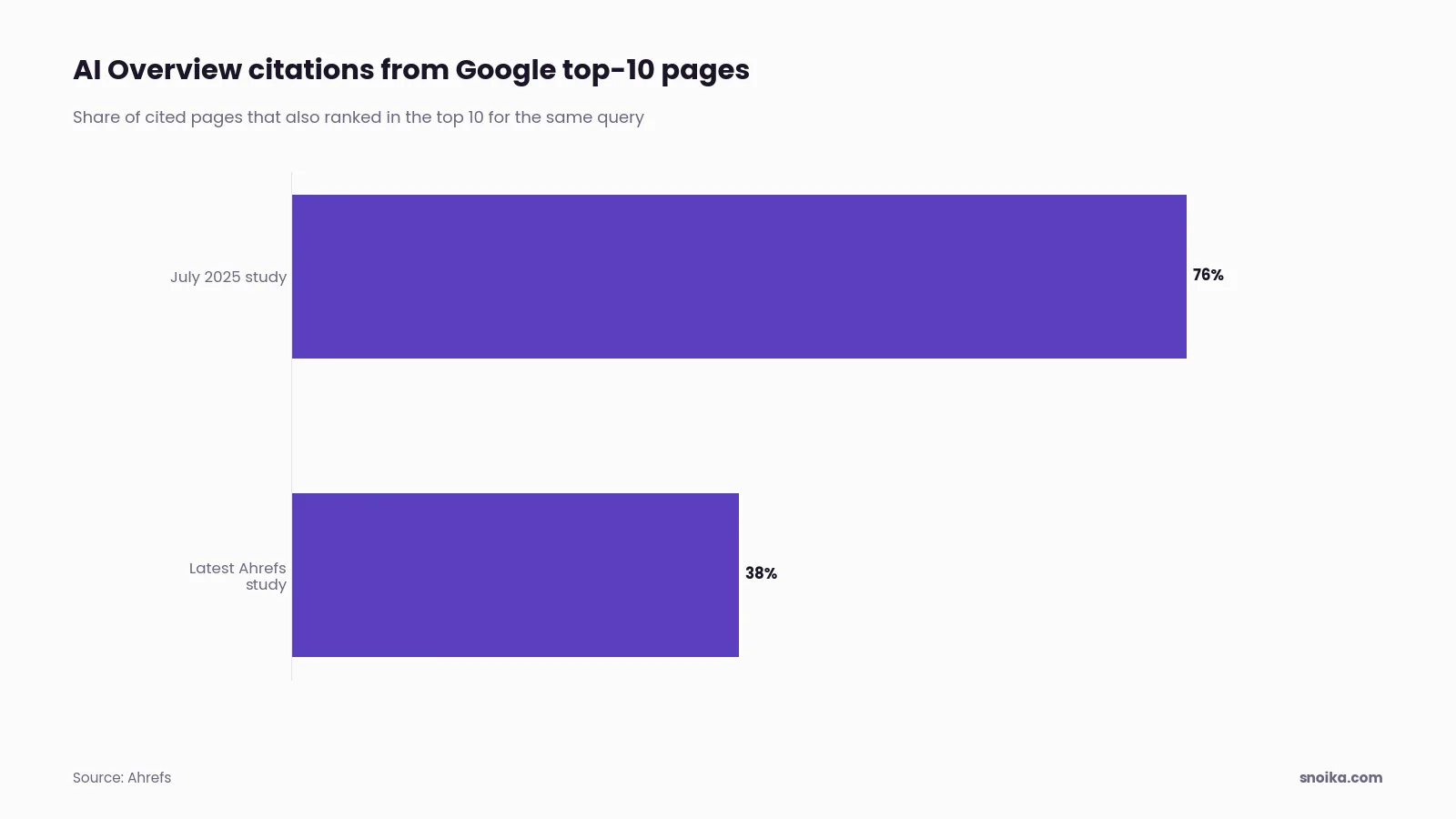
Assistants retrieve candidate pages for the question and then select the passages that best match it. Google splits a query into sub-queries (a process it calls query fan-out) and pulls pages for each one. That's why ranking for the exact query is no longer enough. Ahrefs analyzed 863,000 keywords and found that 38% of AI Overview citations come from pages in Google's top 10, down from 76% in its July 2025 study.
Retrieval needs crawler access first. In May 2026, Cyrus Shepard, founder of Zyppy SEO, scored 23 citation factors across 54 studies. URL accessibility scored 9.5 out of 10 and ranked above search rank and fan-out rank. "Query answer match was a huge one across a lot of the studies I looked at," Shepard said on the BuzzStream Podcast.
Teams get crawler rules wrong when they overlook the distinction between OpenAI's GPTBot for model training and OAI-SearchBot for live search. Its crawler documentation says "sites that are opted out of OAI-SearchBot will not be shown in ChatGPT search answers." You can block training and still allow search, because each setting is independent. Check your robots.txt file for both user-agents. Then check your content delivery network (CDN) or firewall, since a bot-protection rule can block crawlers even when robots.txt allows them.
Audit your AI visibility
To audit whether AI cites your business, run the questions your buyers ask through each assistant and record what comes back. A single check tells you almost nothing because SparkToro found there's a less than 1 in 100 chance that ChatGPT or Google's AI returns the same brand list twice for the same prompt. Work through the audit in this order:
- Write 20 to 50 prompts that a buyer would type before choosing a supplier in your category. Include category questions ("best e-signature tool for law firms") and comparison questions. Add questions about buyers' problems as well.
- Run each prompt at least 5 times in ChatGPT and in Google with AI Overviews showing. Use a logged-out or fresh session so your history doesn't skew the answers.
- For each run, record whether you're mentioned and how the answer describes you. Note which competitors appear and which URLs it cites to complete the four observations.
- List the cited domains across all runs. Those domains are the third-party sites to target later.
- Check your server logs for visits from OAI-SearchBot and Googlebot. No visits means a block somewhere.
- Work out your mention rate for each prompt (mentions divided by runs). This is your baseline.
Google Analytics 4 (GA4) shows referral sessions from chatgpt.com and similar domains, and Google Search Console shows which queries trigger impressions. That's why our onboarding asks for GA4 and Google Search Console access before any recommendation. Google Tag Manager access is required as well. Without them, an audit can show what the assistants say but not whether those answers send anyone to your site.
Fix structured data first
Structured data is code that labels the facts on a page, such as your company name or prices, so machines don't have to guess what they mean. Google says AI Overviews need no special markup. Its guidance on AI features still lists "making sure your structured data matches the visible text on the page" as a best practice. Markup that contradicts the page is worse than no markup, because it gives the system two versions of the same fact.
These are the Schema.org types most businesses need, and the mistakes that cancel them out:
| Schema type | Where it goes | Properties that matter | Common mistake |
|---|---|---|---|
| Organization | Homepage or About page | name, url, logo, sameAs (links to official profiles) | sameAs left empty, so assistants can't connect your profiles |
| LocalBusiness | Location pages | address, telephone, openingHours, geo | Address format differs from your Google Business Profile |
| Product or Service | Offer pages | name, description, offers, price | Prices in markup that no longer match the page |
| Article | Blog and guide pages | headline, author, datePublished, dateModified | dateModified never updated after edits |
| Person | Author and team pages | name, jobTitle, worksFor | Authors with no page to link to |
Organization
- Where it goes
- Homepage or About page
- Properties that matter
- name, url, logo, sameAs (links to official profiles)
- Common mistake
- sameAs left empty, so assistants can't connect your profiles
LocalBusiness
- Where it goes
- Location pages
- Properties that matter
- address, telephone, openingHours, geo
- Common mistake
- Address format differs from your Google Business Profile
Product or Service
- Where it goes
- Offer pages
- Properties that matter
- name, description, offers, price
- Common mistake
- Prices in markup that no longer match the page
Article
- Where it goes
- Blog and guide pages
- Properties that matter
- headline, author, datePublished, dateModified
- Common mistake
- dateModified never updated after edits
Person
- Where it goes
- Author and team pages
- Properties that matter
- name, jobTitle, worksFor
- Common mistake
- Authors with no page to link to
Begin with Organization, since every other entity points back to it. Validate each template in Google's Rich Results Test and fix errors before warnings. Then compare the name and address in your markup with your Google Business Profile and LinkedIn page. Check that the category matches across those sources too. If one says "software company" and another says "consultancy," assistants hedge or leave you out.
Earn third-party mentions
Assistants draw business recommendations from a small set of site types that includes review platforms and community forums. Video sites and industry press also belong to that set. Pew found that three domains accounted for 15% of AI summary sources in its sample. Wikipedia and Reddit were two of them. YouTube was the third. Your audit's list of cited domains tells you which of these matter in your category. Work on those first.
Review and comparison sites in your category
Review platforms and "best of" roundups give an assistant ready-made comparisons. Claim your profiles and fill in every field. Ask recent customers for reviews that name the specific problem you solved. A roundup that already appears in your audit's citations is worth a direct pitch to its editor, with accurate data they can use.
Reddit and niche forums
Community threads carry weight because they read as unpaid opinion. Moderators remove promotion, and the assistants pick up on the backlash too. Answer questions in your field under a named account, and mention your product only when it fits the thread. Fixing a wrong claim about your business in a popular thread can do more than writing a new post.
YouTube and video
YouTube is the most-cited domain in AI Overviews and makes up 5.6% of citations in the Ahrefs dataset. Short videos that answer one buyer question, with a full transcript and your brand named aloud, give the system text to quote.
Industry press and expert lists
Trade publications and association directories confirm that you exist and what you do. A single quote in a trade article that names your category and your company does that job. Brand mentions count even without a link, so judge outreach by the mentions it earns.
Optimize content for retrieval
For AI search optimization, the content changes that help most make each passage easy to lift out and quote on its own. Researchers from Princeton and Georgia Tech collaborated with the Allen Institute for AI and IIT Delhi to study generative engine optimization. They found that adding statistics and sourced material in the form of quotations and citations can lift visibility by up to 40%. Make these changes page by page:
- Put the direct answer in the first sentence under each heading, before any background.
- Write sections that still make sense when read alone, because the system pulls passages instead of whole pages.
- Replace vague claims with figures, and name the source in the sentence.
- Cover the sub-questions a buyer asks next, since fan-out retrieves pages for those too.
- Use tables to compare prices and specs so an assistant can read them without interpretation.
- Show a visible "last updated" date and change it only when the content changes.
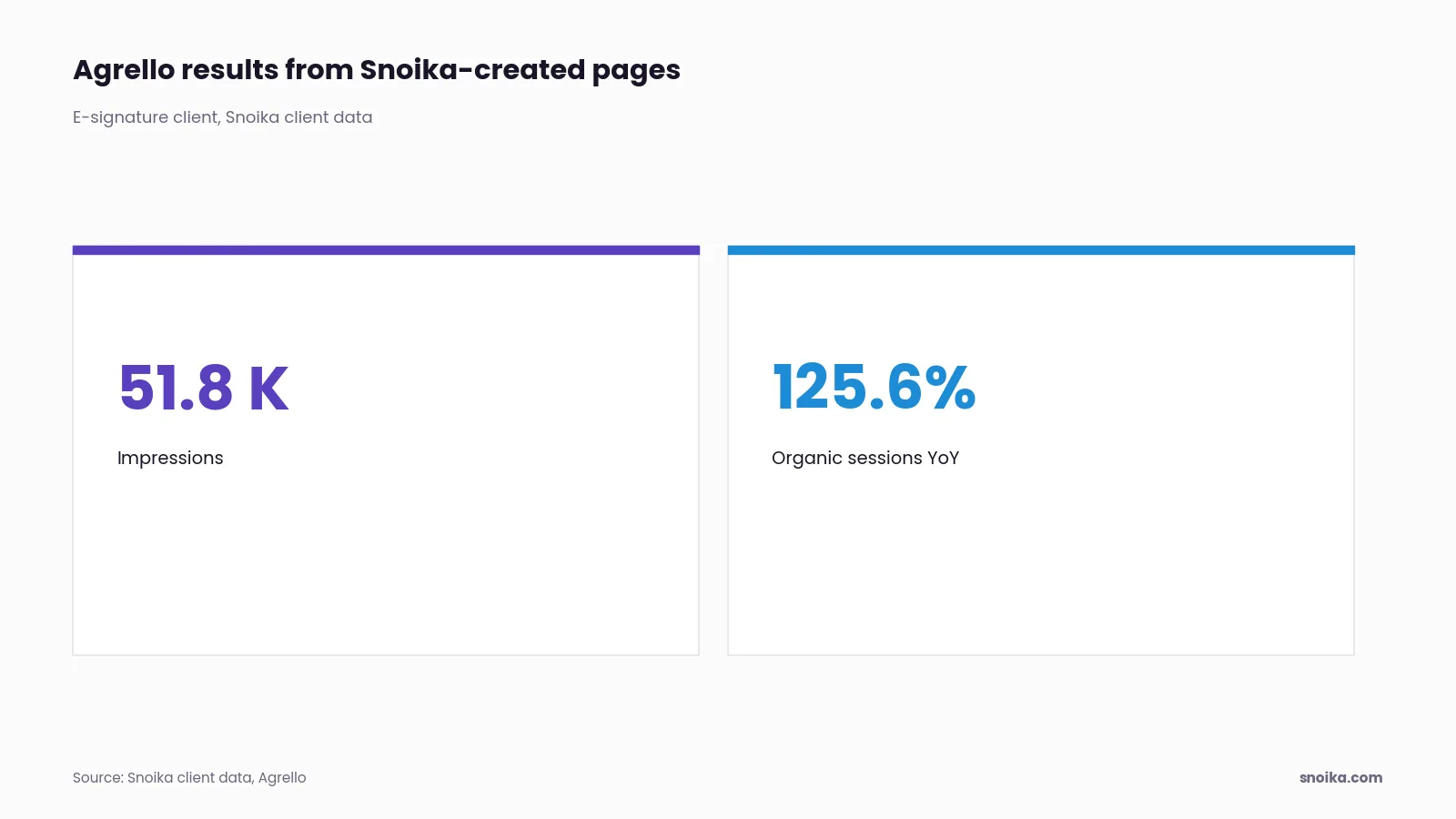
Publish new content on your own domain so that it builds your brand's authority. Snoika publishes pages through a DNS connection. It works on any CMS without a migration. Agrello, in e-signature, generated 51.8K impressions from Snoika-created pages and saw +125.6% organic search sessions YoY. If you sell abroad, write each market's pages in its own language. Assistants answer in the user's language and cite pages that match it, which is why our content runs in 135+ languages and regional variants.
Track AI recommendations
Track how often you're mentioned across repeated runs, because a single position in one answer means little. Rand Fishkin, co-founder of SparkToro, said that "any tool that gives a 'ranking position in AI' is full of baloney." The SparkToro data showed that how often a brand appears across dozens of runs stays far more stable than where it appears in any one answer.
Measure four signals every week with the same prompt set. Mentions show whether you appear. Share of voice compares your mentions with your competitors'. Sentiment captures how the answer describes you, and LLM citations show which of your URLs the assistant links to. Our tracking runs weekly prompt sets in ChatGPT and Google AI Overviews, where most AI search traffic happens. Keep the prompts fixed for at least a quarter. If you change them, you introduce another source of visibility changes that obscures the effect of your work.
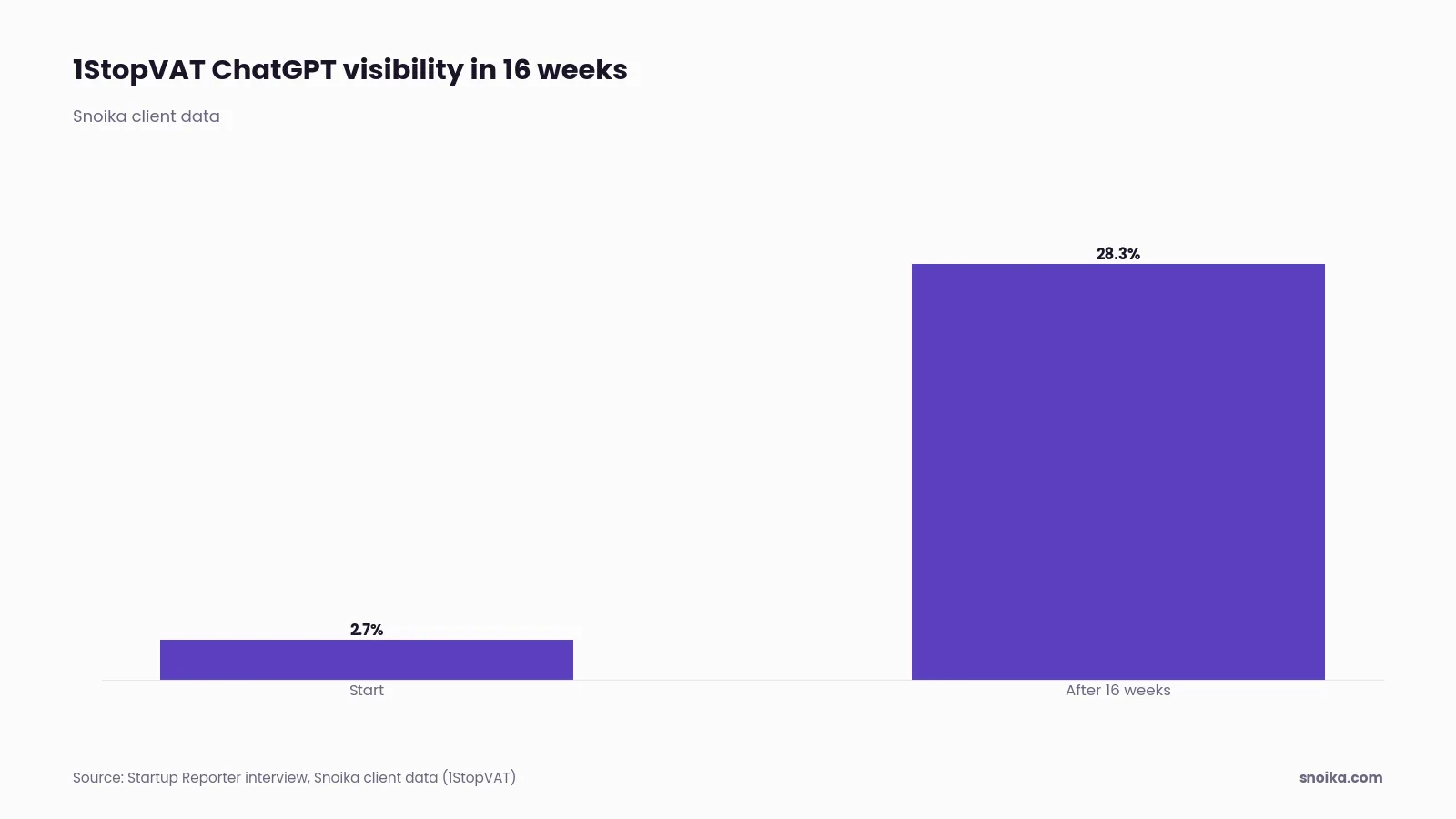
Expect progress in weeks. Snoika's founder Anton Vedeshin reported to Startup Reporter 1StopVAT's move from 2.7% to 28.3% ChatGPT visibility in 16 weeks. Whenever a figure moves, check it against your change log. If mentions rose two weeks after a trade article ran, that article is the pattern to repeat.
Tools that speed progress
Tools save the most time on the repetitive parts of this work, like running prompts and logging results. Free tools cover impressions through Google Search Console and markup checks through the Rich Results Test. Your server logs show crawler visits. The paid options differ mostly in how much they cover:
| Approach | What it covers | What it leaves to you | Fits best when |
|---|---|---|---|
| Manual prompt checks | A quick read on a handful of prompts | Repeat runs, record-keeping, trends over time | You're testing whether AI visibility matters in your category |
| Monitoring-only tool | Weekly mention and citation data | Every fix, plus the content and outreach work | You have a team to act on the data |
| Agency | Strategy, content and outreach | Ongoing measurement, which agencies often report monthly | You'd rather hand off the work than the decisions |
| In-house team | Full control and product knowledge | Building the tracking setup and the know-how | AI search is a core channel and you can hire for it |
| All-in-one platform with services | Audit, tracking and publishing in one place | Reviewing and approving what goes live | You want measurement tied to the content that moves it |
Manual prompt checks
- What it covers
- A quick read on a handful of prompts
- What it leaves to you
- Repeat runs, record-keeping, trends over time
- Fits best when
- You're testing whether AI visibility matters in your category
Monitoring-only tool
- What it covers
- Weekly mention and citation data
- What it leaves to you
- Every fix, plus the content and outreach work
- Fits best when
- You have a team to act on the data
Agency
- What it covers
- Strategy, content and outreach
- What it leaves to you
- Ongoing measurement, which agencies often report monthly
- Fits best when
- You'd rather hand off the work than the decisions
In-house team
- What it covers
- Full control and product knowledge
- What it leaves to you
- Building the tracking setup and the know-how
- Fits best when
- AI search is a core channel and you can hire for it
All-in-one platform with services
- What it covers
- Audit, tracking and publishing in one place
- What it leaves to you
- Reviewing and approving what goes live
- Fits best when
- You want measurement tied to the content that moves it
Snoika's GEO services scale with the prompts you track. Whatever you choose, check that the tool reruns each prompt more than once and shows the cited URLs. A tool that does neither repeats the single-check mistake that the SparkToro data warns against.
What to do next
Open your robots.txt file today and confirm that OAI-SearchBot and Googlebot are allowed. Then ask whoever runs your CDN whether a firewall rule blocks either one. It's the cheapest fix on this page, and the best-evidenced factor sits behind it. After that, record your baseline mention rate before you change a single page. Without that starting number, you can't show which work moved your visibility. Learning how to appear in AI search results gets easier once you can measure where you stand. Snoika tracks how ChatGPT and Google AI Overviews mention your brand and builds the content that fills the gaps. To get your starting number, check your AI visibility free.
FAQ
To work out how to appear in ai search results, check crawler access before editing content. Resolve conflicting business details across your website and public profiles. Then prioritize outside mentions that help assistants confirm what you offer.
Test 20 to 50 buyer questions, running each at least five times per assistant in fresh sessions. Record business mentions separately from links to your website. Calculate mentions divided by runs for each question so you've got a baseline for comparison.
The sites repeatedly cited for your buyer questions are the ones to prioritize. Review platforms and industry publications can provide outside confirmation of your business. Use your audit's cited domains to choose where to focus rather than assuming every popular site matters.
Write each section so its opening sentence answers a buyer's question and makes sense on its own. Replace vague claims with sourced figures. For comparison questions, use tables that present prices or specifications in a format assistants can read.
Expect progress in weeks, and keep your tracking questions unchanged for at least a quarter. Review mention rates weekly against your change log. One improved answer doesn't establish a trend because recommendations vary between runs.
Keep reading
All articles

