
LLM citations explained for search teams
LLM citations are the source links an AI assistant attaches to an answer to show which web pages it drew from. When ChatGPT or Google's AI Overviews answers a question in your category, the cited pages get named and linked, and every other page stays invisible. For a search team, the citation now counts as visibility on its own terms, and a strong Google ranking no longer decides who earns it.
 Artem LozinskyOperations and product, Snoika · 12 min read

























Why LLM citations matter
LLM citations matter because the answer is the last thing a reader sees. Pew Research Center tracked 68,879 Google searches by 900 US adults in March 2025. When an AI summary appeared, users clicked a traditional result in 8% of visits, compared with 15% when it didn't. Only 1% of visits included a click on a link inside the summary itself. So the reader takes in the names in the answer and moves on.
The audience for those answers is large and still growing. Sam Altman, CEO of OpenAI, told the company's DevDay audience in October 2025 that "more than 800 million people use ChatGPT every week." When one of those people asks which vendor handles a problem like yours, citation determines which brands make the shortlist, regardless of organic position.
How much this matters depends on how your buyers phrase their searches. Pew found that only 8% of one- or two-word searches produced an AI summary, while 53% of searches with 10 words or more did. Questions and full sentences trigger answers at a higher rate than short keywords do. If your buyers research by asking questions, as they do in B2B software and professional services, citations decide much of your discovery.
Citations also produce pipeline you can count. 3DPrinterOS achieved #1 visibility in ChatGPT for industry-specific queries and turned AI search into a steady inbound lead source, with 3–4 qualified inbound leads/day. To check your own exposure, list the 20 questions a buyer asks before purchase and note which ones already return an AI answer.
What counts as a citation
A citation is a linked reference to a specific URL that the engine shows as a source for its answer. An unlinked brand name counts as a mention, while a homepage link shown only because the user asked for your site counts as a navigational link. Neither one means the engine used your content to build the answer, although both are worth tracking.
Engines show citations in different ways. Perplexity puts numbered references inline and lists them under the answer. Google's AI Overviews show source cards next to the summary. A BrightEdge guide to Claude explains that Claude uses inline links at the point where the information appears. ChatGPT shows sources only when it runs a web search, and the model decides on its own when a search is needed.
Answers drawn from a model's training data carry no citations because there are no retrieved sources to link. Only answers grounded in live retrieval cite sources, so your citation odds depend on whether the question pushes the engine to search. Questions about prices and recent events trigger retrieval, as do comparisons and questions about named products. Broad definitional questions don't.
When you audit your results, sort what you find into four groups:
- Owned citation: the answer links to a page on your domain.
- Earned citation: the answer links to a third-party page, such as a review site or forum thread, that names you.
- Unlinked mention: the answer names your brand but links elsewhere or nowhere.
- Competitor citation: the answer links to a rival's page for a question you want to own.
Check two more things for each citation. Does the cited passage support what the answer says about you? And is the context positive? An engine that cites your pricing page next to a complaint thread is giving you visibility you didn't want.
Rankings no longer guarantee citations
If your site ranks on Google but doesn't show up in AI search results, the reason is that answer engines pull from a wider and different pool of pages than the top 10 for your keyword. They also select sources at the passage level. Ahrefs measured the overlap between AI Overview citations and Google's top 10 at 76.1% in July 2025. By March 2026, in a study of 863,000 keywords, only 38% of cited pages ranked in the top 10 for the same query. Nearly a third came from beyond the top 100.
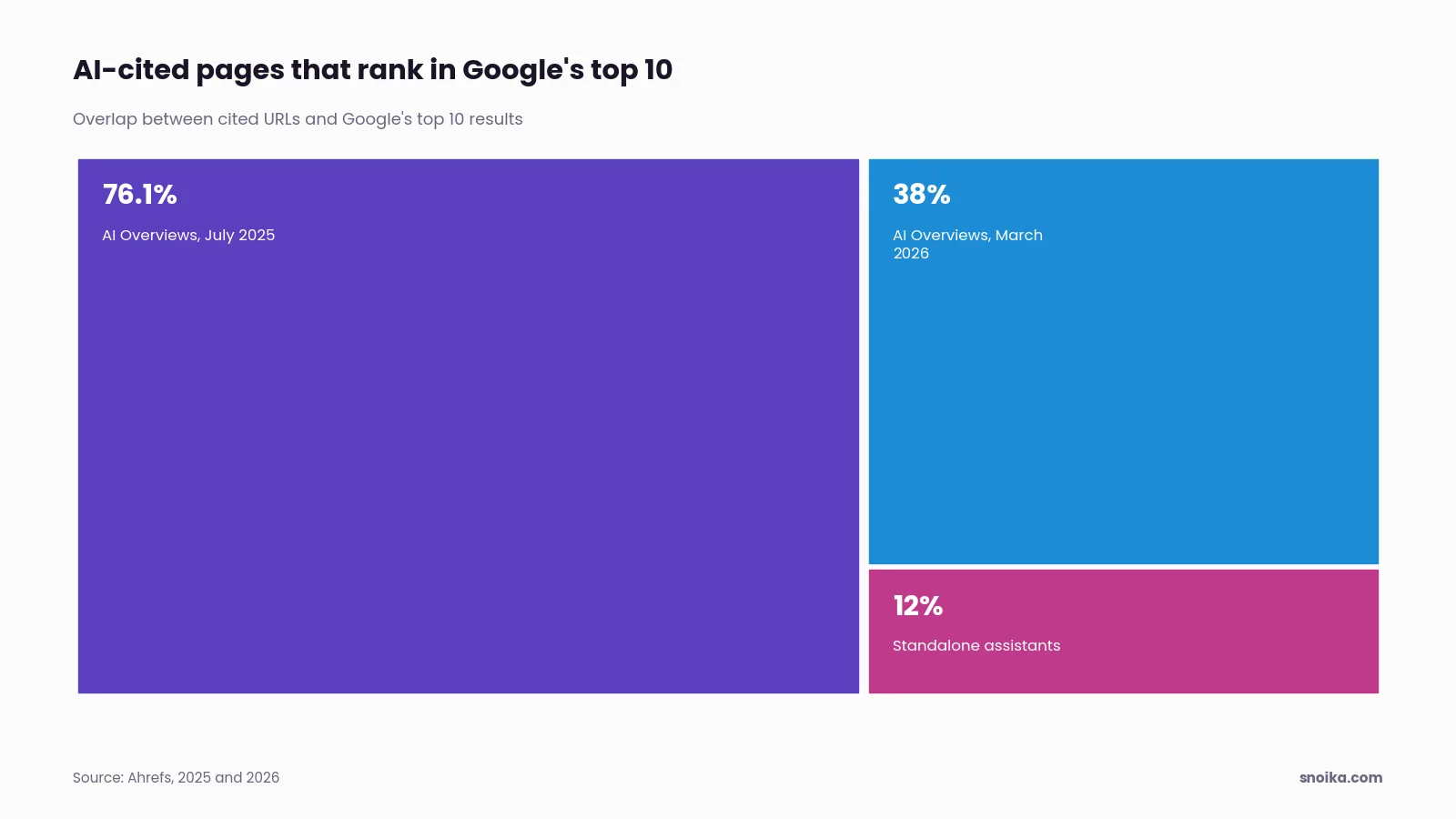
Standalone assistants drift further still. Across 15,000 prompts, Ahrefs data scientist Xibeijia Guan found that only 12% of AI-cited URLs appeared in Google's top 10 for the original prompt. About 80% didn't rank anywhere in Google for that query. Your rank for the head term tells you little about whether ChatGPT will cite you for the same question.
The main cause is query fan-out. Google's own documentation says AI Overviews and AI Mode issue "multiple related searches across subtopics and data sources" to build one response. A question about payroll software becomes several hidden searches about pricing and integrations, with additional searches about compliance. The cited pages come from the results of those sub-queries. While your page ranks for the parent keyword, the engine reads the sub-query results.
Three other causes come up in audits. Your crawler settings block the bot an engine uses for search. The engine relies on an index other than Google's. Or the page ranks on overall authority but buries the answer in a long introduction, so no single passage answers the sub-question cleanly.
Testing this takes an afternoon. Pick 10 queries where you rank in the top three. Run each one in ChatGPT and Perplexity, then repeat the test in Google. Record who gets cited. Then write down the sub-questions each answer covers and ask whether any page of yours answers each one in a paragraph that makes sense out of context.
How engines differ on sourcing
Each AI engine retrieves from its own index or search partner and favors different types of source, so citations for the same question vary by engine. Profound analyzed 30 million citations from August 2024 to June 2025 and found distinct patterns for each engine. Only about 11% of domains were cited by both ChatGPT and Perplexity. The table sets the main engines side by side.
| Engine | Where it retrieves | Top source in its 10 most-cited domains | Overlap with Google's top 10 |
|---|---|---|---|
| Google AI Overviews | Google's index, with query fan-out | Reddit at 21% | 38% of cited pages (Ahrefs, March 2026) |
| ChatGPT | OpenAI's search crawler, OAI-SearchBot | Wikipedia at 47.9% | Low, inside a 12% average with Gemini and Copilot (Ahrefs) |
| Perplexity | Live web search | Reddit at 46.7% (Profound) | Nearly 1 in 3 citations (Ahrefs) |
| Claude | Brave Search | Not covered in the same study | 34% of cited URLs, against 79.2% in Brave's top 10 |
Google AI Overviews
- Where it retrieves
- Google's index, with query fan-out
- Top source in its 10 most-cited domains
- Reddit at 21%
- Overlap with Google's top 10
- 38% of cited pages (Ahrefs, March 2026)
ChatGPT
- Where it retrieves
- OpenAI's search crawler, OAI-SearchBot
- Top source in its 10 most-cited domains
- Wikipedia at 47.9%
- Overlap with Google's top 10
- Low, inside a 12% average with Gemini and Copilot (Ahrefs)
Perplexity
- Where it retrieves
- Live web search
- Top source in its 10 most-cited domains
- Reddit at 46.7% (Profound)
- Overlap with Google's top 10
- Nearly 1 in 3 citations (Ahrefs)
Claude
- Where it retrieves
- Brave Search
- Top source in its 10 most-cited domains
- Not covered in the same study
- Overlap with Google's top 10
- 34% of cited URLs, against 79.2% in Brave's top 10
Google AI Overviews stay closest to Google's rankings because they draw on the same index. To be eligible, a page has to be indexed and able to show a snippet, and Google states "There are no additional technical requirements." They lean on community and video platforms; in Profound's data, Reddit leads both YouTube and Quora.
ChatGPT favors encyclopedic and reference sources, and it's the engine most willing to cite pages with no Google visibility. It also cites the newest content of any assistant Ahrefs measured. Because it decides for itself when to search, prompts that ask for current facts or comparisons are where your pages compete.
Perplexity searches the live web on almost every query and ranks community discussion highly. That makes Reddit threads and niche review sites as important as your own pages. Josh Blyskal of Profound found that across roughly 35,000 Claude citations, the cited URLs matched Brave's top 10 far more closely than Google's, which sets Claude apart in where it searches. If Brave hasn't indexed a page, Claude is unlikely to cite it.
Find out which engines your buyers use, then check the source types each one favors for your category. For a software brand, ChatGPT citations of review aggregators call for different work than Perplexity citations of forum threads.
Signals behind citation selection
LLM citation selection starts with retrieval, which decides which pages enter the candidate pool; the model then picks passages that answer each sub-question clearly and come from sources it has reason to trust. No engine publishes a formula, so the signals below come from documentation and correlation studies. These strong patterns vary by engine and category.
Can the engine reach the page?
Access comes first, because a page outside the retrieval pool can't be cited. OpenAI's crawler documentation says sites that block OAI-SearchBot "will not be shown in ChatGPT search answers, though can still appear as navigational links." Blocking GPTBot, the training crawler, is a separate setting and doesn't remove you from search. For Google's AI features, the page needs to be indexed with a snippet allowed. For Claude, it needs to be in Brave's index. Check your robots.txt line by line, because a rule written in 2023 to block AI training can still be blocking AI search today.
How often the web mentions your brand
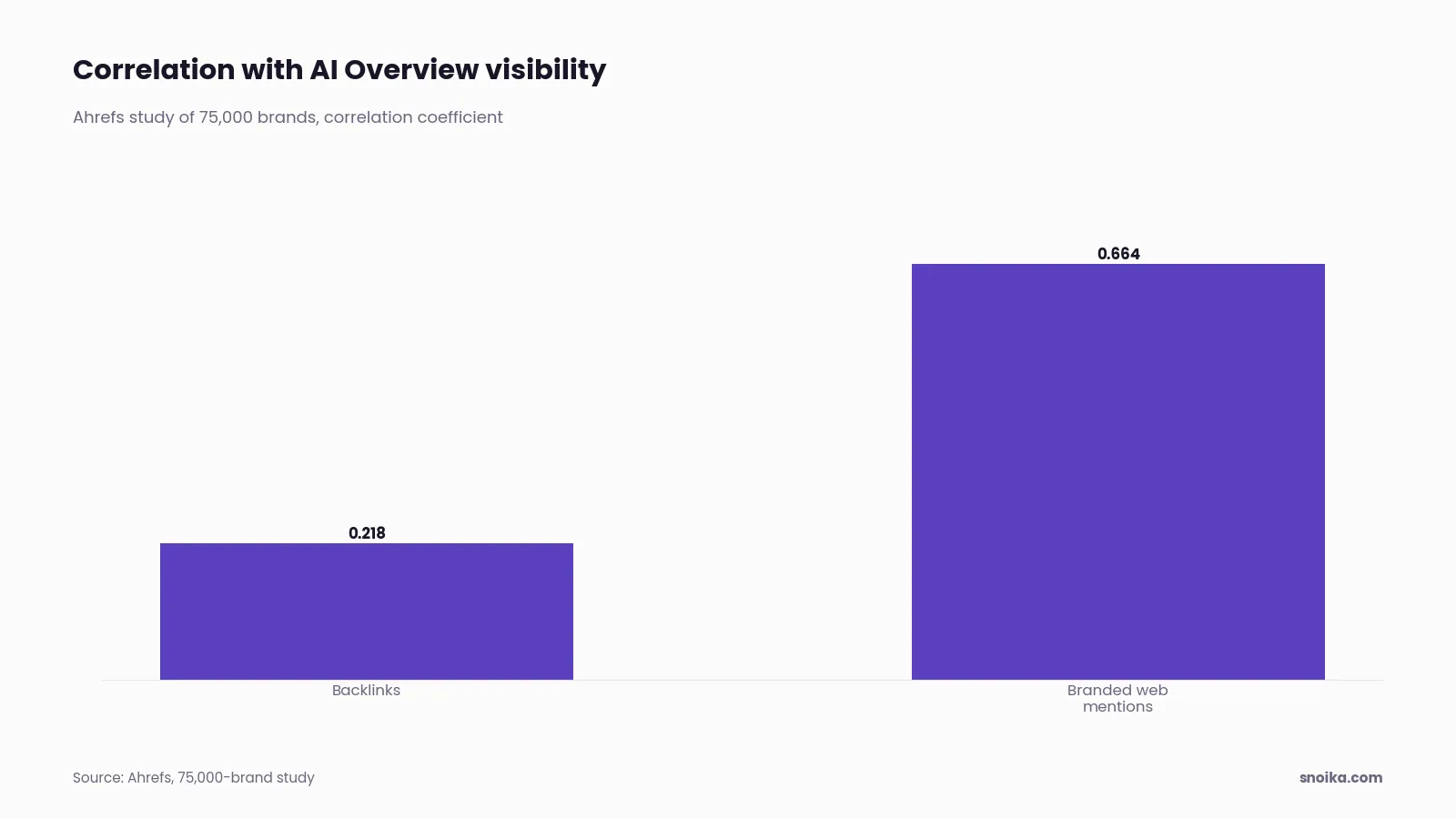
Off-site mentions track citation visibility more closely than links do. In an Ahrefs study of 75,000 brands, branded web mentions correlated with AI Overview visibility at 0.664, against 0.218 for backlinks. Brands in the top quartile for mentions averaged 169 AI Overview mentions, while the next quartile averaged 14. Mentions count whether or not they're linked. The model learns which brands belong to a topic from how often the web pairs them, then cites what fits that picture.
Whether a passage answers on its own
The model lifts passages, so a paragraph that states a fact plainly, with a number and a source, is easier to cite than one that hints at it. Researchers from Princeton worked with colleagues at Georgia Tech and IIT Delhi to test this in their 2024 paper on generative engine optimization. The addition of citations and quotations, together with statistics, lifted source visibility by over 40% across queries on their benchmark. The same paper found that results varied by domain, so a tactic's effectiveness for health queries differs from its effectiveness for software.
How recent the page is
Fresher pages have a higher citation rate. Ahrefs analyzed 17 million citations and found that AI assistants cite content that is 25.7% fresher than the URLs in organic results. The average cited URL was 1,064 days old, against 1,432 days in organic results. Google's AI Overviews leaned toward older pages and ChatGPT toward newer ones. A page refresh requires updates to its facts and figures.
A sequence for earning citations
To get your company cited by AI assistants, first make your pages reachable and give each one answers that stand alone. Then earn mentions on the sites each engine favors and keep the facts current. The order matters, because later work is wasted if an earlier step fails. These are the AI search optimization steps in sequence.
- Open the door. Allow OAI-SearchBot and the other search crawlers in robots.txt, and confirm your key pages are indexed in Google and Brave. Make sure the main content loads without JavaScript that crawlers skip.
- Map the questions. List the questions buyers ask at each stage, then the sub-questions an engine fans out to. Each sub-question needs a page section that answers it.
- Write answers that stand alone. Open each section with a direct answer, then add a sourced number with the condition under which it holds. A passage needs to make sense if it's the only thing the model reads.
- Publish where your authority already sits. Pages on your main domain inherit its trust, and pages on a separate subdomain or microsite start from zero. Snoika publishes client pages on the client's own domain through a DNS connection, with no migration.
- Earn mentions off your site. Look at which domains each engine cites for your category, then work on getting named there through reviews and comparisons. Community answers and press offer other LLM seeding routes to mentions on those domains.
- Refresh on a schedule. Update statistics and prices at least once a quarter, and remove figures you can no longer source.
LLM optimization, or generative engine optimization (GEO), is the name for this work, and it builds on SEO. Agrello, in e-signature, grew organic search sessions by +125.6% YoY and generated 51.8K impressions from Snoika-created pages. That's the same content earning search traffic and feeding the retrieval pool at once.
Common content strategy gaps
The gaps that cost citations sit in how content is written and where the brand shows up. Technical SEO is rarely the culprit. Most teams built their content for keyword rankings, and a page can rank well while giving a model nothing it can quote. We see these gaps when a ranking site goes missing from AI answers.
- Pages built around keywords. A page that targets "invoice software" but never answers "how much does invoice software cost for 10 users" misses the sub-query the engine actually runs.
- Claims without evidence. "Industry-leading accuracy" gives a model nothing to cite. "Processes 2,000 invoices an hour, per our 2025 benchmark" does.
- A brand that only exists on its own site. If you're absent from category mentions on review sites and forums, as well as in publications, the correlation data in the previous section works against you.
- Stale figures. A 2022 statistic on a page about 2026 pricing invites the engine to cite a fresher competitor.
- One language only. Buyers ask assistants questions in their own language, and an English-only site competes poorly for those prompts. Snoika creates content in 135+ languages and regional variants for this reason.
- Long introductions. When the answer sits in the fourth paragraph, the passage the model extracts is the throat-clearing above it.
Start with the 10 pages that rank best for buyer questions. Rewrite their opening sections with direct answers and sourced numbers. Update anything older than a year. Then measure again before you touch the rest of the site.
Measuring citation share
Citation share is the percentage of AI answers to a fixed set of prompts that cite your domain or name your brand, tracked over time and set against your competitors. It replaces rank as the main visibility metric for AI search. The reason is that single answers vary too much to rank. Rand Fishkin, co-founder of SparkToro, found that there's a less than 1 in 100 chance that ChatGPT or Google's AI will return the same list of brands in any two responses to the same prompt. He called treating these tools as consistent sources "provably nonsensical." Your appearance rate across many runs held up as a stable measure.
A workable measurement process runs in five steps.
- Build a prompt set of 50 to 500 real buyer questions, grouped by topic and funnel stage.
- Run each prompt several times on each engine you care about, because one run tells you almost nothing.
- Record citations and unlinked mentions. Note the competitors named and the sentiment of each answer.
- Calculate your share per topic as cited answers divided by total answers.
- Repeat weekly and compare trends, since single readings bounce around.
Your prompt set will vary with your market. A narrow B2B category needs 50 prompts to cover every buyer question, while a consumer brand needs hundreds. Choose prompts that reflect how buyers actually phrase questions in sales call notes and the long queries in Google Search Console.
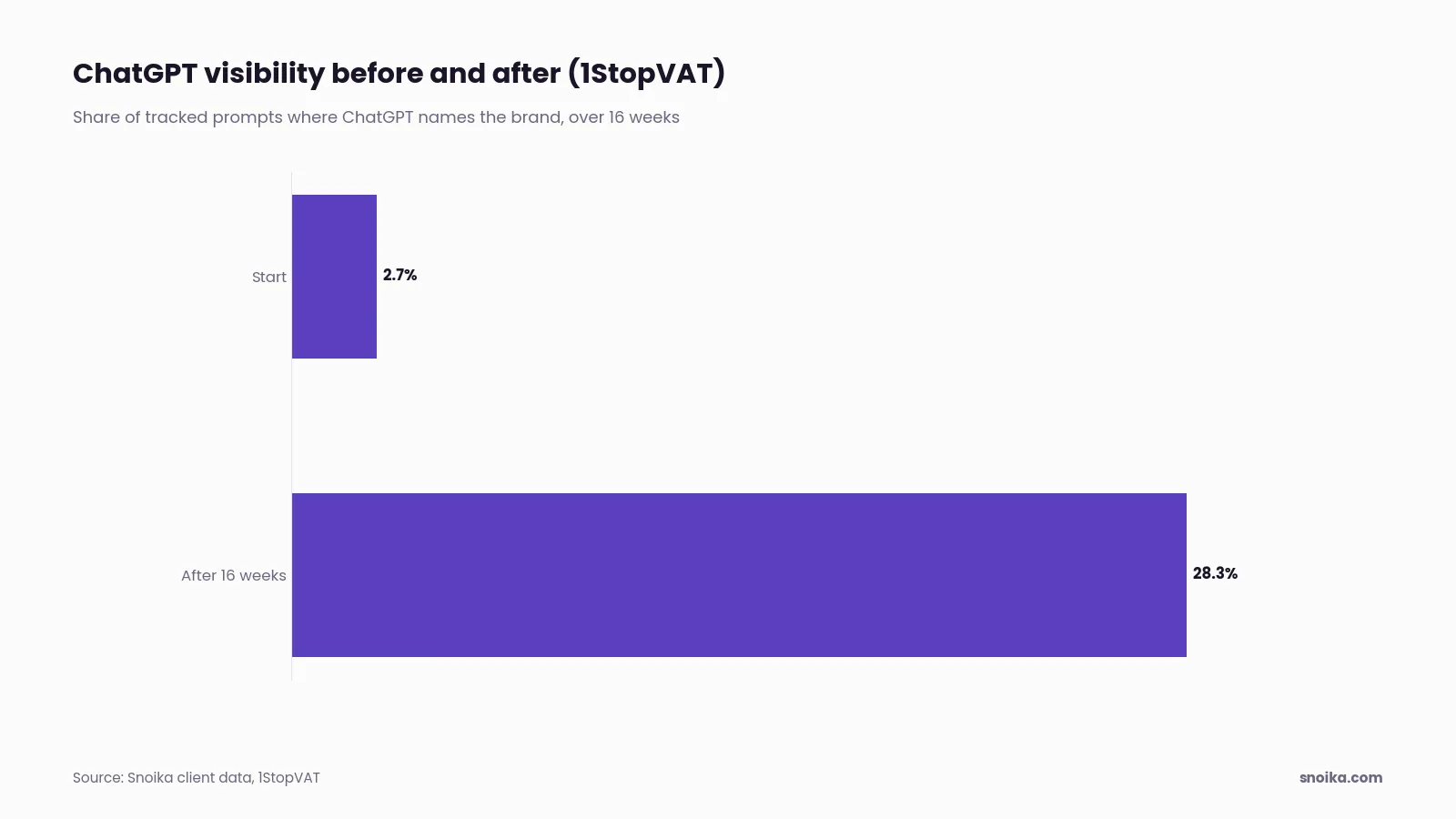
Snoika's founder Anton Vedeshin reported to Startup Reporter 1StopVAT's move from 2.7% to 28.3% ChatGPT visibility in 16 weeks. Snoika's tracking uses weekly prompt sets in ChatGPT and Google AI Overviews to measure mentions and share of voice. It also measures sentiment and citations. Those two engines are where most AI search traffic happens.
Tie citation share to outcomes before you report it upward. Set up AI referral sources in GA4 and watch branded search volume in Search Console. Then check whether the topics where your share grew are the ones that send leads. A rising share on prompts no buyer asks is a vanity number.
Guides in this cluster
This page covers the whole subject at a working level. The guides in this cluster go deeper on each part of it, and each one picks up a question this page answers in brief:
- AI crawler access: how to set robots.txt for OpenAI's OAI-SearchBot and GPTBot, with instructions for the Claude and Perplexity crawlers as well. The guide also explains how to confirm in your server logs that they're reaching your pages.
- Engine-by-engine sourcing: separate breakdowns for ChatGPT and Perplexity, with additional breakdowns for Google AI Overviews and Claude. Each examines the source types the engine cites for B2B and consumer queries.
- Writing passages models can cite: before-and-after rewrites of product and pricing pages for direct answers and sourced figures. Comparison pages receive the same treatment.
- Earning third-party mentions: how to find the domains engines cite for your category and get your brand named on them through LLM seeding.
- Building a prompt set: turning sales calls and Search Console queries into a prompt list that matches how buyers ask.
- Reporting citation share: dashboards and benchmarks that connect AI visibility to traffic and pipeline.
Read them in the order of your weakest step. If the crawler audit turns up a blocked bot, start there, because none of the other work counts until engines can reach your pages.
What to do next
Run a citation baseline before you change any content. Run each of 20 buyer questions three times in ChatGPT and Google, and record who gets cited. That one spreadsheet distinguishes access problems from problems with content or mentions; each calls for different work. Keep the sheet, because it's also your benchmark for proving that LLM citations moved after you acted.
We track citation share across ChatGPT and Google AI Overviews and build the content that earns it, with a free AI visibility report as the usual starting point. To go through your baseline with our team, book a call.
FAQ
Start by making your pages accessible to search crawlers and writing sections that answer specific buyer questions directly. Support claims with current sources. Then seek relevant third-party mentions on sites the engines already cite for your category.
AI assistants search related sub-questions and select individual passages, so ranking for the original query doesn't guarantee a citation. Check whether your pages answer those narrower questions. Also confirm that the relevant search crawler can access your content.
Crawler access and passages that answer the question are central to citation selection. Correlation studies also associate llm citations with third-party brand mentions and fresher content. No engine publishes a selection formula, so these patterns shouldn't be treated as guaranteed ranking factors.
Engines use different search sources and favor different page types. Google uses its own index, while Claude relies on Brave. ChatGPT favors reference sources, while Perplexity gives community discussions more weight. Compare the sources each engine cites for your category before deciding which pages to improve.
There's no fixed timeline for earning citations. Timing depends on whether engines can retrieve your pages and how much work your content needs. Third-party coverage also matters. Compare repeated tests of the same buyer questions weekly rather than treating a single citation as sustained progress.
Keep reading
All articles

