
How to do generative engine optimization
Generative engine optimization (GEO) means editing your pages so that AI assistants such as ChatGPT and Google AI Overviews can find them and quote them as a source. To learn how to do generative engine optimization, start small. Pick 12 to 20 pages that answer buyer questions and score each one for citation readiness. Fix the weakest scores first. Then track whether AI answers start to cite you. Each fix improves your odds of a citation.
 Artem LozinskyOperations and product, Snoika · 9 min read

























Start with page selection
To get pages cited by AI, start by choosing a short list of pages. A pilot of 12 to 20 pages lets you tell which changes worked and is small enough to edit properly. It is also large enough to show a pattern when you track it. Before you pick those pages, confirm that AI systems can reach your site at all.
OpenAI's crawler documentation says that sites which block OAI-SearchBot won't appear in ChatGPT search answers. Open your robots.txt file and look for a disallow rule under that user agent. Google requires a page to be indexed and eligible for a snippet to appear as a supporting link in AI Overviews, and lists no other technical requirements. If a page fails either check, no AI answer can cite it, however good the writing is.
Record a baseline with 20 to 50 prompts buyers type. Run them in ChatGPT and in Google, and note which brands and URLs each answer names. Every engagement we run starts with onboarding, where we ask for access to Google Analytics 4 (GA4) and Google Search Console. We also ask for Google Tag Manager access because the before-and-after numbers live in those accounts. Without a baseline, you'll have no way to tell later whether your edits changed anything.
Score citation readiness first
To score a page for GEO readiness, rate it against six criteria at 0 to 2 points each, before you decide what to edit. A page is citation-ready when an AI system can find it and read it easily enough to lift a clean answer without extra work. Each criterion below marks a place where AI systems drop a page, and weak pages fail more than one.
| Criterion | What to check | 0 points | 2 points |
|---|---|---|---|
| Access | Crawlers allowed, page indexed, answer present in raw HTML | Blocked, or text appears only after scripts run | Open and indexed |
| Answer first | The first two sentences answer the page's main question | Answer buried halfway down | Direct answer in the opening |
| Checkable claims | Figures, dates and named sources | Opinions only | A sourced number in each main section |
| Self-contained sections | Each section makes sense when quoted alone | Relies on "as mentioned above" | Each section names its own subject |
| Structure | Descriptive headings, tables for comparisons, lists for steps | One long block of text | Headings match the questions buyers ask |
| Freshness and authorship | Visible update date and a named author | No date, no author | Recent date that reflects real changes, named expert |
Access
- What to check
- Crawlers allowed, page indexed, answer present in raw HTML
- 0 points
- Blocked, or text appears only after scripts run
- 2 points
- Open and indexed
Answer first
- What to check
- The first two sentences answer the page's main question
- 0 points
- Answer buried halfway down
- 2 points
- Direct answer in the opening
Checkable claims
- What to check
- Figures, dates and named sources
- 0 points
- Opinions only
- 2 points
- A sourced number in each main section
Self-contained sections
- What to check
- Each section makes sense when quoted alone
- 0 points
- Relies on "as mentioned above"
- 2 points
- Each section names its own subject
Structure
- What to check
- Descriptive headings, tables for comparisons, lists for steps
- 0 points
- One long block of text
- 2 points
- Headings match the questions buyers ask
Freshness and authorship
- What to check
- Visible update date and a named author
- 0 points
- No date, no author
- 2 points
- Recent date that reflects real changes, named expert
Add up the points for a total out of 12. A page at 9 or above needs light edits. Between 5 and 8, fix the lowest-scoring criterion first, since one zero can hold back a page that's otherwise sound. Below 5, the page probably needs a rewrite. That costs more, so it moves the page down your priority list.
When two pages tie, give the most weight to checkable claims. In the KDD 2024 paper that named generative engine optimization, researchers from Princeton and Georgia Tech tested nine methods on 10,000 queries in collaboration with partner institutions. Adding statistics lifted visibility by 41% on position-adjusted word count, while keyword stuffing did worse than the unedited baseline. We read that result as evidence that AI systems reuse sentences they can verify. Formatting helps only when a page has facts to check.
Pick high-impact pages
Optimize first the pages where buyer demand overlaps with a realistic chance of citation. That list rarely matches your top-traffic pages. Demand determines the value of a citation, while the odds indicate whether the edit will pay off within the pilot.
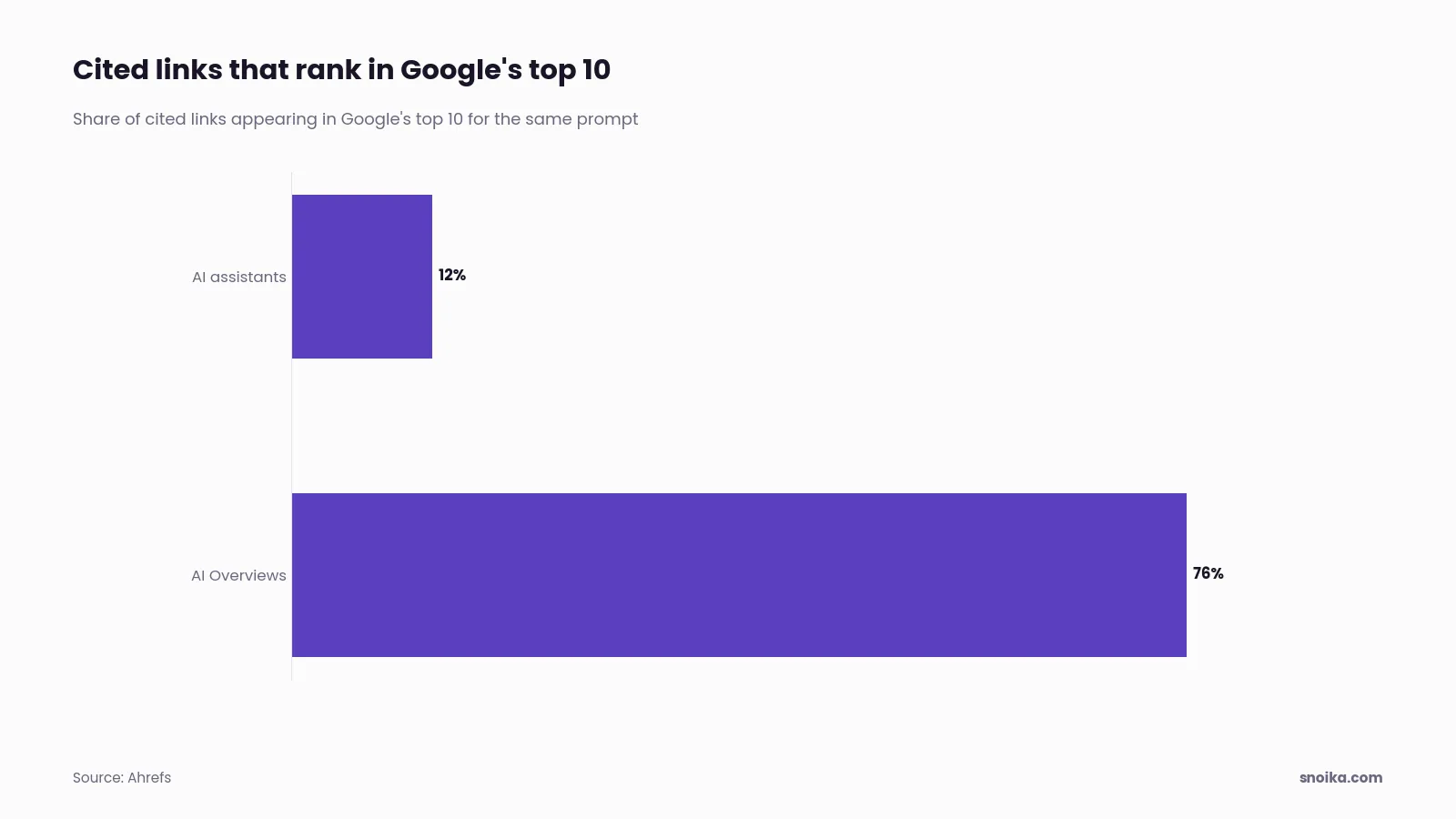
Ahrefs assessed the link between rankings and citation odds by comparing AI citations with Google results across 15,000 prompts. It found that only 12% of cited links from AI assistants appeared in Google's top 10 for the same prompt. Google's own AI feature behaves differently, with 76% of AI Overview citations coming from top 10 pages. So a page-one ranking makes a page a good candidate for AI Overviews but says little about its chances in ChatGPT.
Pages a few positions down are the better bet because reanalysis of the KDD results shows that citing sources raised visibility by 115.1% for fifth-ranked pages. Pages ranked first lost visibility with the same edit. These page types combine demand and good odds:
- Comparison pages that set your offer against generic alternatives
- Pages that explain how your product or service works
- Category definitions that buyers search before they know any vendor names
- Pricing explanations and cost breakdowns
- Use-case pages written for one industry or role
Narrow industry pages deserve a slot because fewer sources compete for those prompts. In one GEO example, 3DPrinterOS achieved #1 visibility in ChatGPT for industry-specific queries and turned AI search into a steady inbound lead source, at 3–4 qualified inbound leads/day. Test each pick against your baseline prompts. If no prompt on that list leads a buyer to the page, drop it from the pilot.
Audit existing structured content
Audit the structure you already have before you add anything. Broken markup and hidden content hurt a page more than missing markup does. Start with the raw HTML of each pilot page, which you see with "view source" in your browser. If the main answer or a pricing table appears only after JavaScript runs, a crawler that reads raw HTML won't see it.
Then check your schema markup, the structured data that labels what each part of a page is. Google says structured data isn't required for AI features. Fabrice Canel, Principal Product Manager at Microsoft Bing, told the SMX Munich audience in March 2025 that "Schema Markup helps Microsoft's LLMs understand content". He meant the large language models (LLMs) behind Copilot. Markup helps clarify content that already has substance.
For each pilot page, go through this GEO checklist:
- The schema type fits the page (such as Article or Product)
- Prices and dates match the visible text, as does every other value in the markup
- Each heading tells a reader what the section below it answers
- Comparison data sits in an HTML table
- The author and date fields in the markup match the byline on the page
A mismatch between markup and visible text costs the page its Access or Structure points in your score. Fix mismatches first. They take minutes, and they stop a model from finding two versions of the same fact.
Make your first edits
The edits that most improve a page's chances in AI answers make each passage easy to quote and easy to verify. Start with the page's lowest-scoring criterion. Leave the rest of the page alone until tracking shows a result, or you won't know which change did the work.
Put the answer in the first two sentences
AI systems pull passages, not whole pages, so the sentence that answers the question has to come first. Rewrite each section's opening so it answers the heading in 40 to 60 words and names the subject outright. "Our platform offers flexible options" gives a model nothing to quote. "The basic plan costs X per month and includes Y" gives it a fact it can repeat.
Add numbers with named sources
Replace each vague claim with a figure and the name of the person or organization behind it. Replace "Hundreds of customers" with the exact count and identify the study behind "Industry research shows" by its author and year. If you can't back a claim with a number or a source, cut it. A page with fewer claims that all hold up scores better than a page full of loose ones.
Make each section stand alone
Someone who reaches your page from an AI citation lands in the middle of it. Name the subject in every section instead of writing "it" or "this tool", and remove cross-references such as "as discussed earlier". Then read the section with everything around it covered. If the section doesn't make sense on its own, the model will skip it too.
Refresh content before you change the date
Ahrefs analyzed 17 million citations and found that AI assistants cite content that's 25.7% fresher than the pages in Google's organic results. Refresh the content before you change the visible date, with an updated figure or a recent example. Removal of an outdated claim also counts as a refresh. A new date on unchanged text misleads readers and earns the page no points.
Once you've made the edits, score each page again. A page that hasn't gained points has an edit in the wrong place.
Track AI citation signals
Track how often your brand appears across repeated runs of a fixed set of prompts every week, because a single AI answer tells you almost nothing. SparkToro, the audience research company co-founded by Rand Fishkin, ran 12 prompts 60 to 100 times each. It found that fewer than 1 in 100 runs returned the same list of brands. Fishkin wrote that treating these tools as sources of consistency is "provably nonsensical." What does hold up is the share of runs that name you.
Log these signals each week for every pilot page and its prompts:
- Mention rate: the share of runs that name your brand
- Citation rate: the share of runs that link to one of your URLs
- Share of voice against the competitors those same answers name
- Sentiment of the sentences that mention you
- Referral sessions in GA4, which you can isolate because ChatGPT adds utm_source=chatgpt.com to referral URLs
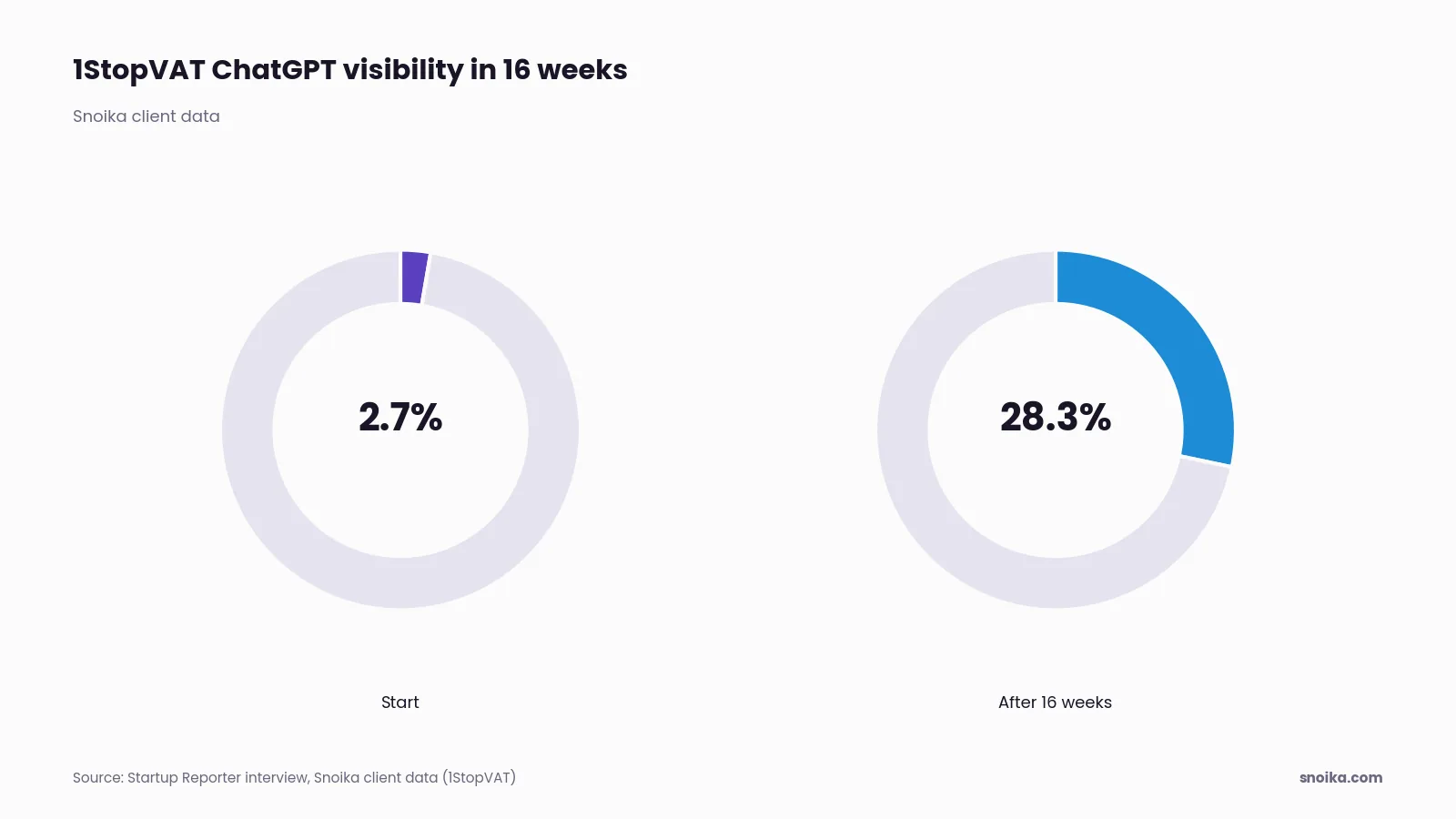
Our own tracking uses weekly prompt sets to measure mentions and citations in ChatGPT and Google AI Overviews, where most AI search traffic happens. We measure share of voice and sentiment in those same answers. Snoika's founder Anton Vedeshin reported to Startup Reporter 1StopVAT's move from 2.7% to 28.3% ChatGPT visibility in 16 weeks. Don't judge a pilot on one week's numbers.
Close gaps SEO misses
GEO in marketing covers ground that a keyword report can't see. Buyers ask AI assistants full questions with conditions attached, such as "for a 20-person team in Germany" or "without a migration". Keyword tools rarely show those phrasings. So add the conditions to your prompt set, and write sections that answer them directly.
Answer engine optimization (AEO) is the same work aimed at direct answers in assistants and search features, and the checks on this page apply to it unchanged. Teams overlook language, even though buyers who ask in Polish get Polish answers and a Polish page answers them more directly than an English one can. We create content in 135+ languages and regional variants because a pilot run in English only measures one market. If you sell in more than one language, run your baseline prompts in each of them and score the local pages separately.
Build lasting authority cues
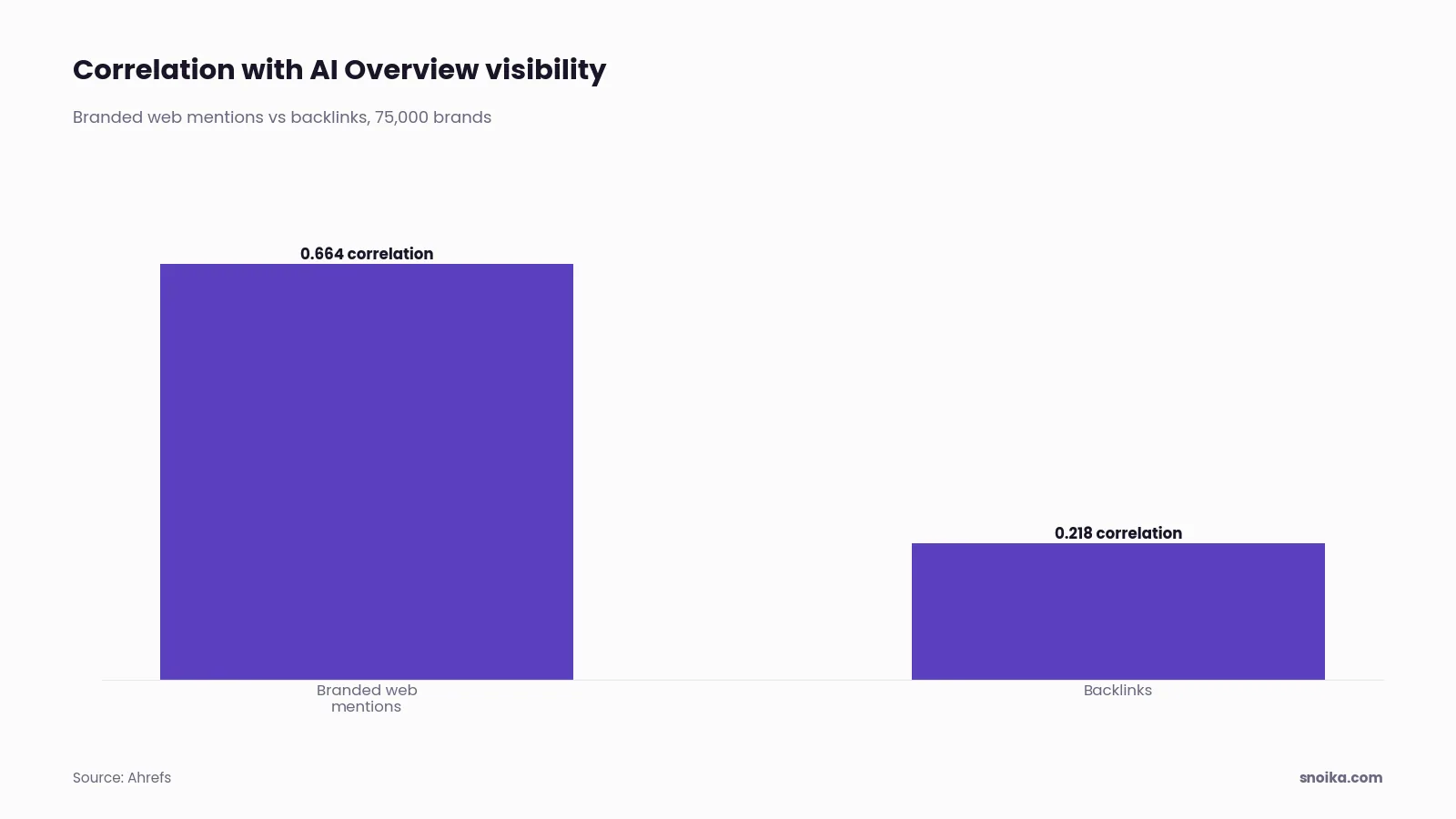
Lasting authority depends on what the rest of the web says about you, so once the pilot edits are done, the GEO strategy moves off your own pages. Ahrefs studied 75,000 brands and found that branded web mentions correlated with AI Overview visibility at 0.664, against 0.218 for backlinks. Mentions in trade press and community threads count whether they link to you or not.
On your own site, use authority cues a model can check. Put a named author with real credentials on each pilot page, and explain the method behind any original data you publish. Keep company facts identical on your site and on public profiles. When the facts conflict, a model has a reason to cite someone else.
When we publish for clients, pages go live through a DNS connection on the client's own domain without a migration. That way every citation builds the authority of the domain the buyer already knows.
What to do next
Pick your pilot pages and score them this week, before you edit anything. Keep a copy of each page as it was before the edits. When a citation appears, you can then compare versions and see which change came before it. That record tells you which edits to repeat across the rest of the site. It's also how to do generative engine optimization in a way you can measure, page by page. Snoika tracks brand mentions and citations in ChatGPT and Google AI Overviews, and a free AI visibility report is the usual first step. To see where you stand before your first edit, check your AI visibility free.
FAQ
Check whether search crawlers can access your pages before editing content. When learning how to do generative engine optimization, record a baseline using 20 to 50 buyer prompts before making changes. Keep copies of the original pages so later citations can be compared with specific edits.
Prioritize pages that match buyer prompts and need manageable edits, rather than choosing by traffic alone. Exclude a page if none of your baseline prompts fits it. Pages scoring below 5 probably need rewrites, so move them down the pilot priority list.
Rate each criterion in the guide's checklist from 0 to 2, then add the scores for a total out of 12. Use the weakest criterion to decide what to fix first. When pages tie, give more weight to claims backed by named sources.
Fix the page's lowest-scoring criterion first and leave unrelated content unchanged while tracking results. For a weak opening, move the direct answer into the first two sentences. For unsupported claims, add a verifiable figure with its source or remove the claim.
Track results weekly across repeated runs, rather than judging the edits after one week. The guide doesn't establish a fixed timeline for earning citations. Compare the share of answers linking to your pages with the baseline, using the same buyer prompts.
Keep reading
All articles

