
Generative engine optimization agency: what to expect before you hire one
A generative engine optimization agency works to get your brand named and cited in the answers that ChatGPT and Google AI Overviews give your buyers. First it checks how those assistants describe you today. Then it fixes the pages and outside sources they draw on, and it publishes content written to be quoted. You pay a retainer. In return, the agency reports how often assistants mention and cite you, where an SEO agency would report keyword rankings.
 Denys SuliatytskyiHead of Growth, Snoika · 8 min read


















What a GEO agency does
A generative engine optimization (GEO) agency changes what AI assistants say about your brand by changing what those assistants read. For a lot of queries, tools like ChatGPT search the web before they write an answer, and then they cite the pages they trust. The agency finds the prompts your buyers type and records which brands show up in the answers. Then it works out why a competitor gets named and you don't.
On your own site, the agency rewrites pages so assistants can quote them. The original GEO research from Princeton found that adding statistics and quotations from relevant sources can raise visibility by up to 40% in generative engine responses. Off your site, it builds mentions. An Ahrefs study of 75,000 brands found that branded web mentions correlated with AI Overview visibility at a 0.664 correlation, compared with 0.218 for backlinks. Before you sign, ask the agency which prompts it will track and which outside sources it plans to work on.
How GEO differs from SEO
SEO earns you a ranked link, and GEO earns you a mention inside an answer that the reader may never click past. Pages that crawlers can't reach, or that bury the answer, fail in both channels, so most GEO work sits on top of solid SEO. An SEO agency tracks keywords and positions, while a GEO agency tracks prompts and how often you appear across repeated runs of them.
Repeated runs matter because AI answers move around. SparkToro, the audience research company, found there's a less than 1 in 100 chance that ChatGPT or Google's AI will return the same list of brands twice for the same prompt. So be wary of any agency that reports a single "AI ranking position". The pressure to adapt is real either way. Gartner predicted that traditional search volume will drop 25% by 2026. Alan Antin, VP Analyst at Gartner, said that "GenAI solutions are becoming substitute answer engines."
A GEO agency and an LLM SEO agency sell the same service under different names. Agencies also sell this service under the LLMO and answer engine optimization (AEO) labels. An "LLM agency" without the SEO part is a different business altogether, a firm that builds chatbots or fine-tunes large language models (LLMs) for your product. If a proposal talks about model training and never mentions citations, you're talking to the second kind.
How engagements are scoped
Most engagements open with an audit and then run a set list of priorities over a retainer with a minimum term. The minimum term varies widely. WebFX sells its GEO package with a 6-month minimum, and Siege Media runs 12-month contracts with a 30-day out clause. Some agencies commit to a fixed number of monthly deliverables, while others commit only to hours.
Snoika scopes its work in strategy slots and bills weekly. A slot is one strategy actively running, such as website fixes. Service pages can follow those fixes, with blog posts after that. Slots run in parallel, so in week one, for example, the site audit runs while content already goes out on Reddit and LinkedIn. In week two the website fixes and content publishing start, and the Reddit and LinkedIn posting carries on. Once results show, a Visibility Booster strategy can be added to support them. For you, this means you can see what's running in any given week, which is easier to check than a monthly bundle.
Whichever agency you choose, expect it to ask for analytics access. Snoika asks for Google Analytics 4 (GA4) and Google Search Console access when work begins. It also requests Google Tag Manager access so AI visibility can be tied to the traffic you already measure. Ask any agency for its first four weeks of work in writing before you sign.
Services to expect
A full-service GEO agency should offer most of the services below. If it offers only one or two, it's selling a part of the job:
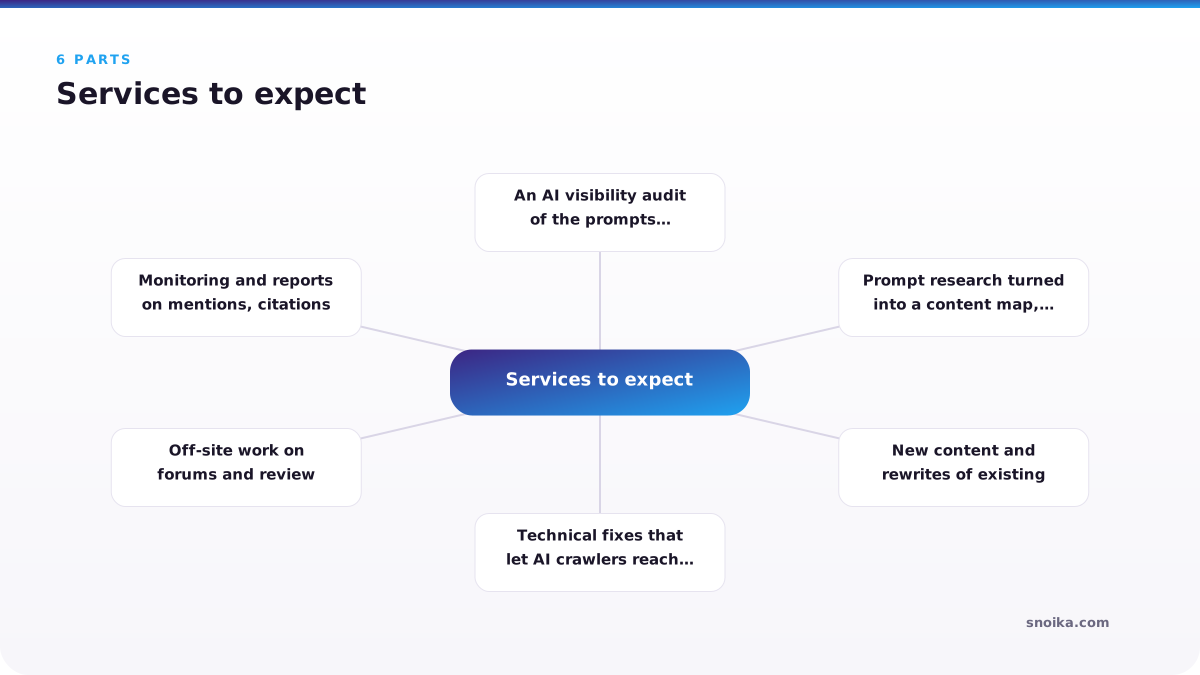
- An AI visibility audit of the prompts that matter to your buyers, with a check on competitors
- Prompt research turned into a content map, so every page targets a question buyers ask
- New content and rewrites of existing pages, structured so assistants can quote them
- Technical fixes that let AI crawlers reach and parse your pages
- Off-site work on forums and review sites, plus press coverage that builds brand mentions
- Monitoring and reports on mentions, citations and the leads they bring
Snoika runs these services in a loop that starts with an audit, followed by research and planning. Content creation and publication come next, before amplification. Monitoring and reporting complete the loop. Every stage runs inside the Snoika app. The same team that runs the platform also delivers the services, and people review the output of the automated workflows. That setup matters if you've ever paid separately for a tracking tool and an agency that never looks at it. Snoika also publishes content in 135+ languages and builds AI-ready websites from scratch, which is useful if you sell in several markets or your current site can't be fixed.
Choosing a GEO agency
Choose the agency that can show measured results on prompts like yours and that agrees in writing on what counts as success. Four questions separate the serious agencies from the rebranded ones.
Can it show before-and-after visibility data?
Ask for a case that compares starting and ending visibility figures over a stated period, ideally in your industry. A logo wall proves nothing about AI answers. Any agency doing this work for more than a few months should have numbers.
How does it measure AI visibility?
Ask which assistants it tracks and how it handles answers that change from run to run. Then ask how it connects visibility to revenue. Snoika's reports show how published content changes share of voice in ChatGPT and Google AI Overviews, alongside changes in mentions and citations. They also show which pages bring leads, through GA4 and Tag Manager events that Snoika sets up. The app also checks internal links and backlinks for orphan pages and broken links. It checks links to redirects as well, and tracks referring domains gained and lost.
What happens if targets are missed?
Most retainers bill the same whether results arrive or not. If the agreed key performance indicators (KPIs) are missed, Snoika extends its services at no cost until it delivers them. Whoever you hire, get the KPIs and the remedy written into the contract.
Who does the work?
Ask who writes the content and who reviews it before it goes live. Unreviewed AI output repeats what's already online, and that gives assistants no reason to cite you.
What GEO agencies cost
Agency retainers for GEO mostly cost $1,500 to $10,000 a month, and enterprise programs cost far more. WebFX puts agency services at $1,500 to $50,000+ per month. First Page Sage counted 1,146 quotes from 214 agencies and published monthly bands of $1,800 to $4,200 for starter work and $4,500 to $11,000 for growth. Its band for advanced programs was $11,000 to $22,000 a month. First Page Sage is itself an agency, so treat its bands as one view of the market.
Most engagements are priced as monthly retainers, and a few are fixed projects. Price goes up with the number of assistants tracked and the content volume. Off-site mention building usually costs the most. Snoika's weekly bill depends on the number of strategy slots.
- Enterprise: priced on request
Those figures put Snoika below the typical agency entry point. With weekly billing, you're also never more than a week into a commitment you want to change.
Top GEO agencies compared
Entry prices for GEO agencies range from about €124 a week to six-figure project minimums. Most agencies don't publish prices at all. The table below includes only figures that each source read from the agency's own pages or its Clutch listing in 2025 and 2026, so check them again before you shortlist.
| Agency | Published starting price | Terms published |
|---|---|---|
| Snoika | €124 per week (1 strategy slot) | Weekly billing, free extension if KPIs are missed |
| RevenueZen | $3,000 per month | Month to month, no commitment |
| Optimist | $3,000 advisory, $4,000 full service | Not published |
| WebFX | $3,000 per month | 6-month minimum |
| Siege Media | $8,000 per month minimum | 12 months, 30-day out clause |
| Omniscient Digital | $10,000 per month | Not published |
| NoGood | Above $20,000 per month (average retainer) | Not published |
| iPullRank | $50,000+ Clutch minimum | Price not published |
Snoika
- Published starting price
- €124 per week (1 strategy slot)
- Terms published
- Weekly billing, free extension if KPIs are missed
RevenueZen
- Published starting price
- $3,000 per month
- Terms published
- Month to month, no commitment
Optimist
- Published starting price
- $3,000 advisory, $4,000 full service
- Terms published
- Not published
WebFX
- Published starting price
- $3,000 per month
- Terms published
- 6-month minimum
Siege Media
- Published starting price
- $8,000 per month minimum
- Terms published
- 12 months, 30-day out clause
Omniscient Digital
- Published starting price
- $10,000 per month
- Terms published
- Not published
NoGood
- Published starting price
- Above $20,000 per month (average retainer)
- Terms published
- Not published
iPullRank
- Published starting price
- $50,000+ Clutch minimum
- Terms published
- Price not published
Your budget and the type of work you need should drive the choice. Brands worth hundreds of millions that need heavy PR and technical work fit the iPullRank and NoGood tier. Mid-market B2B teams that want an established content agency sit around Siege Media and Omniscient Digital. If you want to test GEO without a long contract, RevenueZen's month-to-month terms and Snoika's weekly slots are the lowest-risk entry points, and Snoika adds multi-language publishing. In my reading of these terms, the contract length tells you as much as the price.
GEO for B2B growth
B2B companies tend to see GEO pay back first, because their buyers now research vendors in AI tools before they speak to sales. Forrester found that 89% of business buyers used AI in their buying process in 2024, and the figure rose to 94% the next year. In Forrester's 2026 survey, 55% compare vendors in AI tools. If an assistant leaves you off the shortlist, the buyer may never visit your site.
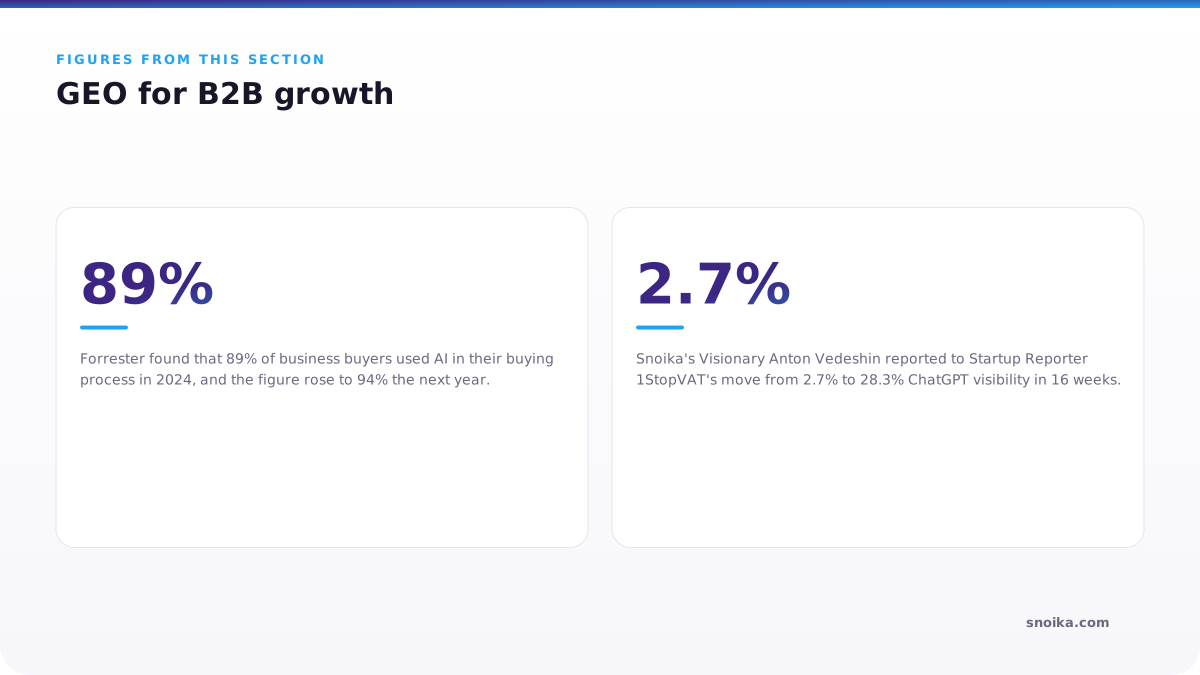
Snoika's Visionary Anton Vedeshin reported to Startup Reporter 1StopVAT's move from 2.7% to 28.3% ChatGPT visibility in 16 weeks. That's a tenfold gain in about four months, in a regulated niche where assistants are cautious about which sources they cite. Long sales cycles mean pipeline effects show up later than visibility gains do. So track which pages generate leads alongside your mention rate.
When to hire a consultant
Hire a consultant when you already have writers and developers and you need a strategy and an audit more than you need hands. Consulting is billed by the hour. Singularity Digital, for example, charges $200 per hour for GEO consulting, separate from its retainers. A consultant can map your priority prompts and train your team in a few sessions.
An agency makes more sense if nobody in-house can publish every week or run outreach on forums and review sites. Content volume and off-site mentions are where results come from, and those are the hardest parts to staff. Some companies hire a consultant first to set up the strategy, then hire an agency to carry it out.
What to do next
Before you compare proposals, find out where you stand on the prompts your buyers actually type. You can't judge any agency's plan, or its promised gains, without a baseline. Snoika's free AI visibility audit needs no access to your systems. You fill in a short form, and it checks your buyer prompts and how assistants answer them. It also covers competitors and your markets, and it shows the gaps. Take those results to every generative engine optimization agency on your shortlist and ask how they'd close each gap. To get that baseline from Snoika, request the free audit.
FAQ
A generative engine optimization agency improves the sources AI assistants use when describing your business. It tracks relevant buyer questions and updates content that assistants can quote. Before hiring, check whether its scope includes work on outside sources as well as your website.
Choose an agency with before-and-after visibility data for buyer questions similar to yours. Compare how proposals handle repeated testing and connect visibility to leads. Get the first four weeks of work in writing, with agreed success measures and a remedy for missed targets.
Most GEO engagements use monthly retainers, typically ranging from $1,500 to $10,000, with enterprise work costing more. Pricing depends on tracking scope and content volume. When comparing proposals, check whether off-site work is included and how long the minimum commitment lasts.
A GEO agency works on visibility and citations in AI-generated answers. An LLM agency generally builds chatbots or fine-tunes models for products. The label “LLM SEO agency” usually means GEO, so compare the proposed work rather than relying on the agency's name.
A reported case showed visibility gains over 16 weeks, but that doesn't establish a standard timeline. In B2B, long sales cycles mean pipeline effects arrive later, so track lead-generating pages alongside mentions.
Keep reading
All articles

