
Competitor analysis in AI search
Competitor analysis in AI search means finding out which rival brands ChatGPT and Google AI Overviews name when buyers ask about your category, and which pages those answers cite as proof. You run a fixed set of buyer prompts on a schedule and compare your share of mentions with each rival's. The output maps the prompts where you lose recommendations to rivals and identifies the sources that put those rivals there.
 Jevgenia PogadajevaCFO, Snoika · 12 min read

























Which competitors AI recommends
The brands ChatGPT recommends most in your category are the ones that turn up most often across many repeated runs of unbranded buyer prompts. One chat session won't tell you. A buyer asks "best VAT compliance software for ecommerce" and gets five names. Ask again and the list changes. In SparkToro's 2026 study, 600 volunteers ran the same 12 prompts through ChatGPT and Claude. They also tested Google's AI, and fewer than 1 in 100 runs returned the same list of brands. Fewer than 1 in 1,000 returned the same list in the same order.
So the useful question is how often each rival appears. Rand Fishkin, co-founder of SparkToro, put it this way in the study: "These tools are probability engines: they're designed to generate unique answers every time." Run a prompt enough times and you'll still see a pattern. A small group of brands appears in most answers, while a middle group comes and goes. Beyond those groups, a long tail shows up once and disappears. Your real competitors in AI search are that first group, and it differs from the list your sales team would give you.
What changes from case to case is the engine and the stage of the buyer's question. ChatGPT and Google AI Overviews draw on different sources, so the leading rival on one sits in the middle group on the other. A broad prompt like "how do I handle EU VAT" surfaces publishers and big platforms. A shortlist prompt like "best VAT tools for Shopify stores" surfaces vendors. Before you trust any list of top rivals, check how many runs it rests on and which engine produced it. Also check whether the prompts named a brand. A prompt that includes your own name tells you nothing about who wins when buyers don't know you yet.
How AI picks brands
AI assistants name brands based on what the model absorbed in training and what it retrieves from the web when it answers. ChatGPT with search turned on and Google AI Overviews both pull live pages, then write a summary that names the brands those pages mention. A rival that's described clearly on pages the engine trusts gets named. If a rival has a strong site but nobody else writes about it, it gets named less.
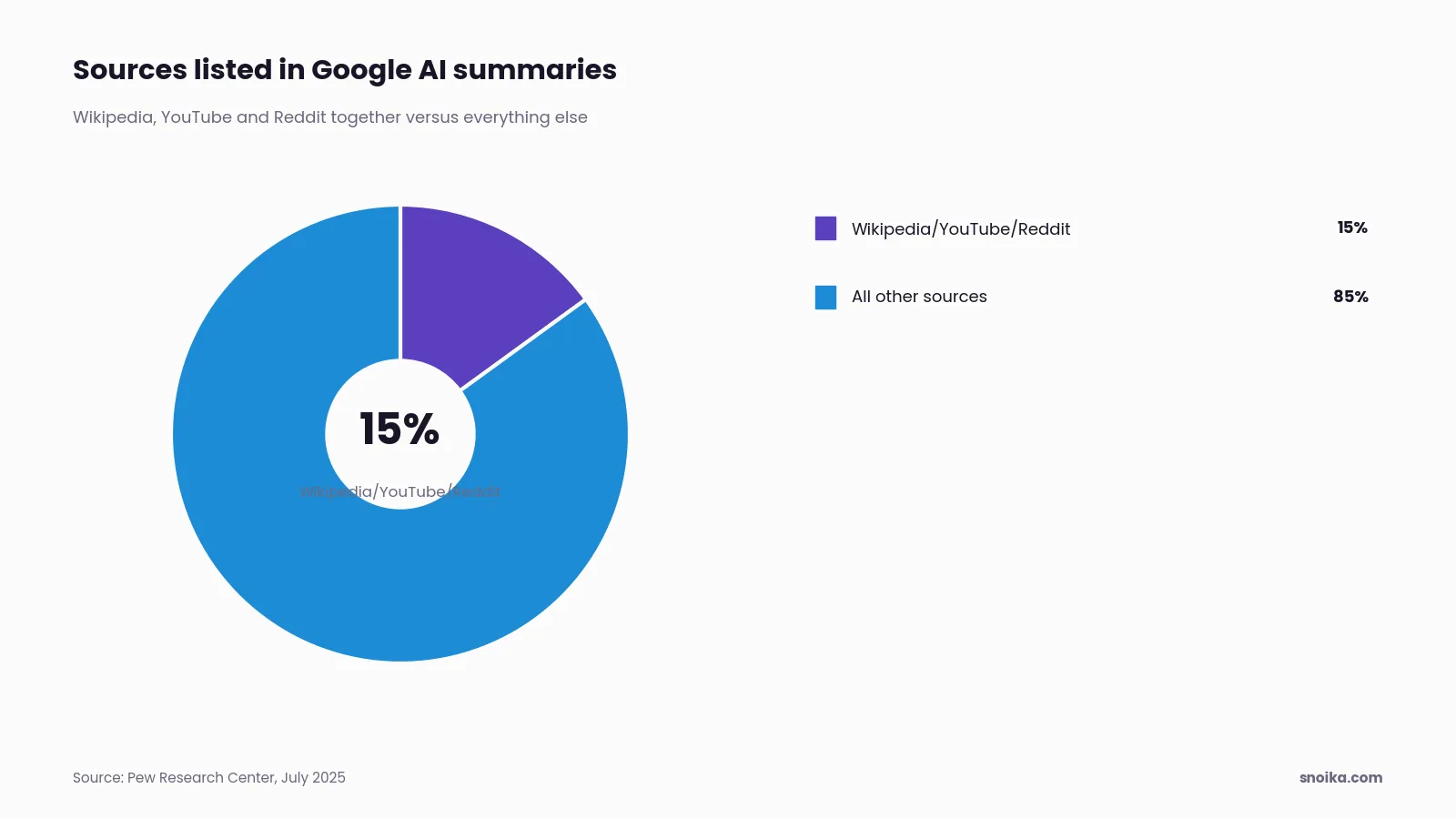
Pew Research Center studied Google searches from March 2025 and found that Wikipedia and two other platforms, YouTube and Reddit, made up 15% of sources listed in AI summaries. The other 85% spread across review sites and news, with comparison articles and vendor pages also represented. So when a rival keeps appearing, the reason is a handful of third-party pages that describe it well. Its own homepage rarely explains it.
That's also how you find the brands AI cites instead of yours. Take every prompt where you're absent and open the cited links in the answer. Write down each brand the answer names and the URL that supports it. After 20 or 30 prompts, the same domains repeat through sources such as a comparison article from 2025 or a subreddit thread. An industry directory or a rival's own guide also appears repeatedly. Those domains are the actual competition. A rival with 4 citing domains is easier to displace than one with 40, and you'll only know which case you face by counting.
Check whether the cited pages are current and whether they describe your category the way buyers do. Old pages that still get cited are an opening. A page that lists 8 rivals and leaves you out is a page you can ask to be added to, or one you can answer with better material of your own.
Measuring AI share of voice
AI share of voice is the share of all brand mentions in your prompt set that belong to you. Suppose 30 prompts each run 10 times produce 900 brand mentions in total, and 135 of those name your brand. Your share of voice is 15%. Run the same share-of-voice benchmarking for every rival and you have a scoreboard that holds up even though single answers vary.
Share of voice on its own hides useful detail, so track it next to a few related measures:
- Mention rate: the percentage of answers that name your brand at all. This is the basic visibility number.
- Share of voice: your mentions divided by all brand mentions. It shows whether you gain on rivals or just ride a general rise in mentions.
- Citation share: how often your own pages are the linked source. A brand can be named from someone else's page and still get no link back.
- Sentiment analysis: whether the answer describes you favorably, neutrally or with a warning attached. A mention that says "older interface" can cost you the sale.
- Prompt coverage: the number of prompts where you appear at least once. A high share on 5 prompts is weaker than a moderate share across 30.
Leave rank position out of your scorecard. Fishkin said in his write-up that "any tool that gives a 'ranking position in AI' is full of baloney," because order changes with almost every run. Frequency across many answers gives you a reliable signal despite the noise in position inside one answer.
The measures need to stay the same from week to week. Snoika's AI competitor analysis tool, for example, records mentions and share of voice in ChatGPT and Google AI Overviews, which is where most AI search traffic happens. It also records sentiment and citations, and it runs on weekly prompt sets. Whatever setup you use, check that it reports how many times each prompt ran and lets you export the raw answers. A share-of-voice figure you can't trace back to the answers behind it can't support a budget decision.
Gaps rivals haven't claimed
A gap is a buyer prompt where no rival holds a steady place in the answers. The answers name a different set of brands on every run or cite general publishers and leave vendors out. A lukewarm or outdated description of a rival also indicates a gap. All three mean the engine hasn't found a source it trusts for that question, and a well-built page can become that source.
To find gaps, sort your prompt log by the share of voice of the strongest brand on each prompt. Prompts where the leader appears in under a third of runs are open ground, while those where one rival appears in 80% of runs are taken and cost far more effort to win. Most teams start with the taken prompts because those are the head terms they already target in Google. It pays to do the opposite.
Gaps differ by category. In regulated fields like tax or fintech, answers stay generic because the engine is cautious and few vendors publish specific, current explanations. That makes specific answers valuable there. Vespia, a fintech SaaS, recorded a 220% increase in AI brand mentions, and fintech is a category where precise explanations are still scarce. In crowded consumer categories, gaps sit in narrow use cases.
Before you act on a gap, confirm that buyers ask the prompt in practice through sales call notes and support tickets. Google Search Console queries also provide that evidence. Second, read the current answers in full. A gap where the engine gives a wrong answer is easier to claim than one where it gives a good answer and names nobody.
Competitor visibility over time
To track competitors and tell whether they're gaining AI mentions, compare their share of voice on the same prompt set over at least 4 to 8 weekly runs and look at the trend line. A single snapshot can't answer it. Week-to-week swings of a few points are normal noise. A rival whose share climbs in 5 straight weeks is gaining. That means new third-party coverage or a fresh comparison page, unless a model update has favored their sources.
Trend data only works if the instrument stays fixed. Change a prompt's wording and that prompt's history no longer compares. Keep a versioned prompt file in which new prompts become new rows and old ones stay unchanged. When an engine ships a model update, mark the date on your chart. A sudden shift across every brand at once points to the engine changing, while a shift in one rival points to something that rival did.
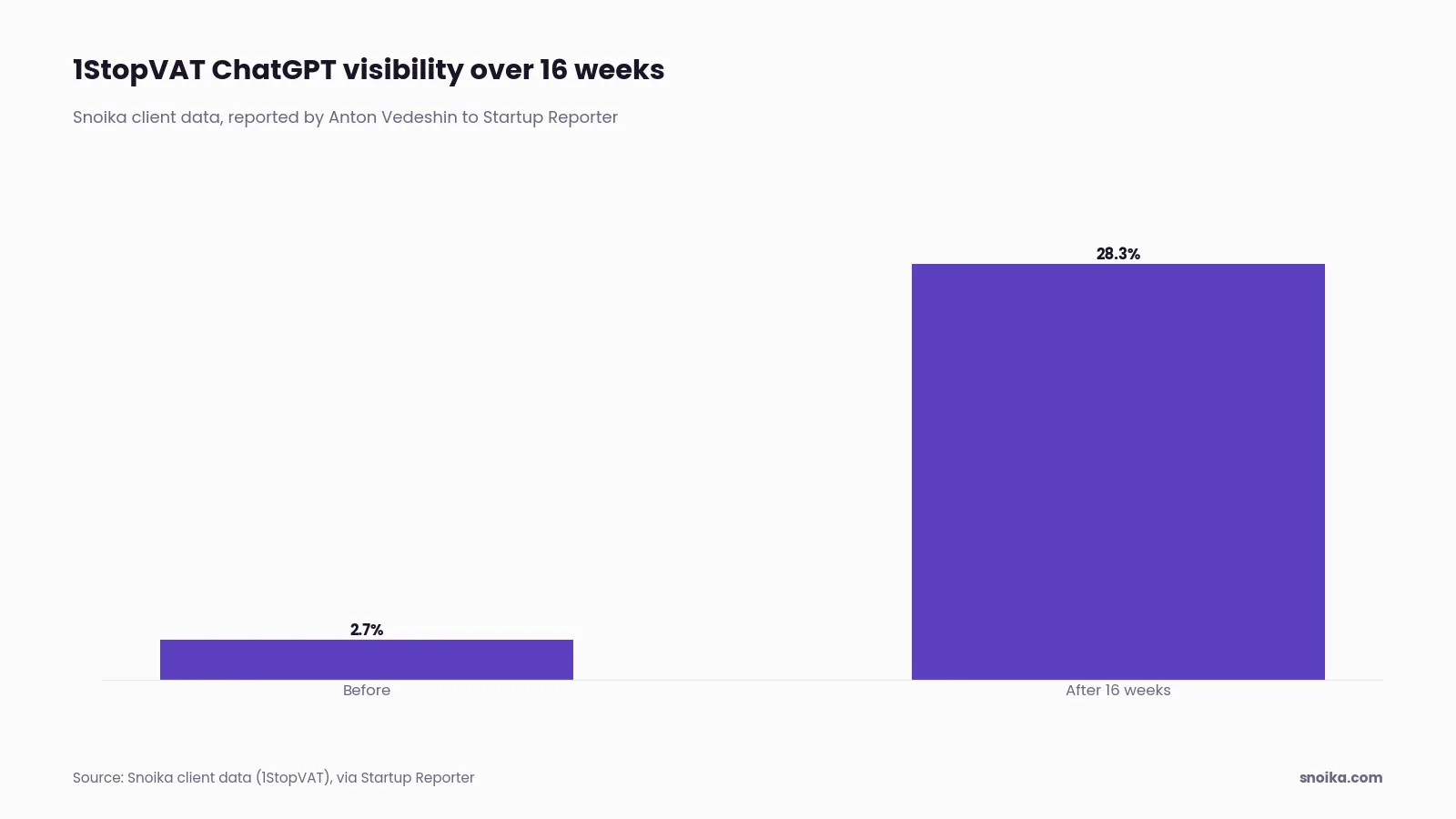
How fast you can move depends on how much open ground there is. Snoika's founder Anton Vedeshin reported to Startup Reporter 1StopVAT's move from 2.7% to 28.3% ChatGPT visibility in 16 weeks. That's a company-reported figure from a tax and fintech category where answers were thin. A category with entrenched leaders moves slower, and a rival's gains there show up only as a drop in your share while your mention rate holds steady.
If a rival rises on prompts you used to own, open the newly cited URLs that week and find out what changed. And if your mention rate holds while your share falls, the category is getting more crowded, and new entrants are taking space in answers that used to name fewer brands.
Prompt-based competitor audits
A prompt-based audit runs a fixed library of buyer questions through each AI engine, many times, and logs every brand and source in the answers. It's the method behind every section above. Done by hand, a first audit of 20 prompts across 2 engines takes a focused analyst a few days. Weekly reruns make that first audit useful over time.
Which prompts to include
The prompts that audit competitor AI visibility are unbranded questions written the way buyers ask them, grouped by the stage of the purchase. Leave every brand name out, yours and your rivals', so the engine has to pick on its own. Cover at least these groups:
- Category questions: "What's the best way to manage VAT across EU countries?"
- Shortlist prompts: "Best e-signature tools for small law offices in 2026"
- Problem-led prompts: "Our 3D printer fleet keeps failing jobs overnight, how do we fix that?"
- Comparison prompts without names: "Cheaper alternative to enterprise contract software for startups"
- Constraint prompts: "VAT software that integrates with Shopify and supports OSS filing"
Start with 20 to 30 competitor analysis prompts and spread them across the groups. Pull wording from sales calls and support tickets. Don't make it up in a workshop, because buyers phrase problems in ways your marketing team wouldn't.
How many runs each prompt needs
Run each prompt enough times that one odd answer can't skew the result. Fishkin's advice for prompts that ask for a list of options was to run them about 60 to 100 times for a full picture. A weekly tracking set can use fewer runs per prompt and lean on the trend across weeks instead. Use fresh sessions with no chat history and set the location to your target market. Record the date and engine for each run.
What to log from each answer
Give each answer its own row with the prompt and engine. Add the date and run number, then record every brand named with the sentiment toward it. Include every cited URL in that row. Keep the full answer text in a separate column. Months later, when a rival's share jumps, that text is what lets you see whether the engine started describing them differently or simply started citing a new page.
Categories rivals miss
Rivals miss categories when the way they describe themselves doesn't match the way some buyers ask. A rival that calls itself "contract lifecycle management" dominates prompts with that phrase and is absent from "simple e-signature for freelancers." Your audit will show this as a cluster of prompts where the usual leaders disappear and the answers fall back on generic advice.
Industry-specific questions are one of three recurring kinds of missed categories. A rival that wins generic prompts has no page explaining how its product works for university labs or dental clinics. 3DPrinterOS achieved #1 visibility in ChatGPT for industry-specific queries and turned AI search into a steady source of 3–4 qualified inbound leads/day. Buyer role also changes the answers, with prompts "for CFOs" and "for developers" naming different brands for the same product type. The third is language and region. Most rivals publish in English, so engines that answer in German or Polish have fewer vendor sources to draw from. The same holds for Brazilian Portuguese. Snoika creates content in 135+ languages and regional variants, and the reason that matters here is that every language is a separate set of answers with separate leaders.
To test for missed categories, copy your 10 best-performing prompts and rewrite each one for a new industry or role. Also test rewrites in a new language. Run the variants. Where rivals' share falls sharply and the answers turn vague, you've found a category they haven't covered. Check demand before you build for it. Search Console impressions and sales conversations will tell you whether buyers in that segment exist in numbers worth a page.
Turning findings into content
Findings become content when each gap or missed category gets a specific page built to be the source an AI engine cites for that prompt. Group the prompts by the question underneath them, then write one page per group that answers that question directly in its first paragraph.
The format should follow what the engine already cites for that prompt. If the current answers lean on comparison articles, publish a fair comparison with a table. If they cite how-to guides, write the steps. The Princeton and Georgia Tech study that defined generative engine optimization found that adding statistics and source material such as citations and quotations raised a source's visibility by up to 40% in generative engine responses. So include named sources and real figures, and leave adjectives out. Keyword stuffing hurt visibility in the same study.
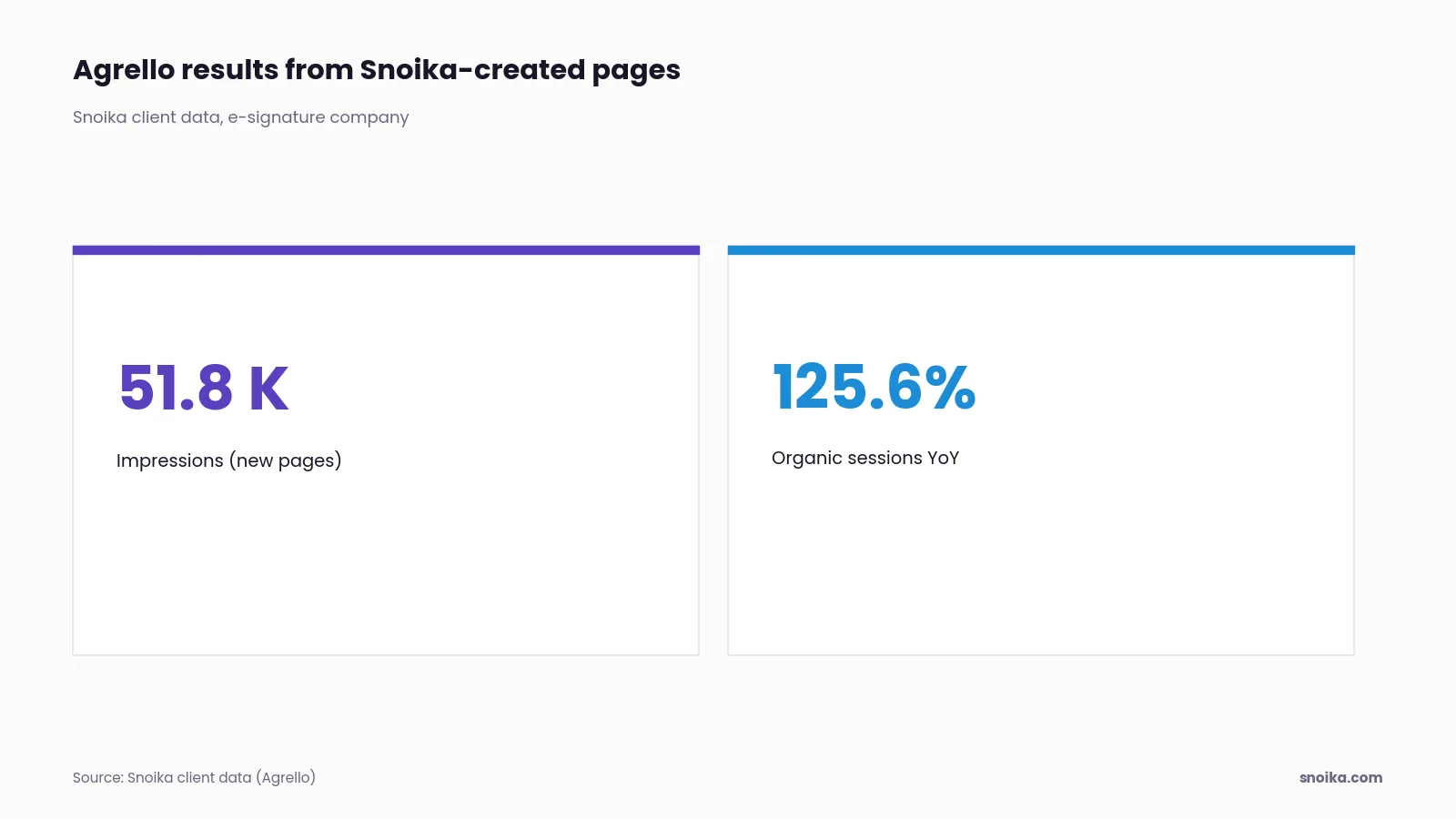
Where the page lives affects whether it builds your authority or someone else's. Snoika publishes on the client's own domain. It uses a DNS connection with no migration and works on any CMS. The client reviews and approves pages in the dashboard before they go live. Agrello, in e-signature, generated 51.8K impressions from Snoika-created pages and +125.6% organic search sessions YoY. Your own pages are half the work, though. If your audit showed that rivals win because of third-party pages, you also need coverage on those domains. Request a correction to an outdated comparison or contribute an expert answer to a forum thread. A listing in the directory the engine trusts is another way to get that coverage.
After publishing, rerun the affected prompts weekly and give each page 4 to 8 weeks. A page that gets indexed but never cited answers too late in the text, or answers a different question than the prompt asks. Fix the opening before you write anything new.
Ways to run the analysis
You can run competitor analysis in AI search five ways, and they differ mostly in who does the work after the data comes in. Acting on what you find every week costs more than measurement alone. The table compares the options on the attributes that decide the choice.
| Option | What you get | Who acts on findings | Cost in 2026 | Suits |
|---|---|---|---|---|
| Manual spreadsheet audit | A one-off or occasional prompt log you build yourself | You | Analyst time only, a few days for a first 20-prompt audit | Teams testing whether AI search matters in their category |
| Monitoring-only tool | Automated prompt runs and dashboards | Your team | Subscription, varies by prompt volume | Teams with writers and SEO staff who only lack data |
| Agency | Audits, recommendations, often content | Agency, with your approval | Retainer, varies widely | Companies that want to outsource strategy and writing |
| In-house team | Full control of prompts and content | Your staff | Salaries plus tooling | Large brands with steady content budgets |
| Snoika | Weekly tracking, content maps, content created and published on your domain, human review | Snoika team, with your approval | Plans on the pricing page | Companies that want one team to measure and act |
Manual spreadsheet audit
- What you get
- A one-off or occasional prompt log you build yourself
- Who acts on findings
- You
- Cost in 2026
- Analyst time only, a few days for a first 20-prompt audit
- Suits
- Teams testing whether AI search matters in their category
Monitoring-only tool
- What you get
- Automated prompt runs and dashboards
- Who acts on findings
- Your team
- Cost in 2026
- Subscription, varies by prompt volume
- Suits
- Teams with writers and SEO staff who only lack data
Agency
- What you get
- Audits, recommendations, often content
- Who acts on findings
- Agency, with your approval
- Cost in 2026
- Retainer, varies widely
- Suits
- Companies that want to outsource strategy and writing
In-house team
- What you get
- Full control of prompts and content
- Who acts on findings
- Your staff
- Cost in 2026
- Salaries plus tooling
- Suits
- Large brands with steady content budgets
Snoika
- What you get
- Weekly tracking, content maps, content created and published on your domain, human review
- Who acts on findings
- Snoika team, with your approval
- Cost in 2026
- Plans on the pricing page
- Suits
- Companies that want one team to measure and act
Snoika's plans on its pricing page scale by prompt volume and platforms. The Free Trial tests 10 AI prompts weekly on 1 AI platform with basic competitor tracking. Starter tests 100 prompts weekly across 3 platforms with basic competitor tracking and a monthly AI visibility report. Growth tests 500+ prompts weekly across all AI platforms and adds advanced competitor tracking and advanced competitor intelligence. It also includes a dedicated account manager. Enterprise adds unlimited prompts and multi-brand management. Custom integrations and API are also available with Enterprise and are arranged by booking a call.
Start with the manual audit if you've never measured AI visibility, because 20 prompts will show whether rivals own your category or it's still open. A monitoring-only tool suits a team that already has the people to write and publish. Choose an agency or a combined platform when the gap between knowing and doing is the real problem.
Next steps
Run a baseline before you spend anything on content. Write 20 unbranded buyer prompts and run each one at least 10 times in ChatGPT and Google AI Overviews. Record every brand and cited URL. Then repeat the run weekly for a month. Do the work in that order, because 4 weeks of data separates real rival gains from noise, and that difference sets every priority after it. A gap that holds for 4 weeks is worth a page.
If you'd rather have one team run your competitor analysis in AI search and track it weekly, Snoika does that work with a human review layer over every automated step. The team also publishes the pages that close the gaps. The work begins with a free AI visibility report. Book a call to scope your prompt set.
FAQ
The leading competitors are those named most often across repeated tests of unbranded buyer questions. Count appearances across your prompt set rather than trusting one answer. Compare each engine separately, because competitors’ visibility varies by engine and the buyer’s question.
Check answers where your brand is missing and record the competitors named alongside their supporting links. Count which source domains recur across those answers. Distinguish a competitor being recommended from its website being cited, since third-party pages can support recommendations.
Use unbranded questions taken from sales calls or support tickets, such as “Best accounting software for freelancers” and “Cheaper alternative to enterprise contract software.” Build 20 to 30 prompts covering different buying stages, keeping the wording unchanged for repeat tests.
Compare competitors’ share of mentions across the same prompts over 4 to 8 weekly runs. A sustained rise is more informative than a single week’s change. Mark model updates so you can distinguish engine-wide shifts from changes affecting one rival.
The cost of competitor analysis in ai search depends on prompt volume and who handles the follow-up work. A manual first audit of 20 prompts across two engines takes a few analyst days. Automated monitoring adds subscription costs, while content work requires separate resources.


