ChatGPT prompts for competitor analysis
ChatGPT prompts for competitor analysis are questions you ask ChatGPT the way a buyer would. You then read each answer for the brands it names and how it describes each one. A fixed set of prompts that you run on a schedule and count shows which rivals the model recommends ahead of you and why.
 Artem LozinskyOperations and product, Snoika · 9 min read

























Prompts that reveal AI positioning
You find your AI positioning with prompts that copy what a buyer types when they're building a shortlist. In a March 2026 survey of 1,076 B2B decision makers, the software review site G2 found that 51% begin software research with an AI chatbot more often than with Google. Your position is whatever those answers say about you. We group positioning prompts into three types, because each one shows a different part of the picture.
Category prompts a buyer would type
Category prompts show whether the model puts you in the category at all. Write them without your brand name: "What are the best e-signature tools for a 50-person legal team in Germany?" Then ask a follow-up in the same thread: "Why did you pick each one?" The follow-up shows which attributes the model links to each brand. Those attributes are your positioning as the model sees it.
Head-to-head comparison prompts
Comparison prompts show how the model frames you next to a named rival. Try "Compare [your brand] and [competitor] for a mid-market finance team. Where is each one stronger?" Read the answer for the adjectives. If the model calls the competitor "enterprise-grade" and calls you "affordable", that's the gap your buyers are reading, whatever your homepage says.
Alternative-to prompts
Alternative prompts show who the model offers when a buyer is unhappy with a rival. "What are the alternatives to [competitor] for [use case]?" is the prompt switchers type. If you're missing from that list, the model doesn't see you as a replacement, and you lose the buyers who are easiest to win.
How ChatGPT ranks competitors
ChatGPT builds a new competitor list for each answer from what it learned in training and, with search turned on, from the pages it pulls in. OpenAI's help article on search says ChatGPT "typically rewrites your query into one or more targeted queries" before it sends them to search providers. So the same question can return different sources, and different brands, from one run to the next.
SparkToro ran 2,961 prompts with 600 volunteers and found that ChatGPT returned the same brand list less than 1% of the time. The same list in the same order came up less than 0.1% of the time. Rand Fishkin, SparkToro's co-founder, put it like this: "If you ask an AI tool for brand/product recommendations a hundred times nearly every response will be unique."
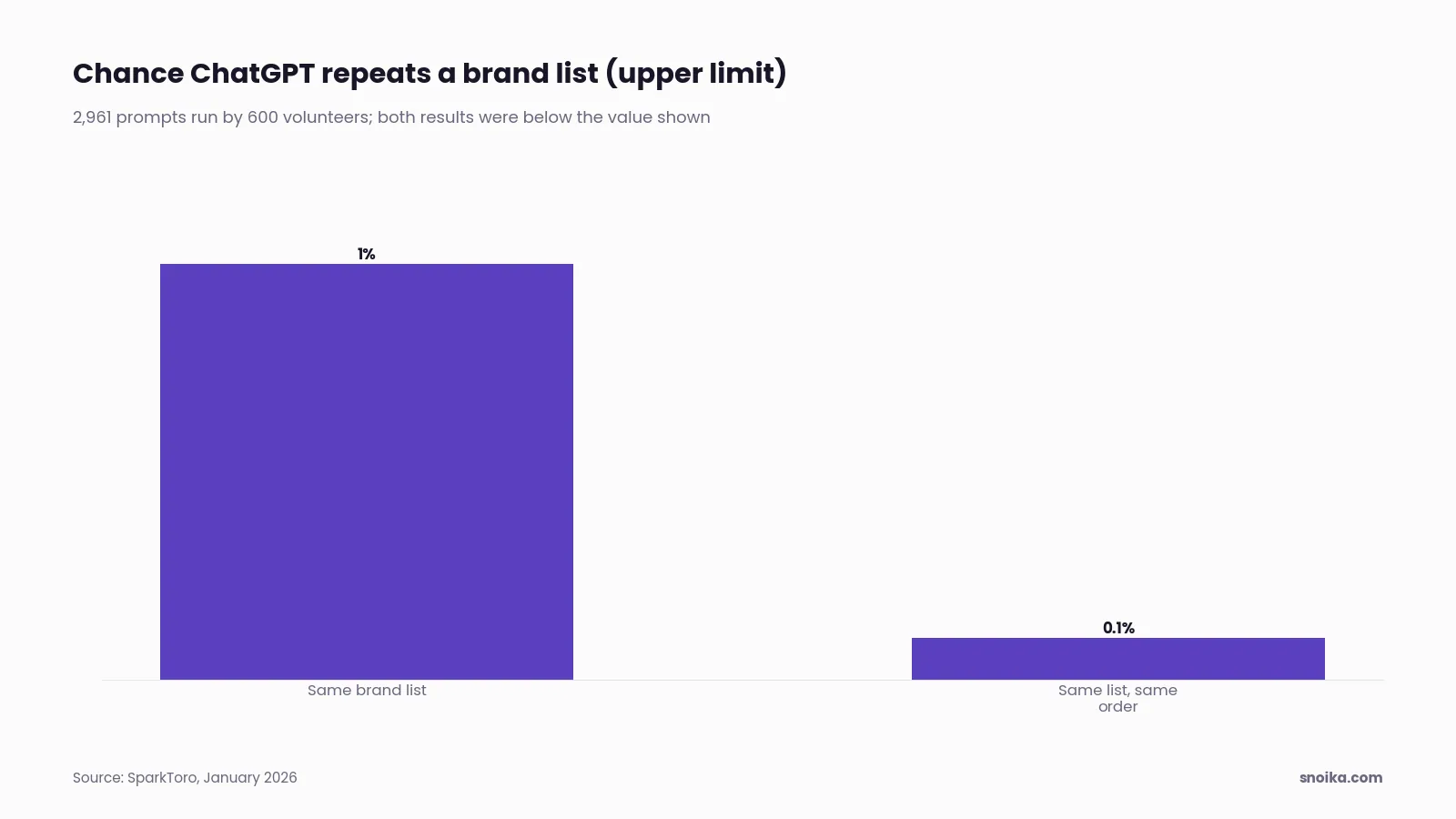
That changes how you work out which competitors ChatGPT recommends over your company. Count how often each brand appears across repeated runs of one prompt. Don't look at where it sits in one answer. A competitor that shows up in 70 of 100 runs while you show up in 20 is beating you, even if you happened to come first the time you checked by hand. The SparkToro researchers also found that visibility percentage holds steadier than position, so position is the number to stop reporting.
Positioning gap prompts
To find gaps in a competitor's messaging, give ChatGPT their copy and yours, then ask it to map the claims each side makes and the buyer questions nobody answers. Paste the page text directly into the chat. When you paste the words, the model reasons over the copy you can see.
We run these prompts in this order:
- "Here is the homepage and pricing page copy for [competitor]. List every claim they make, grouped by buyer concern."
- "Here is our copy for the same pages. Do the same."
- "Which buyer concerns does neither of us address? Which concerns does only one of us address?"
- "For each gap, write the question a buyer would type into ChatGPT that would expose it."
The fourth step turns a messaging gap into a prompt you can add to your tracking set, so you can watch whether closing the gap changes the answers. Gaps come in two kinds that need different fixes. A claim the competitor owns, like "fastest setup", needs proof from you before you can contest it. A concern nobody covers, like data residency for EU buyers, is open ground, and the first credible page on it becomes the source the model cites.
Check each gap the model reports against the real pages before you act on it. It sometimes reports a gap for information that sits halfway down a competitor's pricing page.
Prompts for cited messaging
Cited-messaging prompts show which pages shape how ChatGPT describes you and your rivals. Turn search on and ask: "Recommend tools for [use case] and cite the source behind each claim you make about each brand." The cited pages are the raw material of your positioning in AI answers. They're review sites or comparison posts that you didn't write.
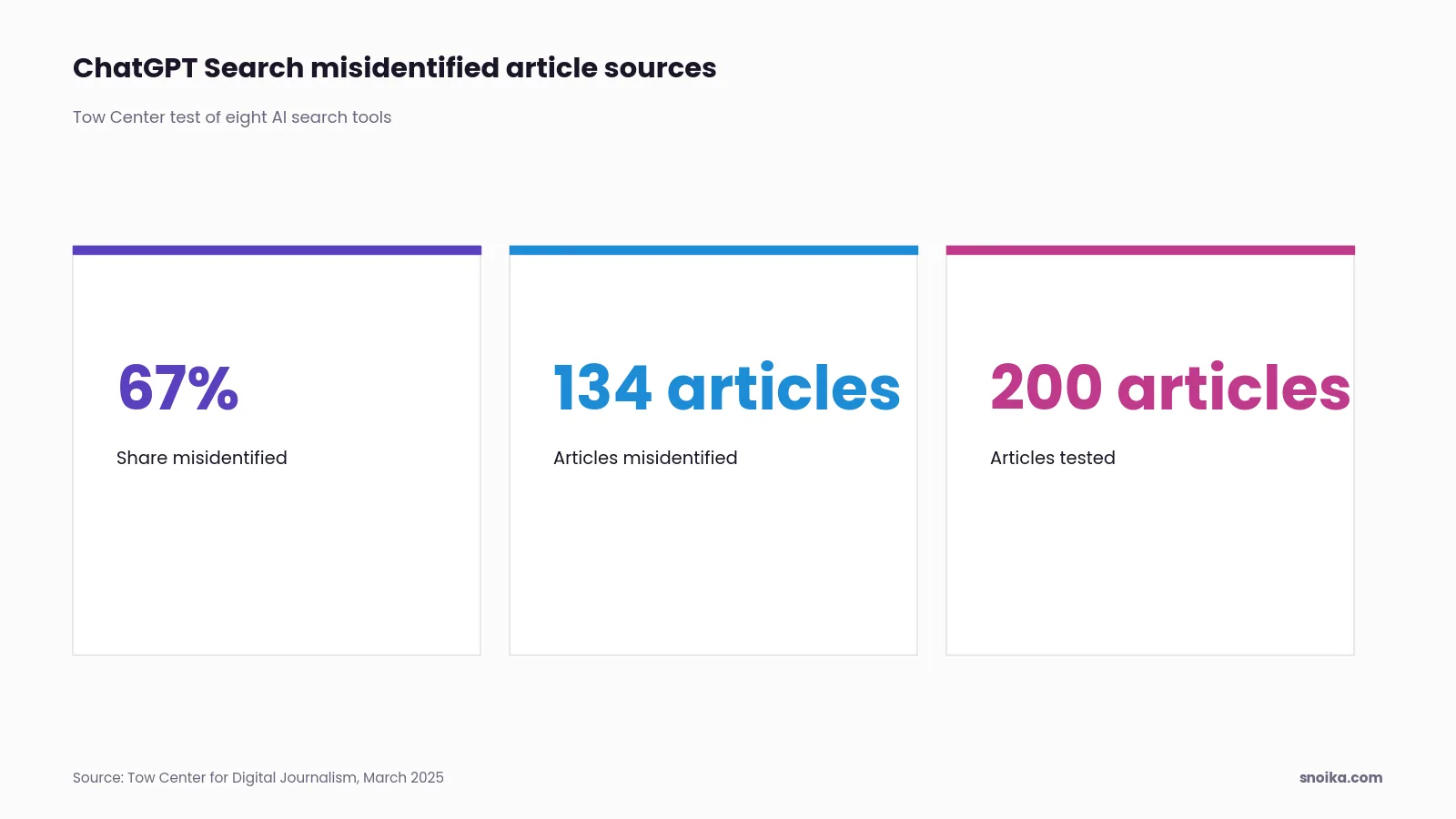
Open every citation before you trust it. The Tow Center for Digital Journalism at Columbia University tested eight AI search tools and found that ChatGPT Search misidentified 67% of articles (134 of 200) when asked to name an article's source. A citation can point to a page that doesn't support the answer's claim or to a copy of the original.
Verified citations identify which third-party pages describe the competitor in the terms you want for yourself and which pages describe you wrongly. Vespia, a fintech SaaS, recorded a 220% increase in AI brand mentions while working with us. Our work starts with a list of the pages models actually read.
Repeatable visibility checks
A repeatable AI visibility check runs the same prompts under the same conditions every week, then records whether each brand appears. Here's the routine we'd give anyone doing it by hand:
- Fix the prompt set. Write 20 to 50 buyer prompts from the three positioning types and your gap prompts. After that, don't change the wording, because new wording makes this week's numbers impossible to compare with last week's.
- Clear the context. Use a temporary chat or turn memory off. OpenAI's help article describes ChatGPT's use of saved memories when rewriting a search query, which biases the answers toward what it knows about you.
- Run each prompt more than once. One run is noise. A Passionfruit analysis of the SparkToro data suggests 60 to 100 runs give meaningful visibility data, which is more than most teams can do by hand. So run at least 5 per prompt and accept wider error bars.
- Log the same fields every time. For each run, record whether your brand and each competitor appeared. Note the cited URLs and whether the tone was positive or negative.
- Calculate visibility per brand. Divide the runs that mention a brand by the total runs for that prompt.
- Repeat on the same weekday. Compare week against week, prompt by prompt.
You'll know the check works when two weeks with no changes on your side produce similar percentages. If the numbers swing widely with nothing changed, you need more runs per prompt.
Validating outputs at scale
To validate ChatGPT's output at scale, treat every fact it gives you as a claim, then check a fixed sample against the source. Begin each session with a standing instruction: "Never invent statistics or prices. The same rule applies to search volumes. If a fact isn't in the text I provide, say so." That one rule stops most fabricated figures before they reach a report.
The instruction cuts errors but doesn't remove them. So check by type. Prices and feature claims about competitors get checked every time, because they go stale fastest and do the most damage when wrong. Spot-check visibility counts by rerunning one prompt out of ten to confirm the brands match your log. Citations get opened, for the reasons the Tow Center study gives.
With 50 prompts and 5 runs each, you're reading 250 answers a week to track 4 competitors. That's why we put a human review layer on top of our automated workflows. Machines can count mentions, but a person still needs to judge whether an answer describes a brand fairly.
What strong prompts include
A strong competitor prompt reads like a real buyer's question and asks for output you can log. Weak prompts ask "Who are the top companies in X?" and get a generic list. Strong ones carry context that narrows the answer to the buyers you sell to. They include:
- A buyer role. "I'm the head of finance at a 200-person SaaS company."
- A use case. "We need to file VAT in 12 EU countries."
- A constraint. Budget, region, company size or a must-have integration.
- An output format. "List up to 5 vendors in a table with one reason each."
- Permission to say no. "If you're unsure a vendor fits, leave it out."
Put together, it reads: "I'm the head of finance at a 200-person SaaS company that needs to file VAT in 12 EU countries. Which vendors would you shortlist? Give up to 5 in a table with one reason each, and leave out any you're unsure fit." Keep one prompt per buyer type you sell to. If you sell to two segments, they'll get two different shortlists, and the second segment is where a rival is quietly winning.
Feeding findings into roadmaps
Each competitor analysis finding goes into the roadmap as a page to publish or a source to earn. Rank them by the prompts where competitors appear and you don't. A prompt where you're absent and three rivals show up in most runs is a gap the model has already filled with someone else. That makes it the first target.
Turn each finding into a brief with a single job. For a gap prompt, write a page that answers the buyer question directly; for a bad citation, plan outreach to fix the third-party page. Then add the prompt to the tracking set, if it isn't there already, so the roadmap item has a number to move. Through this loop, 3DPrinterOS achieved #1 visibility in ChatGPT for industry-specific queries and gained a steady AI search inbound lead source of 3–4 qualified inbound leads/day.
Where the pages live matters. When we publish, pages go live on the client's own domain. A DNS connection supports this on any CMS without a migration. The client reviews and approves each page in the dashboard first. If you sell in more than one market, run the prompt set in each language too. Rivals hold different positions in different markets, and we create content in 135+ languages and regional variants for that reason.
Tracking AI share of voice
AI share of voice is your share of all brand mentions across a fixed prompt set. If your prompts produce 400 brand mentions in a week and 60 of them are you, your share is 15%. It's the number to report to leadership, because it puts you next to competitors on the same prompts. You can track it in four ways, and they differ most in who does the fixing.
| Option | What it measures | Who acts on findings | Cost (2026) | Suits |
|---|---|---|---|---|
| Manual checks in ChatGPT | What you log by hand, usually 1 platform | You | Your team's hours | Early checks on under 20 prompts |
| Monitoring-only tool | Mentions and citations across platforms | You or an agency | Varies by vendor | Teams that already have writers |
| Agency or in-house team | Whatever their process covers | The agency or your staff | Retainer or salaries | Firms with budget for headcount |
| Snoika | 10 AI prompts tested weekly, 1 AI platform | You | Plans on the pricing page | A first baseline |
| Snoika | 100 AI prompts tested weekly, 3 AI platforms | Snoika team and you | Plans on the pricing page | One brand in one main market |
| Snoika | 500+ AI prompts tested weekly, all AI platforms, advanced competitor intelligence | Snoika team with a dedicated account manager | Plans on the pricing page | Competitive categories, several markets |
| Snoika Enterprise | Unlimited prompts, multi-brand management | Snoika team | Custom | Groups with several brands |
Manual checks in ChatGPT
- What it measures
- What you log by hand, usually 1 platform
- Who acts on findings
- You
- Cost (2026)
- Your team's hours
- Suits
- Early checks on under 20 prompts
Monitoring-only tool
- What it measures
- Mentions and citations across platforms
- Who acts on findings
- You or an agency
- Cost (2026)
- Varies by vendor
- Suits
- Teams that already have writers
Agency or in-house team
- What it measures
- Whatever their process covers
- Who acts on findings
- The agency or your staff
- Cost (2026)
- Retainer or salaries
- Suits
- Firms with budget for headcount
Snoika
- What it measures
- 10 AI prompts tested weekly, 1 AI platform
- Who acts on findings
- You
- Cost (2026)
- Plans on the pricing page
- Suits
- A first baseline
Snoika
- What it measures
- 100 AI prompts tested weekly, 3 AI platforms
- Who acts on findings
- Snoika team and you
- Cost (2026)
- Plans on the pricing page
- Suits
- One brand in one main market
Snoika
- What it measures
- 500+ AI prompts tested weekly, all AI platforms, advanced competitor intelligence
- Who acts on findings
- Snoika team with a dedicated account manager
- Cost (2026)
- Plans on the pricing page
- Suits
- Competitive categories, several markets
Snoika Enterprise
- What it measures
- Unlimited prompts, multi-brand management
- Who acts on findings
- Snoika team
- Cost (2026)
- Custom
- Suits
- Groups with several brands
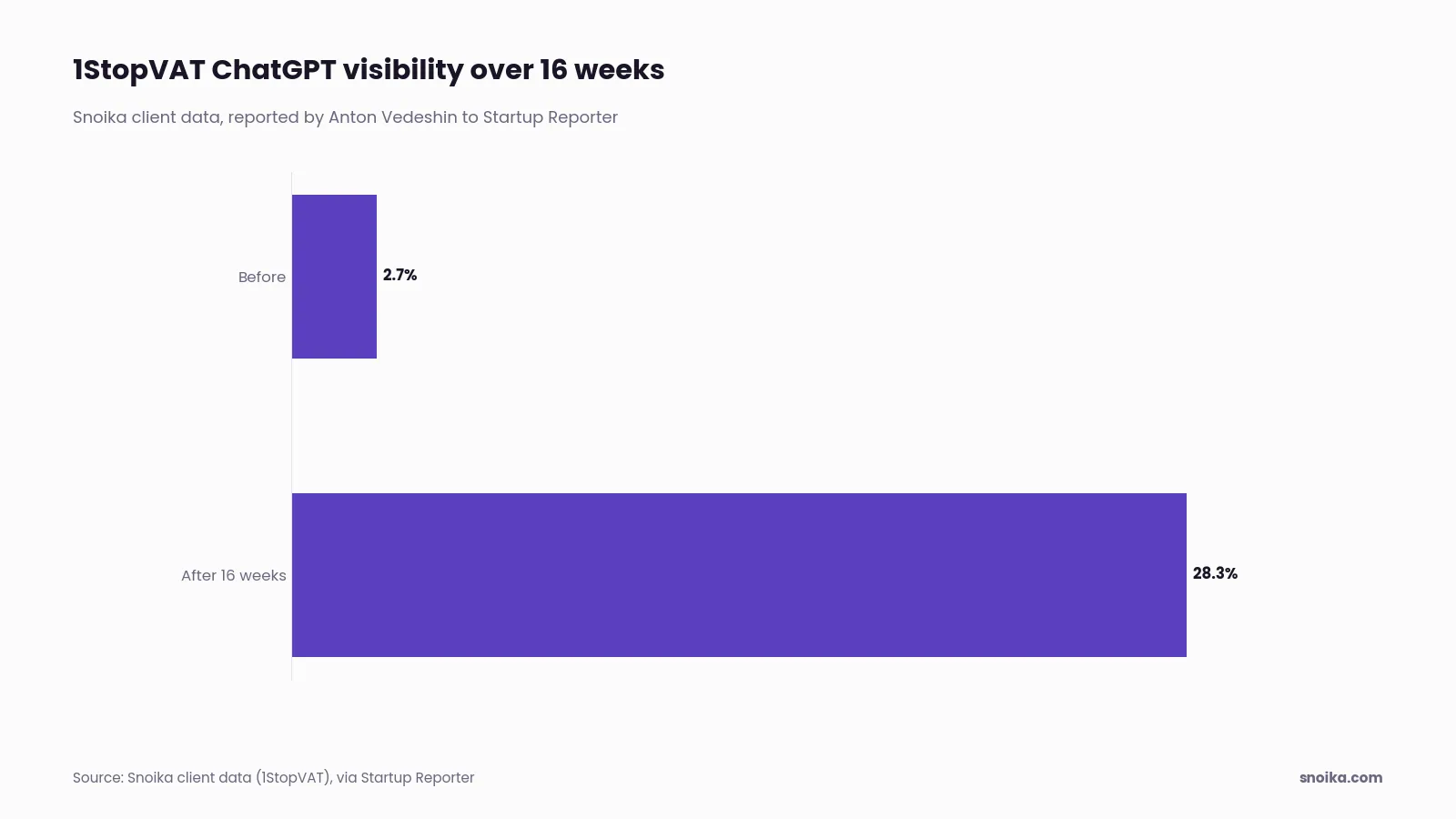
Our AI competitor analysis tool uses weekly prompt sets to measure mentions and share of voice in ChatGPT and Google AI Overviews, which is where most AI search traffic happens. It also runs sentiment analysis and tracks citations in those answers. Snoika's founder Anton Vedeshin reported to Startup Reporter 1StopVAT's move from 2.7% to 28.3% ChatGPT visibility in 16 weeks.
Manual checks are enough to learn the method and get a first baseline. Past roughly 20 prompts, the run counts the SparkToro data calls for are more than one person can do by hand. At that point, choose based on who will write the pages and fix the citations, because a dashboard by itself doesn't move share of voice.
What to do next
Get a baseline before you change a single page. Run 10 of the ChatGPT prompts for competitor analysis above, five times each, and write down which brands appear. That gives you a number to beat and identifies the competitor to study first. Start with the one that turns up in the alternative-to prompts, since that's the rival your buyers are leaving. When we take on an engagement, we start the same way. At onboarding, we learn about your category and buyers as we discuss your goals. We then ask for access to Google Analytics 4 (GA4) and Google Search Console, followed by Google Tag Manager. To see where you stand now, get a free AI visibility report.
FAQ
Use chatgpt prompts for competitor analysis that ask for a buyer shortlist or a head-to-head comparison. Ask which tools fit a specific buyer's needs without naming your company, then compare your company with a rival. The descriptions show how the model positions each option.
Paste the competitor's homepage and pricing copy alongside your equivalent pages, then ask which buyer concerns only one company addresses or neither covers. Check each reported gap against the original pages before turning it into a buyer question for your tracking set.
Run a fixed set of buyer prompts on the same weekday under unchanged conditions. Use temporary chats and keep search settings consistent. Repeat each prompt at least five times, then divide each brand's appearances by the total runs for that prompt to compare weekly visibility.
The competitors appearing more often than your company across repeated buyer prompts have greater visibility in those checks. Count appearances instead of relying on list order in one answer. Alternative-to prompts help identify whether the model considers your company a replacement for a rival.
A check with 50 prompts repeated five times produces 250 answers to review each week. The time needed depends on how many citations and factual claims require verification. Competitor prices and feature claims need checking every time, which adds work beyond counting mentions.