
AI brand monitoring in LLMs
AI brand monitoring means running a fixed set of buyer prompts through large language models (LLMs) on a schedule. Two examples are ChatGPT and Google AI Overviews. Each run records whether the answer names or cites your brand and where it puts you against competitors. Because one answer changes from run to run, the result is a share measured over hundreds of runs. You can report that share every week, even though your analytics can't see this channel.
 Artem LozinskyOperations and product, Snoika · 7 min read

























LLM monitoring vs brand tracking
LLM monitoring measures what AI models tell buyers about you, while brand tracking measures what people remember about you. Classic brand tracking surveys a panel of people every quarter about awareness and consideration. LLM monitoring has no panel. It puts the question to the model, over and over, and logs each answer. The table compares the two on the same attributes.
| Attribute | Survey-based brand tracking | LLM monitoring |
|---|---|---|
| What it measures | Recall and preference among people | Mentions, citations and recommendations in AI answers |
| Data source | Survey respondents | Model outputs for a fixed prompt set |
| Frequency | Quarterly or annual waves | Weekly or daily prompt runs |
| What it explains | How people feel about the brand | Which sources shape the answer a buyer reads |
| What it tells you to fix | Messaging and campaigns | Pages, earned coverage and product facts |
What it measures
- Survey-based brand tracking
- Recall and preference among people
- LLM monitoring
- Mentions, citations and recommendations in AI answers
Data source
- Survey-based brand tracking
- Survey respondents
- LLM monitoring
- Model outputs for a fixed prompt set
Frequency
- Survey-based brand tracking
- Quarterly or annual waves
- LLM monitoring
- Weekly or daily prompt runs
What it explains
- Survey-based brand tracking
- How people feel about the brand
- LLM monitoring
- Which sources shape the answer a buyer reads
What it tells you to fix
- Survey-based brand tracking
- Messaging and campaigns
- LLM monitoring
- Pages, earned coverage and product facts
Surveys still show whether people trust you. A survey can't show that ChatGPT left you off a shortlist yesterday, and buyers now make that decision in the chat window. G2 surveyed 1,076 software buyers in March 2026 and found that 51% of B2B software buyers start research with an AI chatbot more often than with Google. A strong survey score next to weak AI visibility means the models aren't reading the sources that built your reputation.
Why LLMs need separate monitoring
LLMs need their own monitoring because their answers never reach the tools you already use. A rank tracker records where links sit on a results page. Google Analytics only sees a visit when someone clicks, and a click from an AI answer that arrives without a referrer gets filed as "direct." The real decision happens when the model names three vendors and leaves you out, and nothing records it.
TechCrunch reported that ChatGPT reached 900 million weekly active users in February 2026. Google's own results also send fewer clicks than before. On December 2025 data, Ahrefs found that an AI Overview goes with a 58% lower clickthrough rate for the page ranked first. So a page can rank first and still lose the buyer to the summary above it.
The answers also change from run to run, so a single manual check proves little. SparkToro co-founder Rand Fishkin led a study in which 600 volunteers ran the same prompts 2,961 times. It found a less than 1-in-100 chance of ChatGPT or Google's AI returning the same brand list twice. "If you ask an AI tool for brand/product recommendations a hundred times nearly every response will be unique," the SparkToro report concludes.
Signals that matter
Four signals tell you how an AI answer treats your brand. Track each signal separately because a brand's scores can differ across them.
- Mention: the model names your brand in its text.
- Citation: the model links to one of your pages or uses it as a source.
- Sentiment: the tone of the description and whether its facts are correct.
- Position: whether you're the top pick or one name in a list of alternatives.
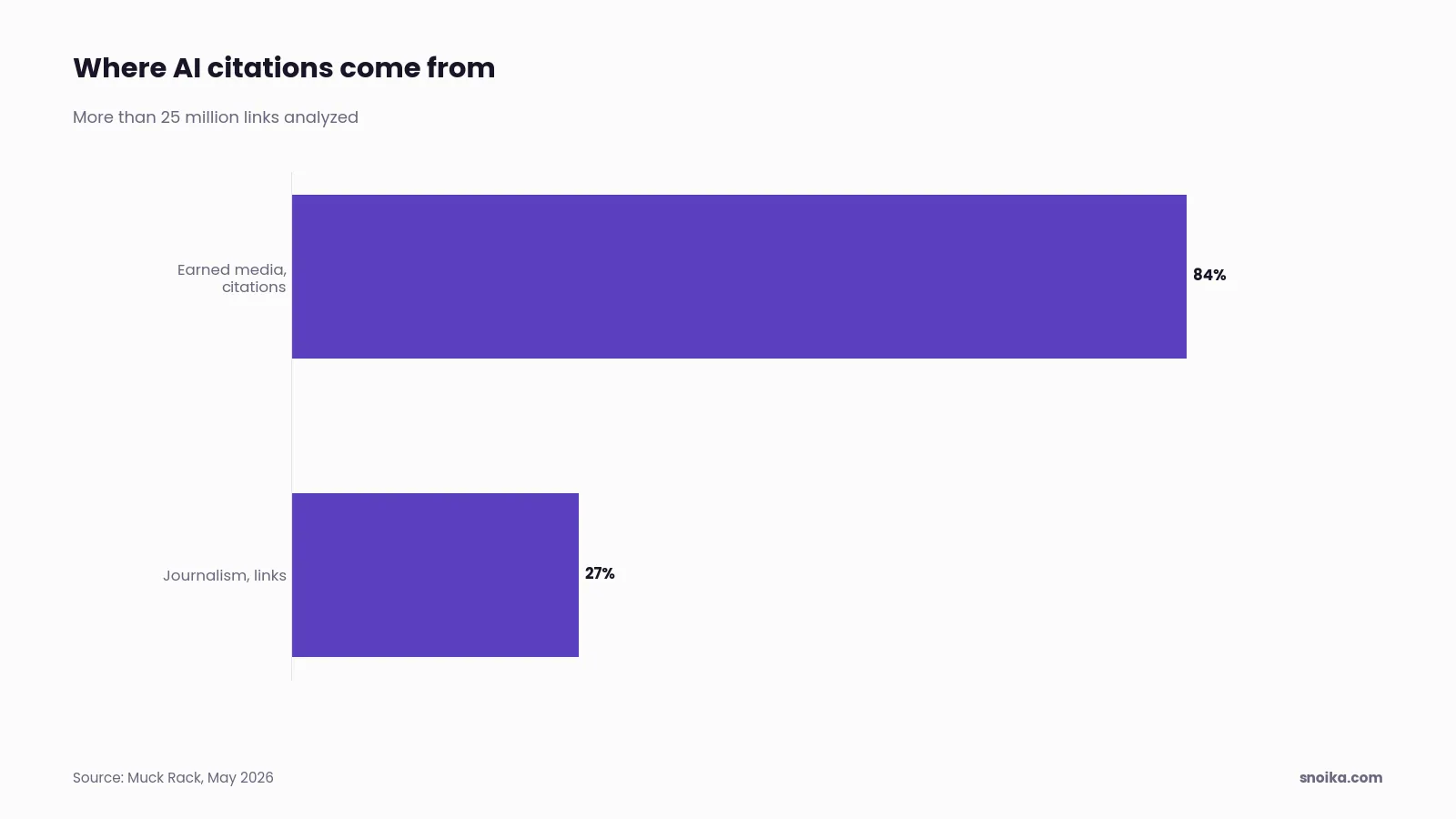
Look at the cited sources as closely as your own scores. Muck Rack's May 2026 study of more than 25 million links found that 84% of AI citations come from earned media, which consists of sources a brand doesn't own or pay for. Journalism alone made up 27% of the links. So when a competitor gets named and you don't, check which third-party domains the model cited. The mix changes by industry, and a review site that matters in software means nothing in manufacturing.
How LLMs select brands
An LLM picks brands based on what it learned during training and what it retrieves from the web when an answer needs current sources. Training favors brands that have been written about widely and consistently for years, while retrieval favors pages that answer the prompt directly and contain checkable facts. Trusted third parties also count for more than your own site.
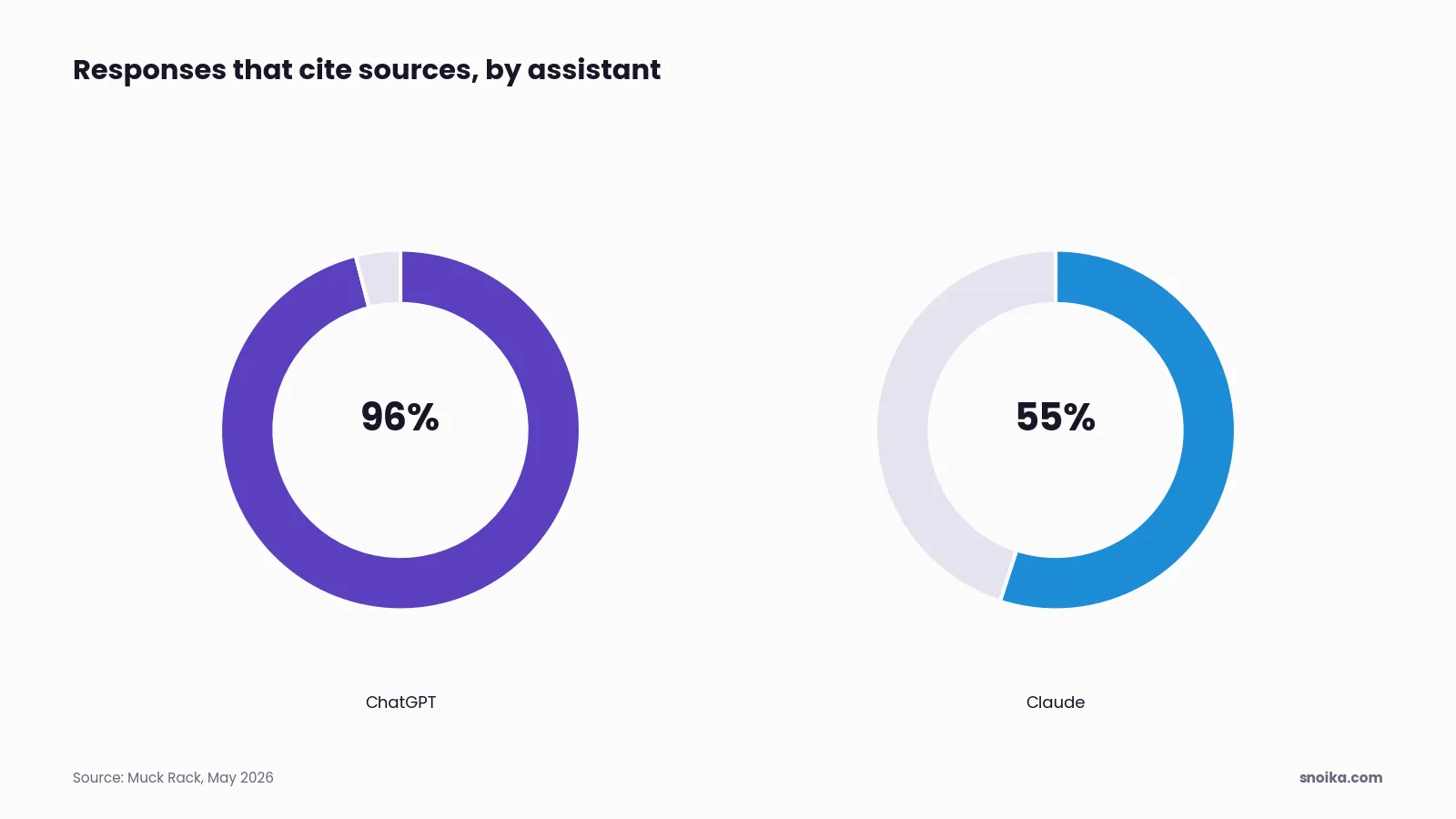
In the GEO paper from Princeton and its partners (Aggarwal et al. KDD 2024), content with added statistics and quotations boosted visibility by up to 40% in generative engine responses. The authors also found that the effect varied by subject area. Muck Rack reports that ChatGPT cites sources in 96% of its responses and Claude in 55%, so one strategy won't move every engine equally.
Check that your pricing and use cases are consistent across your site and review pages, because the model hedges or drops you when they differ.
Metrics your dashboard needs
Your AI citation share comes from four metrics, each calculated across the full prompt set over a fixed period. Use the same prompts and platforms every period, or the trend line in AI visibility tracking means nothing.
Share of voice across the prompt set
Share of voice is your brand mentions divided by all brand mentions in the tracked answers. If competitors get 300 mentions and you get 60, your share is 60 out of 360, or about 17%. Break it down by prompt group, since the overall number hides weak spots like comparison queries.
Citation rate and cited-domain share
Citation rate is the percentage of answers that cite at least one of your URLs. Cited-domain share shows which domains the model relies on for your category, and how often your own domain is one of them.
Visibility rate per platform
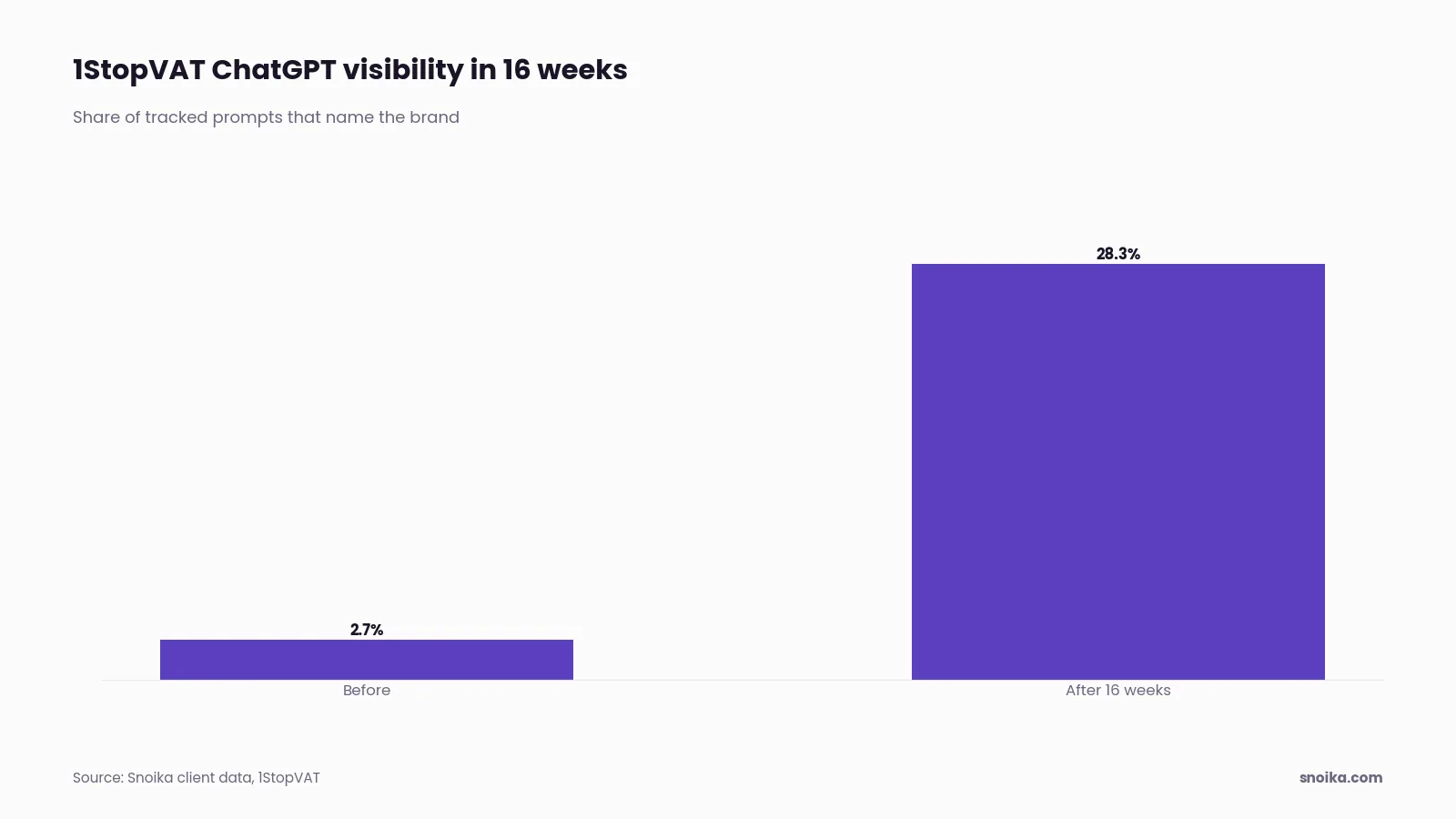
Visibility rate is the share of runs in which your brand appears at all, reported separately for each platform. The SparkToro researchers found that visibility percentage across queries holds steadier than ranking position, so lead with this number. Snoika's founder Anton Vedeshin reported to Startup Reporter 1StopVAT's move from 2.7% to 28.3% ChatGPT visibility in 16 weeks.
Sentiment and accuracy
Brand sentiment scores the tone of each mention, and accuracy flags answers that get your pricing or features wrong. A wrong fact repeated across runs is a problem that needs fixing at its source.
Gaps in social listening
Social listening can't see AI answers because those answers are never published. A model writes each response for one user in one session, so there's nothing for a crawler to collect. Listening tools measure how much people talk about a brand. A model ignores a busy forum thread and cites a two-year-old review page instead.
Forum and community posts can become sources the model cites later, so a complaint that spreads there is worth catching early. If a listening tool advertises an AI feature, ask whether it sends prompts to the models or only uses AI to summarize social posts. Only the first one monitors LLMs.
Building an LLM monitoring workflow
To monitor whether ChatGPT recommends your brand, run a fixed prompt set on a schedule and log the answers against your competitors.
- Write 50 to 100 prompts the way buyers phrase them. Include category questions and comparisons, with some prompts that request alternatives to a named competitor.
- Group the prompts by buying stage. A drop in late-stage prompts costs more than a drop in early research.
- Run each prompt several times per platform every week, with logged-out sessions so personal history doesn't skew the results.
- Save the full answer each time. Then log mentions and citations for you and each competitor, with position and sentiment recorded for each brand.
- Connect the results to your analytics so you can line up changes in AI share with branded search and direct traffic. Our onboarding asks for access to Google Analytics 4 (GA4) and Google Search Console for this reason. Google Tag Manager access is also part of that request.
- Review once a month and turn each gap into a task, such as a missing comparison page or an outdated fact on a review site.
Changing prompts halfway through a quarter is the most common way to break prompt monitoring. Add new prompts as a separate group and keep the original set fixed, so this quarter compares fairly with the last one.
Turning citations into pipeline
A citation turns into pipeline when the cited page gives the buyer a clear next step and your analytics can credit the visit. Adobe Digital Insights found that in March 2026, visitors from AI assistants converted 42% better than non-AI traffic. Twelve months earlier, the same traffic converted worse.
Through a DNS connection, we publish pages on the client's own domain. Each citation then builds up on a site the client controls, and the client approves every page before it goes live. 3DPrinterOS got to #1 visibility in ChatGPT for industry-specific queries and turned AI search into a steady source of 3–4 qualified inbound leads/day. 3DOS reached top visibility in ChatGPT for targeted queries in its industry and doubled its registered users.
To measure this yourself, set up a GA4 channel for AI referrers and add a "how did you hear about us" field to your forms. Then compare how branded search changes for the prompts you've gained.
Comparing AI brand monitoring options
The best AI brand monitoring option depends on whether you need the numbers alone or help changing them too. The table compares four common setups.
| Option | What you get | Cost (2026) | Suits | Limits |
|---|---|---|---|---|
| Manual checks | Ad hoc prompts typed by your team | Staff time | A first look at the problem | Few runs, results not comparable over time |
| Monitoring-only tool | Automated prompt runs and dashboards | Scales with prompt volume | Teams with in-house content writers | Shows the gaps but leaves the fixes to you |
| Agency | Strategy, content and reporting | $2,000 to $10,000 per month for most B2B companies | Brands without in-house capacity | Reporting depends on the agency's own tools |
| Snoika | Weekly tracking of mentions, share of voice, sentiment and citations in ChatGPT and Google AI Overviews, plus content creation and publishing | Plans on the pricing page | Teams that want tracking and the content work under one team | Plans on the pricing page |
Manual checks
- What you get
- Ad hoc prompts typed by your team
- Cost (2026)
- Staff time
- Suits
- A first look at the problem
- Limits
- Few runs, results not comparable over time
Monitoring-only tool
- What you get
- Automated prompt runs and dashboards
- Cost (2026)
- Scales with prompt volume
- Suits
- Teams with in-house content writers
- Limits
- Shows the gaps but leaves the fixes to you
Agency
- What you get
- Strategy, content and reporting
- Cost (2026)
- $2,000 to $10,000 per month for most B2B companies
- Suits
- Brands without in-house capacity
- Limits
- Reporting depends on the agency's own tools
Snoika
- What you get
- Weekly tracking of mentions, share of voice, sentiment and citations in ChatGPT and Google AI Overviews, plus content creation and publishing
- Cost (2026)
- Plans on the pricing page
- Suits
- Teams that want tracking and the content work under one team
- Limits
- Plans on the pricing page
Start with manual checks if you only want to confirm a problem exists. Choose a monitoring-only LLM SEO tool if you have writers ready to act on the data. If you'd rather buy the work along with the data, compare an agency retainer with an AI visibility tool that runs both on the same terms, and look at prompt volume per euro.
Next steps
Build a baseline this week, before you change any content. Without a fixed prompt set and four weeks of runs, you won't be able to show that later improvements caused a change in AI share. Save the baseline export and keep it, since it's the number future reports will compare against. We run AI brand monitoring on weekly prompt sets and create the content that closes the gaps it finds, with a human review layer on top of automated workflows. To see your own baseline across ChatGPT and Google AI Overviews, book a demo.
FAQ
The best fit depends on whether you need reporting alone or help updating content. Compare ai brand monitoring tools by prompt volume and platform coverage. Check that they run prompts against models rather than only summarize social posts, and compare costs per tracked prompt.
Run the same 50,100 buyer prompts several times each week in logged-out sessions, saving every answer. Record whether your brand is recommended and where it appears against competitors. Compare visibility across repeated runs rather than treating one recommendation as evidence of consistent coverage.
AI monitoring measures what models tell buyers, while surveys measure what people remember or prefer. Use both when you need to compare customer perceptions with AI recommendations. A strong survey result doesn't establish that models include your brand in buyer shortlists.
Citation rate and cited-domain share show how often answers use your pages and how your domain compares with other sources. Keep these separate from mention-based visibility, since being named doesn't mean being cited. Compare results using the same prompts and platforms each period.
Collect four weeks of runs using a fixed prompt set before changing content, and save the baseline export for later comparisons. If you need to add prompts during monitoring, track them as a separate group so the original results remain comparable.


