AI Brand Mention Tracking Limits: What to Know Before You Invest

Content authorArtem Lozinsky, EMBA, MScPublished onReading time11 min read
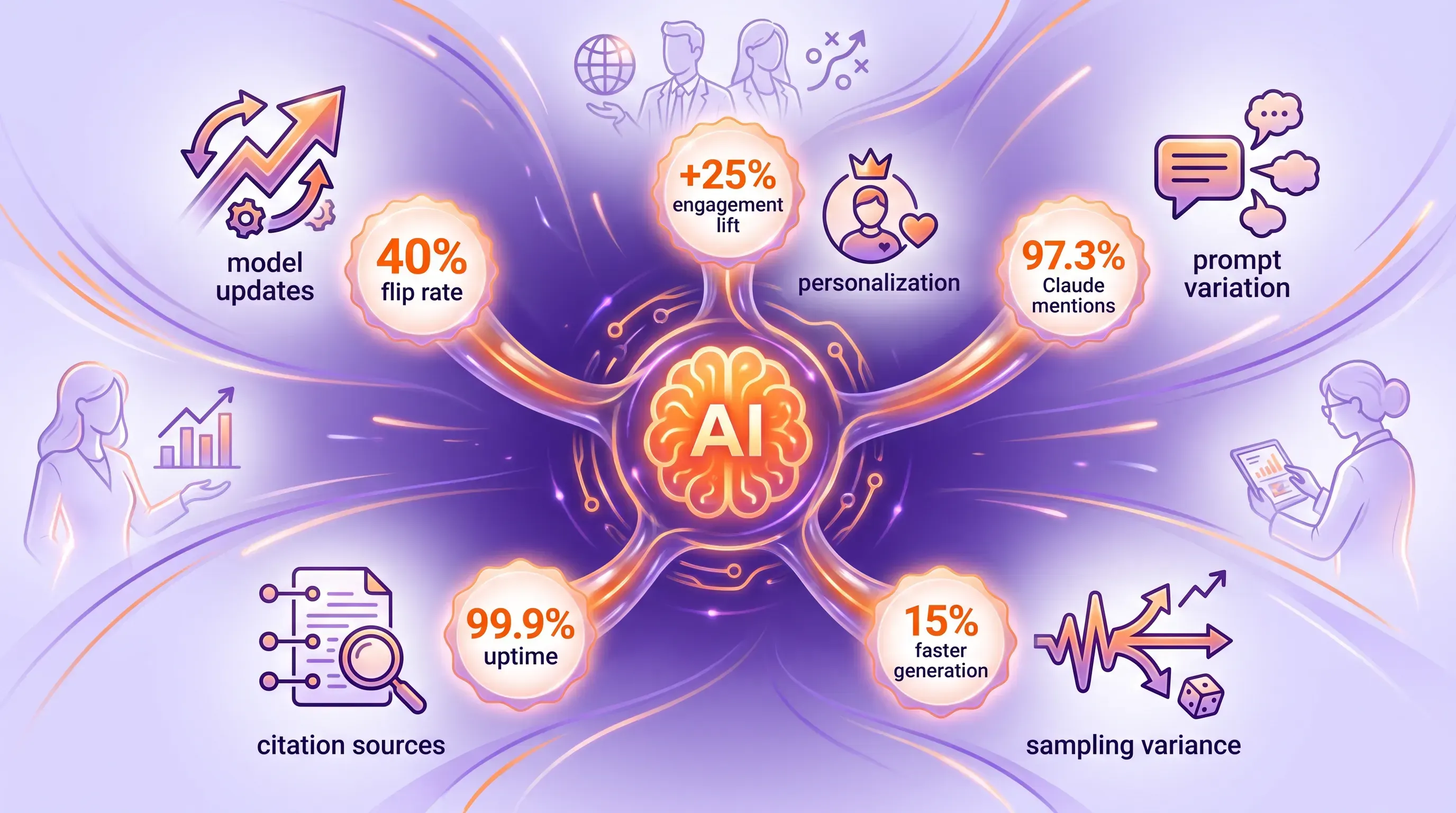
A vibrant illustration featuring a glowing AI-brain icon at the center, surrounded by dynamic line icons and luminous badges in deep violet hues.

AI brand mention tracking reliably shows you directional trends and relative presence over time. AI answers can differ between identical runs. They also personalize by user and change after model updates, so treat these numbers as confidence ranges and never report a single snapshot as fact.

What can AI mention tracking actually measure?

These tools measure the direction your brand is moving and how you sit against competitors. That distinction matters more here than it ever did in search, because a keyword ranking sits still between checks while an AI answer redraws itself every time someone asks. You came from a world where position 4 meant position 4 until Google changed it. This is not that world.

The gap is already visible in how the market behaves. Only 14% of marketers track AI citations while 43% call AI search optimization a core 2026 strategy, according to Digital Applied's share-of-voice framework. The work has run ahead of the measurement.

So the honest read is this. If you buy one of these tools expecting the clean, auditable number your rank tracker gave you, you'll either distrust the whole category the first time the figure jumps, or worse, you'll defend a number to leadership that can't survive a re-run. Buy it for the trend line and the competitive gap. That's what holds up.

Why do AI answers change every time you ask?

The same prompt returns different brands on repeat runs because these models generate text by sampling from a probability distribution rather than reading from a fixed table. Temperature and top-p introduce variation, as does the model's own token-by-token guessing, so a single answer reflects only one draw from the distribution. Even the machine's floating-point math shifts slightly between servers.

Researchers at Stanford and UC Berkeley put numbers on how unstable this gets. In one longitudinal study, some models changed their final recommendation on an identical, repeated prompt up to 40% of the time, as reported in the Journal of General Internal Medicine. Same input, different answer, four times out of ten.

Here's what that means for a report with one number in it. If a mention count can flip 40% on a re-run, then any figure you pulled from a single pass is one coin toss dressed up as a measurement. More passes are the fix, which is a point I'll come back to when we get to reporting.

How much does personalization skew results?

A tracking tool almost never sees what your actual customer sees, because AI answers bend to account history, location, and whether the person is logged in. The tool runs in a clean, neutral environment. Your buyer runs inside months of their own search behavior.

Google spells this out for its own systems. Personalized recommendations can reorder results based on a signed-in user's Search history, and location from past sessions refines what surfaces. The same logic drives the AI answer layer.

So when a tool reports you're absent from a category answer, read it as absent in a vacuum. A logged-in customer in your service area, with your brand in their history, will see you fine. Neutral-environment data provides a floor for evaluating the lived experience.

How do model updates reset your data?

Vendors ship model updates that move outputs overnight, which breaks your historical trend without any warning label. A sudden drop in visibility reflects a model change underneath you while your content retains its ground.

The Stanford and Berkeley team documented how sharp these swings can be. GPT-4's accuracy on one classification task fell from 84% to 51.1% between the March and June 2023 versions, per DeepLearning.AI's summary of the study. Nobody told users the behavior had shifted.

The practical lesson is to annotate your timeline the day a major model version lands. Because if you don't mark it, you'll spend a Monday explaining a cliff in the chart that has nothing to do with the work your team did. A discontinuity in the data is not always a discontinuity in your performance.

Need help with your AI visibility?

Book a free consultation with our experts we'll help you determine exactly which services your organization needs.

Why does prompt wording change everything?

Small changes in how a test prompt is phrased pull up different brands, which means your results partly reflect the prompt library the vendor chose rather than pure visibility. "Best project management tool" and "cheapest project management tool" return different lists, and both are reasonable things a buyer types.

There's a limit to the chaos, though, and it's worth knowing. Peec AI analyzed 37,804 AI responses across five engines and found brand visibility stayed stable as long as prompts held above roughly 0.50 to 0.60 cosine similarity, as covered by Search Engine Journal. Wording only wrecks the results when the core intent drifts.

So ask a vendor which intents it tracks and whether you can edit them. If the prompt set doesn't match how your buyers actually ask, you're measuring someone else's category, cleanly and repeatably, and it still won't be yours.

Where does attribution break down?

Attribution breaks the moment an AI recommends you without a clickable link, because most mentions never become a trackable session. The model says your name, and the user later acts on it through a branded search or a direct visit. Your analytics then credit the wrong channel or no channel at all.

The link rates make the scale of the blind spot concrete. ChatGPT includes external links in about 31% of responses while Claude mentions brands in 97.3% of answers with essentially zero links, per AuthorityTech's February 2026 study cited by Ekamoira. A model can talk about you constantly and hand you nothing to measure.

That gap is exactly where you should push hardest on a vendor. Any tool promising clean revenue attribution from AI mentions is either quietly modeling an estimate or counting the thin sliver of linked traffic and calling it the whole picture. Treat a confident dollar figure as a claim that requires verification. The honest version of this metric is influence, and influence doesn't reconcile neatly against a pipeline report.

Can you trust the citation sources a tool reports?

Citation data is useful for pointing your content in the right direction, but you shouldn't treat it as a definitive record of what the model actually read. Some tools infer or approximate which sources fed an answer rather than capturing them at the source, so the list is an educated reconstruction more than a receipt.

The underlying accuracy problem is real even before the tooling layer. A 2023 Allen Institute for AI study found that LLMs correctly attribute factual claims 58% of the time without retrieval assistance, as summarized by Hexagon. The model itself isn't a reliable narrator of its own sources.

This gives you direction for content decisions. If a tool keeps surfacing a competitor's comparison page or a particular Reddit thread as a likely source, that's a strong signal about where to invest content. Use it to decide what to write. Just don't put "the model cited us from page X" in a board deck as established fact, because the citation layer is a best guess sitting on top of a model that misattributes four claims in ten.

How repeatable are the numbers for reporting?

A single measurement is not repeatable enough to report, and only aggregated sampling across many runs and prompts produces figures stable enough to defend. This follows directly from the sampling variance and the up-to-40% answer flips covered earlier. One pass is noise. A distribution is signal.

Before you present anything to leadership, structure the measurement so the number can survive a challenge:

That 12% overlap carries a quiet warning for any executive summary. A blended "AI visibility score" that averages across engines hides more than it shows, because the engines barely agree on who to cite. Report per-model, report a confidence range, and your numbers will hold up in the room. Report a single cross-model figure and someone will re-run it and catch you out.

Need help with your AI visibility?

Book a free consultation with our experts we'll help you determine exactly which services your organization needs.

What should you trust, caution, or ignore?

Trust directional and relative numbers. Apply caution to anything personalized or cross-model, and ignore exact counts and clean revenue claims entirely. That three-way split is the whole discipline, and it maps cleanly onto everything above. The industry's own habits show why the framework matters: 40 to 60% of cited domains shift month to month in active categories, per Digital Applied, which is why a single snapshot lies and a trend line tells the truth.

The point of sorting metrics this way is to protect your own credibility. The fastest way to lose a leadership team's trust in AI visibility work is to report one impressive number they later can't reproduce. Sort every metric into the right column before it ever reaches a slide.

What can you reliably monitor?

You can act on directional movement over time and on your competitive share of voice within a consistent prompt set. Recurring sentiment or accuracy problems also belong here, since a model that keeps describing your product wrong will do it across runs, which makes the pattern dependable even when any single answer isn't.

These hold up because they're built from many observations rather than one. Digital Applied's framework defines AI share of voice as the percentage of answers that mention or cite your brand across a defined prompt set, measured against all brand mentions in those same answers. Relative always beats absolute here. You can't trust the raw count, but you can trust that you moved from third to second against the same rivals on the same questions.

What needs caution before reporting?

Citation attribution and personalized or geo-specific results need a caveat and manual spot-checking before they leave your desk. Comparisons across different AI models need the same treatment. Each one carries a known distortion covered earlier, from inferred sources and neutral-environment blindness to engines that barely cite the same pages.

The cross-model case is the one that trips people up most. Since Perplexity includes external links in over 77% of responses while ChatGPT does so far less often, per LLM Pulse, a brand can look strong on one engine and invisible on another for reasons that have nothing to do with content quality. Verify by hand before you let any of these numbers imply a conclusion.

What should never be treated as definitive?

Exact mention frequencies and direct revenue attribution should stay out of formal reporting completely. So should any conclusion drawn from a single run. A claim that collapses on re-run is a liability.

The evidence for this sits in the variance itself. When identical prompts flip a model's recommendation up to 40% of the time, as the Journal of General Internal Medicine documented, an exact count from one pass describes that one pass and nothing beyond it. If a metric can't be reproduced within a defensible range, don't attach your name to it in a document leadership will hold you to.

How do you set goals before you buy?

Define the decision that tracking has to support before you pick a tool, and write down the validation criteria you'll hold the results to. Working backward from a decision keeps you from buying a dashboard full of numbers you've already learned not to trust. Ask what you'd actually do differently if share of voice fell, and let that answer shape the whole purchase.

A workable pre-purchase checklist looks like this:

  • Name the specific decision the data will drive, such as where to point content investment next quarter.

  • Set your validation bar so it defines the required runs for each prompt and the confidence range that makes a number reportable.

  • Confirm the tool separates mentions from linked citations and lets you edit the prompt set.

The part most tools skip is what happens after the gap is found. Knowing you're absent from a category answer is only useful if something closes that gap. Snoika is an AI visibility platform built for that second step. It combines visibility monitoring with execution across SEO and generative engine optimization (GEO) content, so the workflow lets you understand and fix a gap once you spot it. Before you commit budget anywhere, write down the decision your tracking must serve, and choose the approach that turns raw mention data into action rather than another number to caveat.

Need help with your AI visibility?

Book a free consultation with our experts we'll help you determine exactly which services your organization needs.

Set a target only after you have a baseline from repeated runs with an unchanged prompt set on one model. Compare matching reporting periods, then use the observed average and range to define improvement. A target based on the first dashboard reading turns ordinary output variation into a performance commitment.

Test a vendor with a fixed set of prompts that reflects buyer intent, then ask for repeat runs of the same set. Review the raw answers beside the summary metric. If the vendor can't show its prompt set, model choice, and range of results, you can't assess whether the dashboard measures your category.

Keep a small control set of stable category prompts and run it on the same schedule as your brand prompts. If both sets shift at once after a documented model release, treat the movement as a platform effect first. Investigate content or competitor changes only after that check.

Revise the prompt set when buyer language, product categories, or the decision you need to support has changed. Mark the revision date and start a new comparison baseline. Don't compare results from the revised set directly with earlier results, because the questions now test different intent.

Save the raw answer with a record of the test settings. The record should identify the exact prompt text and model version. Keep these records for every reporting period, because they let your team rerun disputed results and explain whether a change came from the test or the model.

Schedule a Meeting

Book a time that works best for you

You Might Also Like

Discover more insights and articles

Minimalistic SaaS marketing illustration featuring a central ChatGPT icon with a violet background, brand icons interacting with a filter, and an auditor icon.

Why ChatGPT Mentions Competitors Instead of Your Brand: A Visibility Gap Audit

ChatGPT names competitors instead of your brand when it can't confidently identify your company and connect it to the prompt's category with sources it trusts. Some of that absence is random sampling. The rest is a real evidence gap, and you can separate the two by testing the same prompts repeatedly and recording what comes back.

Hand-drawn wireframe flowchart on notebook paper showing AEO implementation workflow for ecommerce product pages with annotated icons.

How ecommerce teams implement AEO for product pages

This article gives you an ordered AEO workflow for making product pages readable and quotable inside AI answers. It covers crawler access and server-rendered facts. Schema and feed alignment then lead into content rewrites and citation tracking. The sequence matters more than any single fix.

Title:
15 best AI tools for SEO ranked for content keywords and competitors

Meta description:
Compare the best AI tools for SEO so you can find keyword gaps and analyze competitors without extra tool

15 best AI tools for SEO ranked for content keywords and competitors

This article ranks 15 best AI tools for SEO based on two jobs: finding worthwhile content keywords and exposing competitor openings. Each entry names one differentiator and the team it suits. Its limitation fixes its place, so you can pick one primary platform and add a specialist only when the data demands it.

A vibrant SaaS marketing visual featuring a central AI hub with glowing icons for ChatGPT, Claude, and Google AI, surrounded by citation nodes and traditiona…

Why ai citations reshape search visibility in 2026

This article explains why a page that ranks well in Google can still go missing inside AI answers, and what that means for ai brand monitoring and how you measure visibility now. It walks through how the major answer engines diverge and why generative engine optimization sits on top of your existing SEO. It also identifies where to start once ranking stops being the finish line.