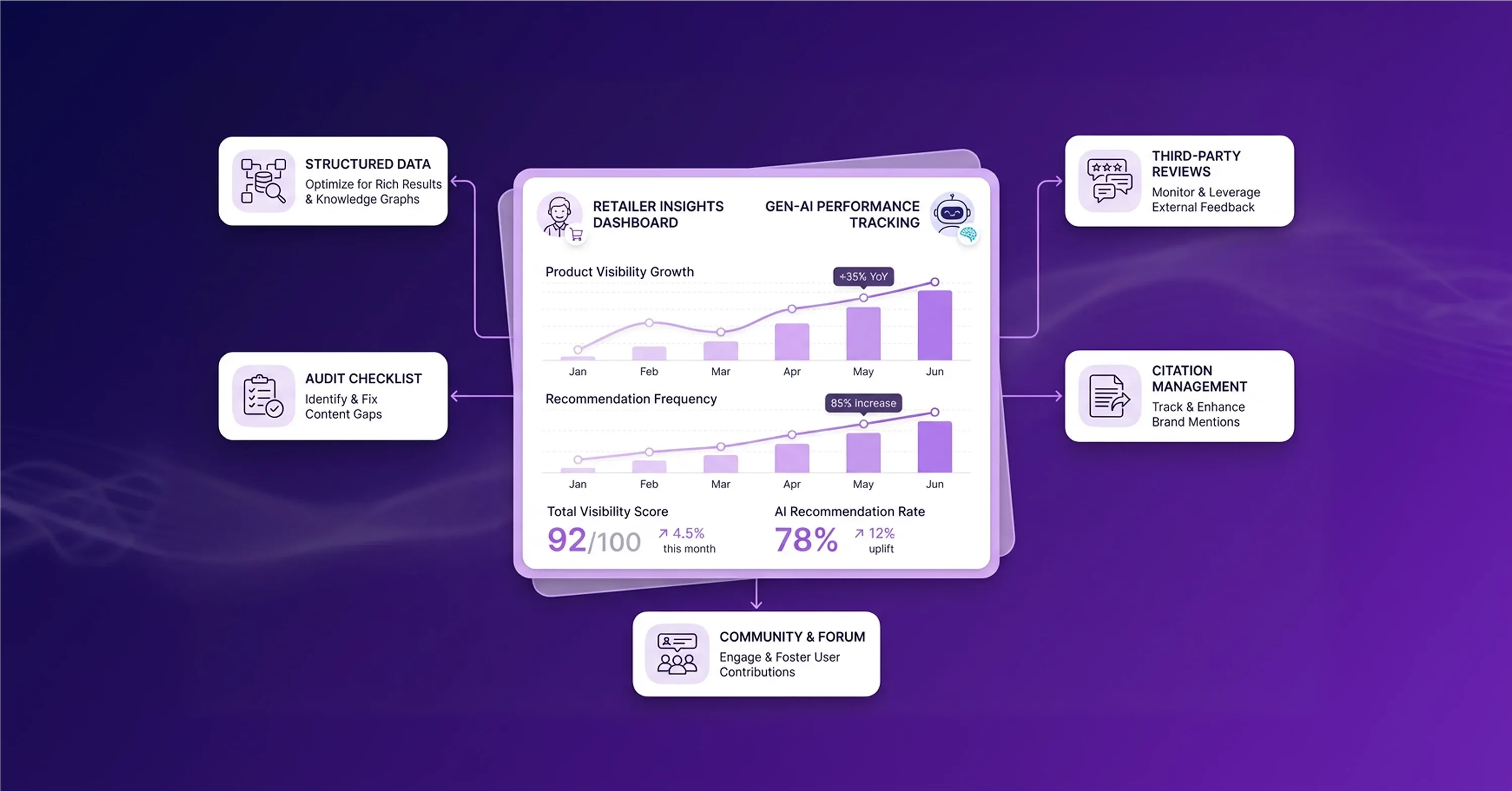
Retailer insights dashboard showing AI performance tracking, product visibility growth, recommendation rates, and structured data, reviews, and citation management inputs

AI Visibility For Ecommerce: Guide To ChatGPT Product Recommendations

In this article, we explain how to structure product feeds and use third-party reviews to secure product recommendations in generative AI shopping assistants. We discuss the shift to agentic commerce and provide strategies to maintain organic visibility.

Content authorArtem Lozinsky, EMBA, MScPublished onReading time9 min read

Introduction

Generative artificial intelligence shopping assistants have changed how consumers find and purchase products online. Historically, shoppers scrolled through search engine results pages to compare items and read reviews before making a decision. Today, shoppers bypass traditional search engines and ask chatbots for direct recommendations. Adobe research shows that AI referral traffic to retail sites recently grew 12-fold, and this growth marks a shift toward zero-click agentic commerce. OpenAI's new shopping experience relies on structured data to suggest items. However, many retailers struggle to adapt their product data for these AI platforms and risk losing market share. Retailers need to understand AI visibility for ecommerce if they want to reach buyers in this new environment. They can ensure that their brands remain competitive by adapting product feeds for agentic platforms. We will examine how ChatGPT's recommendation engine works and explore strategies for building off-site review consensus.

Shift to Agentic Commerce

Before retailers can build off-site review consensus, they must navigate a transition from traditional search habits to zero-click agentic commerce. These merchants see shoppers increasingly bypassing standard search engines and relying on generative artificial intelligence assistants to find products. Retailers must change how they position their catalogs online to adapt to this shift. Generative models act as active agents that curate options, evaluate features, and recommend specific items directly to consumers. OpenAI introduced the Agentic Commerce Protocol to facilitate this new shopping experience. This protocol serves as a standardized language that allows language models to read and process product catalogs accurately.

Retailers must integrate with this protocol to appear in direct ChatGPT shopping interfaces. They recognize that traditional search engine optimization tactics focus on category-page keywords and backlink profiles, whereas agentic commerce requires clean, structured data feeds. These companies must adapt their infrastructure to meet these new technical requirements. Retailers can establish authority in the generative space and ensure that AI models fetch real-time pricing and inventory data when they integrate with this protocol. Some merchants use specific SEO optimization tools to translate their existing catalogs into agentic-friendly formats. Brands that adopt these protocols early gain an advantage over competitors that rely solely on traditional search traffic.

How ChatGPT Recommendation Engine Works

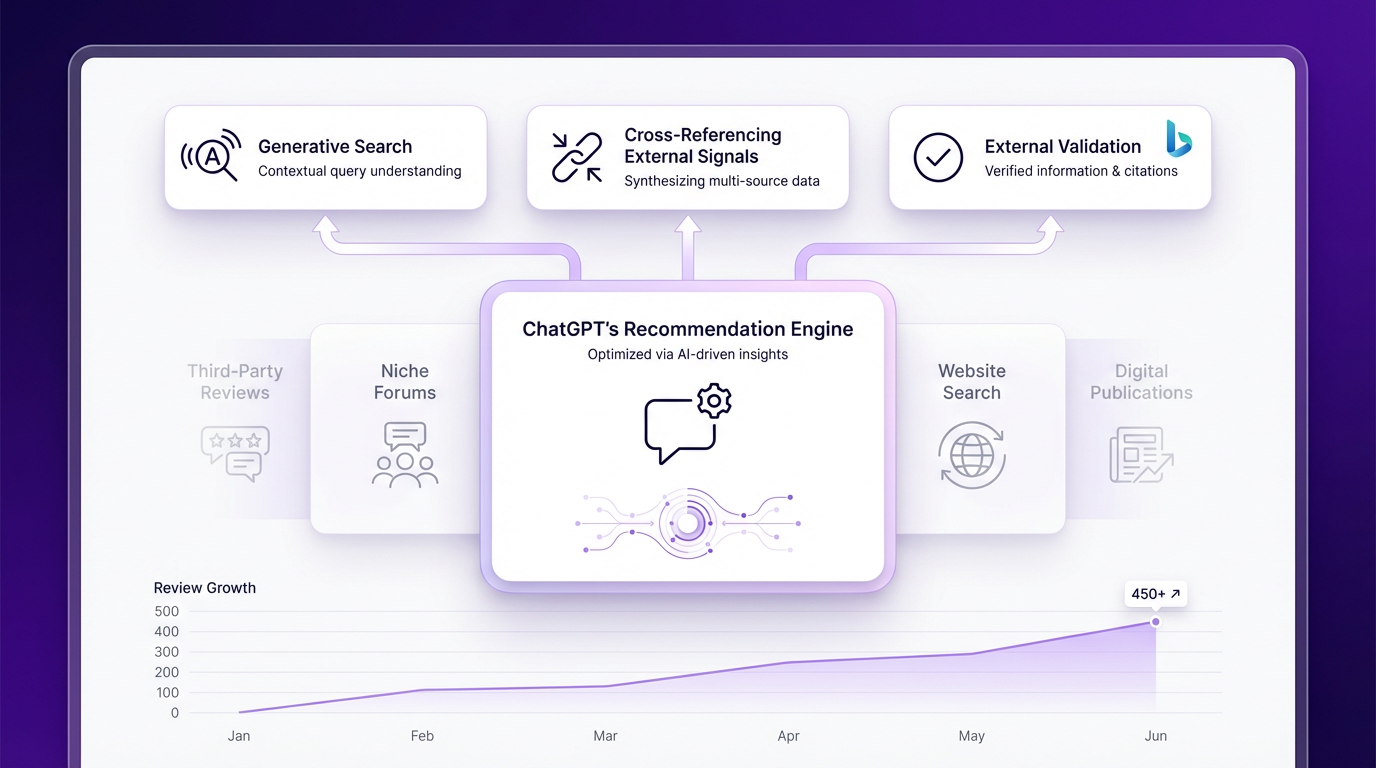
A vibrant SaaS analytics scene featuring a central UI card for ChatGPT, connected to three smaller cards, set against a deep purple gradient.

While competitors rely on traditional search traffic, language models like ChatGPT use mechanisms that differ from those of traditional search crawlers to evaluate and suggest items. These generative assistants do not crawl individual product pages to count keywords. Instead, ChatGPT relies on Bing's search index to cross-reference external signals and establish product consensus. The model looks for proven items that appear consistently across multiple reputable sources. This cross-referencing process determines product discoverability in the generative search environment. Generative search performance improves when retailers follow a specific three-step sequence. First, retailers audit third-party review platforms to gauge initial user sentiment. Second, they analyze niche forums to confirm community consensus about product quality. Third, these companies pitch digital publications to secure product awards and editorial mentions.

When generative models receive a prompt, they synthesize these external signals to deliver a unified recommendation with clarity. These models require external validation to confidently suggest a product to a shopper. Retailers build a strong off-site review footprint to influence these generative suggestions. These companies often adjust their top search optimization strategies to focus on third-party consensus rather than isolated on-site metrics. Ultimately, the model rewards products that possess a verifiable presence across the broader internet.

AI Visibility For Ecommerce Through Data Audits

Generative models combine this verifiable presence with accurate data inputs to formulate helpful responses for consumers. Retailers establish AI visibility for ecommerce when they format their product catalogs into structured, machine-readable feeds. Platforms struggle to interpret product specifications, pricing, and availability without structured data. This technical gap prevents models from recommending relevant items during conversational search queries. Brands require a reliable strategy to organize their inventory data for these modern systems.

Regular data audits help retailers identify missing attributes and fix formatting errors before the data reaches the language model. During a data audit, retailers review product titles, update technical specifications, and standardize category classifications across the catalog system. This thorough review helps ensure that the language model interprets the brand's offerings correctly. Structured information acts as the foundational layer for generative recommendations. According to Yext, brand-influenced sources generate 86% of AI citations across major language models. This data indicates that companies maintain significant control over how platforms perceive their products. Consistent data formatting allows retailers to dictate the core facts that models use when answering consumer queries.

Feed Structure For AI Models

Retailers define these core facts when they use structured attributes to give language models the context they need to match specific products to complex user questions. Consumers often prompt chatbots with specific parameters. For example, a shopper might ask for running shoes for flat feet under a certain price. Models cannot answer these granular requests if the brand's feed lacks detailed, structured tags for arch support and price points. Retailers categorize inventory accurately when they attach descriptive metadata to every product identifier. This precise categorization bridges the gap between human language and machine understanding. Retailers build a stronger foundation for ecommerce SEO when they organize these granular details effectively. Thorough product feed optimization requires retailers to explicitly define materials, use cases, and compatibility features. Generative assistants process these defined attributes to filter options and select the most relevant match for the shopper.

Ecommerce SEO and Brand Citation Control

As generative assistants process these defined attributes, language models also construct their understanding of a brand by aggregating mentions from across the internet. Retailers maintain control over their product narrative when they actively manage these external citations. A modern search visibility approach requires companies to monitor how their products appear in press releases, partner websites, and digital directories. Inconsistent product names or outdated specifications on third-party sites confuse generative algorithms and reduce the likelihood of a recommendation. Retailers protect their brand integrity when they synchronize product details across all external touchpoints. This synchronization ensures that the language model receives a unified message regardless of which source it pulls from during a query. Companies update their public knowledge bases and affiliate networks to reflect the most accurate product specifications. Consistent citations signal authority to the platform and reinforce the structured data that the main product feed provides.

Review Consensus Across Platforms

Consistent citations reinforce the main product feed, but brands gain deeper external validation from consumer discussions, allowing language models to recommend items with greater confidence. Brands improve product discoverability when they encourage buyers to share their experiences on platforms like Reddit and Quora. These companies know that generative assistants scan these community forums to determine whether an item meets consumer expectations. Brands build credibility when they cultivate a presence across decentralized discussion boards. Companies that optimize ecommerce website infrastructure must also focus on generating positive off-site conversations. A brand might offer a product with precise technical specifications, but the algorithm may ignore it if no one talks about it online.

Brands implement specific tactics to encourage user-generated content across niche review sites:

  • Brands send follow-up emails asking buyers to post reviews on industry-specific forums.

  • Companies host community Q&A sessions on Reddit to answer technical questions about new inventory.

  • Customer service teams respond directly to complaints on public review platforms to demonstrate accountability.

  • Brands partner with forum moderators to offer verified-purchase badges for active community members.

These user-generated signals teach the algorithm that real people use and endorse the item. Large volumes of authentic discussion improve product discoverability across generative platforms. These positive community interactions help guide the language model to aggregate this data and link it directly back to the manufacturer's catalog.

Stable Visibility Against AI Inconsistency

Retailers maintain this direct link to their catalog and secure AI visibility for ecommerce when they adopt a different mindset from the one they use to rank on traditional search engine results pages. Companies know that traditional search engines display static links that rarely change. They also recognize that generative chatbots produce dynamic responses that can vary even for identical prompts. Brands can look to SparkToro research showing that ChatGPT responses have less than 1% consistency when users ask the same question multiple times. Retailers must adapt to this inconsistency and rethink how they approach ecommerce SEO. These companies cannot treat an artificial intelligence assistant like a static webpage that locks an item into a permanent top position.

Brands achieve greater stability in generative recommendations when they surround the model with proof of quality. They establish this baseline when they combine high-quality data structuring with widespread off-site signals. These companies receive more frequent recommendations when their structured product feed aligns with the positive sentiment found on external review sites. Brands improve the likelihood of consistent recommendations even when the algorithm generates different conversational outputs. Retailers maintain AI visibility for e-commerce when they build a digital footprint that the language model can detect. Companies use this widespread presence to prevent the chatbot from replacing their brand with a competitor. Over time, these businesses see greater consistency in platform suggestions because every data source points toward the same conclusion.

Conclusion

To summarize, retailers achieve this consistency and optimize for ChatGPT when they build clear third-party consensus and create clean, machine-readable product feeds. AI visibility for e-commerce remains crucial for retailers that want to capture high-intent shoppers and bypass traditional search traffic. As platforms shift toward agentic protocols, generative models will increasingly determine which brands succeed in the digital marketplace. An effective AI for ecommerce strategy helps retailers adapt to these changes. Retailers stay competitive when they audit their off-site review footprint and structure their catalogs for agentic protocols.

You don't need a large budget to optimize your feeds. You can start by manually auditing your current data and correcting basic formatting errors. Small teams often achieve strong results when they build authentic customer relationships that naturally generate positive online discussions.

You'll typically see changes in recommendations a few weeks after you update your catalog. The language models need time to process your structured feeds and cross-reference new external mentions. You must maintain consistent product information across all platforms to speed up this discovery process.

You shouldn't limit your focus to just one platform because buyers use multiple tools to shop. Snoika helps businesses improve their ai visibility for ecommerce across diverse search engines like Perplexity and Gemini. You reach more customers when you optimize your content for all major AI assistants.

You must respond professionally to any complaints you find on public discussion boards. Language models process both positive and negative sentiments when evaluating products. You protect your brand narrative when you acknowledge the problem publicly and offer a solution to the unhappy buyer.

These formatting strategies work well for businesses of any size. A small catalog allows you to monitor third-party discussions closely and manage your data with precision. You can build strong external consensus quickly when you only have a few products to promote.

Schedule a Meeting

Book a time that works best for you