SaaS content marketing: a bottom-funnel playbook for pages that convert
SaaS content marketing helps software buyers choose a product through published pages and judges those pages by the pipeline they create. A bottom-funnel playbook starts with readers who are already comparing tools, through comparison and alternatives pages. It moves up to category education only after those pages convert. Traffic still counts as a way to generate demos and trials from people who arrived with a buying question.
 Artem LozinskyOperations and product, Snoika · 7 min read


























Bottom-funnel pages come first
In a bottom-funnel-first strategy, your first pages answer the searches people type when they're close to choosing. Those searches look like "[competitor] alternatives" and "[your tool] vs [competitor]". Buyers also search for "best [category] software" and "[category] for [use case]". Top-of-funnel explainers wait until these pages exist and convert.
Grow and Convert, a content agency that works with B2B SaaS companies, has the clearest data behind this order. It tracked 2 years of posts for its client Geekbot. Bottom-funnel posts converted at 4.78% against 0.19% for top-funnel posts. The top-funnel articles drew about 7 times more visits (204,303 against 28,190). Yet the bottom-funnel set produced 1,348 of the 1,745 trial signups.
Comparison and alternatives pages
These pages convert best because the searcher already knows the category and the main players. Grow and Convert found that comparison and alternatives keywords had an average 8.43% conversion rate, the highest of any keyword type it measured. The pages that earn that rate admit where a competitor is the better pick. Buyers can tell when a "vs" page is a sales sheet in disguise, and they leave.
Category and use-case pages
"Best [category] software" searches come next. The same agency reported an average conversion rate of 4.85% for category keywords. Use-case and integration pages, such as "[category] for agencies" or "[your tool] with Salesforce", belong in this tier too. A SaaS content writer can only write them well after using the product and sitting in on sales calls, because the buyer's real question is whether the tool fits their setup.
What SaaS content strategy means
SaaS content strategy is the decision about which buyer questions you answer and in what order. Each page has one job tied to a funnel stage, and that stage sets its priority. If you want the strategy that builds the most pipeline, rank work by how close the reader is to buying. Start where conversion rates are highest, then move up.
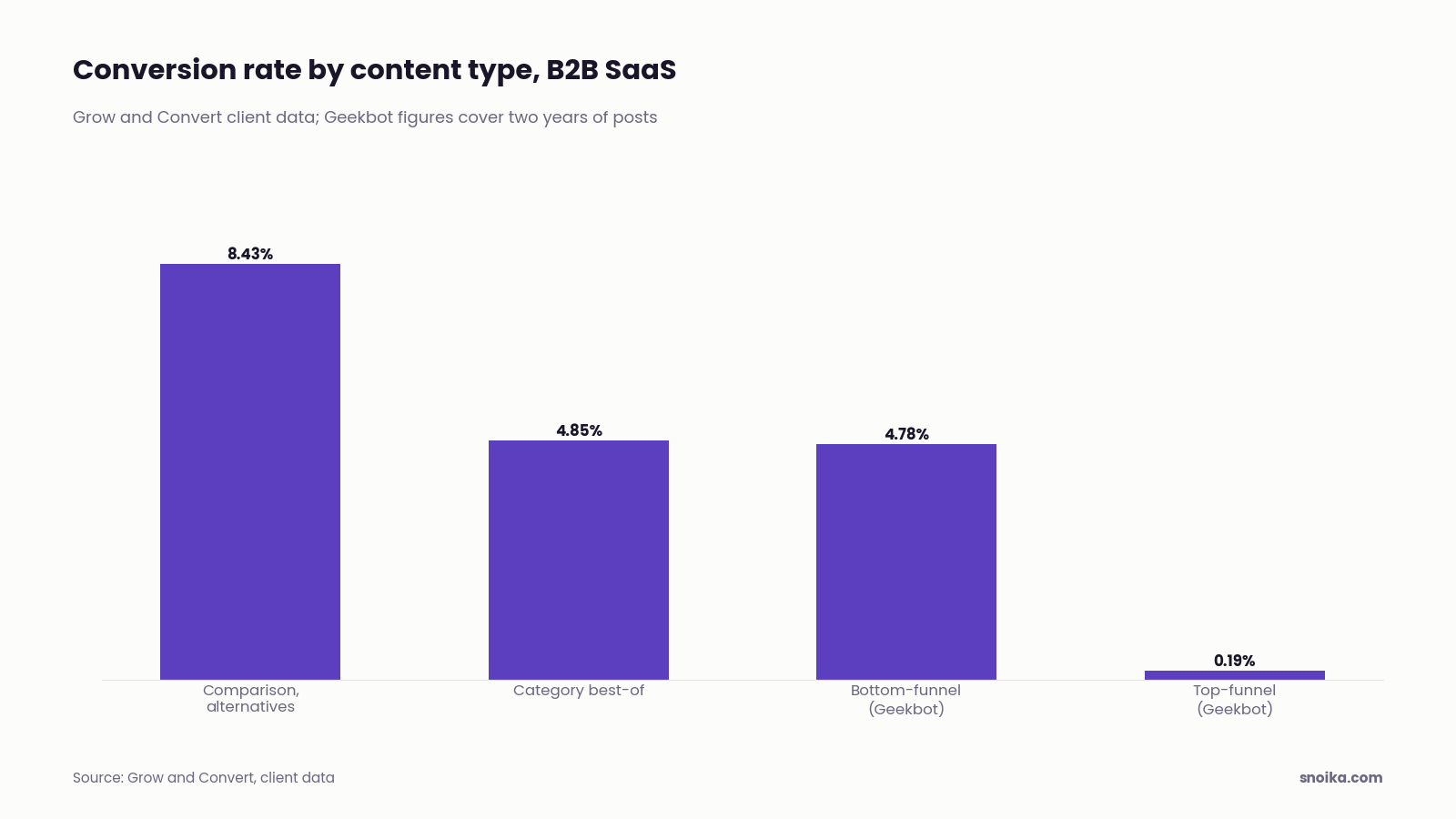
The figures below come from Grow and Convert's client work, cited above.
| Content type | Example search | Reported conversion rate | When to build |
|---|---|---|---|
| Comparison and alternatives | "Asana alternatives" | 8.43% average | First |
| Category "best of" | "best project management software" | 4.85% average | First |
| Bottom-funnel posts overall (Geekbot) | Pain-point and product-led topics | 4.78% | First |
| Top-funnel education (Geekbot) | "how to run better standups" | 0.19% | After bottom-funnel pages convert |
Comparison and alternatives
- Example search
- "Asana alternatives"
- Reported conversion rate
- 8.43% average
- When to build
- First
Category "best of"
- Example search
- "best project management software"
- Reported conversion rate
- 4.85% average
- When to build
- First
Bottom-funnel posts overall (Geekbot)
- Example search
- Pain-point and product-led topics
- Reported conversion rate
- 4.78%
- When to build
- First
Top-funnel education (Geekbot)
- Example search
- "how to run better standups"
- Reported conversion rate
- 0.19%
- When to build
- After bottom-funnel pages convert
Read these numbers as a direction. One agency's clients aren't your market, and your rates will move with price point and with whether you offer a free trial. Check that every planned page has a next step that fits its stage. A comparison page should offer a trial or demo. An educational article should point to a related comparison or use-case page for readers who are still preparing for a sales call.
Category education builds demand
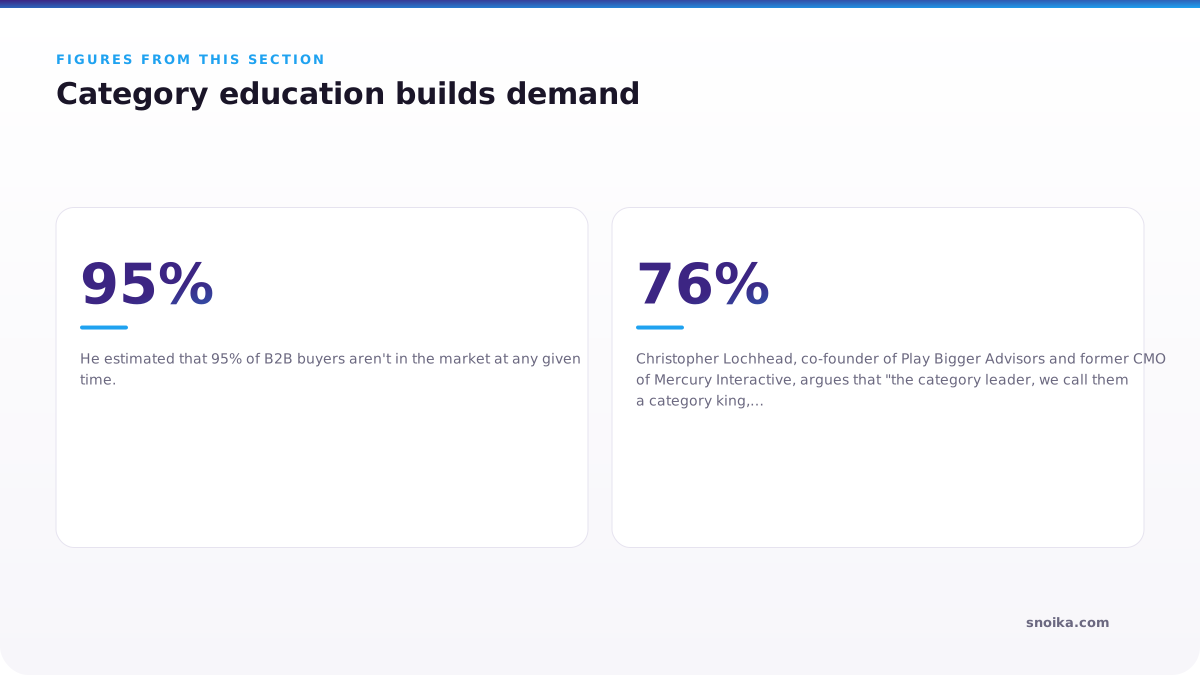
Category education builds demand because it teaches future buyers the problem, and the words for it, before they start shopping. Professor John Dawes of the Ehrenberg-Bass Institute studied this for the LinkedIn B2B Institute. He estimated that 95% of B2B buyers aren't in the market at any given time. Bottom-funnel pages can't reach those people, because they aren't searching for a solution yet.
Education pays off later, when those buyers make their shortlist. The 6sense 2025 Buyer Experience Report found the winning vendor was on the Day One shortlist 95% of the time. So the brand that framed the problem before a buyer contacts anyone ends up with the deal.
How much education you need depends on how new your category is. In a mature category, buyers already search for comparisons, so education can wait and should argue a clear point of view. In a new category, nobody searches for alternatives yet, so education has to come early. Christopher Lochhead, co-founder of Play Bigger Advisors and former CMO of Mercury Interactive, argues that "the category leader, we call them a category king, commands 76% of the market cap of the category." Check that every educational piece names the problem in the buyer's own words and links to the page that solves it.
Distribution amplifies every asset
Distribution decides whether a page gets read, and it starts the day the page goes live. Ross Simmonds, founder of the agency Foundation and author of Create Once, Distribute Forever, defines it broadly: "anything where you're taking an asset that has already been invested in and created and then spreading it... that is distribution."
Bottom-funnel pages get their best distribution from your own sales team. A rep who sends the right comparison page during a deal reaches a buyer at the exact moment the page was written for. Educational pieces travel better through founder posts on LinkedIn and newsletters, where out-of-market buyers spend time. Industry communities also help those pieces reach out-of-market buyers.
Distribution goes wrong when a team publishes and moves on. Before anyone writes a word, decide where the finished asset will go and who will put it there. If nobody can answer that, ask whether the page needs to exist.
Measuring pipeline not just traffic
Measure content by the pipeline it creates or influences, and treat traffic as an early signal. The Content Marketing Institute's 2025 research found that 56% of B2B marketers struggle to attribute ROI to content. The same share struggle to track customer journeys.
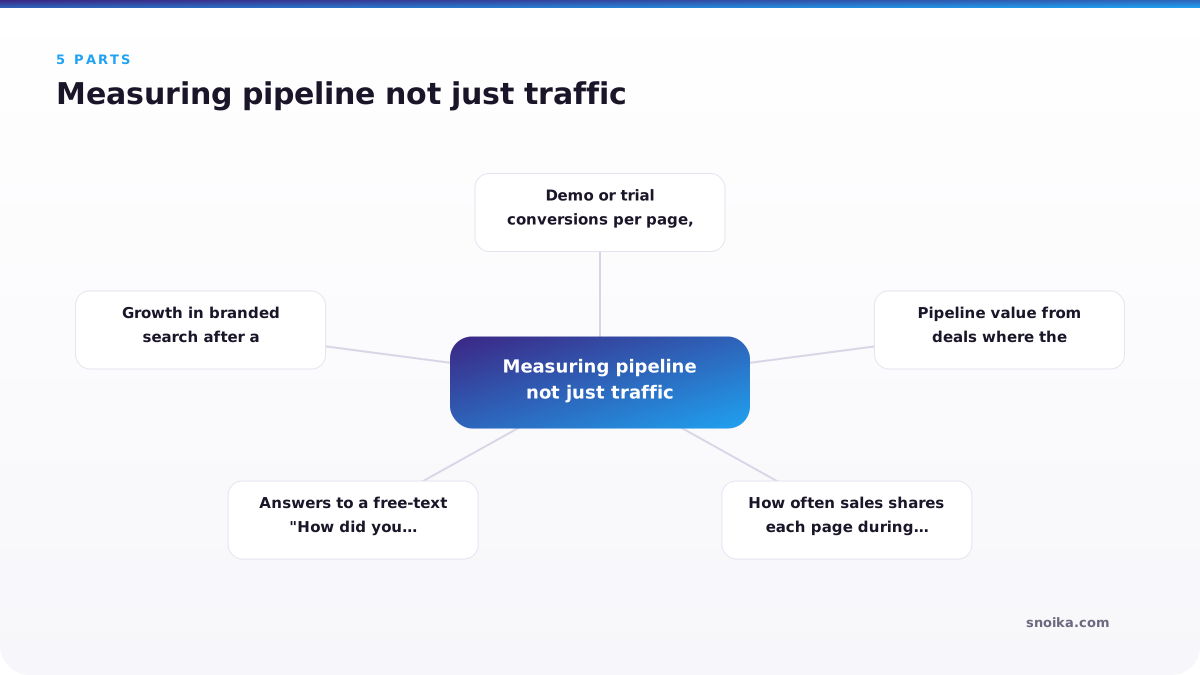
These measures connect content to revenue:
- Demo or trial conversions per page, reported for both first touch and last touch
- Pipeline value from deals where the contact viewed the page before the first sales call
- How often sales shares each page during open deals
- Answers to a free-text "How did you hear about us?" field on the demo form
- Growth in branded search after a category education push
With a 9-month sales cycle, a page published this quarter won't show up in closed deals until next year. Last-click reports also credit paid search or direct visits for deals that content started. Before you judge any page, check that your CRM records page views for known contacts.
AI visibility as a channel
AI assistants now help decide which software makes a buyer's shortlist, so showing up in their answers is a channel you should plan for and measure. G2's 2025 Buyer Behavior Report found that generative AI chatbots were the top shortlist influence, cited by 17.1% of buyers. That put them ahead of software review sites at 15.1% and vendor websites at 12.8%.
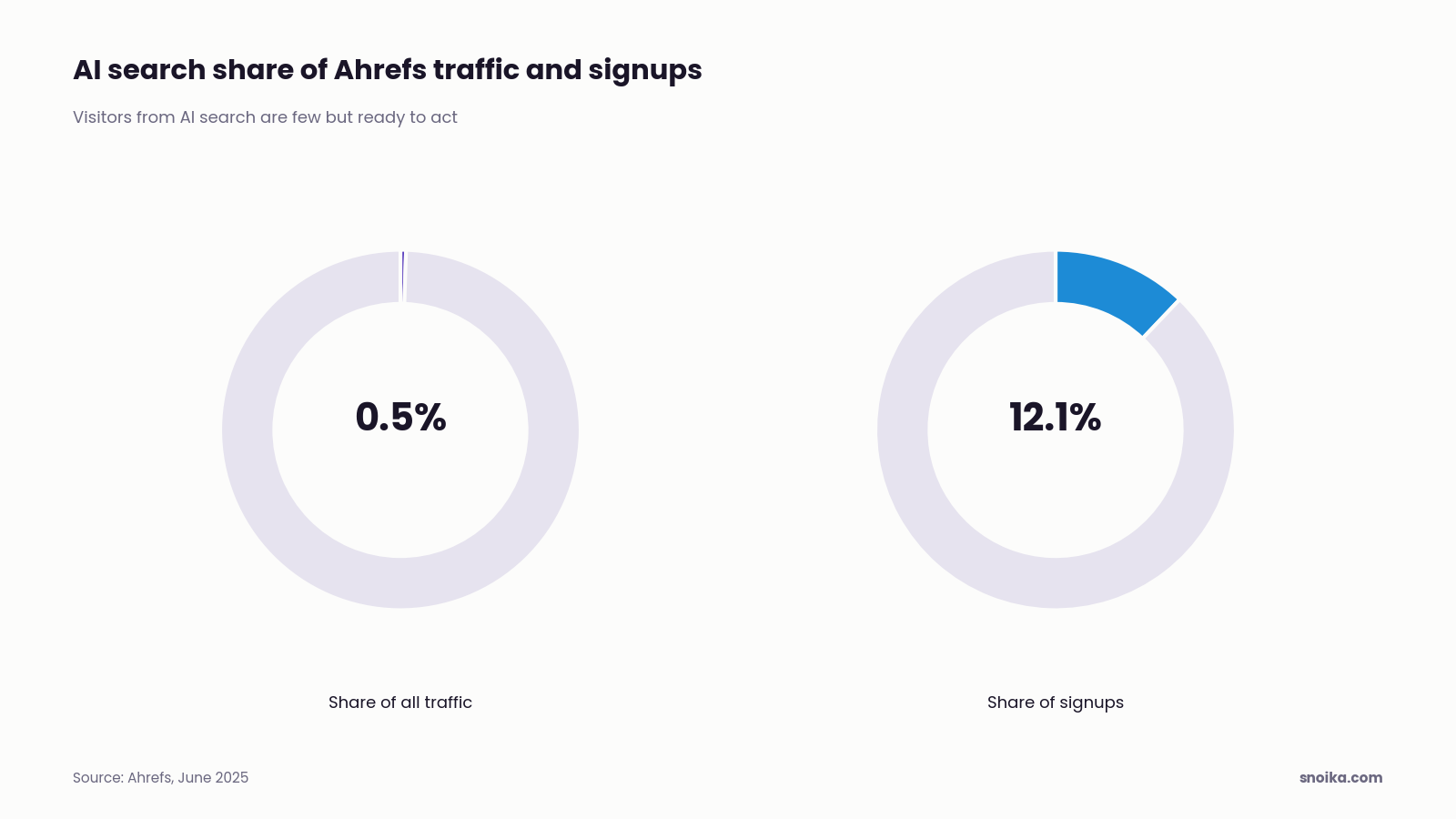
The visitors who click through from these tools are ready to act. Ahrefs reported in June 2025 that AI search brought in 0.5% of its traffic but 12.1% of its signups. The same analysis estimated that AI search users click links 75% less often than people using traditional search. So count how often you're mentioned alongside the visits.
Assistants lean on pages that answer comparison questions plainly, and on third-party sources such as review sites and roundup lists. That's why your bottom-funnel pages do double duty here. Each assistant cites sources in its own way, so ChatGPT and Google's AI Overviews name different brands for the same question. Every month, run the prompts your buyers would ask. Note whether your brand appears and record which pages the answers cite.
Repurposing extends content reach
Repurposing turns one researched piece into new formats for other channels and funnel stages. The Content Marketing Institute found that 37% of B2B marketers call repurposing a challenge.
Assets with original data or customer proof are worth repurposing first. A comparison page can become a one-page battlecard for sales. A customer interview can supply a case study and a short LinkedIn post, and a webinar transcript can be edited into a long article. Each new version has to fit its channel. Pasting the same text everywhere isn't repurposing, and readers on each channel can tell. Before you build anything new, check which of your existing pages already convert, because those are the ones worth reshaping.
SaaS blog architecture that scales
A SaaS blog scales when its structure follows buyer problems and product categories. Group educational articles into hubs, one per problem your product solves. Each hub then links down to the comparison and use-case pages for that problem. Links to pricing pages complete a clear path toward a decision for a reader who arrives at the top.
Give comparison and alternatives pages their own section, such as /compare/. A separate section makes them easy for sales to find and easy for you to update. That upkeep matters because a page with last year's competitor pricing costs you trust with the exact reader it was built for. Assign an owner to each commercial page and set a review date. Then check one simple rule: a reader on any article should be able to reach a trial or demo page within 2 clicks.
What to do next
Start by listing the 20 searches and AI prompts your buyers use when they're close to choosing. Then find out where you appear for each one, in Google and in AI assistants. The gaps on that list are your first content plan, and they'll tell you more than a keyword tool sorted by volume. Recheck the list every quarter, because competitors keep publishing comparison pages, and those pages change what assistants say about your category. Snoika audits websites and tracks brand visibility in Google and AI assistants, which is how a SaaS content marketing team measures that gap. To see which buyer prompts name your brand today, get a free AI visibility report.
Bottom-funnel pages are one part of a content marketing strategy built on a single semantic core, as described in content marketing for SEO. A content map gives each of them a place next to the pages above the funnel: see content mapping explained, or let Snoika's AI search content map plan them for the whole website.
FAQ
It means publishing comparison and alternatives pages before broad educational articles. These pages answer questions buyers ask when choosing software, including where a competing tool is a better fit. Category and use-case pages address buyers checking their options.
For established categories, the page supports a saas content marketing strategy focused first on buyers close to choosing. Judge results by trial conversions and influenced deal value. The reported conversion rates provide direction, but they aren't forecasts for another business.
Category education helps future buyers recognize a problem and learn the language to describe it before they shop. That familiarity can help a product enter their initial shortlist. Educational articles should connect the problem to a relevant comparison or use-case page.
Prioritize comparison and alternatives pages, then category and use-case pages, before expanding into broader education once those pages convert. For a new category, education needs to come earlier because buyers aren't yet searching for alternatives.
The timing depends on your sales cycle and when buyers encounter the content. A long sales cycle can delay closed-deal results beyond the publishing quarter. Track page-level conversions and influenced pipeline while waiting for revenue, rather than judging performance by traffic alone.
Keep reading
All articles