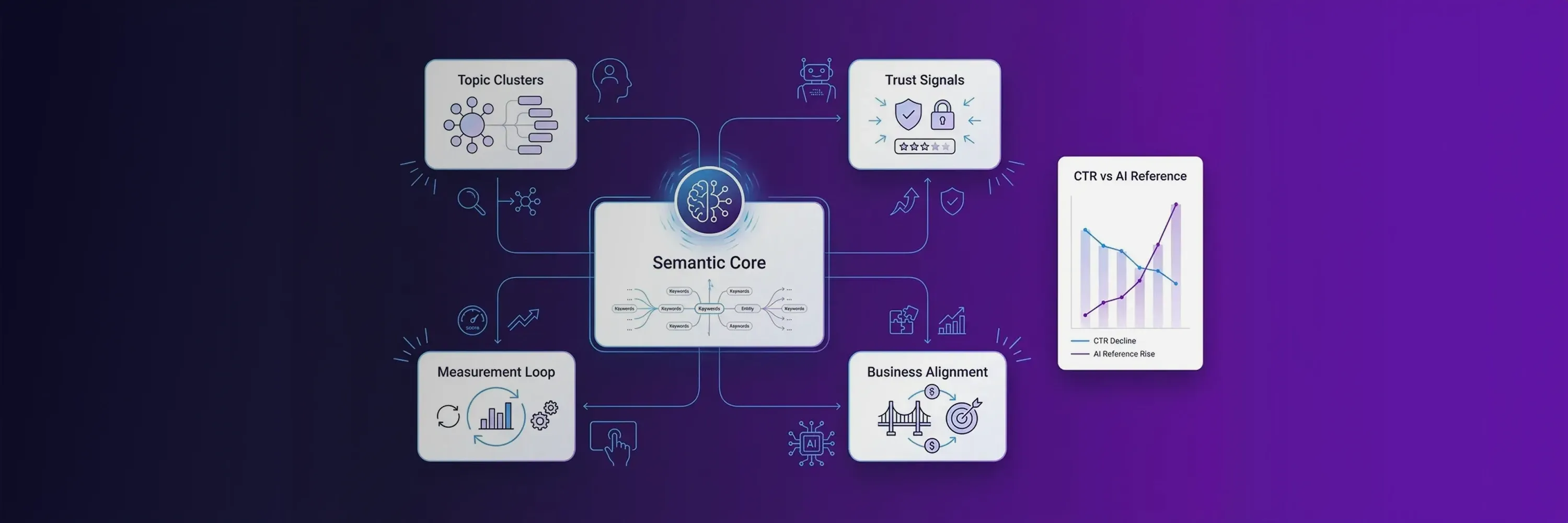
Visual diagram illustrating a semantic SEO and AI search optimization framework with interconnected elements including topic clusters, trust signals, measurement loops, business alignment, and CTR analytics around a semantic core.

Web content strategy for SEO and AI visibility

This article lays out a practical framework for building a web content strategy that performs in both classic search engines and AI answer platforms. You'll get a working blueprint for a semantic core, topic clusters, trust signals, and the measurement loop that keeps the system compounding.

Content authorJevgenia Pogadajeva, MBA, MScPublished onReading time13 min read

Why search and AI changed the rules

Discoverability is no longer a single funnel of blue links. A query now resolves into a stack of organic results, an AI Overview at the top, a featured snippet, and a parallel answer in ChatGPT, Perplexity, Gemini, or Claude. Ahrefs found that the presence of an AI Overview correlates with a 34.5% lower average CTR on top-ranking pages, and Seer Interactive's longitudinal study put the organic CTR drop on AI Overview queries at 61% between June 2024 and September 2025.

That shift forces a different operating model for website content strategy. A web content strategy built around an editorial calendar, where each week brings two new posts and a backlink push, can't address citations inside generative answers or entity recognition by large language models, and it misses the topical authority Google now rewards through its Helpful Content systems. Brands that still treat content as a publishing schedule keep losing surface area to brands that treat it as infrastructure.

The rest of this article is a working framework for the new reality. Start with a semantic core, translate it into clusters, build pages that read cleanly to humans and to retrieval systems, and close the loop with measurement that includes AI citations alongside rank.

What a modern web content strategy actually is

A modern web content strategy is an integrated system for discoverability, trust, and organic revenue. It defines the topics a brand wants to own, the entities it wants associated with those topics, the page architecture that supports them, and the trust signals that make search engines and AI models comfortable surfacing the brand. The editorial calendar comes from this system.

The old model was a linear cycle of publishing and optimization. The new web content strategy model is structural. You define a semantic core, group keywords into clusters anchored by pillar pages, layer in evidence and entity markup, and earn third-party signals that confirm the picture. That structure is what gets you cited by Perplexity, which references 8,027 unique domains compared to ChatGPT's 2,127, according to research summarized by Pepper Effect.

Any website content strategy now serves three audiences at once:

  • Human readers, who decide whether to trust and convert.

  • Search crawlers, which still index pages and route most commercial intent traffic through rankings.

  • AI retrieval systems, which embed content chunks and quote passages inside generative answers.

Those audiences read the same page differently. Humans skim headings. Crawlers parse HTML and schema. Retrieval systems extract self-contained passages. A web content strategy that pretends one audience is enough leaves the other two unserved.

Building the semantic core

The semantic core is the foundational set of topics and entities your brand wants to be associated with across search and AI, with related concepts mapped under them. It's the layer above keywords. Before you decide what to publish, you decide what your brand is about in machine-readable terms, because that's how Google's knowledge graph and LLM training corpora will categorize you whether you intervene or not.

Identify the core by intersecting three inputs. Start with commercial goals, which define the revenue-generating problems your product solves. Layer in audience problems, drawn from sales calls and support channels where buyers describe their situation in their own words. Then run entity research using tools like Google's Knowledge Graph API or InLinks to see which named entities (companies, frameworks, standards, people) already cluster around your space.

Once the core of the web content strategy is defined, every later decision flows from it. Page topics, internal links, schema choices, and even partnership and PR targets become filtered through one question: does this reinforce an entity or topic inside the core? A focused web content strategy with thirty anchored topics will outperform a sprawling one with three hundred unanchored articles every time.

Topics, entities, and intent

Topics and entities form the semantic core, while intent determines how each page serves the reader. Topics are broad themes ("B2B email deliverability"). Entities are specific things search engines and AI models recognize as discrete nodes ("SPF," "DMARC," "Gmail," "Mailchimp"). Intent is what the reader wants to accomplish on a given query, such as understanding a concept or executing a configuration after comparing vendors.

Keywords alone collapse these three into one flat list. That's why keyword-only content planning misses opportunities AI retrieval rewards. A page that names the right entities and answers a specific intent will get cited even when its head keyword has modest volume, because semantic structure is what RAG-style systems use to decide what to pull.

Map your semantic core as a table with three columns: topic, entities involved, and the dominant intent. Then check each row against the Search Quality Rater Guidelines, where E-E-A-T is referenced 136 times across 167 pages, per Schema App's analysis. If you can't credibly demonstrate experience or expertise on a row, deprioritize it.

Aligning the core with business goals

A semantic core has to drive revenue. Filter every candidate topic through three commercial questions before it earns a slot. Does it map to a problem your product solves? Does it attract a buyer rather than a researcher who'll never convert? And is the competitive cost of ranking proportional to the deal size it produces?

Score each topic on demand (search volume plus AI query frequency), competition (domain rating of incumbents and SERP feature density), and business fit (proximity to revenue). A simple 1-5 score across each dimension surfaces the topics worth real investment versus the ones that look attractive but won't pay back.

A focused core wins because topical authority compounds. Google's own guidance tells sites to cultivate a reputation for expertise in a specific area, and AI models trained on web data inherit the same bias. Twenty deeply covered topics beat two hundred shallow ones.

Mapping keywords to topic clusters

Sleek SaaS infographic featuring a central white UI panel over a deep purple gradient, with rounded cluster panels and minimalist icons.

Content planning translates the semantic core into clusters. Each cluster is anchored by a pillar page that covers a broad topic comprehensively, supported by cluster articles that go deep on specific subtopics and intents tied to its entities. Internal links flow from cluster articles back to the pillar and across siblings, so the entire group reads to a crawler as one coherent topic block.

In a web content strategy, group keywords by intent and subtopic. A keyword tool will happily put "email deliverability," "how to fix soft bounces," and "DMARC vs DKIM" in one bucket because they share modifiers. But those queries serve different intents and deserve different pages. The Seer Interactive data is useful here: AI-cited brands earn 35% more organic clicks than uncited ones for the same queries, so getting intent right at the cluster level has direct revenue consequences.

A practical content planning workflow for a cluster looks like this:

  1. Pick the pillar topic from the semantic core and confirm the head keyword.

  2. Pull every related query and group them by intent (informational, commercial, transactional, navigational).

  3. Assign one page per intent-subtopic pair, then check for cannibalization by searching site:yourdomain.com plus the target query.

When two pages target the same intent on the same subtopic, consolidate them. When a keyword has distinct intent or pulls a different SERP layout, it earns its own page. The test is whether the SERPs for two candidate keywords share more than half their results. If they don't, you need two pages.

Designing pillar and supporting pages

Inside a website content strategy cluster, pages play structural roles. The pillar covers the topic at breadth and defines core entities before it links out to every supporting page. Supporting pages each take one subtopic or intent and answer it to depth, then link back up to the pillar page and laterally to relevant siblings. Together they signal that this domain treats the topic seriously.

Formatting choices decide whether the structure is legible to machines. Use clear H2 and H3 hierarchies that frame each section as a question or a concrete subtopic. Lead each section with a direct, self-contained answer in the first one to two sentences, then expand. Google's AI Mode and other retrieval systems pull chunks, not chapters, and the 60-word answer rule keeps your passages extractable.

Depth on the pillar combined with breadth across supporting pages is what signals expertise. A pillar that runs 3,000 words with a clear definition and a structured comparison connected to ten supporting pages outperforms ten standalone articles that don't connect. That's why a website content strategy organized around clusters consistently beats one organized around isolated posts.

Content planning for AI answer platforms

Content planning for ChatGPT, Perplexity, Gemini, and Google's AI Overviews follows different rules than ranking in classic search. Retrieval systems reward passages that can be lifted out and used verbatim. Your job is to write those passages on purpose.

Start by writing each section as a self-contained unit. The reader (or the LLM) should be able to understand the passage without scrolling up for context. Name entities explicitly instead of using pronouns. Repeat the subject when a section is long. Avoid setups like "as we saw earlier," which break extractability. A 2026 Slate HQ study of 300,000+ AI citations across six B2B SaaS brands found Claude gave brands the highest owned citation share at 9.1% and ChatGPT consistently the lowest, which means platform-specific tuning matters.

Factual density is the second lever. AI systems prefer to quote passages that carry verifiable claims and original data with unambiguous phrasing over passages that hedge. If you have proprietary data, lead with it. If you have a definition, write it tightly. The Pepper Effect breakdown shows ChatGPT's premium model cites brand sites 56% of the time vs. 8% for the default model, which rewards brands that publish answer-shaped content over generic explainers.

Machine-readable content also depends on length discipline. Sections of 120 to 180 words extract more reliably than sprawling narratives. Tables, numbered steps, and clean definitions get pulled disproportionately. If a passage requires three paragraphs of setup before it makes its claim, it won't be cited, however accurate the claim turns out to be.

Strengthening trust with evidence and entity clarity

Trust signals are what move a page from "indexed" to "cited." The on-page signals that matter most are concrete and stack on each other. Cite primary research with named studies, dates, and methodology. Name the experts behind a claim with their role and institution. Link to authoritative references rather than to your own pages when the supporting evidence lives elsewhere.

Entity clarity comes from consistent markup. Implement Organization, Person, Article, and FAQPage schema using JSON-LD, and keep the same entity names across schema, visible page copy, and external references like LinkedIn and Wikipedia. Schema App's analysis explains that structured data links your entities to Google's knowledge graph, which is the substrate AI models use when they decide what a name refers to.

Author bios and About pages do work that's easy to underestimate. Person schema with jobTitle, worksFor, sameAs, alumniOf, and knowsAbout properties gives AI platforms explicit proof of expertise, per Stackmatix. Trust is the most weighted component of E-E-A-T, and Google has been explicit that trust contributes to all the others. A page from an unnamed author on an unidentified site will lose to an equivalent page with named expertise every time.

Internal links and third-party authority

Internal links in a website content strategy distribute authority and tell crawlers how your clusters fit together. Every supporting page in a cluster should link back to its pillar with descriptive anchor text, and laterally to two or three relevant siblings. The pillar should link out to every supporting page. This creates a hub-and-spoke graph that crawlers parse as a single topic block.

Third-party signals still decide what scales. Backlinko's analysis of 11.8 million search results found that the #1 result has 3.8x more backlinks than positions 2-10, and Ahrefs reports that 96.6% of content gets zero external backlinks at all. The same picture holds for AI inclusion. An Ahrefs study Chris Long highlighted found brand mentions were the single most correlated factor (0.664) with appearance in AI Overviews, ahead of domain rating and referring domains.

Earn those mentions without resorting to low-quality link building. The tactics that work today are:

  • Original research and benchmark reports that journalists and analysts cite as primary sources.

  • Expert commentary distributed through HARO replacements like Qwoted and Featured.

  • Podcast appearances and contributed articles on publications inside your topic space.

  • Tools and calculators that solve a discrete problem and become reference utilities.

None of these depend on outreach volume. They depend on producing something worth referencing, which is the same standard AI retrieval systems use when they decide what to pull into an answer.

Measuring and evolving the strategy

When a web content strategy measures visibility through rank and AI citations while tying that data to revenue, measurement has to widen. Rank tracking on its own underreports performance because AI Overviews swallow informational clicks. Pure traffic reporting hides the upside on commercial queries where conversion stays strong. The metric set that actually matches the new reality is:

  • Position tracking for commercial and branded queries, segmented by AI Overview presence.

  • Share of voice across your semantic core.

  • AI answer monitoring across ChatGPT, Perplexity, Gemini, and Claude, with citation frequency tracked per cluster.

  • Assisted conversions and branded search lift, since Loganix's synthesis of six studies put AI search traffic conversion at 14.2% versus 2.8% for Google organic.

Feed results back into the semantic core every quarter. Topics where citations are growing but rank is flat get more supporting content. Topics where rank is strong but AI citations are absent get rewritten for extractability and entity clarity. Topics that produce neither rank nor citations after two quarters get cut, because a focused web content strategy stays focused only if you prune.

Putting the framework into action

The content planning sequence to start next week is short. Audit your existing content against the semantic core and tag every page with its topic and intent, then note the entities it supports. Identify the one cluster with the highest commercial fit and the largest gap between current coverage and competitor depth. Then list the trust signals each page in that cluster is missing, from author bylines to schema to primary citations.

Build that one cluster end to end before moving to the next. Pillar first, supporting pages second, internal links and schema third, outreach for third-party mentions fourth. Consistency across the web content strategy system beats one-off optimization on any single page, because clusters compound while isolated posts remain separate.

Snoika is the AI search visibility platform built for exactly this work. The platform's LLM Visibility Engine and Synthetic Q&A Benchmark work with Signal Injection tools to help enterprise teams operationalize a web content strategy that earns citations across ChatGPT, Gemini, Perplexity, and Claude while holding ground in classic search. To see how your current website content strategy performs across AI engines and where the biggest visibility gaps sit, request an AI Visibility Report or book a call with the Snoika team.

Review content clusters every quarter. Compare rankings and AI citations against the semantic core. Refresh pages with weak entity coverage. Merge pages that target the same intent, because overlapping pages split signals and make it harder for search systems to choose the best source.

Add Article schema to standard content pages and connect it to Organization or Person schema. Use FAQPage only when the page has visible questions and answers. Include author names and job titles in both schema and page copy so crawlers can match the entity.

Yes, a small website can compete when it owns a narrow topic with original evidence. AI systems need clear, quotable passages from trusted sources, so a focused cluster can win citations before the whole domain has high authority. Start with one commercial topic and cover its buyer questions in depth.

Yes, you can use AI tools for outlines or first drafts, but a subject expert should edit every claim. Add source checks. Include entity names and examples from your own experience. A web content strategy fails when pages sound generic or repeat facts already published elsewhere.

Check citations by testing fixed questions in AI answer tools such as ChatGPT and Perplexity, then record whether your pages appear and which passages are quoted. Snoika can run this type of AI visibility check at scale. For a manual check, repeat the same prompts monthly and track changes by cluster.

Schedule a Meeting

Book a time that works best for you

You Might Also Like

Discover more insights and articles

Infographic comparing a traditional search snippet with an AI-driven answer box featuring citations, structured data, authenticity signals, and AI-powered visibility metrics

Generative Engine Optimization Strategies: Digital Marketing Tips For AI-First Growth

In this article, we explain how to adapt traditional workflows into an AI-first framework that prioritizes citation visibility and structured data over traditional click-based metrics. We also discuss how to balance automation with authentic, human-centered content to maintain brand authority in modern search engines.

Five-step AI-powered brand audit workflow infographic showing stages from defining scope and gathering data to analyzing brand performance, identifying opportunities, and creating strategic recommendations

Brand audit: How to measure SEO and AI search visibility

This article walks through a practical method for auditing how a brand appears across Google search and AI answer engines like ChatGPT, Perplexity, Gemini, and Google's AI Overviews. It explains the signals that determine whether AI systems cite or ignore a brand, and how to turn findings into an action plan.

Comparison infographic showing a legacy SEO approach with 96% invisibility versus an AI-driven future using generative AI, answer engines, semantic structure, analytics, and monitoring for improved visibility and engagement

Best SEO Marketing Tools Tested For AI-Driven Growth [2026]

In this article, we examine the shift from traditional search engines to artificial intelligence answer engines and the software that protects brand visibility. We explain how modern optimization platforms help companies capture citations and build sustainable growth.

Framework diagram showing answer-first structured content connecting traditional SEO practices with generative AI optimization and AI citation systems

Search Engine Optimization Content Writing For Generative Search: Step-by-Step Framework

In this article, we explain how to structure digital content for both traditional search engines and AI generative models. An answer-first architecture secures algorithmic citations and maintains high readability for human audiences.