
What is a content map in SEO content planning
A content map is the plan of every page a website needs so that Google can find it and AI assistants can cite it.
If you're asking what is a content map in SEO, that's the answer. It's one document that groups the pages you already have and the pages you still need by topic, with an action for each page.
























Content map defined for SEO
In SEO, a content map is a plan for the whole site that ties each page to its assigned topic and search questions. You build it before anyone writes, so every new article has a place and a reason to exist. Because it covers the whole site, some teams call it a website content map. A content map is unfinished if two pages on the list target the same question.
Two meanings of the term
The term means different things in content marketing and in SEO. Content marketers use "content map" or "content mapping" for a grid that matches content to buyer personas and to funnel stages, from awareness to decision. In SEO, it means a topical plan of the whole site. Snoika, an SEO and AI search platform, uses the SEO meaning and adds the questions each page must answer in AI assistants. So when someone asks what is content mapping, find out which meaning they have in mind first.
What a content map contains
A content map places every page on the site in a structure and assigns it an action. Existing and missing pages both belong in the map.
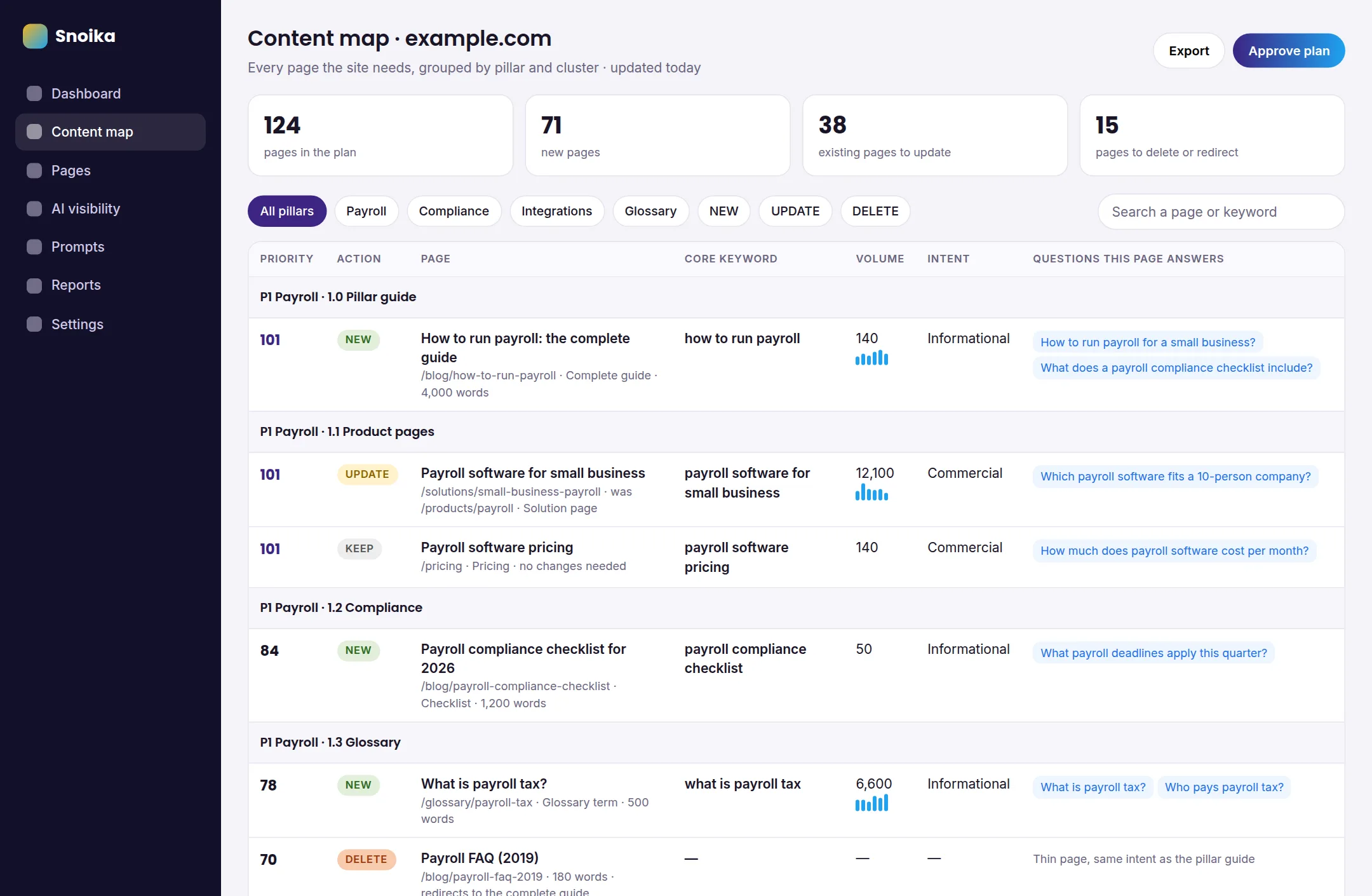
Pages grouped into pillars and clusters
Pillar pages cover a broad topic, and cluster pages answer the narrower questions under it. Each cluster links up to its pillar. This grouping shows the gaps. A pillar with only two thin clusters needs more pages, and keywords your competitors haven't used become obvious places to add new ones.
An action for every existing page
Every existing page gets one of four decisions, with keep and update as options for pages that stay. The other options are redirect and delete. Because of this step, new pages don't compete with old ones for the same query. Thin pages that add nothing are the first to go. A map that lists only new pages is a publishing plan, and your old URLs will keep competing with the new ones.
Content map vs topical map
A topical map lists the subjects a site needs to cover to show authority, and a content map turns those subjects into specific pages. The content map assigns each subject to a page with a target keyword and specifies what happens to the pages already live. You need the topical map first, but you can only act on the content map.
Why AI search needs one
AI assistants answer questions, so each question needs one page on your site that answers it clearly. When three posts each half-answer the same question, a content map assigns that question to a single page so an assistant has a clean passage to quote. Before you publish, check that every page lists the questions it must answer.
A short content map example
Here is a slice of a content map for a small accounting firm's site. One pillar sits at the top and its clusters sit under it:
Each page also lists the question it must answer for AI assistants, such as "How do freelancers pay quarterly taxes?"
Related terms worth knowing
Four terms sit close to the content map, and each one does a different job:
A content map is a plan for additions and changes to a site, with decisions about which existing pages to keep or fix and which to remove. To start your own, export every URL on your site and give each one a pillar and an action.