How to earn more citations in perplexity AI search

Content authorArtem Lozinsky, EMBA, MScPublished onReading time11 min read
A woman energetically shouts into a loudspeaker, sending vibrant sound waves to the word 'Perplexity' in a dynamic cityscape background.

This article walks through the exact sequence that moves a page from retrieved-but-ignored to actually cited by Perplexity. You'll get a checklist you can run against your own site this week, plus a way to track whether the work paid off.

Why mentions are not citations

Getting pulled into perplexity ai search is not the same as getting cited. Your page can be retrieved and read in perplexity ai search without earning one of the clickable source links Perplexity puts at the top. The pipeline pulls 5 to 10 candidate pages per query, then filters through three reranking layers and a synthesis step that cites only 3 to 4. More than half of what gets retrieved is cut before the answer is assembled.

The goal is surviving the ranking stage. And that survival comes down to a sequence of fixable moves that cover technical setup and extend to authority signals in your content. Each stage of the pipeline tests something specific, and each thing it tests is something you can change.

Make sure PerplexityBot can read you

The first thing you should do is to check whether Perplexity's fetchers can parse your page. Two checks matter here, and you'll act on them separately, so work through them in order with me here.

Check robots.txt and firewall rules

Perplexity runs two agents you need to allow. PerplexityBot indexes websites for search results and citations, while Perplexity-User fetches a page in real time when someone's query needs it. Open your robots.txt and confirm neither is caught in a blanket AI-bot disallow. A rule meant to block training crawlers will silently remove you from retrieval too.

Robots.txt is only half the story. A Web Application Firewall (WAF) or a Cloudflare bot-challenge rule can serve a 403 or a JavaScript challenge to these agents even when your robots.txt reads clean. That's a real risk, because Cloudflare de-listed Perplexity from its Verified Bots program in August 2025 over crawler disputes, which means default bot rules on many stacks now treat Perplexity's agents with suspicion.

To verify, do one of these:

  • Fetch your page using the PerplexityBot user-agent string and check that you get the full HTML back.

  • Search your server logs for visits from PerplexityBot and Perplexity-User to confirm they're actually getting through.

If your firewall is challenging them, whitelist both agents by user-agent and by Perplexity's published IP ranges.

Fix JavaScript-only pages

Fetchers for perplexity ai search parse the HTML your server returns in a single request. They don't run a full rendering pipeline, so a client-side-rendered single-page application that ships an empty shell delivers nothing quotable. The fetcher sees a blank div that should contain your answer.

Luckily, I know the fix. What you need to do is move content pages to server-side rendering or static generation. For a legacy SPA you can't rebuild quickly, edge prerendering that serves rendered HTML to bots works as a bridge.

And this is where the rendering problem bites twice: if your JSON-LD schema is injected by client-side JavaScript, the fetcher never sees it either. To confirm the fix without touching code, view the raw page source in your browser. If your main content and your schema both sit in that raw HTML, you're good. If they don't, you now know what you have to do.

Need help with your AI visibility?

Book a free consultation with our experts we'll help you determine exactly which services your organization needs.

Lead every page with the answer

Put a direct, self-contained answer in the first sentence of the page or the section, before any setup. The perplexity ai search synthesis step only cites what it can quote without distortion, so it hunts for a passage it can lift cleanly. A warm-up paragraph pushes that passage further down and makes your page harder to extract from than a competitor who answered in line one.

Think about the difference in practice. A warm-up opener reads like "In today's fast-moving search environment, understanding how citations work has become more important than ever, and there are many factors to consider." An answer-first opener reads like "Perplexity cites 3 to 4 of the 5 to 10 pages it retrieves per query, so a page has to survive three reranking layers to be shown."

The second one is quotable on its own. The first one says nothing the model can attach to a claim. Structure matters here too: sections between 120 and 180 words earn 4.6 average citations against 2.3 for sections that run too short or too long, so give each answer room to be complete without padding it.

Add quotable specifics

Once your answer is easy to find, make it worth citing. Perplexity ai search favors factual density, and fact density is its highest-weighted ranking signal. A passage with a concrete number and a precise claim beats a hedged, vague one every time the reranker has to choose between two competing sources.

So write claims a reader can verify. Attach dates to your statistics, because freshness and specificity then reinforce each other in the same sentence. And place your evidence directly next to the claim it supports, since pages that survive all pipeline stages have evidence adjacent to claims.

There's a hard limit on faking this, though. A 2026 analysis found that pages citing non-existent research saw a 64% citation rate decline after detection, so every figure you add has to be real and checkable.

Apply Article, FAQ, and HowTo schema

Structured data helps perplexity ai search understand what your page is and extract from it cleanly. Use schema that matches the content:

  • Use Article schema on your guides and posts to mark up the article's publication details.

  • FAQPage schema on genuine question-and-answer sections, since question-format structure matches how people query Perplexity.

  • HowTo schema on step-by-step instructions so the model can lift the sequence.

Two rules keep this from backfiring. First, the schema has to be server-rendered, which ties straight back to the rendering fix above, because client-injected JSON-LD is invisible to the fetcher. Second, only apply a type that genuinely matches the page. Stuffing FAQ and HowTo markup onto a page that's neither invites structured-data errors and does nothing for extraction. Validate your markup before you ship it, and treat schema as a way to clarify real content rather than dress up thin content.

Build authority for perplexity ai search

A single strong page rarely wins on its own. Perplexity weights niche topical authority and cross-source agreement, so when two pages are close on relevance and freshness, the surrounding signals break the tie. What decides those close calls is whether Perplexity already sees your site as a recognized entity in the topic. That recognition is built two ways, and you'll work on each separately.

Build topical clusters

Covering one topic in depth across interlinked pages tells perplexity ai search your site is a go-to source for that niche. Build a cluster of related pages around your strongest subject and connect them with clear internal links, because AI fetchers miss deep pages that aren't linked from somewhere they already reach. Internal links are how those deeper pages get discovered at all.

This reinforces something from earlier: Perplexity rewards focused, single-topic pages over sprawling generalist content. A tight cluster of pages that each answer one thing well signals more authority than one giant page trying to cover everything. Map your cluster around the topic where you already have the most to say, then fill the gaps with pages that each own a specific question.

Need help with your AI visibility?

Book a free consultation with our experts we'll help you determine exactly which services your organization needs.

Earn off-site validation and ai citation tracking

Perplexity looks for cross-source agreement, so the same claims and the same brand appearing positively across independent sources raises your citation odds. Part of the candidate pool comes from Bing, since retrieval merges Bing's index with Perplexity's own cache, which makes Bing Webmaster Tools a foundational step rather than an optional one. Beyond that, off-site work does the heavy lifting: securing guest posts on respected sites in your niche and publishing expert bylines that reinforce who's behind the writing.

The reason off-site validation moves the needle for Perplexity specifically is that its reranker checks whether other recent sources corroborate your claims. If your figure appears only on your own page, it's a lone voice. If it appears across several independent sources, it reads as consensus.

This is where ai citation tracking becomes a discipline rather than an afterthought, because ai citation tracking is how you learn whether all that outreach actually converted into citations instead of just backlinks. Watching for that link between authority effort and real citations is the whole point of ai citation tracking, and Snoika is one option for mapping and monitoring citation visibility across the queries you care about.

Without ai citation tracking, PR efforts rely on guesses about what perplexity ai search rewarded. Good ai citation tracking closes that gap, and the same ai citation tracking data tells you which off-site placements to double down on.

Keep content fresh

Perplexity ai search applies a strong freshness bias, which means a recently updated page can outrank identical older content on the strength of its date alone. The numbers are stark. Content updated within 90 days captures 68% of all citations, with a sharp drop-off after 180 days. Roughly half of all Perplexity citations come from content published within the last 13 weeks.

Refresh your core and high-value pages every 60 to 90 days, and make the update visible with a publish date in the template. Add a "last updated" date, and keep your dateModified truthful so your sitemap lastmod reflects real changes.

The freshness signal combines timestamps with changes to the page. Perplexity checks whether the substance actually changed, so cosmetic edits don't trigger a boost. Faking a date without real updates gets you nothing and risks your credibility. If you manage a large library, put the refresh cycle on a calendar and update the substance.

Track whether you get cited

There are two signals you can watch without any special tooling. First, monitor perplexity.ai referral traffic in your analytics, because a visitor arriving from Perplexity means your page was cited and clicked. That traffic is worth watching closely: Perplexity referral converted at 10.5% in Seer Interactive's study of 25.1 million impressions, against 1.76% from Google organic. Second, test your target queries directly in Perplexity and check whether your page shows up as a source.
strategies.png

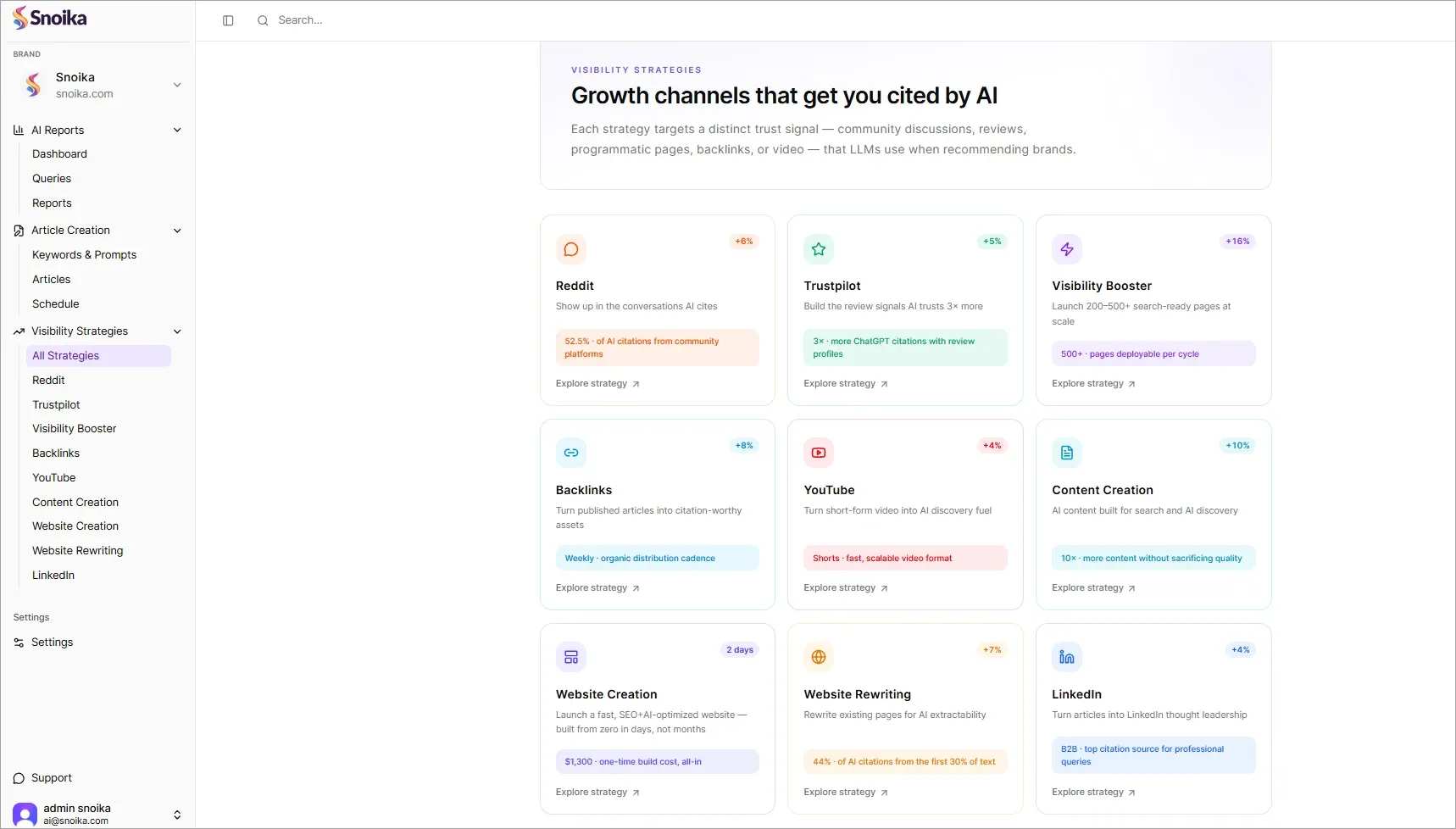
Manual query testing breaks down once you have more than a handful of queries to watch. That's where an ai search strategy needs a measurement loop that scales, and a dedicated tool such as Snoika maps and monitors citation visibility over time across the prompts that matter to you.

This loop is the part of your ai search strategy that tells you which earlier steps worked. If referral traffic climbs after a refresh, your ai search strategy is compounding. If a guest post moves nothing, your ai search strategy needs a different bet. And an ai search strategy without measurement is just a list of hopes, which is why connecting your analytics to actual citation checks turns an ai search strategy into something you can steer. A sound ai search strategy treats these signals as useful feedback.

Mistakes that cost you citations

The fastest way to undo everything above is to bury your answer under a long introduction. When the extractor scans your page and hits three paragraphs of throat-clearing before any quotable claim, it moves on to a competitor who led with the answer. This one error fails the synthesis stage directly, because the model can't cite a passage it never reached.

Two more quietly drain your citation odds:

  • Stale content that has aged past its freshness window. Once a page crosses the 180-day mark without a real update, its citation rate falls off and fresher rivals take the slot, which is why the refresh cadence exists.

  • Thin, me-too pages that repeat what existing sources already say. If your page offers only information the model can get elsewhere, it offers nothing to cite and gets filtered at the ranking layer for lack of factual density.

Each mistake maps to a fix you've already read. Bury the answer, so lead with it. Let content go stale, so refresh it. Publish a me-too page, so add quotable specifics. Run the checklist against your own site this week. First, confirm that PerplexityBot can even read you. This will close the gap between getting retrieved and getting cited in perplexity ai search.

Need help with your AI visibility?

Book a free consultation with our experts we'll help you determine exactly which services your organization needs.

PerplexityBot should receive a 200 response with the article text and JSON-LD in the initial HTML. For perplexity ai search, test a representative URL with its user-agent and compare the response with the browser’s raw source. A redirect, 403, challenge page, or empty application shell needs a technical fix.

The canonical tag should point to the version you want crawlers to evaluate and cite. Put the same substantive content on that canonical page, use consistent internal links, and avoid conflicting canonical tags. Split URL signals make it harder for a crawler to identify the preferred source.

Remove or replace an outdated claim when its original evidence no longer supports the current page. Preserve the source context when historical information matters, and label it with the relevant date. A truthful update improves accuracy, whereas changing a timestamp alone doesn’t update the substance.

Record the exact prompt and test date, then save the cited URLs and whether your domain appeared. Keep the answer text or a screenshot when possible. This record separates a ranking change from a prompt variation and gives your next content update a clear basis.

Snoika is an AI visibility service that can map citation visibility across selected prompts over time. Try its AI visibility services alongside analytics data, then compare citations with referral visits after each update. Use the results to decide which pages need further work.

Schedule a Meeting

Book a time that works best for you

You Might Also Like

Discover more insights and articles

Ultra-minimal flow illustration on deep violet background featuring glowing icons for leadership, AI, and analysis, connected by an orange arrow.

How to Build a Leadership Case for GEO, AEO, and LLM Visibility

Build the case around business exposure. Show where AI-generated answers already influence how buyers shortlist vendors in your category and request approval for one bounded pilot with predetermined scale-or-stop criteria.

Minimalistic SaaS marketing illustration featuring a central ChatGPT icon with a violet background, brand icons interacting with a filter, and an auditor icon.

Why ChatGPT Mentions Competitors Instead of Your Brand: A Visibility Gap Audit

ChatGPT names competitors instead of your brand when it can't confidently identify your company and connect it to the prompt's category with sources it trusts. Some of that absence is random sampling. The rest is a real evidence gap, and you can separate the two by testing the same prompts repeatedly and recording what comes back.

Hand-drawn wireframe flowchart on notebook paper showing AEO implementation workflow for ecommerce product pages with annotated icons.

How ecommerce teams implement AEO for product pages

This article gives you an ordered AEO workflow for making product pages readable and quotable inside AI answers. It covers crawler access and server-rendered facts. Schema and feed alignment then lead into content rewrites and citation tracking. The sequence matters more than any single fix.

A vibrant illustration featuring a glowing AI-brain icon at the center, surrounded by dynamic line icons and luminous badges in deep violet hues.

AI Brand Mention Tracking Limits: What to Know Before You Invest

AI brand mention tracking reliably shows you directional trends and relative presence over time. AI answers can differ between identical runs. They also personalize by user and change after model updates, so treat these numbers as confidence ranges and never report a single snapshot as fact.