
Quora marketing services for AI visibility
Our Quora marketing services put your experts' answers on the Quora questions that ChatGPT and Google AI Overviews pull from. Then we show you which of those answers the assistants actually cite. Every answer carries the author's real name and states their affiliation with your company, so it holds up under Quora's rules and under a skeptical buyer's eye. Start with a free AI visibility audit, which needs no access to your systems and shows where your brand appears in AI answers today, where your competitors appear instead and which Quora threads already shape AI answers in your category.
Trusted by

























Quora for AI citations
Quora gets your brand into AI answers because assistants quote Quora threads when they answer buyer questions. In the Snoika app, Quora is one of the visibility strategies we set up and schedule, and it runs on the same plan as the rest of your search and AI work. The service covers these parts:
Question selection
We pick the buyer questions on Quora that AI assistants already draw on in your category.
Expert answers
Your experts write the answers, or we write them for your experts. Each answer discloses who the author works for.
Brand Space
We set up a Quora Space that collects your company's longer posts in one place.
Citation tracking
We record when ChatGPT or Google AI Overviews cite one of your answers.
This work suits B2B and considered-purchase brands whose buyers research before they buy. If nobody in your category asks questions on Quora, the audit will show it, and you'll know to spend the budget somewhere else.
Why AI cites Quora answers
AI assistants cite Quora because every page puts a plain question above direct answers, and that layout is easy for a model to lift and attribute. Quora also ranks its own answers, which hands the AI a quality signal it doesn't have to work out for itself.
ChatGPT citations of Quora
ChatGPT cites Quora answers, and a Quora presence correlates with more citations. A Contently analysis from April 2026 found that domains with substantial Quora brand mentions earned 4.1 times more ChatGPT citations than domains with little Quora presence. That number measures a correlation, and ChatGPT changes how it picks sources often.
In September 2025, its citation share for Reddit dropped from roughly 60 percent to about 10 percent of prompts in two weeks. So we track citations every week.
Google AI Overviews citations
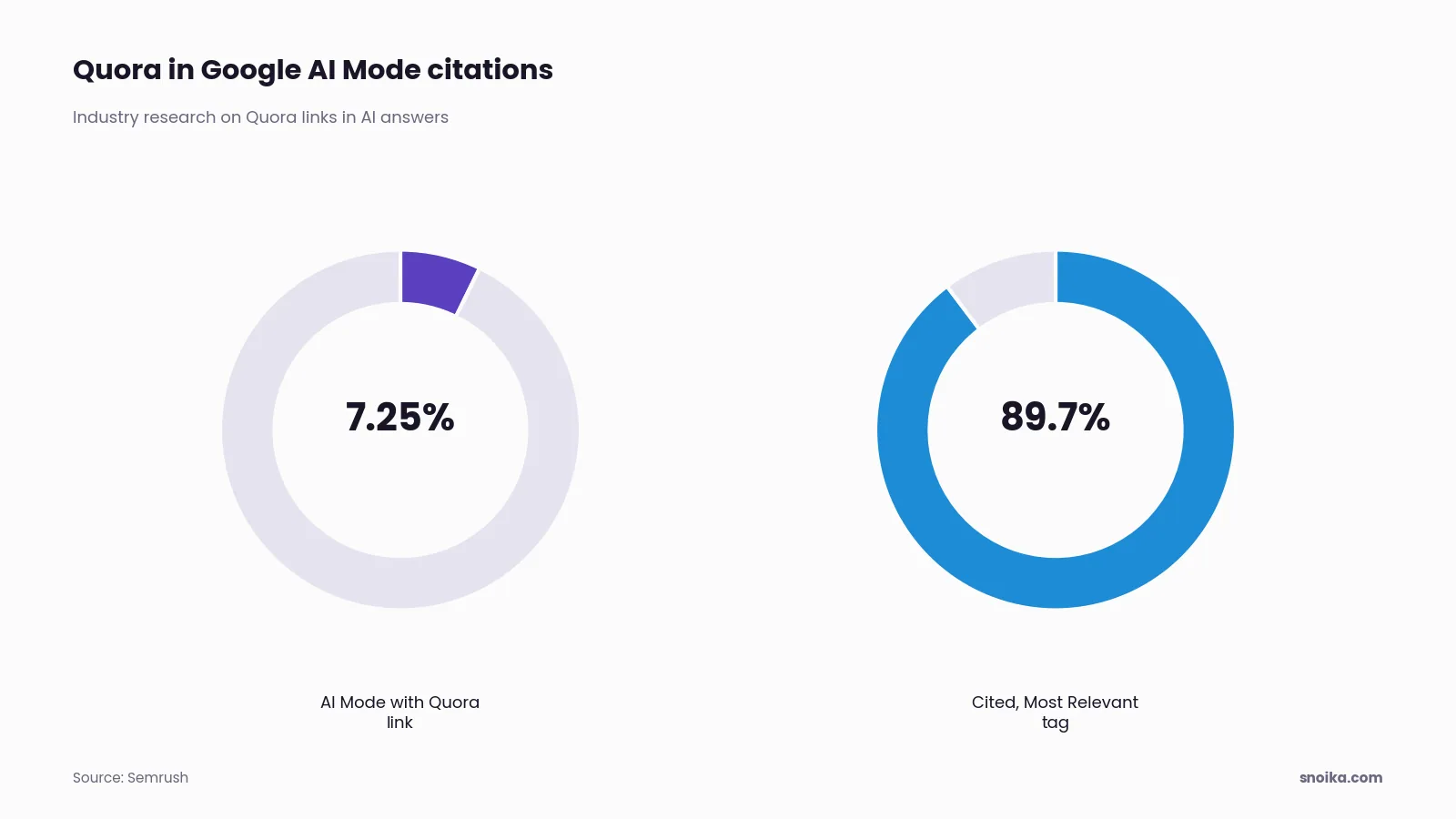
Industry research found that Google AI Mode included a Quora link in 7.25% of responses, and earlier research from the same source named Quora the most cited source in AI Overviews. In the same study, 89.7% of cited answers also carried Quora's own "Most Relevant" tag.
To get your answer into an AI Overview, you first have to win on Quora itself. So the answers we write open with lines that answer the exact question, give specifics the other answers lack and show a credential that matches the topic.
Questions Snoika targets
We target buyer questions from your content map that Google and AI assistants already surface. The content map is the research we build from the queries your buyers ask about your category, so a Quora answer and a page on your site can serve the same buyer intent.
We rank candidate questions on four signals:
AI citation
The Quora thread already appears in ChatGPT or Google AI Overviews responses.
Buyer stage
The question comes up while a buyer compares options, which matters more than early curiosity.
Weak answers
The existing answers are old or vague, or they come from people with no credential on the topic.
Expert fit
One of your people can answer from first-hand experience.
We create content in 135+ languages and regional variants, so a buyer asking in German or Brazilian Portuguese gets an answer written in that language. Before we write anything, we check that the question names a problem your product solves, because otherwise a citation won't bring you a buyer.
Disclosed expert answers
You market a brand on Quora with disclosure by having a named person answer and stating their affiliation in the answer or in their credential. Quora's Question and Answer Policies say a user should disclose relevant affiliations "explicitly in an answer or in the credential that appears with the answer."
Our answers follow that rule:
Draft
Your expert writes the answer, or we draft it from their notes and our research.
Expert review
The expert edits the draft until it says what they would say and nothing they wouldn't.
Disclosure
The answer names the employer, for example with a credential line such as "Head of Compliance at [your company]."
Publication
The answer goes out under the expert's own account, on the schedule set in the app.
A good answer helps the reader even if they never click through to your site. It mentions your product only where the product is part of the honest answer. Readers forgive a disclosed bias but punish a hidden one, as do Quora's moderators.
Building your brand Space
A brand Space is your company's own collection on Quora. It holds longer posts, curated answers and updates that read as too promotional inside a reply to someone else's question. Followers of the Space see new posts in their feed, and the Space gives each of your experts a home base to link from their profile.
We treat the Space as a supporting asset. The citation data above comes from answers to questions, which a Space best complements through deeper coverage of topics your experts already answer well, such as a worked example or a regulatory change explained in full. Every post should still make sense to someone who has never heard of your brand.
Tracking AI citations
You track AI citations of your Quora answers by running a fixed set of buyer prompts every week and recording which sources each assistant cites. In Snoika, we track citations of your Quora answers in ChatGPT and Google AI Overviews, which is where most AI search traffic happens.
| Metric | What it shows |
|---|---|
| Citations | Which of your Quora answers an assistant links to |
| Mentions | How often your brand is named in AI answers |
| Share of voice | Your mentions compared with competitors' |
| Sentiment | Whether AI answers describe you favorably |
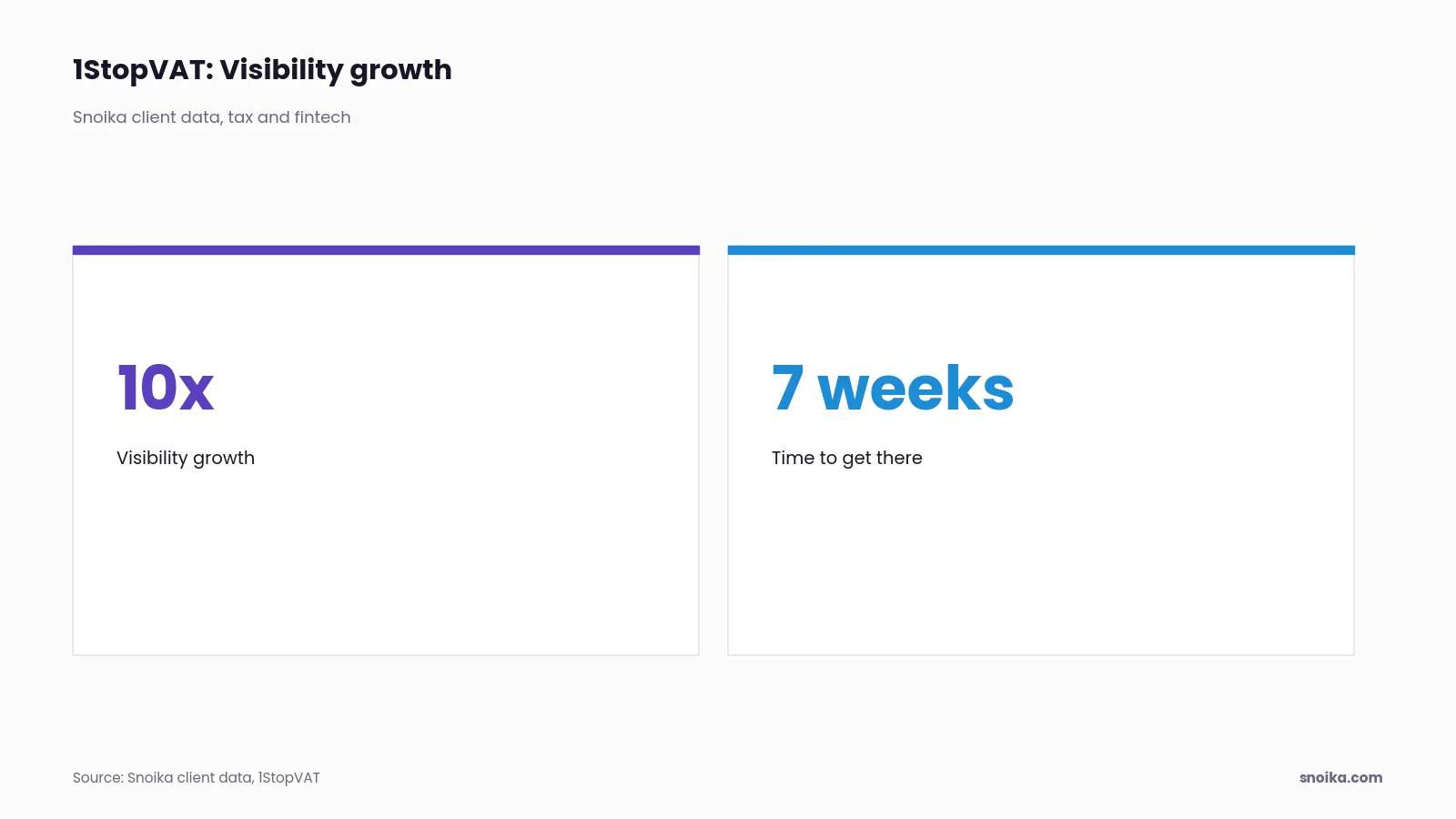
An assistant can cite your answer without naming your brand, or it can name you without linking to you. 1StopVAT, in tax and fintech, saw 10x growth in ChatGPT visibility in 7 weeks.
Once an engagement starts, we ask for access to Google Analytics 4, Google Search Console and Google Tag Manager, so AI visibility can be tied to the traffic you already measure.
Quora vs other answer platforms
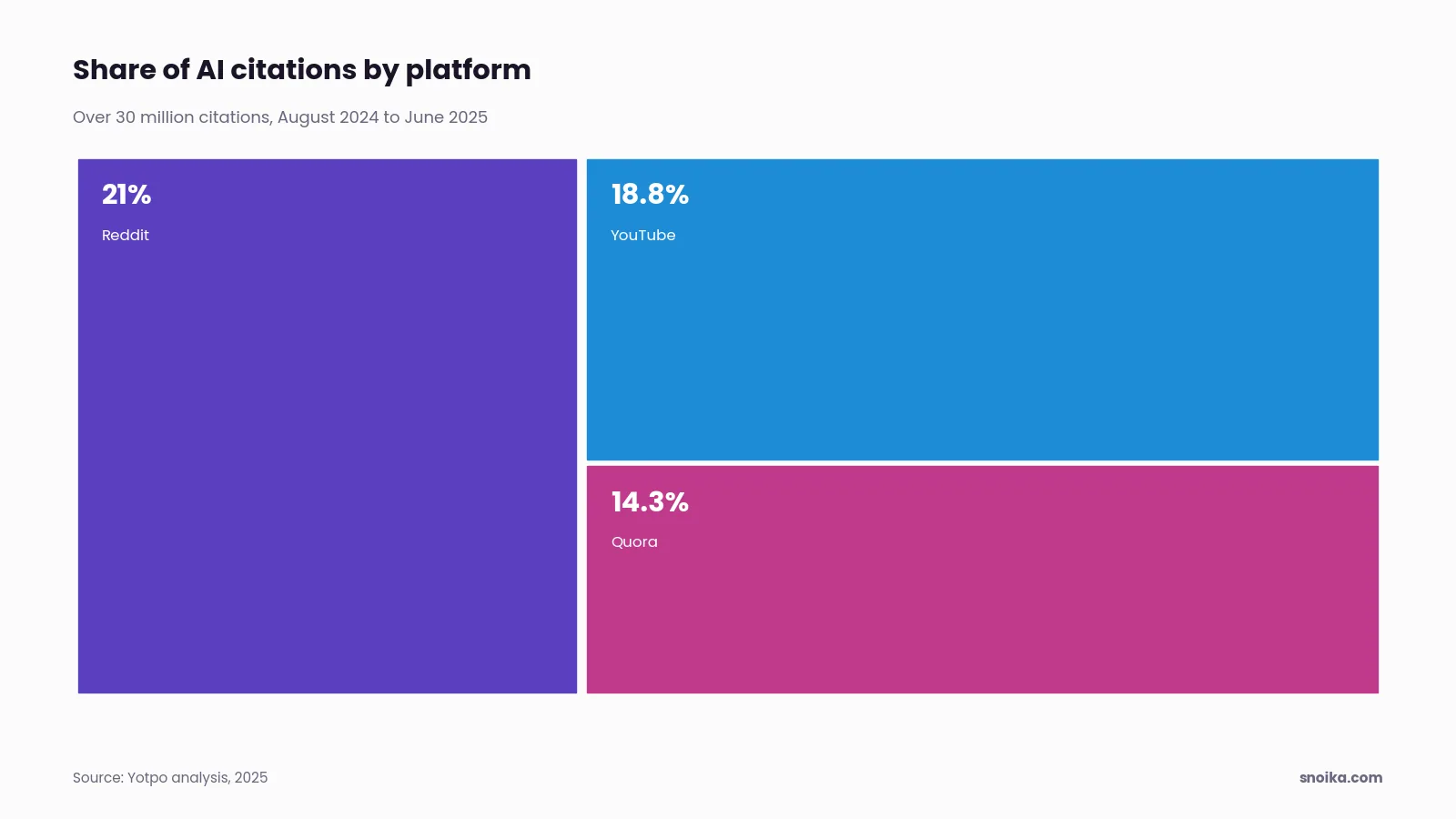
Quora is the strongest platform for structured, expert question-and-answer content, but it isn't the biggest source AI cites. An analysis of over 30 million citations between August 2024 and June 2025 placed Quora at about 14.3%, trailing Reddit at 21.0% and YouTube at 18.8%.
| Platform | Best for | Watch out for |
|---|---|---|
| Quora | Expert answers to specific questions | Answers must win "Most Relevant" |
| Peer opinion and product comparisons | Communities reject brand voices | |
| Professional authority, B2B | Reach depends on the author's network | |
| Your own site | Full control and conversions | Slower to earn citations |
Quora suits a brand that has real experts and a category where buyers ask detailed questions, while Reddit suits consumer products that people argue about. Your own site supports every other channel: we publish pages there through a DNS connection, with no migration and on any CMS, and you approve every page in the dashboard before it goes live. Our verdict is to use Quora alongside your site, and never as a replacement for it.
Compliance without fake accounts
Every answer comes from a real person at your company, and every upvote comes from a reader who chose to give it. Each answer goes out under a named expert's own account, with the affiliation shown in the answer or the credential, never under a persona.
Quora's moderation flags coordinated activity, and a 2026 guide to Quora bans lists "similar answer patterns across multiple accounts" among the triggers. If an account network gets banned, you lose the answers along with every citation pointing to them, which is the risk behind "aged accounts" and "upvote packages."
Answers plus tracking
Snoika writes disclosed expert answers and measures their AI citations in one loop, which needs your experts' input. If AI citations are the goal, someone has to pick questions from citation data and then check the results every week:
Question picks
We choose questions from citation data, not guesswork.
Weekly checks
We track which answers ChatGPT and Google AI Overviews cite.
Human review
A human review layer sits on top of the automated workflows.
If your experts write well and you only care about Quora's own traffic, an in-house team can handle the posting without us.
FAQ
Yes, ChatGPT cites Quora answers, but a Quora presence doesn't guarantee citations; the research we cite shows a correlation, not proof of cause. That's why we track links to individual answers separately from brand mentions.
The answers we write open with a direct answer to the exact question, add first-hand details the existing answers lack and carry an author credential that matches the topic. That improves an answer's chances, but nothing guarantees inclusion in Google AI Overviews.
With Snoika, every answer goes out under a real expert's account and states their company affiliation in the answer or its credential. When we draft an answer, the expert reviews it before publication, and the product is mentioned only when it helps answer the question.
We run the same buyer prompts every week in ChatGPT and Google AI Overviews and record which Quora answers they link to. Citations are kept separate from brand mentions, since an assistant can link to an answer without naming the author's company.