
Backlink monitoring with internal link checks
A backlink monitoring tool that ignores your internal links only shows you half of the problem. Links from other sites bring authority to your pages, and your internal links decide which pages get that authority. Snoika checks both in the same app, and one report shows lost referring domains, orphan pages, broken links and weak paths to the pages that make you money. We fix what we find with your access, or your team takes the issue list and fixes it.
Trusted by

























Backlinks plus internal links checked
Snoika runs the backlink check and the internal link check in one app. Most teams buy these separately, with a backlink index from one vendor and a site crawler from another, and the split costs time because the problems are linked. A backlink that lands on a deleted page and an internal structure that never reaches your pricing page both waste authority.
Backlink monitoring
It runs in the Snoika app.
Internal link audit
It runs in the same app, on the same site.
Fixes done for you
Our team makes them once you give access.
AI visibility tracking
Every plan includes it, and plans are on the pricing page.
You get the checks and the follow-up work from one team.
Why lost referring domains hurt
A lost referring domain takes away a vote of trust your page earned, and rankings that relied on that vote drop when it goes. You'll barely notice when a site drops one of its dozens of links to you, but rankings drop if a trade publication removes its only link to you.
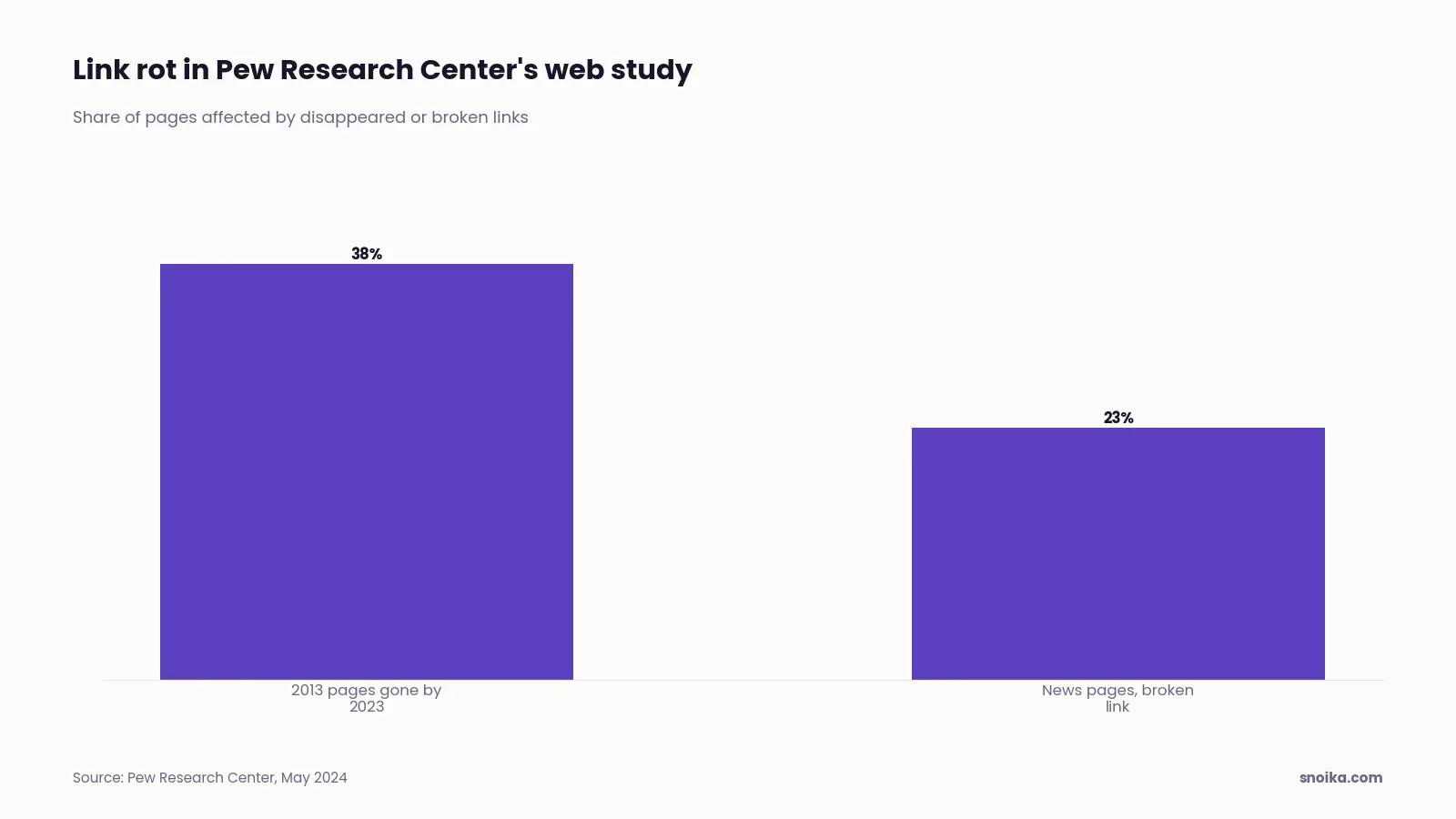
Links also disappear when nobody decides to remove them: Pew Research Center found that 38% of webpages from 2013 were gone by October 2023. We review the domains you lost in the last 30 days, starting with the most authoritative, and contact the owners whose pages were moved instead of deleted.
Backlinks pointing at 404s
We find backlinks pointing at 404 pages by checking the HTTP status of every page your backlinks land on and keeping the ones that return 4xx errors. These are the cheapest wins in link building, because the other site still links to you and the authority remains available despite the broken destination. We work through them in this order:
Collect
We pull your backlinks with the status code of each target URL.
Filter
We keep the 404 and 410 responses.
Prioritize
We sort the broken targets by how many referring domains point at each one.
Fix
We restore the page, or add a 301 redirect to the closest live page on the same topic.
We don't redirect everything to the home page. Google treats irrelevant redirects as soft 404s, which gets you back to where you started.
Anchor text mix
A healthy anchor text mix is mostly your brand name and bare URLs, with exact-match keyword anchors making up a small share. No single ratio is correct, because the right mix depends on your market and on whether your brand name contains a keyword.
What we watch is change over time. If exact-match anchors suddenly spike from domains you've never heard of, someone is buying links on your behalf or attacking you. That's why we review the new anchors each month, next to the domains that carry them.
Follow vs nofollow balance
A natural profile has both followed and nofollow links, and no fixed ratio is the right one. Forums, social platforms and big publishers add nofollow to outbound links by default, so a real brand picks up nofollow links just by being mentioned. Google has treated nofollow as a ranking hint since September 2019, which means those links aren't automatically worthless. The two patterns we check for are:
- Almost no nofollow links. This makes a profile look engineered.
- Only nofollow new links. This suggests your off-page SEO outreach only reaches sites that don't vouch for anyone.
Orphan pages found automatically
Snoika finds orphan pages by comparing the URLs a crawler reaches through your internal links with the URLs listed in your sitemap, Google Search Console and analytics. Any page that shows up in those lists but not in the crawl is an orphan, which visitors and crawlers can reach only by direct link or by luck.
Our onboarding already asks for GA4 and Google Search Console access, the data this comparison needs. We link each orphan page that still has value from a relevant parent page, and redirect or remove outdated ones.
Broken internal links flagged
A broken internal link points from one of your pages to a URL on your site that returns an error. Because you control both ends, the fix is an edit to the source page. They're more common than teams assume: Pew Research Center found that 23% of news webpages contain at least one broken link. Most of them appear after one of these:
a site migration
a CMS slug change
a retired product
We check redirect chains in the same pass, because a link that hops through 3 redirects still works at the cost of crawl budget and page speed. We also rerun the check after every redesign or migration, since that's when internal links break in bulk.
Weak links to money pages
A money page is weak when internal links don't give it enough support. In SaaS link building, money pages are pages such as your pricing, product and demo pages. The audit flags a money page when:
it gets few internal links
it sits deep in the site
it's reached only through generic anchors like "learn more"
Internal links tell Google which pages you care about. John Mueller, Search Advocate at Google, called internal linking "one of the biggest things" you can do to guide Google and visitors to the pages you think matter. We count the internal links pointing at each money page, read their anchors, and keep these pages within 3 clicks of the home page.
Fix issues or delegate them
Snoika will fix link issues for you if you give us access, or you can take the issue list and fix everything yourself. Either way, the audit is the same.
Fixing link issues yourself
This route works if your team has a developer and an editor with CMS rights. Redirects, internal link edits and orphan pages are routine work that you can finish in a sprint. Lost backlinks are slower because someone has to contact site owners, and nobody can force them to restore a link.
Letting Snoika fix them
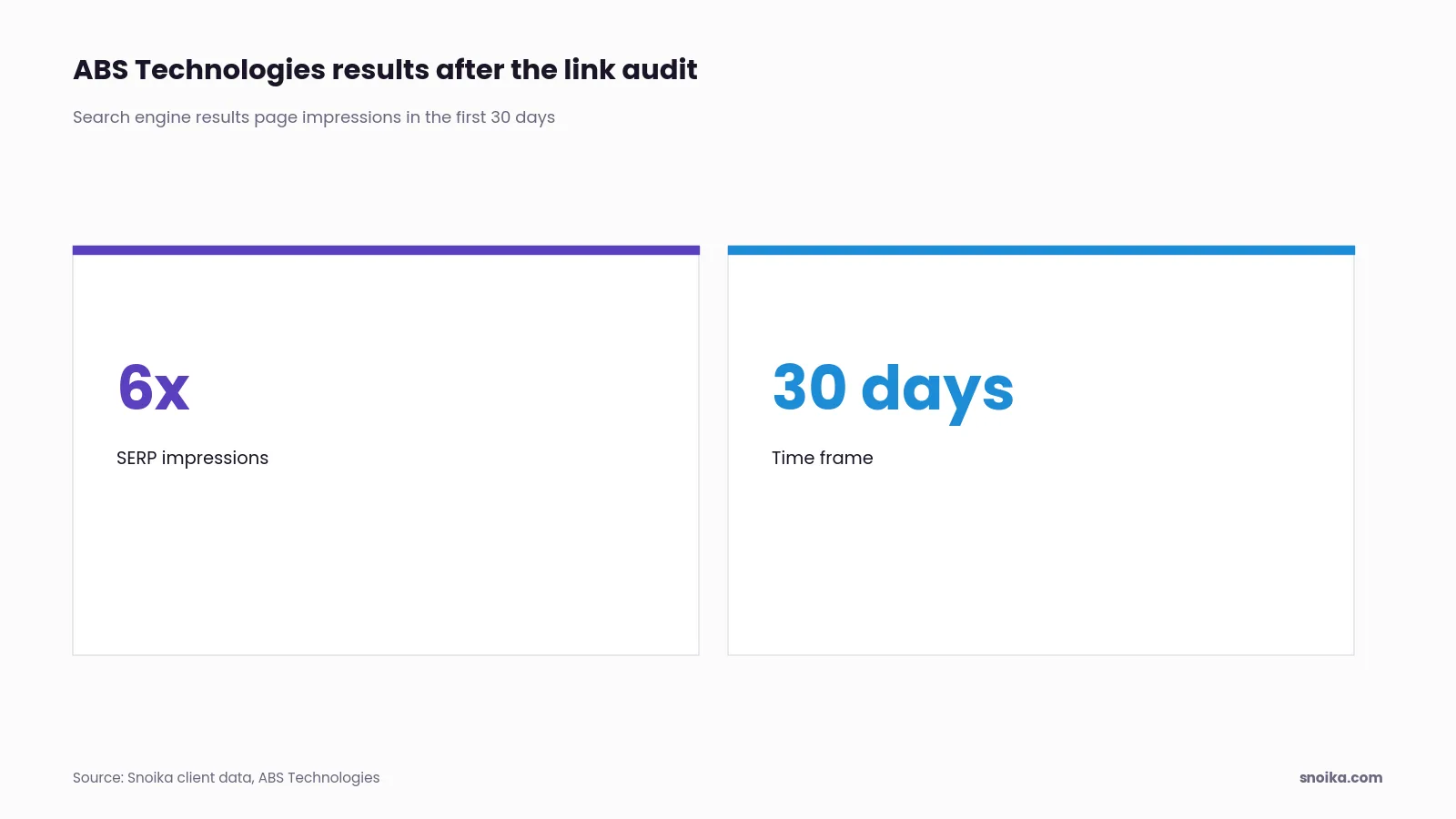
With CMS access, Snoika's team makes the fixes, and a person reviews the automated work before anything changes. Any new page goes live only after you approve it in the dashboard. For ABS Technologies, the results included "6x SERP impressions" (search engine results page impressions) and "improved keyword indexability" within the first 30 days. If the audit shows you have too few referring domains, Snoika also offers off-page SEO services as a visibility strategy.
FAQ
Snoika checks backlinks and internal links in one app. One report covers lost referring domains, orphan pages, broken links and weak paths to money pages, and our team can fix what it finds.
We check the status code of every page your backlinks land on and keep the 404 and 410 responses. Broken targets are sorted by how many referring domains point at them, then restored or redirected to a live page on the same topic.
Snoika compares the URLs a crawler reaches through your internal links with those in your sitemap, Google Search Console and analytics. Pages that appear in those sources but not in the crawl are orphans, and we link the useful ones from a relevant parent page.
Snoika's team fixes link issues for you, and a person reviews the automated work before anything changes. New pages go live only after you approve them in the dashboard.
Redirects and internal link edits fit into a sprint. Recovering lost backlinks takes longer because it depends on other site owners, who may choose not to restore them.