
How to optimize for AI search
Learning how to optimize for AI search means making your pages accessible to assistants like ChatGPT and Google AI Overviews so they can read and quote them. Begin by auditing where AI answers mention you today. Then you remove the technical blocks and rewrite pages so the answer sits in the opening lines. After that you add schema and build credibility on and off your site. Scheduled content refreshes and citation measurement follow.
 Artem LozinskyOperations and product, Snoika · 9 min read

























Start with an AI audit
An AI audit shows which buyer questions name you in AI answers and which name a competitor instead. It also checks whether AI crawlers can read your site at all. It's your baseline. If you skip it, you can't tell later whether a change worked or whether the answers just drifted. Plan for one focused day of work. Then rerun the same audit every quarter so your numbers stay comparable.
Which prompts to test
Write 20 to 50 prompts in the language your buyers use in a chat box. Include category questions ("best e-signature tool for small law offices") and comparison questions ("X vs Y for VAT filing"). Add problem questions where your product is one possible fix. Run each prompt several times, because a single answer tells you little. SparkToro, the audience research company led by Rand Fishkin, found there's less than 1 in 100 chance that ChatGPT or Google's AI gives the same list of brands twice for the same question. What holds steady is how often your brand appears across repeated runs.
What to record for each answer
For each prompt, log whether you're mentioned and whether your page is cited as a source. Note which competitor shows up where you don't. Then note the URL the assistant cited, even when it isn't yours. The cited-URL column matters most because it identifies the third-party pages that AI assistants trust in your category and where your brand needs to appear. The prompts where a rival wins and you're absent become your first fixes.
Which technical gaps to check
Check your site for the following gaps that keep good pages out of AI answers.
- robots.txt rules that block AI search crawlers
- CDN or firewall settings that reject bot traffic even when robots.txt allows it
- Key copy, prices or tables that only load through JavaScript
- Schema markup that's missing, or that doesn't match the text on the page
- Stale pages with old figures and no visible update date
Snoika runs this audit as the first part of onboarding. The team learns the category and its buyers, then establishes the goals. It asks for access to Google Analytics 4 (GA4) and Google Search Console, along with access to Google Tag Manager, so the AI findings sit next to real traffic data.
Allow AI crawler access
To appear in AI search results, you need to let the search crawlers of each AI platform reach your public pages, both in robots.txt and at the server level. Each company runs separate bots for separate jobs, and they're controlled one at a time. OpenAI's own crawler documentation says sites that block OAI-SearchBot "will not be shown in ChatGPT search answers." GPTBot is a different bot that collects training data, and you can block it without losing search visibility.
Decide whether you want to appear in AI search separately from whether you allow your content to be used for training. A common robots.txt setup allows OAI-SearchBot and blocks GPTBot.
``` User-agent: OAI-SearchBot Allow: /
User-agent: GPTBot Disallow: / ```
robots.txt is only half of the check. Google's guidance on AI features and your website tells site owners to make sure crawling is allowed "by any CDN or hosting infrastructure," too. Bot protection on a CDN returns errors to AI crawlers while the robots.txt file looks fine. Open your server logs and filter by user agent. If OAI-SearchBot requests come back with 403 or 5xx status codes, the problem sits in your firewall rules, and no content change will fix it.
Improve page speed
AI crawlers need your page to answer fast and to deliver the full text in the first HTML response. Delivering the full text in that response matters because a server-log study by Vercel and MERJ found that none of the major AI crawlers run JavaScript. OpenAI's crawler downloaded JavaScript files in 11.5% of requests but never executed them. Anything your site injects after load never reaches those crawlers. That applies to pricing tables and tabs, as well as reviews. In some single-page apps, even body copy loads this way.
Search for your main answer paragraph in a page fetched with JavaScript turned off or in the raw source. If it isn't there, switch that template to server-side rendering or static generation before you work on anything else.
For load speed, Google's Core Web Vitals give you clear targets. Google's web.dev thresholds apply to the 75th percentile of measurements from real visits.
| Metric | What it measures | Good | Poor |
|---|---|---|---|
| Largest Contentful Paint (LCP) | Loading | 2.5 seconds or less | Over 4 seconds |
| Interaction to Next Paint (INP) | Responsiveness | 200 ms or less | Over 500 ms |
| Cumulative Layout Shift (CLS) | Visual stability | 0.1 or less | Over 0.25 |
Largest Contentful Paint (LCP)
- What it measures
- Loading
- Good
- 2.5 seconds or less
- Poor
- Over 4 seconds
Interaction to Next Paint (INP)
- What it measures
- Responsiveness
- Good
- 200 ms or less
- Poor
- Over 500 ms
Cumulative Layout Shift (CLS)
- What it measures
- Visual stability
- Good
- 0.1 or less
- Poor
- Over 0.25
Google Search Console reports these numbers by URL group. Fix the templates behind your most-cited competitor topics first. A slow product page costs you more than a slow blog archive.
Structure content for parsing
AI systems quote passages, so open every section with a sentence that answers its heading and makes sense when it's lifted out alone. The model reads your page and pulls a few sentences that answer the user's question. A paragraph that warms up for three sentences before it reaches the answer gives the model nothing usable at the top. Write headings as the question or task the reader has. Put the answer directly under each one. Follow it with the reasons and the exceptions.
The fastest way to get cited by AI is to rewrite pages that already rank on Google's first page for your audit prompts. Google states that "there are no additional requirements to appear in AI Overviews or AI Mode." A page only needs to be indexed and snippet-eligible. Pages that already rank have cleared that bar. Add a direct answer and a sourced figure to one of them. With a clean table added too, you can see a change within weeks. A new page takes much longer.
Evidence matters as much as layout. The 2023 Generative Engine Optimization (GEO) study from researchers at Princeton and IIT Delhi tested additions of statistics and quotations to pages. With source citations also added, a page's visibility in generated answers rose by up to 40%. Keyword stuffing did worse than leaving the page alone. Name your sources in the sentence and use digits for numbers. Keep one idea per paragraph.
Check each rewritten page by reading only the first sentence under every heading. If those sentences answer the reader's questions in order, the page is ready for parsing.
Add schema markup
Schema markup tells AI systems who you are and what you sell on a page. It also conveys what the product costs and what people think of it. For products, the types that help most are `Product` (with `Offer` and `AggregateRating` nested inside) and `Organization` with `sameAs` links to your official profiles. Together they connect your product page to your brand and give assistants facts they can repeat without guessing.
Schema won't get a weak page cited. Google's guidance on AI features asks site owners to make sure "structured data matches the visible text on the page," and it lists no special markup for AI Overviews. Use JSON-LD to mark up only what a visitor can see. Update the markup whenever the page changes.
| Schema type | What it tells AI systems | Where to use it |
|---|---|---|
| Organization | Brand name, logo, official profiles (`sameAs`), contact | Home page and about page |
| Product with Offer | Product name, price, currency, availability | Every product or plan page |
| AggregateRating / Review | Rating value and review count from real customers | Product pages that show reviews |
| SoftwareApplication | App category, operating system, pricing | SaaS product pages |
| Article | Author, publish date, `dateModified` | Guides, blog posts, research |
| FAQPage | Questions and answers shown on the page | Pages with a visible question section |
Organization
- What it tells AI systems
- Brand name, logo, official profiles (`sameAs`), contact
- Where to use it
- Home page and about page
Product with Offer
- What it tells AI systems
- Product name, price, currency, availability
- Where to use it
- Every product or plan page
AggregateRating / Review
- What it tells AI systems
- Rating value and review count from real customers
- Where to use it
- Product pages that show reviews
SoftwareApplication
- What it tells AI systems
- App category, operating system, pricing
- Where to use it
- SaaS product pages
Article
- What it tells AI systems
- Author, publish date, `dateModified`
- Where to use it
- Guides, blog posts, research
FAQPage
- What it tells AI systems
- Questions and answers shown on the page
- Where to use it
- Pages with a visible question section
Validate every template with Google's Rich Results Test. Then compare one marked-up price or date against the visible page. A mismatch here is the most common error, and it teaches systems to distrust your markup.
Build topical credibility
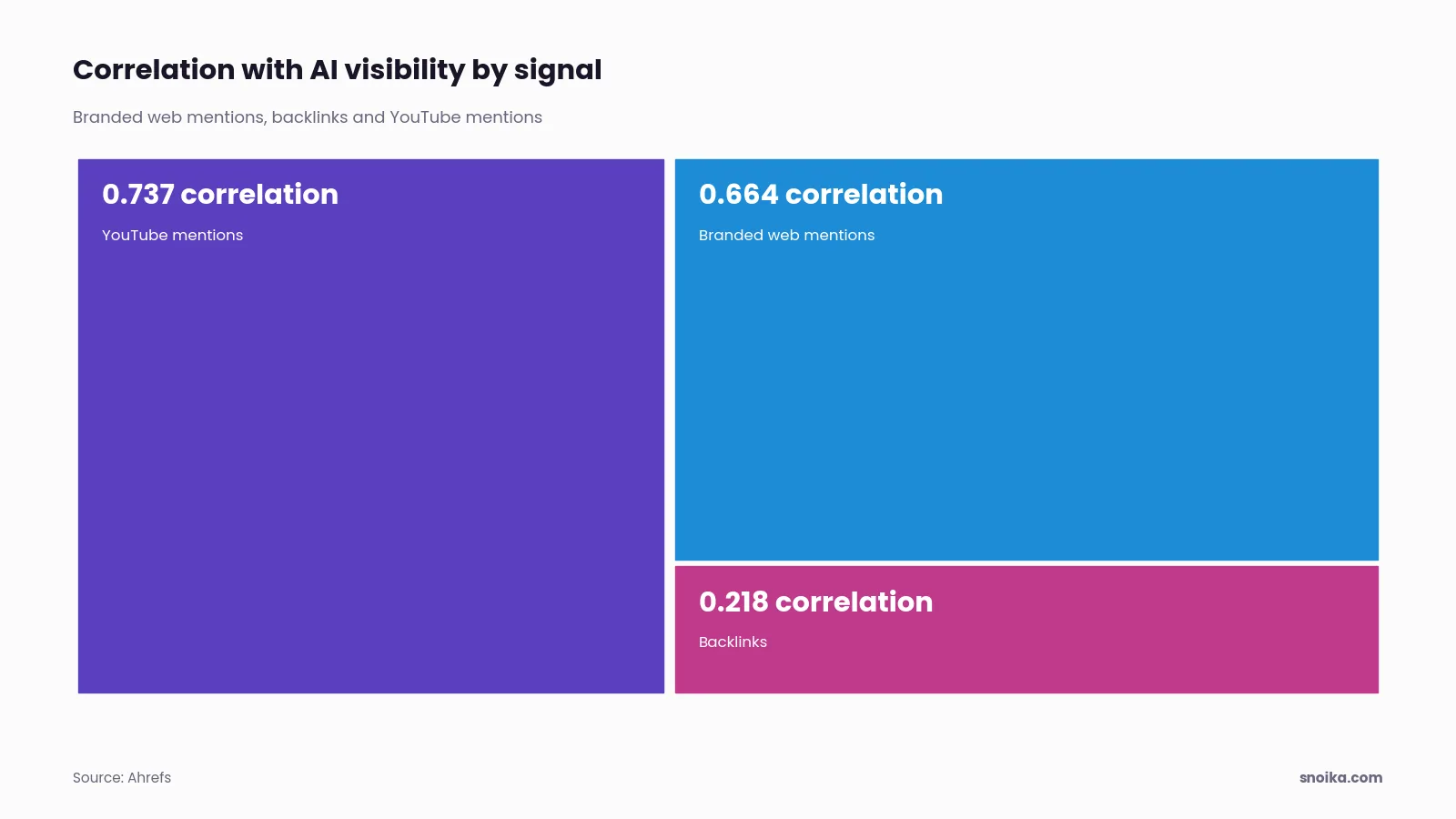
AI assistants recommend brands that the wider web already talks about, so credibility comes from what others publish about you as well as what you publish yourself. Ahrefs studied 75,000 brands and found that branded web mentions correlate with AI Overview visibility at 0.664, against 0.218 for backlinks. A follow-up study found YouTube mentions correlate even more strongly, at about 0.737 across ChatGPT and Google's AI Mode and AI Overviews.
On your own site, credibility means you cover a topic completely. Map every question a buyer asks throughout the purchase process. Then publish one page per question and link the pages so the cluster reads as a whole. A single strong page on a topic seldom beats a competitor with 20 linked pages that answer each sub-question in depth.
Off your site, go back to the cited URLs from your audit. Assistants already trust these review sites and industry roundups. The same holds for the forums and videos cited in your audit. Seek accurate mentions on those pages through product reviews and expert commentary. Data others can cite and partner content are other ways to earn those mentions. Regional markets need their own coverage, which is why Snoika's GEO services produce content in 135+ languages and regional variants. An assistant that answers in German draws on German sources.
3DPrinterOS achieved #1 visibility in ChatGPT for industry-specific queries and gained a steady 3–4 qualified inbound leads/day through AI search.
Refresh content on cycles
Refresh your commercial pages every quarter and your fast-moving topics every month, because AI assistants favor recently updated sources. Ahrefs analyzed 17 million LLM citations and found that AI-cited content is 25.7% fresher than the pages in Google's organic results. ChatGPT showed the strongest pull toward recent pages of any platform in that study.
Set each page's refresh cycle to match how quickly its facts go out of date.
| Page type | Refresh cycle | What to update |
|---|---|---|
| Pricing, plan and comparison pages | Monthly, or whenever a price changes | Prices, features, competitor details |
| Statistics and research roundups | Monthly | New figures, dead sources |
| Product and solution pages | Quarterly | Screenshots, specs, customer results |
| Evergreen how-to guides | Every 6 months | Steps, tool changes, examples |
Pricing, plan and comparison pages
- Refresh cycle
- Monthly, or whenever a price changes
- What to update
- Prices, features, competitor details
Statistics and research roundups
- Refresh cycle
- Monthly
- What to update
- New figures, dead sources
Product and solution pages
- Refresh cycle
- Quarterly
- What to update
- Screenshots, specs, customer results
Evergreen how-to guides
- Refresh cycle
- Every 6 months
- What to update
- Steps, tool changes, examples
During each refresh, swap in newer data and rewrite sections your audit flagged as weak. Add the sub-questions buyers now ask and remove claims that no longer hold. Then update `dateModified` in the schema and show the update date on the page. If you change only the date, a crawler finds the same text as last time, and you've told readers something false.
Measure citation gains
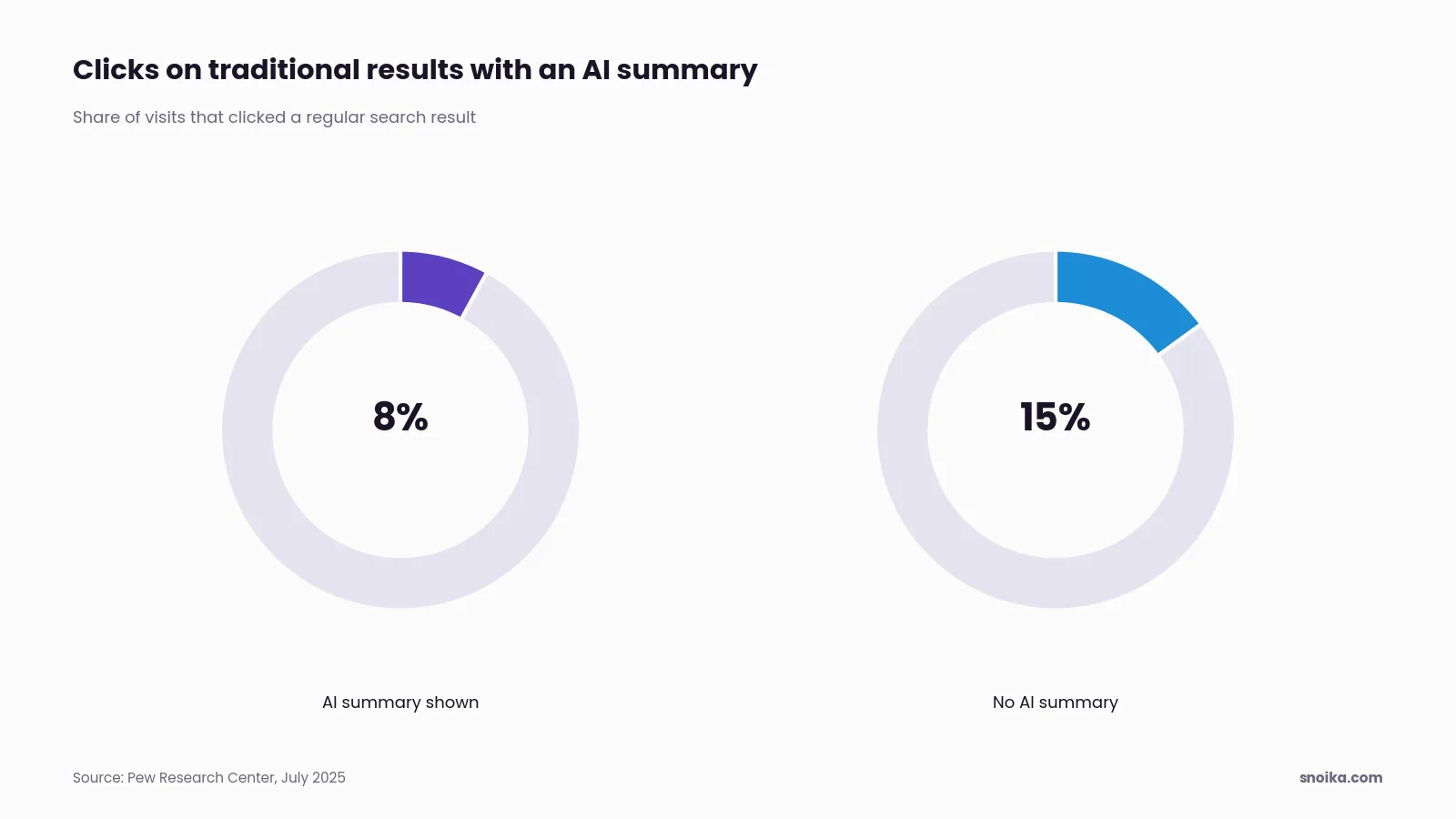
You measure progress by how often AI answers mention and cite you across your prompt set, tracked weekly against the audit baseline. Clicks alone won't show it. Pew Research Center tracked the searches of 900 US adults and found that people clicked a traditional result in 8% of visits when an AI summary appeared, against 15% without one. Your visibility can rise while referral traffic stays flat.
Track changes in each of the four measures below for every prompt group.
- Mentions: how often your brand appears in answers
- Share of voice: your mentions as a share of all brand mentions in the answers
- Sentiment: whether the assistant describes you accurately and favorably
- Citations: how often your own URLs are linked as sources
These are the measures Snoika's tracking uses, run on weekly prompt sets in ChatGPT and Google AI Overviews, where most AI search traffic happens. Weekly runs smooth out the randomness covered in the audit section, so a change in the trend reflects your work.
Pair the AI numbers with Google Search Console. Google counts AI Overview and AI Mode appearances inside the Performance report under the "Web" search type, so rising impressions on refreshed pages point the same way. Expect a timeline of months. Snoika's founder Anton Vedeshin reported to Startup Reporter 1StopVAT's move from 2.7% to 28.3% ChatGPT visibility in 16 weeks.
What to do next
Start with the audit and run it this week, before you change any code or copy. A list of 20 prompts with the cited URLs next to each one will show you what you need to know about how to optimize for AI search on your own site. It also catches the cheapest fix first. When a firewall blocks AI crawlers, none of the other seven steps can work, and that block takes ten minutes to remove.
Snoika tracks mentions and share of voice in ChatGPT and Google AI Overviews. It also tracks citations, and our team writes and publishes the content that closes the gaps on your own domain. To see where your brand stands now, check your AI visibility free with our AI visibility checker.
FAQ
The quickest starting point is improving pages already ranking on the first page for your target questions. Put a direct answer at the top and add a sourced figure. Changes can appear within weeks, while broader visibility gains can take months.
When deciding how to optimize for ai search, test 20 to 50 buyer questions repeatedly and record mentions alongside cited URLs. Prioritize questions where competitors appear and you don't, then check whether crawlers can access the relevant pages. Allow one focused day for the audit.
Use Product markup with Offer details on product pages, plus Organization markup with links to official profiles. Add AggregateRating only where genuine customer ratings are visible. Markup must match the page and doesn't guarantee a citation.
Review pricing pages and statistics monthly, updating prices whenever they change. Product pages generally need quarterly reviews, while evergreen guides need checks every six months. Update the visible date and dateModified after substantive edits, rather than changing dates on unchanged content.
AI citations can increase without more visits because readers may get their answer within the AI response. Track citation frequency and mentions weekly against your baseline, alongside referral traffic, rather than treating clicks as the only measure of progress.
Keep reading
All articles

