
Is generative engine optimization worth the investment
GEO pays off for B2B and ecommerce brands whose buyers already ask AI assistants to compare vendors, and it works best when solid SEO is already in place. It's a weaker bet for local or impulse-purchase businesses. For most companies that sell considered purchases, the answer to "is generative engine optimization worth it" is yes. Start with a fixed-length pilot that has exit criteria, and commit a full budget only after the pilot shows results.
 Jevgenia PogadajevaCFO, Snoika · 6 min read

























GEO deserves budget now
GEO deserves budget now because buyers have already moved their research into AI answers. Forrester's 2026 Buyers' Journey Survey of about 18,000 business buyers found that 94% used AI during their most recent purchase, and 55% used it to compare vendors. Sam Altman, CEO of OpenAI, said at DevDay in October 2025 that ChatGPT had reached 800 million weekly users. "AI has gone from something people play with to something people build with every day," he told developers.
In 2024, Gartner predicted that traditional search volume will drop 25% by 2026. Alan Antin, Vice President Analyst at Gartner, said generative AI tools "are becoming substitute answer engines." The timing matters because an AI answer names only a handful of vendors, so each spot on that list is worth more than one position on a page of ten links. Before you fund anything, ask your sales team how often prospects mention ChatGPT. Then check how many GA4 referral sessions come from chatgpt.com.
What GEO actually costs
In 2026, GEO costs anywhere from a few dollars a month for a monitoring tool to five figures a month for a full agency program. Where you land depends on how much of the work your own team can do. One agency's 2026 cost guide puts DIY tools at $10 to $1,000+ a month and agency services at $1,500 to $50,000+ a month.
| Option | Typical price (2026) | What you get | Who it suits |
|---|---|---|---|
| Monitoring-only tool | $10 to $1,000+ per month | Dashboards of AI mentions. Your team makes the fixes. | Teams that already have writers and SEO staff |
| GEO agency | $1,500 to $50,000+ per month | Strategy, content and outreach, done for you | Larger brands that want to outsource the whole job |
| In-house team | Salaries plus tool licenses | Full control, but slow to get going | Enterprises with established content operations |
| Snoika | Plans on the pricing page | 100 AI prompts tested weekly, 3 AI platforms monitored, monthly AI visibility report | Smaller teams running a first pilot |
| Snoika | Plans on the pricing page | 500+ AI prompts tested weekly, all AI platforms monitored, dedicated account manager | Companies competing across several AI platforms |
Monitoring-only tool
- Typical price (2026)
- $10 to $1,000+ per month
- What you get
- Dashboards of AI mentions. Your team makes the fixes.
- Who it suits
- Teams that already have writers and SEO staff
GEO agency
- Typical price (2026)
- $1,500 to $50,000+ per month
- What you get
- Strategy, content and outreach, done for you
- Who it suits
- Larger brands that want to outsource the whole job
In-house team
- Typical price (2026)
- Salaries plus tool licenses
- What you get
- Full control, but slow to get going
- Who it suits
- Enterprises with established content operations
Snoika
- Typical price (2026)
- Plans on the pricing page
- What you get
- 100 AI prompts tested weekly, 3 AI platforms monitored, monthly AI visibility report
- Who it suits
- Smaller teams running a first pilot
Snoika
- Typical price (2026)
- Plans on the pricing page
- What you get
- 500+ AI prompts tested weekly, all AI platforms monitored, dedicated account manager
- Who it suits
- Companies competing across several AI platforms
The price tag hides the biggest variable, which is who does the work after the data arrives. A monitoring tool shows you where you're missing, but the page that fills the gap still needs to be written. Snoika combines a platform with GEO agency services under one team whose staff review the output of the automated workflows. Whichever option you look at, check whether the price covers content creation and publishing. Confirm whether a tracking-only price applies instead.
ROI metrics that matter
To measure ROI from GEO, link visibility in AI answers to traffic, then link traffic to revenue. Read the layers in that order, because each one moves later than the one before it.
How often AI answers name your brand
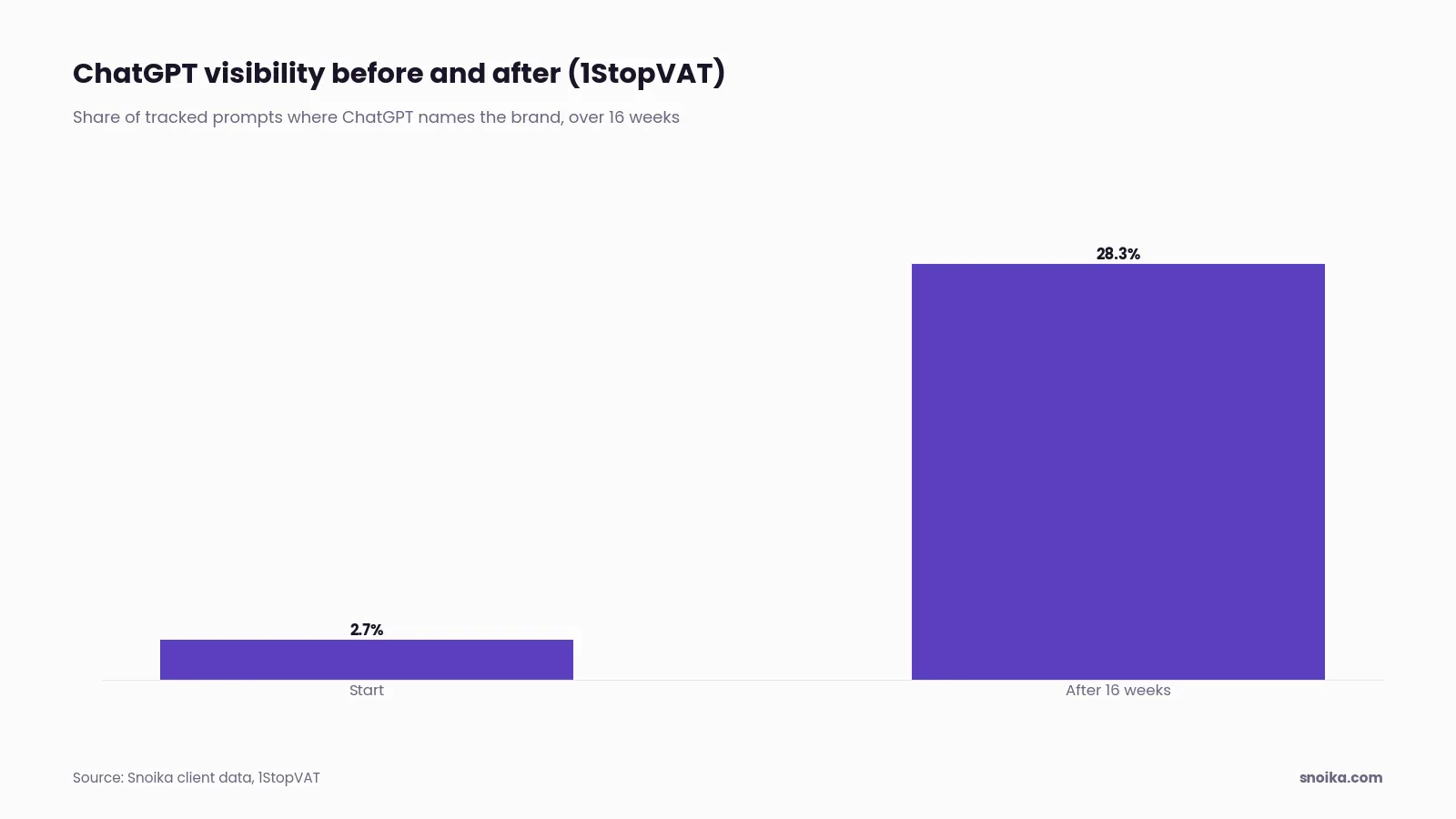
Share of voice, the core number, is the percentage of tracked buyer prompts where your brand appears. Snoika uses weekly prompt sets to track mentions and share of voice in ChatGPT and Google AI Overviews. It also records sentiment and citations. Snoika's founder Anton Vedeshin reported to Startup Reporter 1StopVAT's move from 2.7% to 28.3% ChatGPT visibility in 16 weeks. Citations count separately from mentions, because a citation links the answer back to your page.
What AI referral traffic does on your site
In GA4, look at referral sessions from AI platforms and compare their conversion rate with your other channels. Adobe found that AI-referred shoppers converted 31% more often than visitors from other sources during the 2025 holiday season. Expect low volume at first. Judge this layer on the quality of the visitors before you judge it on the count.
Whether it reaches the pipeline
Add "AI assistant" as an option in your "How did you hear about us?" field. Then count qualified inbound leads that name it. 3DPrinterOS turned AI search into a steady inbound lead source of 3–4 qualified inbound leads/day. To calculate ROI, subtract what you spent on GEO from the revenue attributed to it and divide the result by what you spent.
Risks of ignoring AI visibility
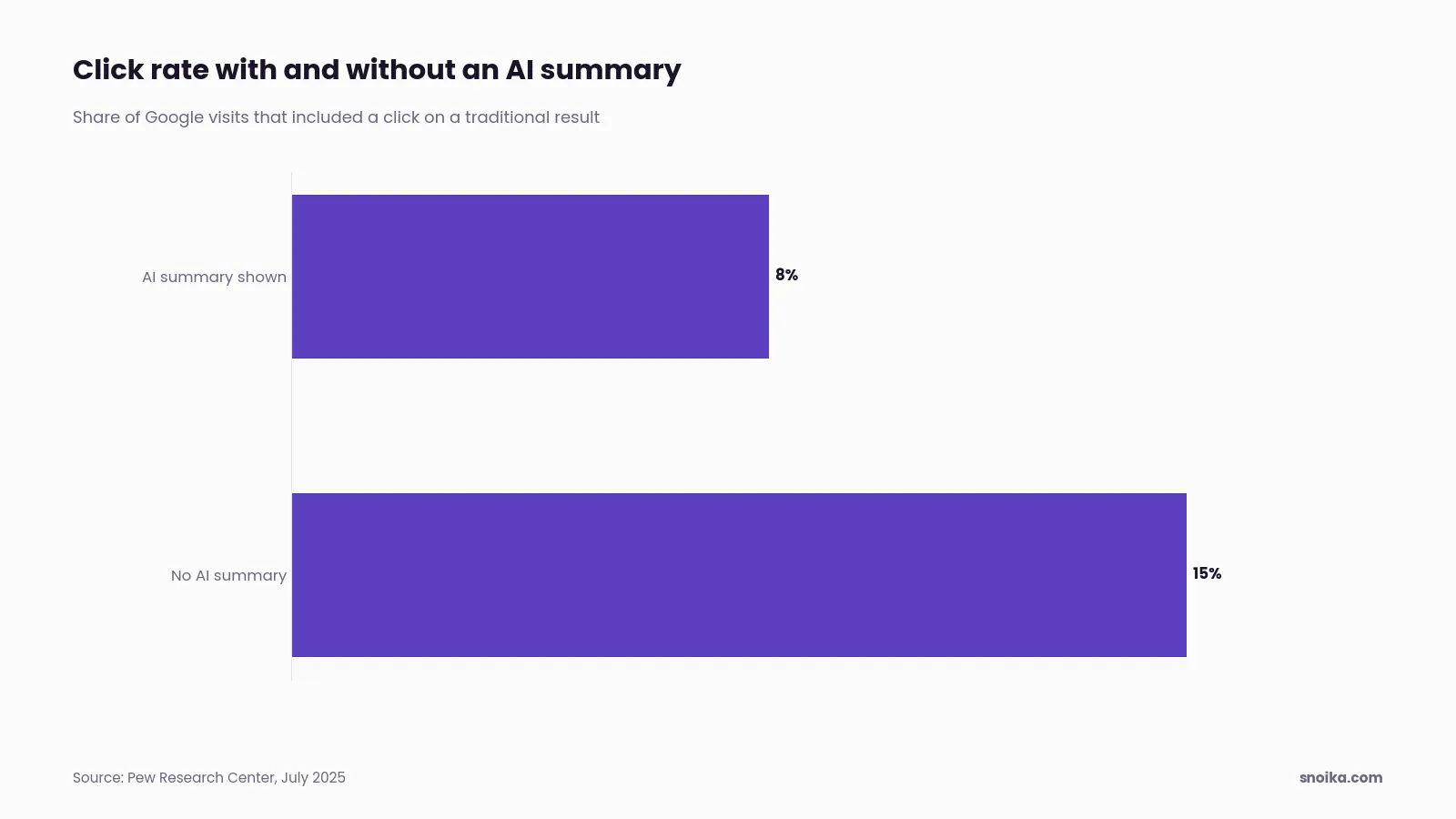
If you don't invest in GEO, buyers build their shortlist without you, and your analytics won't record the loss. Pew Research Center studied 68,879 Google searches. When an AI summary appeared, users clicked a result in 8% of visits, compared with 15% when no summary appeared. You never see a session when the buyer forms a view from the answer and moves on.
A second risk is the AI describing you wrongly. Old pricing or a dropped product can sit in answers for months while nobody on your team checks. A competitor's framing can persist just as long. Vespia, a fintech SaaS, recorded a 220% increase in AI brand mentions, which shows the risk of how quickly one company in a category can take more of the answer. To check your exposure, run your top 20 buyer questions in ChatGPT and write down who gets named.
GEO spend versus SEO
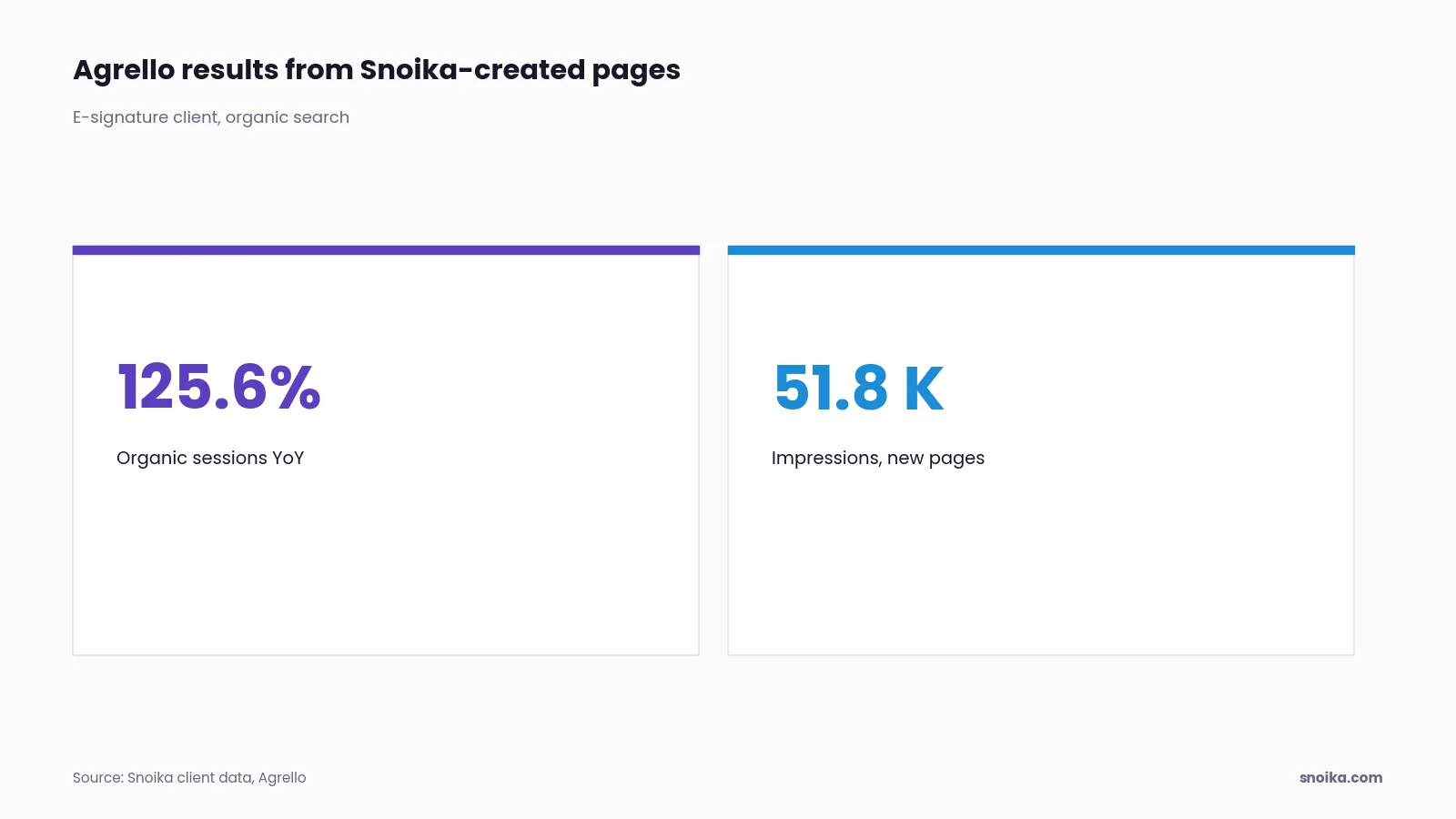
GEO spend goes on top of SEO and draws on the same assets. AI assistants pull from indexed web pages, so crawlable sites and useful content still decide what gets cited. Generative engine optimization targets answer-first pages and comparison content. Third-party mentions are another target, and citations measure success. GEO and SEO support each other, as Agrello, in e-signature, saw +125.6% organic search sessions YoY and generated 51.8K impressions from Snoika-created pages.
Content location matters for both channels, and Snoika uses a DNS connection to publish on the client's own domain. It works on any CMS without a migration, and the client approves each page in a dashboard first. That way the authority builds on your site. If your technical SEO is weak, fix that before you fund GEO. If it's strong, move one content workstream over to answer-first formats.
Building the internal business case
Show where AI answers already shape your buyers' shortlists, then ask for one pilot with a fixed length and scale-or-stop criteria agreed in advance. Leave the acronyms out of the meeting. Leaders approve outcomes.
- Record a baseline. Run 20 to 50 real buyer prompts in ChatGPT and Google AI Overviews, and note which brands appear.
- State the gap in one sentence, such as "A rival appears in 31 of 40 buyer prompts, and we appear in 6."
- Multiply expected AI referral sessions by your conversion rate to estimate conversions, then multiply that estimate by average deal value to put a price on the gap.
- Ask for a pilot of 12 to 16 weeks with a capped budget.
- Write the scale-or-stop thresholds down before the pilot starts.
Measuring GEO success early
Visibility metrics show early success within weeks, while traffic and pipeline take months. Track changes in ChatGPT visibility every week during a pilot.
Set up measurement before any content goes out. Snoika's onboarding asks for access to GA4 and Google Search Console. It also requests Google Tag Manager access, plus CMS access when it will publish pages, so the baseline exists from day one. Keep your prompt set the same throughout the pilot. AI answers change from one run to the next, so read the trend across several weeks and ignore single results.
A realistic GEO budget
Base your budget for AI search optimization on what one new customer is worth. If a single deal from AI search would pay for a quarter of GEO work, the pilot carries little risk. For example, 13 weeks on Snoika's Starter plan cost €3,224. For a B2B company with five-figure contracts, that's a small bet.
Next, fund a one-quarter pilot at an entry tier. Move to broader platform coverage only after share of voice rises. Multi-brand groups need custom scope, which is what Snoika's Enterprise plan is priced for.
When GEO pays off fastest
GEO pays off fastest in niche categories with considered purchases, where buyers ask detailed questions and few competitors have published clear answers. 3DOS reached top visibility in ChatGPT for targeted industry queries and saw 2x registered users growth. In technical markets like that one, a single strong page can answer the questions that stay unanswered elsewhere.
Language offers another fast route because competitors publish only in English while buyers ask AI assistants questions in their own language. Snoika creates content in 135+ languages and regional variants. Payback is slowest for commodity products and local services. Sites with no SEO foundation share that slow pace. Approval delays in regulated industries also slow it down.
When it is worth it
Run your baseline this month before you set a budget to judge whether generative engine optimization is worth it for you. The baseline identifies any gap worth paying to close and provides a yardstick for any later pilot, whoever runs it. Without a baseline, you can't prove a result. Our team tracks how ChatGPT and Google AI Overviews describe your brand, then turns the gaps into pages on your own domain. Get a free AI visibility report to see where you stand today.
FAQ
Subtract GEO spending from revenue attributed to it, then divide the result by that spending. Track AI referral conversions and leads that report finding you through an AI assistant. More mentions alone don't prove a financial return.
You risk being absent from buyers' shortlists or having outdated information shape their decisions. These losses may never appear in website analytics. Check your top 20 buyer questions in AI assistants to see whether competitors appear and whether your details are accurate.
Set a capped pilot budget based on what one new customer is worth and how much work your team can handle. The page lists monitoring tools at $10 to $1,000+ monthly, but content work costs extra unless included. Compare the full quarter's spending with expected customer value.
Plan a 12- to 16-week pilot with scale-or-stop criteria agreed before it begins. Visibility can improve within weeks, while traffic and pipeline take months. Keep the same buyer questions throughout testing so weekly trends provide a consistent basis for your decision.
Delay spending if your technical SEO needs fixing or there's little evidence your buyers research purchases through AI. For local or impulse-purchase businesses, the answer to “is generative engine optimization worth it” is less likely to be yes.
Keep reading
All articles

