
How to rank on Perplexity
To rank on Perplexity, your page has to be picked as one of the numbered sources under an answer. Perplexity searches the live web for every question to retrieve a short list of candidate pages. It cites the few that answer clearly and look trustworthy. The four jobs needed to rank on Perplexity begin with crawler access and an answer near the top of the page. They also require claims backed by named sources and authority on one topic.
 Artem LozinskyOperations and product, Snoika · 9 min read

























Citation checklist for Perplexity
To get cited on Perplexity, your site needs crawler access that works and pages that load as plain HTML. Each page also needs an answer the system can lift in one piece. Run the checks below in order, because a page Perplexity can't fetch never reaches the later checks. The technical checks take an afternoon, and the content checks apply to every page you want cited.
Can PerplexityBot and Perplexity-User reach the page?
Of Perplexity's two agents, PerplexityBot builds the search index, while Perplexity-User fetches a page in real time when someone's question needs it. Perplexity's own documentation recommends allowing PerplexityBot in robots.txt and accepting requests from its published IP ranges. It also says changes can take up to 24 hours to show up.
- Open robots.txt and confirm neither agent sits under a blanket rule written to block AI training bots.
- Check your firewall and bot-management settings. Cloudflare de-listed Perplexity as a verified bot in August 2025 after it measured an undeclared Perplexity crawler making 3-6m daily requests. Since then, default rules on a lot of stacks treat Perplexity traffic with suspicion.
- Fetch a page with the PerplexityBot user-agent string and confirm you get a 200 status and the full HTML back.
- Search your server logs for both agents. If you find a 403 status or a JavaScript challenge, allowlist them by user agent and by the published IP ranges.
Does each page give an extractable answer?
- The question the page targets gets a direct answer in its first 100 words.
- Each H2 answers one sub-question, and the first sentence under it gives the answer.
- Every figure names its source and links to it.
- The page shows a visible "last updated" date that matches the date in your markup.
- The core facts sit in the HTML on first load, with no need for user interaction or scripts.
How Perplexity selects sources
Perplexity selects sources in two passes, with retrieval of candidate pages for the query followed by reranking. It cites the pages that best support the answer it writes. Its help center says it searches the internet in real-time and that every answer carries numbered citations back to the original sources. Aravind Srinivas, Perplexity's CEO, said at Bloomberg's Tech Summit that the engine handled 780 million queries in May. He added: "Give it a year, we'll be doing, like, a billion queries a week if we can sustain this growth rate."
Outside analysts have reconstructed Perplexity's unpublished ranking logic from observed behavior. An analysis by AuthorityTech found the system pulls 5 to 10 candidate pages and cites 3 to 4 sources. That means most retrieved pages get dropped before the answer is assembled. Treat the stages below as a working model.
| Stage | What it checks | What you control |
|---|---|---|
| Query parsing | What the user is asking and how recent the answer must be | Headings phrased the way buyers phrase the question |
| Retrieval | Keyword match plus meaning match against the index | Crawl access, plain wording, the entity named early |
| Reranking | Relevance, freshness and source authority | Updated dates, sourced figures, mentions on other sites |
| Synthesis | Which passages support each sentence of the answer | Self-contained paragraphs that quote cleanly |
Query parsing
- What it checks
- What the user is asking and how recent the answer must be
- What you control
- Headings phrased the way buyers phrase the question
Retrieval
- What it checks
- Keyword match plus meaning match against the index
- What you control
- Crawl access, plain wording, the entity named early
Reranking
- What it checks
- Relevance, freshness and source authority
- What you control
- Updated dates, sourced figures, mentions on other sites
Synthesis
- What it checks
- Which passages support each sentence of the answer
- What you control
- Self-contained paragraphs that quote cleanly
Your page competes at every stage, and a fault at retrieval can't be fixed by better writing at synthesis. When a page is indexed but never cited, look at reranking first.
Structured content wins citations
Perplexity prefers content it can quote without rewriting. Use direct definitions and paragraphs that stand on their own. Present procedures as numbered steps and comparisons in tables. The answer engine builds sentences out of passages, so a passage that only makes sense with the three paragraphs before it is hard to use. Each block in a cited format answers one question by itself.
- Definition paragraphs put the term and a one-sentence meaning at the top of the page.
- Numbered steps fit any task done in order, with one action per step.
- Tables suit options compared on the same attributes, such as prices and limits. Dates also work as a comparison attribute.
- Question-led H2s match the way people type into Perplexity and give each answer a clear boundary.
- Original data, such as your own survey or benchmark, gives the engine a figure it can only credit to you.
Kevin Indig, a growth advisor, studied ChatGPT citations and found 44.2% of citations came from the first 30% of a page's content. The study's scope was ChatGPT, but both engines take passages from retrieved pages, so front-loading your answer is a safe bet on either.
Researchers from Princeton and Georgia Tech worked with colleagues from the Allen Institute for AI and IIT Delhi to test edits on pages. They found that statistics and quotations, when added alongside citations, lifted visibility in generative engines by up to 40%. You can check your own pages for this quickly. Count the claims that carry a number or a named source. If there are none above the fold, start there.
Domain authority still matters
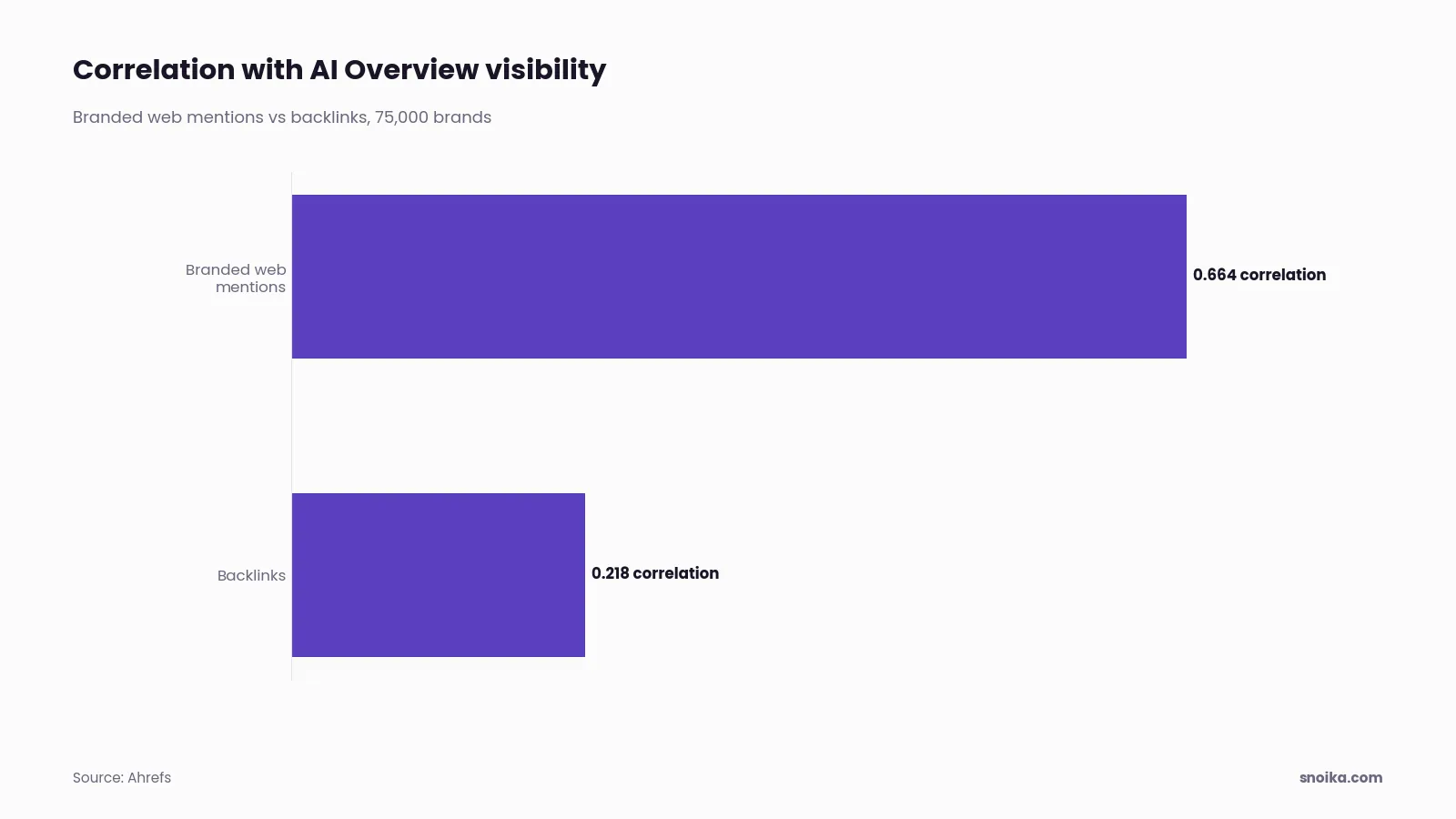
Authority still counts on Perplexity, but the engine reads it from more than your backlinks. In a study of 75,000 brands, Ahrefs found that branded web mentions correlated with AI Overview visibility at 0.664 versus 0.218 for backlinks. That finding concerns Google's AI feature and supports the same point about authority. What other sites say about you counts for more than the number of links pointing at you.
A Semrush study of 230,000 prompts found Reddit and LinkedIn among Perplexity's top sources. NIH and Microsoft also ranked among the top sources, as did Google. A mid-sized brand earns authority through its own pages and the places where buyers already discuss the category. Those discussions happen in threads and profiles, as well as in trade publications.
A blog on a separate subdomain or a rented platform builds authority for that host. Through a DNS connection that requires no migration, Snoika publishes pages on the client's own domain. Every citation those pages earn then adds to the main site. Before you invest in new content, check that it will sit on the domain you want cited.
Schema markup boosts visibility
Schema markup helps Perplexity trust a site when it states the same facts as the visible page. It won't lift a weak page on its own. Mark Williams-Cook, an SEO consultant at Candour, ran a February 2026 test. He hid a fake address in invalid JSON-LD on a page for a made-up company. The LLMs he asked, Perplexity among them, returned the address anyway. In his words: "I built a fake company with nonsense schema. The LLMs returned the address anyway." His conclusion was that AI models read structured data as plain text instead of parsing it the way Google does.
Treat schema as a second, tidy copy of your key facts, and keep it consistent with the page.
- Organization, with your legal name and logo, plus sameAs links to your profiles on other sites.
- Article, with an author, datePublished and dateModified.
- FAQPage or HowTo, only where the same questions or steps appear visibly on the page.
- Product or Service, with prices and descriptions that match the visible text.
Most sites get dates wrong. Ahrefs analyzed 17 million citations across 7 AI search platforms. It found that Perplexity's in-text references appear ordered from newest to oldest. So a dateModified that never changes, or that doesn't match the visible date, works against you. Update the date when you change the substance of a page, and only then.
Measure your Perplexity presence
To find out whether Perplexity already cites your company, ask it the questions your buyers ask. Record which sources it cites and repeat the same set on a fixed schedule. A single search tells you little, because answers shift with phrasing and with what's been indexed that week. A fixed prompt set run weekly gives you a trend you can trust.
- Write category questions and comparisons in your buyers' words. Add "best tool for" searches in the same language. Leave out your brand name.
- Run each prompt in Perplexity and log every cited URL, along with any mention of your brand in the answer text.
- Note which competitors appear when you don't, and which of their pages get cited.
- Check Google Analytics 4 (GA4) for referral sessions from perplexity.ai.
- Look in your server logs for Perplexity-User hits, which show real-time fetches of your pages.
Snoika uses weekly prompt monitoring to measure mentions and share of voice in ChatGPT and Google AI Overviews at scale. It also tracks sentiment and citations. A steady baseline shows whether your work is moving the number. Snoika's founder Anton Vedeshin reported to Startup Reporter 1StopVAT's move from 2.7% to 28.3% ChatGPT visibility in 16 weeks.
| Metric | What it tells you | Where to find it |
|---|---|---|
| Citation rate | Share of prompts where your URL is a numbered source | Your prompt log |
| Mention rate | Share of prompts where your brand is named in the answer | Your prompt log |
| Share of voice | Your citations against competitors' on the same prompts | Your prompt log |
| Referral sessions | Visits that clicked through from an answer | GA4 |
| Real-time fetches | Pages Perplexity reads live for user questions | Server logs |
Citation rate
- What it tells you
- Share of prompts where your URL is a numbered source
- Where to find it
- Your prompt log
Mention rate
- What it tells you
- Share of prompts where your brand is named in the answer
- Where to find it
- Your prompt log
Share of voice
- What it tells you
- Your citations against competitors' on the same prompts
- Where to find it
- Your prompt log
Referral sessions
- What it tells you
- Visits that clicked through from an answer
- Where to find it
- GA4
Real-time fetches
- What it tells you
- Pages Perplexity reads live for user questions
- Where to find it
- Server logs
Topical depth beats breadth
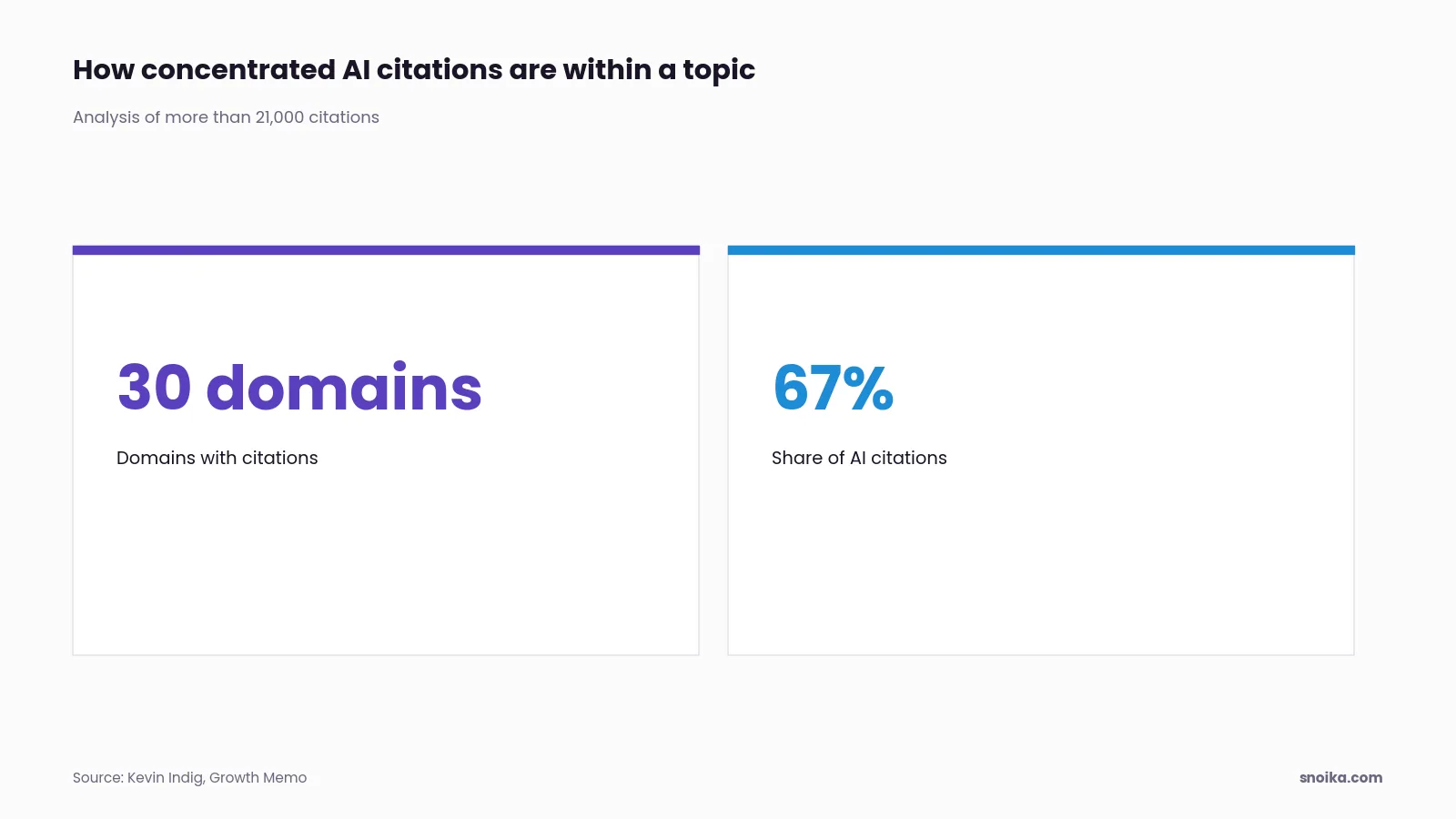
A site that covers one subject in depth gets cited more than a site with thin pages on dozens of subjects. Kevin Indig's Growth Memo analysis of more than 21,000 citations found that about 30 domains hold 67% of AI citations within a topic. The same analysis found that one evergreen page covering 10 or more query intents is worth more in citation reach than 10 single-intent pages.
Depth means you answer the whole set of questions a buyer has about your category. Define the subject and explain how it works. Compare costs and options, and explain the mistakes people make. Map those questions before you write, and group them so each page owns a cluster without overlapping its neighbors. A content map like this keeps two of your own pages from competing for the same prompt.
Here's what that looks like in practice. 3DPrinterOS, a 3D printing software company, focused its content on its own industry's questions. It "achieved #1 visibility in ChatGPT for industry-specific queries" and turned AI search into a steady source of "3–4 qualified inbound leads/day." To test your own depth, list the 20 questions a buyer asks before purchase and mark which ones your site answers on a dedicated page.
Common citation killers
Most pages that get retrieved but never cited fail for a short list of fixable reasons. None of the fixes needs new content, so check these before you write anything else.
- JavaScript-only rendering. If the main text appears only after scripts run, the fetcher sees an empty shell. Serve the core content in the first HTML response.
- Interstitials and walls. Cookie overlays and newsletter pop-ups that cover the text can block a clean fetch. Login gates can do the same.
- Claims with no checkable source. A line like "industry-leading results" gives the engine nothing to quote. One sourced figure beats a paragraph of adjectives.
- Stale figures. A 2022 statistic on a page dated last week erodes trust in the date and in the page.
- Contradicting consensus without evidence. A page that disagrees with the other sources gets dropped unless it shows its data.
- Duplicate pages on one question. Two thin pages split the signals that one strong page collects.
- Canonical and noindex errors. A stray noindex tag or a canonical that points somewhere else removes the page from the candidate pool entirely.
What to do next
Start with the crawler checks, this week, before you write or rewrite anything. A page that returns a 403 status to Perplexity-User can't be cited, however well it's written, and the fix takes one firewall rule. Then record a baseline with a fixed prompt set, so you can see which changes actually moved your citations. When you work out how to rank on Perplexity, check access before measurement and address content afterward.
Snoika audits websites and tracks brand visibility in Google and AI assistants, with a human review layer on top of its automated workflows. To see where your brand stands today, check your AI visibility free.
FAQ
Run buyer questions without your company name and check whether your URLs appear as numbered sources. Repeat the same prompts weekly to track changes. A company mention isn't a citation, and referral traffic measures clicks rather than every appearance as a source.
Self-contained passages work best because Perplexity can quote them without surrounding context. Use numbered steps for procedures and tables for comparisons. Each section should answer its question directly rather than depend on earlier paragraphs.
Structured data should match the facts readers can see, including the page's update date. Keep core text available in the initial HTML response so crawlers can read it. Technical consistency supports the content but can't compensate for unsupported claims.
There's no fixed timeline for earning citations after an update. Perplexity's crawler documentation says access changes can take up to 24 hours to appear, but that isn't a citation deadline. Track the same questions weekly to assess whether your changes affect source selection.
An indexed page may lose out when Perplexity compares its relevance and source authority with other candidates. When assessing how to rank on perplexity, check for outdated figures or unsupported claims. Replace them with current, named evidence that directly supports the answer.


