
Google AI Overviews tracker for your prompts
Our AI Overview monitoring runs every week on the prompts your buyers type. It shows which of those prompts return a Google AI Overview and whose pages get cited when one appears. The result is a weekly record of where your brand shows up and where competitors take the space. The first step is a free AI visibility audit built on prompts written for your brand, which needs no access to your systems and shows how often overviews appear for your category at all.
Trusted by

























Track AI Overview appearances
To see when your brand appears in Google AI Overviews, we run a fixed set of buyer prompts every week. For each prompt we record whether an overview shows and whether your pages are cited in it. Each run also notes whether the brand is mentioned without a link, which is a weaker result than a citation.
Pew Research Center found that 18% of Google searches in March 2025 produced an AI summary. That's why we put the prompt set ahead of raw keyword volume and write prompts that sound like buyers' questions. Full questions trigger overviews more often than short head terms do.
Which prompts trigger AI Mode
Searchers activate AI Mode themselves and bring longer questions with several parts, such as comparisons or "which one should I pick" queries. Google's documentation describes query fan-out, issuing multiple related searches as the process AI Mode uses to search across subtopics before it writes an answer. So the prompts worth flagging in your set are the multi-step ones: prompts that name two options, add a constraint or ask for a recommendation.
Monitor brand citation sources
We monitor which sources Google cites by recording every cited URL for every tracked prompt each week. Then we split the list into your pages and everyone else's, so you can see which of your URLs Google actually uses.
Citations are rarely a single slot. Pew found that 88% of AI summaries cited three or more sources, so you can share an overview with rivals and still win a place in it. We compare the page Google cites against the page you'd want cited. A gap there means your best answer is buried or missing.
How Google selects cited sources
Google picks cited sources from pages it has already indexed, then matches them to the sub-questions behind the prompt. Two parts of that process explain most of what we see in tracking data.
Eligibility comes first
Google says a page must be indexed and eligible for a snippet to appear as a supporting link, with no extra technical requirements. A page that's blocked or missing from the index can't be cited, however good it is. So when a strong page never shows up, we check indexing before anything else.
Fan-out widens the pool
Fan-out breaks one prompt into related searches. A page that answers one narrow sub-question can therefore be cited next to a broad guide. That's how smaller sites earn citations on prompts they'd never rank for in the classic results.
Closing the gaps
When tracking reveals a gap in your coverage of a sub-question, we can write the page. Pages we create go live on your own domain through a DNS connection. That works on any CMS, and you approve every page in the dashboard before it's published.
Citation share across competitors
To show whether competitors get cited in AI Overviews more often than you, we compare citation counts across the same prompt set, week by week. Our tracking records which competitors appear in place of your brand. It also measures share of voice and sentiment, so you know how often a rival appears and how the overview describes them.
Citation share moves by topic. For example, a competitor leads on pricing prompts while you lead on integration questions. That's why we report share per prompt cluster instead of as one blended number, which hides the clusters where you're losing.
Alerts for new AI Overviews
Each weekly run compares results with the week before, so prompts that start returning an overview stand out. A new overview with a competitor cited and your brand absent is the highest-priority item in any week.
Teams that want this data outside our dashboard can use the Snoika MCP server and the Snoika API. You can pull visibility data into BI dashboards or into AI assistants such as Claude or Cursor. The same access automates reporting and can trigger content workflows when a gap appears.
Tracking AI Mode separately
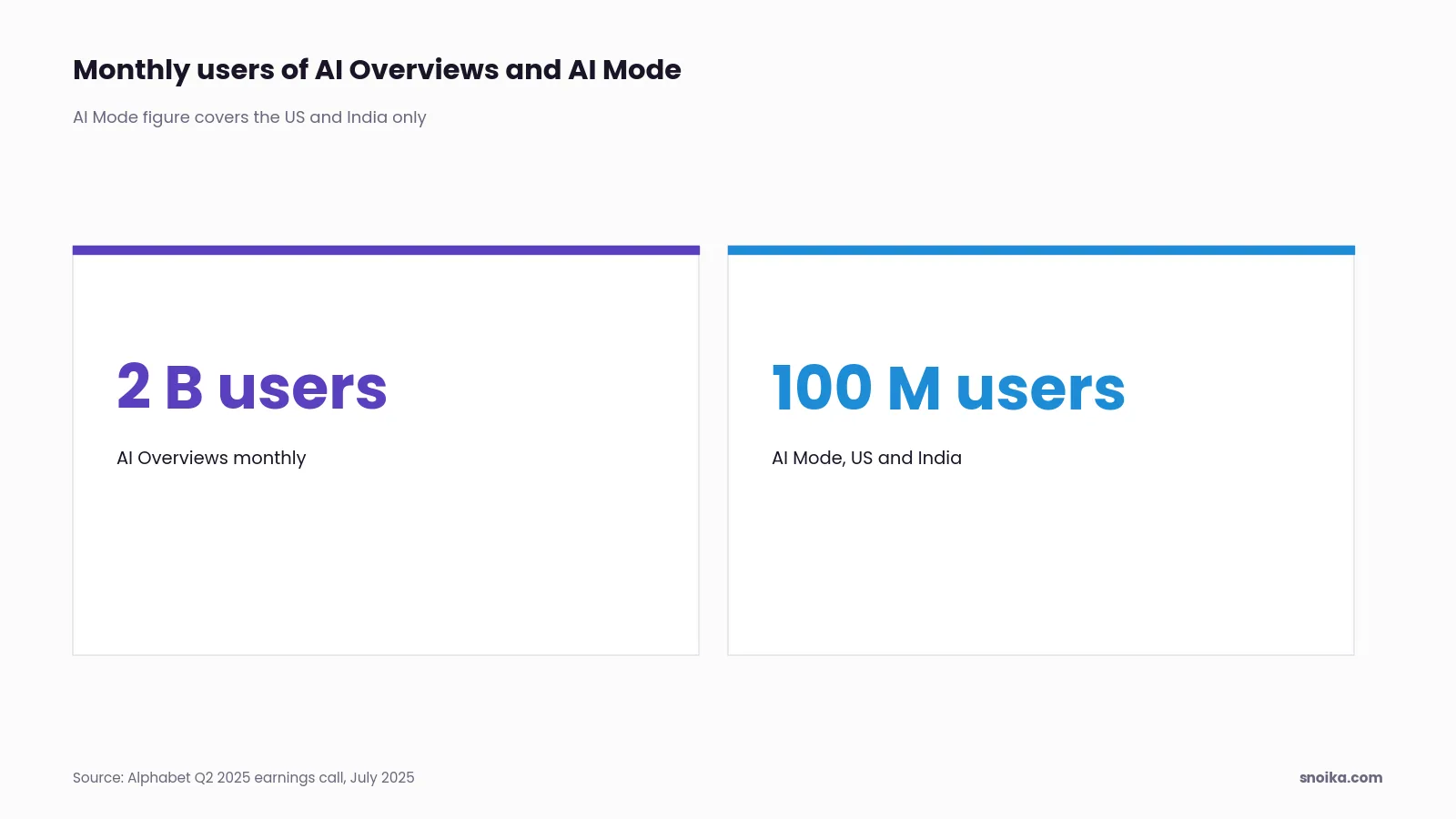
AI Mode needs its own view because it's a different surface from the overview at the top of the results page. Its separate tab contains longer answers and a different set of links. Sundar Pichai, CEO of Alphabet, reported that AI Mode had 100 million monthly users in the US and India in mid-2025.
Our weekly tracking covers Google AI Overviews and ChatGPT. We interpret citation share separately for AI Overviews and AI Mode, and we recommend keeping the surfaces in separate rows when you report to leadership.
Why citation monitoring matters
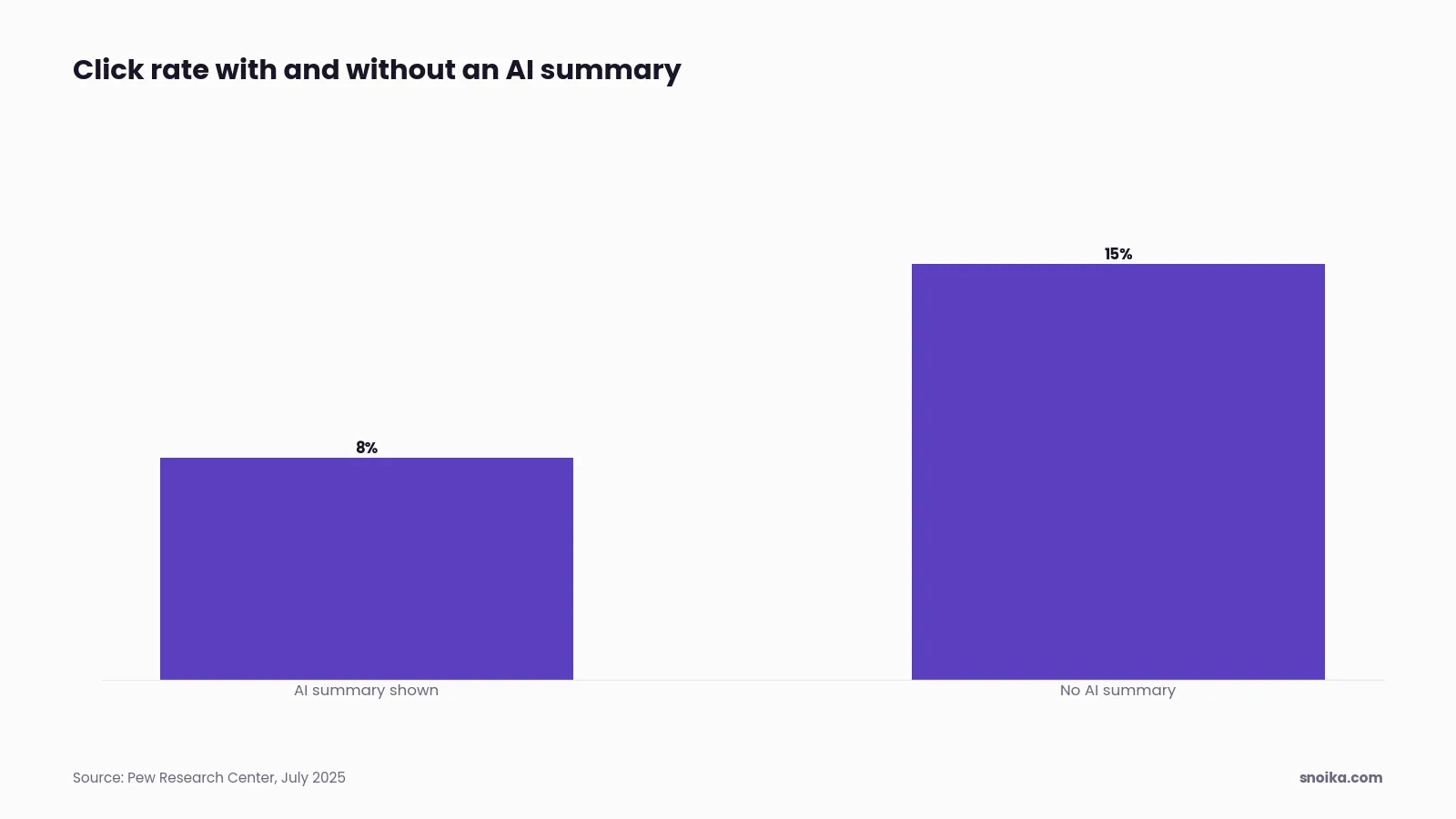
Citations decide who gets the few clicks an overview leaves behind. Pew found that people who saw an AI summary clicked a traditional result in 8% of visits, against 15% when no summary appeared. And Google's AI Overviews reached 2 billion monthly users, according to Pichai on the Q2 2025 earnings call.
Google AI Overviews and ChatGPT carry most AI search traffic, so we track them first. Vespia, a fintech SaaS, recorded a 220% increase in AI brand mentions. Once an engagement starts, we ask for access to Google Analytics 4, Google Search Console and Google Tag Manager, so we can tie AI visibility to the traffic you already measure.
Tracking with built-in fixes
Snoika pairs weekly tracking with pages built for the gaps it finds, so you get the data and the fix from one team. Here is what that covers:
Weekly tracking
Prompts, overviews and cited pages are recorded every week.
Pages for the gaps
We write the missing pages and publish them after your approval.
Human review
People review the output of every automated workflow.
One team
The same team runs the platform and the services.
A monitoring-only tool is enough if you already have writers who can act on the gaps. If you don't, you'll end up with a report and no fix.
FAQ
Snoika runs a fixed set of buyer prompts every week and records whether an overview appears and whether it cites your pages. We keep unlinked brand mentions separate from citations, since a mention without a link is a weaker result.
We record every cited URL for each tracked prompt and separate your pages from other sources. Comparing the cited URL with the page you'd want Google to use shows where your best answer is buried or missing.
Yes, Snoika's AI Overview monitoring records which tracked prompts produce overviews and which pages they cite. It runs weekly, so it shows changes from one week to the next rather than continuous updates.
We compare your citation counts with competitors' counts across the same prompts each week. Results are read by topic, since a competitor may lead on pricing questions while your pages lead on integration questions.
Our free audit doesn't need access to your systems. You fill in a short form, we hold a brief onboarding call, and the automated check of tailored buyer prompts, competitors and gaps takes about two hours.