ChatGPT SEO: A Practical Workflow for Better Visibility

Content authorJevgenia Pogadajeva, MBA, MScPublished onReading time11 min read
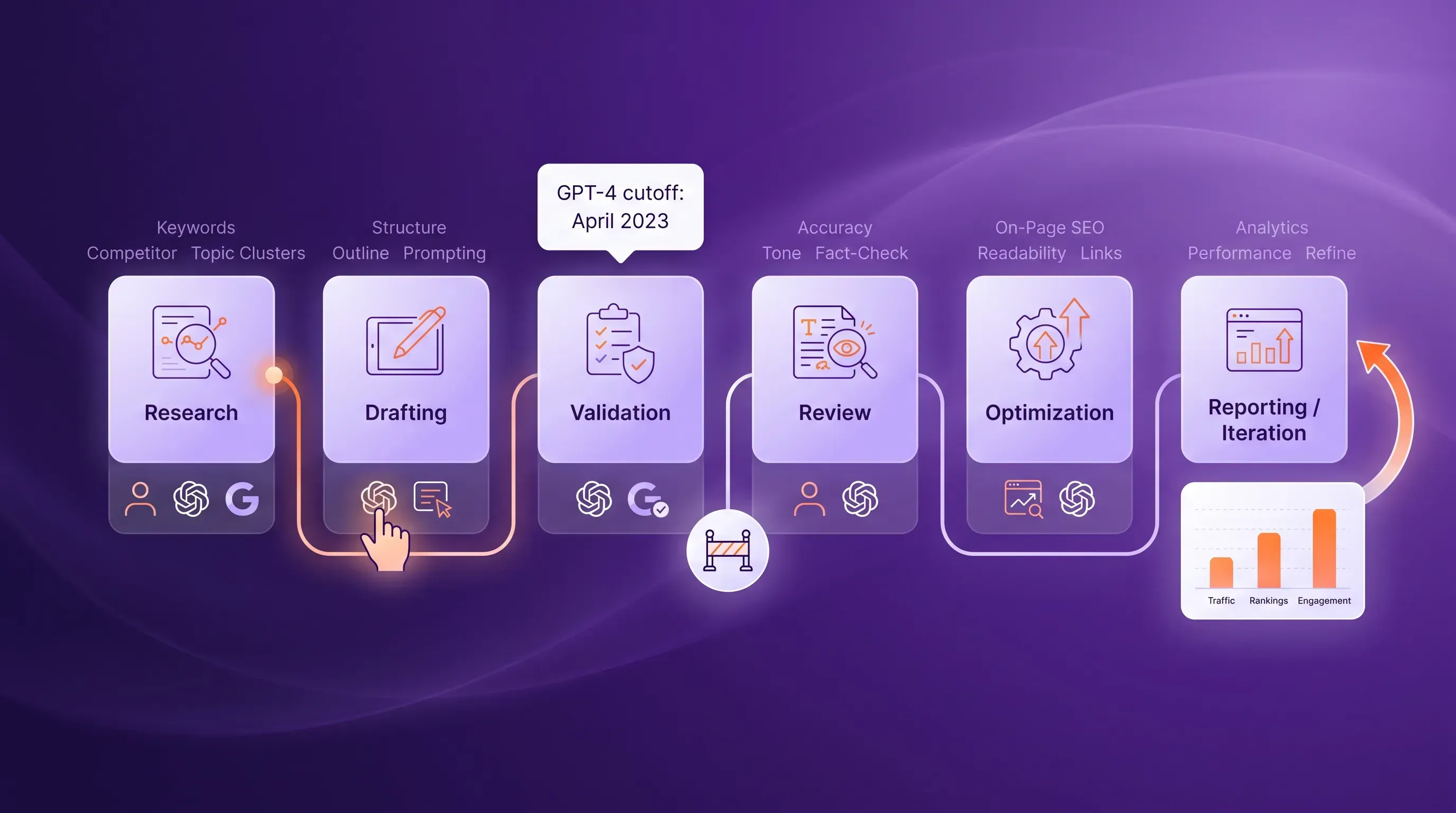
Luminous SaaS marketing illustration featuring a flowchart of six UI cards representing stages in a ChatGPT SEO workflow over a deep purple background.

This article walks through a six-stage ChatGPT SEO workflow you can run on every piece you publish. It shows where the model earns its place and where your own judgment stays in charge after dedicated tools confirm the data.

Why scattered ChatGPT use fails

You already use ChatGPT SEO in small ways. A keyword list one afternoon, then a deadline-driven outline the next. The output swings between genuinely useful and forgettable, and you can never predict which you'll get. That inconsistency shows there's no process to hold it together.

The gap is sequencing. When you open a blank chat and type whatever the moment calls for, the model has nothing to anchor to, so it gives you the average answer it gives everyone. That average is exactly the generic, low-trust draft you're afraid of shipping. Random prompting produces random quality, and no amount of clever wording fixes a process that doesn't exist.

A 2024 survey reported that 77% of marketers were using ChatGPT in their work, so the tool is hardly a secret weapon anymore. What separates useful output from filler is the system around it. The rest of this piece lays out that system as one connected chatgpt seo workflow, from the first seed keyword to the report that feeds your next round of research.

How a ChatGPT SEO workflow fits together

Before the stages, here's the whole arc so you can see how the pieces connect. The chatgpt seo workflow moves from research to reporting, then loops back to research. Each handoff feeds the next, which is what turns scattered prompts into a pipeline.

One principle holds the entire thing together: ChatGPT is a layer that sits on top of your SEO tools and your own review. It is not a replacement for either. The model is fast at language and pattern work, which means it drafts and reorganizes well. It has no live access to search data and no way to verify its own claims, so it can't be trusted to confirm anything.

That division of labor repeats at every stage in three parts:

  • ChatGPT drafts the raw material: outlines and first passes.

  • Tools like Google Search Console or Ahrefs confirm the numbers behind it.

  • You decide what's worth keeping and what ships.

Keep that split in mind as you read. Every stage below is a variation on the same theme, and the workflow only holds up because the guardrails are built in from the start.

The six stages of the workflow

This is the core of the workflow. Each stage gets its own section so you can jump to whichever step you're on. For every one, you'll see what you hand to the model and where your judgment is the deciding factor after a real tool confirms the data.

Research and keyword discovery

Start with a handful of seed keywords and ask ChatGPT to expand them. The model is quick with semantic variations and intent groupings, which saves the manual sorting that eats an afternoon. Feed it five seeds and you'll get back a sprawling list of related phrases in seconds, organized roughly the way a person would organize them.

Here's the hard limit. The model has no idea what any of those terms are worth. It can't tell you real search volume, and it can't tell you difficulty, because that data lives in tools it can't see. Ahrefs calculates keyword difficulty from the backlink profiles of the top 10 ranking pages, on a scale from 0 to 100. ChatGPT has none of that. So in chatgpt seo, every term it suggests is a hypothesis until a tool confirms it, and any phrase that fails validation doesn't earn a spot in the plan.

The practical move closes the loop. Export the validated data from Search Console or Ahrefs, then paste it back into ChatGPT and ask it to cluster by intent. Now the model is sorting real numbers instead of guesses, which is the difference between a keyword list you trust and one you hope is right. The five recognized intent buckets give the model a clear frame to group against, and the clustering it returns is genuinely useful because the underlying data is real.

Need help with your AI visibility?

Book a free consultation with our experts we'll help you determine exactly which services your organization needs.

Planning and content briefs

With validated keywords in hand, ChatGPT turns them into structure. It drafts outlines and builds pillar-and-spoke arrangements that would take you an hour to sketch by hand. Ask for a brief and it'll cover the target keyword and the competitor angles worth addressing, all in a couple of minutes.

That speed is the point, but speed isn't strategy. The model can arrange what you give it. It can't decide which topic deserves your effort this quarter or which insight from your own work nobody else can write. Those calls are yours, and they're the part of the brief that actually determines whether the finished piece is worth reading.

Treat the brief ChatGPT hands back as a first draft that needs your direction. Read it and add the priorities and the point of view the model has no way to supply. Use this short check on every brief before you act on it:

  1. Does the angle say something the top-ranking pages don't?

  2. Is the target keyword backed by validated volume and difficulty?

  3. Have you added at least one insight that comes from your own experience?

If the chatgpt seo brief clears those three, you've compressed hours of structuring into minutes without handing the strategy to a machine.

Drafting without generic output

This is the stage you're most worried about, and you're right to be. Drafting is where AI content goes flat, because a thin prompt produces a thin draft. If you feed the model nothing but a keyword, it returns the same hollow paragraphs it returns to everyone, and that's the forgettable output you're trying to avoid.

The fix is what you put in. Feed the full brief with your brand voice and the first-hand details only you have. The richer the input, the more substance the model has to build on, and the closer the draft gets to something that sounds like a person wrote it. But even a well-fed draft remains raw material. The model is assembling language from patterns, which is why it can't supply the things that make writing worth reading.

You add those. Experience and a position you're willing to defend. There's good reason to take this seriously beyond your own taste. Google's guidance on creating helpful content puts trust at the center of E-E-A-T, and the experience and expertise that build that trust are exactly what the model can't fake. This is the stage where your input most directly protects chatgpt seo quality, so it's the one place you can't shortcut.

On-page ChatGPT optimization

Once a draft holds together, ChatGPT optimization handles the on-page work fast. The model drafts titles and meta descriptions, then generates schema markup. Give it the industry and the goal as context, and it can audit a live page against a target keyword so you can see where the structure drifts from what you're trying to rank for. For schema specifically, JSON-LD is the only format Google recommends, and the model produces it cleanly when you tell it the page type.

The ChatGPT optimization output looks finished, which is the trap. The model ignores the real-world signals that decide whether a change helps. It doesn't know that Google truncates titles around 600 pixels on desktop, so it'll happily write one that gets cut off in the results. It can't judge whether a title will earn the click, because clickthrough is a human reaction it has no data on.

That's why a person approves every on-page change before it ships. Read the title the way a searcher would. Check the meta description against what actually appears in the results. Confirm the schema matches the page's primary content, because correct markup on the wrong content won't earn a rich result. ChatGPT optimization gets you a strong first pass on every element. Your review is what keeps that chatgpt optimization pass from quietly breaking something.

Need help with your AI visibility?

Book a free consultation with our experts we'll help you determine exactly which services your organization needs.

Validation and quality checks

Between a finished draft and a published page sits the stage that protects everything before it. Validation covers fact-checking and a final confirmation that the piece serves the search intent you targeted back in research. Skip it and the whole workflow gets faster and less trustworthy at the same time.

Fact-checking is non-negotiable, because the model invents things with total confidence. A comparative analysis of ChatGPT and Bard found hallucination rates between 28.6% and 91.4% when the tools generated references for systematic reviews, with the authors concluding the output needs rigorous validation before anyone relies on it. Apply that lesson to every statistic and claim in your draft. If you can't trace it to a source, it doesn't ship.

Accuracy has a second problem: timing. The model's knowledge stops at a fixed point. GPT-4's training data cuts off around April 2023, which means anything that changed after that date is a blind spot unless you supply current information yourself. ChatGPT can't validate its own work, so this stage belongs to you, supported by live tools that show what's true right now. Think of it as the safeguard that keeps the workflow honest.

Reporting and iteration

The last stage closes the loop. Pull your performance data from Search Console or your analytics and ask ChatGPT to turn the numbers into plain narrative. The model is good at spotting patterns across a messy export and writing them up in a way a stakeholder can read, which saves you the work of translating a dashboard into a paragraph.

The numbers and the decisions stay with the tools and with you. ChatGPT can describe a drop in impressions. It can't tell you whether that drop matters or what caused it, because those answers depend on context the export doesn't carry. Use the model to draft the story and surface candidate next experiments, then decide which experiment is actually worth running.

Reporting feeds straight back into research. The patterns you find in this chatgpt seo cycle become the seed keywords and content gaps for the next one, which is what makes the workflow repeatable instead of a one-off effort. A report that ends in a clear next action is the difference between a dashboard you glance at and a system that keeps improving.

Where ChatGPT visibility still needs humans

The limitations scattered through the stages add up to one honest picture, and it's worth seeing it whole before you decide how much to trust the output. ChatGPT visibility into your actual SEO performance depends on guardrails. Pull the guardrails out and the workflow collapses into the generic output you started worried about.

Four gaps account for most of the risk. None of them is fatal for chatgpt visibility, because each one is covered by a tool or a person:

  • No real-time data. The model's knowledge is frozen at its training cutoff, so live volume and current rankings come from Search Console or Ahrefs.

  • No true competitive analysis. The model can describe competitor angles in the abstract, but the real SERP and the real backlink profiles come from your tools.

  • Factual unreliability. With hallucination rates documented as high as 91%, every claim needs a human checking it against a source.

  • A pull toward generic phrasing. Left alone, the model writes the average. Your experience and opinion are what lift a draft above it.

Protecting your ChatGPT visibility means keeping each of those gaps covered every time, not occasionally. The model is a fast, capable layer for language and structure. It earns its place in the workflow precisely because you've decided in advance what it can and can't be trusted to do, and strong ChatGPT visibility depends on that decision holding at every stage.

Make the workflow your own

Don't try to stand the whole system up at once. Pick the single stage that costs you the most time right now and systematize that one. Build a small prompt library with your brand voice and your context baked in, so you're not rewriting the same setup every session. Then standardize your human review points, because that's what holds quality steady as your volume grows.

A documented, repeatable process is what separates teams that scale ChatGPT SEO from the ones still shipping forgettable content. Take the workflow above and refine it on your next article. That first deliberate pass is where a real ChatGPT SEO practice begins.

Need help with your AI visibility?

Book a free consultation with our experts we'll help you determine exactly which services your organization needs.

Update your ChatGPT SEO prompts whenever your audience, offer, review rules, or data source changes. Keep a dated prompt library and retire prompts that produce repeated edits. A monthly review works for active publishing teams, while low-volume sites can review prompts after each content cycle.

Include the verified keyword data and the exact task you want completed. Add the search intent and source rules, then attach a sample paragraph if tone matters. The prompt should give the model enough context to draft useful material without asking it to invent facts.

Yes, if your policy and local rules don't require disclosure. Google evaluates helpfulness and quality rather than the production method, so review facts and sources before publishing. Keep an internal note on how AI was used, and check originality during editing.

Measure it with a fixed comparison window in Search Console. Track clicks and average position for pages created with the workflow against older pages in the same topic area. Use 28-day periods, since shorter windows get distorted by indexing delays and normal ranking movement.

Assign review to an SEO owner and a subject expert before publication. The SEO owner checks intent match and on-page elements, while the subject expert verifies claims from real experience. For client work, record who approved the final draft and which data source supported the target keyword.

Schedule a Meeting

Book a time that works best for you

You Might Also Like

Discover more insights and articles

Comparison visual of AI search optimization tools with overlapping cards for Tool A and Tool B, featuring charts and evaluation criteria.

Choosing AI search optimization tools for your team

This article clears up the confusion between AI visibility tools and the keyword trackers you already run, then walks through the criteria that matter when you're buying for a team. By the end, you'll be able to run a fair trial and defend your pick.

A modern SaaS dashboard featuring a central 'LLM SEO Framework' card surrounded by four pillar cards, all on a deep purple gradient background.

LLM seo: a practical framework for AI visibility

This article gives you a vendor-neutral framework for LLM SEO, the practice of getting your brand cited inside AI-generated answers and included when those answers discuss your category. It explains source selection and measurement, with the carryover from your existing program built into the signal framework.

A luminous SaaS marketing illustration with a central UI card labeled 'AI Answer Engine Citations' surrounded by seven floating cards.

How to Improve Your AI Visibility and Get Cited by Answer Engines

This article explains the mechanics of how AI answer engines decide which sources to name and link, then walks through the concrete moves that raise your odds of being cited. It treats AI visibility as its own discipline next to the SEO you already run and shows where the two overlap before ending with what to audit and how to measure progress.

A luminous SaaS dashboard with a deep purple gradient, featuring a central audit card and three overlapping cards with icons and charts.

Lighthouse agentic browsing: Google’s New AI Agent Readiness Audit Explained

This article explains the new Agentic Browsing category in Lighthouse: its checks and the workflow from running the audit to reading its unusual pass-ratio output. It connects each signal to how autonomous browsing agents behave, so you can decide where to spend your effort first.