Does Google penalize AI content?
No. Its ranking systems assess whether a page helps the person who searched, while its spam policies punish pages made mainly to manipulate rankings, whoever or whatever produced them. Ask "does Google penalize AI content" in 2026 and you get the answer Google first gave in 2023. The risk comes from publishing large volumes of unoriginal pages for search engines instead of readers. AI makes that cheap, which is why people confuse the two.
 Artem LozinskyOperations and product, Snoika · 6 min read

























Google penalizes intent not origin
Google judges why a page exists. The tool that drafted it doesn't count. Danny Sullivan, Google's Search Liaison until August 2025, repeatedly emphasized helpfulness as the test for AI-generated content with the question "is it helpful?" Spun articles and scraped pages were spam long before language models existed. The policy treats an AI version of them the same way.
Google infers a publisher's intent from patterns. It looks at publication volume and how alike the pages are. It also checks whether each page answers something the reader couldn't get elsewhere. A thousand location pages that swap one city name look like ranking bait, whether a person or a model typed them. Test your own site by asking whether you'd publish each page if search engines didn't exist.
What Google's policy actually says
Google's official policy sits in two documents, and neither one bans AI. The February 2023 guidance from Danny Sullivan and Chris Nelson of the Google Search Quality team says "appropriate use of AI or automation is not against our guidelines." It defines appropriate as content that isn't made primarily to manipulate rankings.
Google added the scaled content abuse policy to its spam policies for Google web search in March 2024 to address pages "generated for the primary purpose of manipulating search rankings and not helping users," with the qualification "no matter how it's created." That phrase covers human content farms too. The policy page was last updated in August 2026 and still uses that wording, so the 2026 answer hasn't changed. Google reported that the March 2024 changes left 45% less low-quality, unoriginal content in its results.
Under the Search Quality Rater Guidelines, human raters' scores give Google feedback on whether its systems work. The guidelines tell raters to assess originality alongside "the use of Generative AI tools alone": pages whose main content is almost all AI-generated with little originality get the Lowest rating.
AI content that ranks well
AI-assisted pages rank every day, and the large studies find no link between AI use and position. Si Quan Ong, SEO and marketing educator at Ahrefs, ran 600,000 top-20 pages through the company's detector. He found that 86.5% of top-ranking pages contained some AI-generated text, and the correlation between AI share and ranking was 0.011. The correlation is effectively zero.
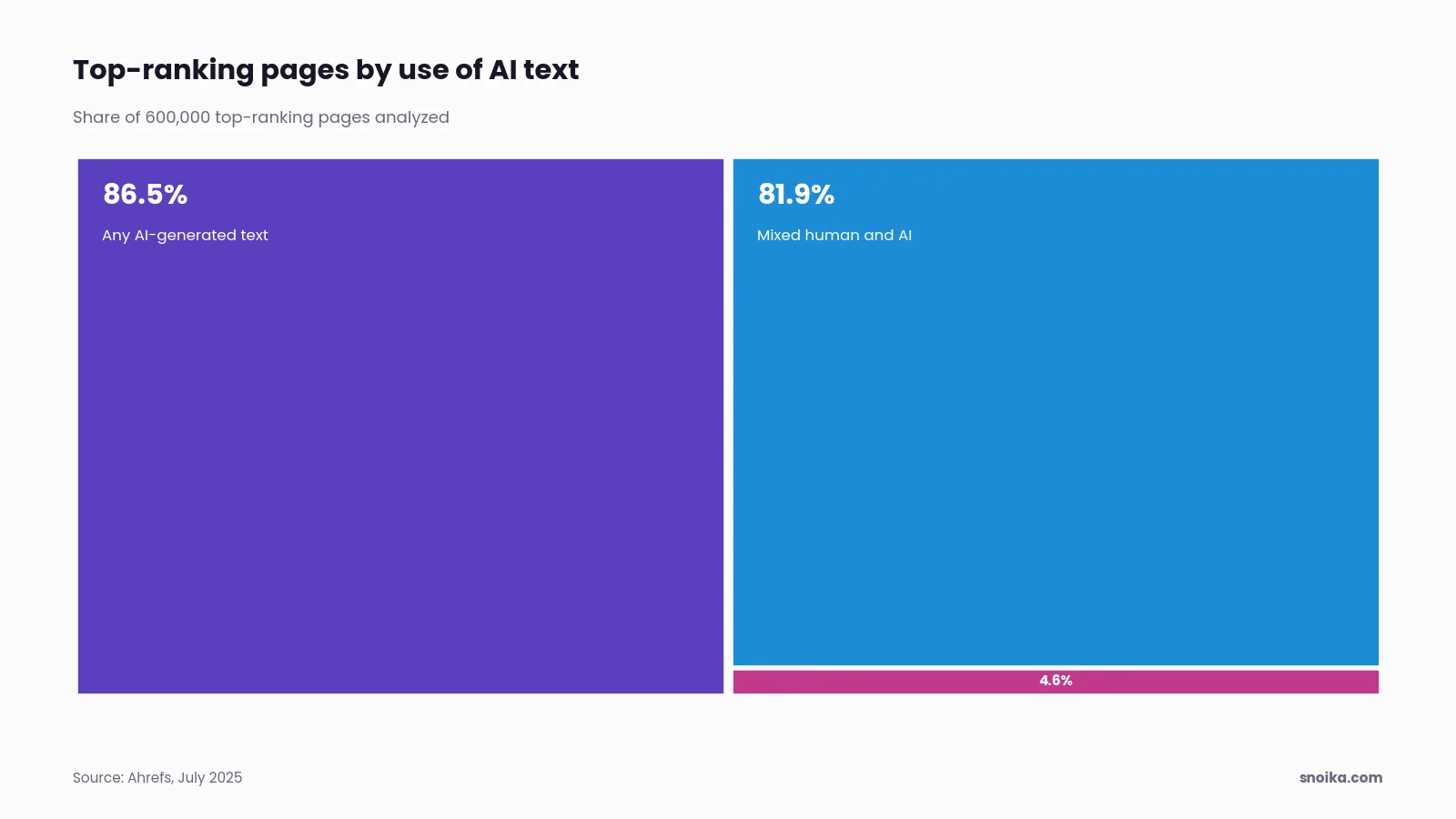
Results for the same drafting method vary with the publication site and the care put into the content.
| Study | What was tested | Result |
|---|---|---|
| Ahrefs, July 2025 | 600,000 pages ranking for 100,000 keywords | 81.9% mixed human and AI, 4.6% pure AI, no ranking correlation |
| SE Ranking, own blog | 6 AI-assisted articles on an established domain | About 555K impressions, 3 in the organic top 10 |
| SE Ranking, new domains | 2,000 AI articles on 20 sites with no history | Pages in the top 100 fell from 28% to 3% after three months |
| Originality.ai, March 2024 | 79,000 content sites checked | 1,446 sites hit by manual actions, half with 90 to 100% AI posts |
Ahrefs, July 2025
- What was tested
- 600,000 pages ranking for 100,000 keywords
- Result
- 81.9% mixed human and AI, 4.6% pure AI, no ranking correlation
SE Ranking, own blog
- What was tested
- 6 AI-assisted articles on an established domain
- Result
- About 555K impressions, 3 in the organic top 10
SE Ranking, new domains
- What was tested
- 2,000 AI articles on 20 sites with no history
- Result
- Pages in the top 100 fell from 28% to 3% after three months
Originality.ai, March 2024
- What was tested
- 79,000 content sites checked
- Result
- 1,446 sites hit by manual actions, half with 90 to 100% AI posts
Agrello, an e-signature company, generated 51.8K impressions from Snoika-created pages on its established domain, consistent with the results above. What ranks is AI content creation on a site that already has trust, with editing that adds something new.
Signals that trigger ranking loss
AI-written pages lose rankings when they show the patterns of scaled content abuse or plain unhelpfulness. Google's spam policy and the cases in the table above identify these signals of abuse.
- Volume without depth. Hundreds of pages appear in weeks on a young domain, and none goes deeper than the others.
- Template sameness. Pages share one structure with a keyword or city swapped in, so they compete with each other.
- Nothing new. The page sums up what already ranks without any original facts or examples. It offers no opinion of its own either.
- Unchecked errors. Invented statistics or outdated advice appear, which hurts most on health and money topics.
- Topic drift. A site publishes outside its known subject to catch traffic it has no claim to.
A manual action shows up in the Manual Actions report in Google Search Console, with a notice and a way to request review. An algorithmic demotion appears without a notice as a drop that lines up with a core or spam update date. Check that report first. Before you rewrite anything, compare the dates of your traffic loss against Google's published update history.
Scaling AI content safely
You can publish AI content at volume if every page gets the same checks a hand-written page would. AI content marketing teams of any size can use the following review process.
- Map topics before drafting. Give each page one question that no other page on the site answers, and cut keyword-swap variants at the planning stage.
- Feed the model real material. Use your product documents and support tickets as source material, supplemented by internal data. A model that works only from the open web repeats it.
- Edit with a subject expert. Someone who knows the field can humanize AI content by rewriting weak claims and adding examples, and every number gets checked against its source.
- Approve before publishing. A named person signs off on each page. In our workflow, a human review layer sits on top of the automated drafting, and clients approve each page in the dashboard before it goes live.
- Publish at the pace your review can hold. If reviewers can check 20 pages a week, publish 20, even if the model can draft 200.
- Watch each batch. Track indexation and impressions per batch in Search Console. Improve or remove pages that stay unindexed after a few months.
We produce content in 135+ languages and regional variants, where native-speaker review is an extra check: a translated page that no native speaker has read is as thin as an unedited draft.
Detection alone won't cause penalties
Google's systems, such as its SpamBrain spam filter, look for spam behavior. The detectors aren't reliable enough to act on anyway. OpenAI's own classifier correctly flagged only 26% of AI-written text and mislabeled human writing 9% of the time. OpenAI withdrew it in July 2023.
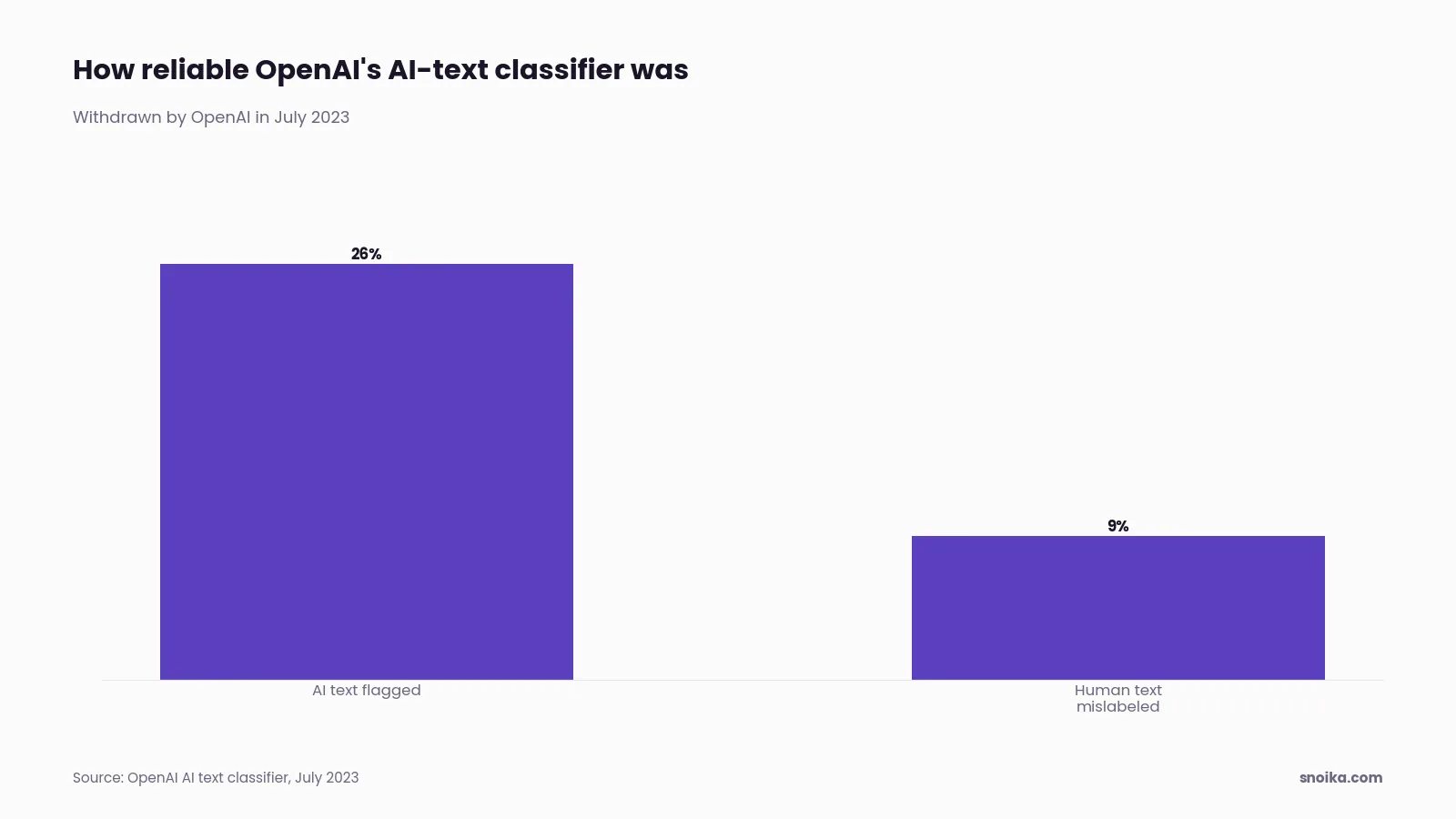
The Originality.ai sites in the table combined heavy AI use with large-scale publication under little oversight. A detector can't separate those causes in a penalty study. Read a useful page the way a customer would and fix what doesn't help them.
Where human expertise still wins
People still beat models on anything that needs first-hand knowledge. A model lacks first-hand knowledge of your product and sales calls, as well as the edge case your support team handles every week. It writes the consensus view because it predicts the most likely next sentence. That consensus is already on page one.
An editor's judgment helps them recognize when a popular claim is wrong for a certain kind of buyer and which caveat a reader in a regulated field can't do without. Google's rater guidelines hold pages on health and finance to stricter trust standards. The same applies to legal topics. A confident error there costs more than a clumsy sentence. Let the model handle structure and first drafts, with someone who has done the work responsible for the claims and examples. That person should also make the final call.
Building E-E-A-T into AI output
The two E's in E-E-A-T stand for experience and expertise. A and T stand for authoritativeness and trust. You add it to AI content by putting real people and checkable evidence on the page. Each practice below addresses Google's guidance to ask "Who, How, and Why" about content.
Add experience the model can't have
Add one thing per page that only your team knows. Use a test result or a screenshot of your own setup. A mistake a client made or a number from your own data also supplies that first-hand detail. One concrete detail from real use does more for the page than three extra paragraphs of general advice.
Put a named expert on the byline
Show who wrote the page and who checked it, with a short bio that says why they're qualified. An author page that links to their other work and their profiles lets readers and Google's raters confirm the person exists and knows the field.
Cite sources a reader can check
Link every statistic to the place it came from and name the source in the sentence. Models invent figures that sound right, so this step also catches errors before they go live.
Disclose how automation helped
To address Google's "How" question where readers would reasonably expect it, say that AI drafted or assisted the content and explain what the human editors added. Being open about the process builds the trust that E-E-A-T rewards.
Next steps
Pick the 20 AI-assisted pages on your site that get the most impressions. Then check the Manual Actions report before you assess each page against the other signals above. If a page adds nothing a reader can't find elsewhere, improve it or merge it before you publish more. Every thin page you remove makes the rest of the site easier for Google to trust. After that, the question of "does Google penalize AI content" matters less than what Google and AI assistants already say about your brand. Snoika tracks brand mentions and citations in ChatGPT and Google AI Overviews with weekly prompt sets. Get a free AI visibility report to see where you stand today.
FAQ
Google permits AI-generated content that isn't created primarily to manipulate rankings. For readers asking “does google penalize ai content,” the distinction is purpose: mass-produced pages offering little original value can violate spam policies regardless of who or what wrote them.
AI-written pages can lose rankings when they offer little original value or show patterns of spam. Repeated templates and unchecked claims are warning signs. Check whether each page answers a distinct reader question before publishing more variations.
Add first-hand evidence and identify the qualified person responsible for reviewing the content. A real test result can demonstrate experience, while a reviewer bio explains their expertise. Check each statistic against its original source so readers can verify the claims.
Check the Manual Actions report in Google Search Console for a confirmed manual action. If there's no notice, compare the traffic decline with Google's update history. An algorithmic ranking loss can happen without a manual action notice.
Your publishing pace should match how many pages people can properly review. If reviewers can check 20 articles a week, publish 20 even if AI can draft 200. That capacity is an editorial limit, not a Google-approved quota.